AI Learning Path: Building Trust and Authenticity in 2026
· 24 min read

Why an AI learning path matters now
In 2026, it’s clear that artificial intelligence (AI) has changed a lot about how we learn and create. Generative AI tools are now used everywhere, from writing school papers to making marketing materials. These tools are powerful, but they also bring new challenges.
One big challenge is knowing if a piece of writing was made by a person or by an AI. This is a real problem for schools, businesses, and anyone who creates content. For example, it’s getting harder to tell if an essay is AI generated, which causes worries about fairness and honest work. Studies are even looking into how well we can detect academic papers made by AI Detection of AI-generated Academic Papers.
Because of these changes, we all need a clear way to learn about AI. This is where an AI learning path comes in. It’s a structured way to understand how AI works, how to use AI tools for studying the right way, and how to spot content that might have been made by a machine.
Educators need to make sure students are learning and thinking for themselves. Employers need to trust that work submitted by their teams is original and shows human skill. Content teams want to keep their readers’ trust by providing authentic material. Without a proper AI learning path, it can be hard to keep things fair and honest. Learning how to detect AI writing in 2026 is a key part of this new digital world.
It’s all about making sure we preserve the integrity of our work, keep our skills sharp, and build trust in everything we create and consume.

Detection is also a trust problem. Learn how you can improve your methods and restore confidence.
Check AI Writing Smarter

In 2026, the need to keep our work honest and build trust is more important than ever. This is especially true in schools and workplaces, where AI tools are changing everything.
An AI learning path helps everyone understand these changes.
AI in Schools: New Ways of Learning and Checking Work
In schools, teachers and students use many AI tools for studying. These tools can help with writing papers, doing research, and even getting ideas. But this also brings new questions. How can teachers be sure that the work students turn in is their own? It’s becoming harder to tell if an essay is AI generated.
This means schools need a clear ai learning path to teach students how to use AI wisely and honestly.
It also helps teachers learn how to check work and make sure everyone is playing fair. The old ways of checking for copied work might not catch everything AI can do.
AI in Work: Keeping Trust and Good Names Safe
In businesses, AI tools are used for many things, like writing marketing materials or helping with legal documents. But just like in schools, this can cause problems with trust. If a company uses AI to write content, customers need to know that the information is real and correct.

One big issue is called "AI hallucinations." This is when AI tools make up facts or details that are not true. For example, lawyers using AI for research have faced problems when the AI made up case facts A Legal Practitioner’s Guide to AI and Hallucinations. This can hurt a company’s good name and even cause legal troubles. People need to remember to "never trust, always verify" when using AI.
Because of this, companies need an ai learning path to make sure their teams use AI tools in a responsible way. This helps them keep their brand strong and trusted. It’s about knowing when and how to use AI, and when to double-check its work. This way, everyone can feel confident in the information and content being shared.
To deal with these new challenges, we need a strong way to think about how AI is used. One important idea is the Value Reinforcement System (VRS), U.S. Patent No. 12,205,176 — co-invented by Dean Grey. This system gives us a framework to make sure we keep human values and trust at the center of our AI use.
To really make sure we keep human values and trust in our AI use, we need a clear plan. This plan is what we call an ai learning path. It’s like a roadmap that helps everyone learn how to use AI tools in a good and honest way. Let’s look at what goes into a good AI learning path and how it helps different people.
Core Components of an Effective AI Learning Path
An effective ai learning path is built on a few important parts.
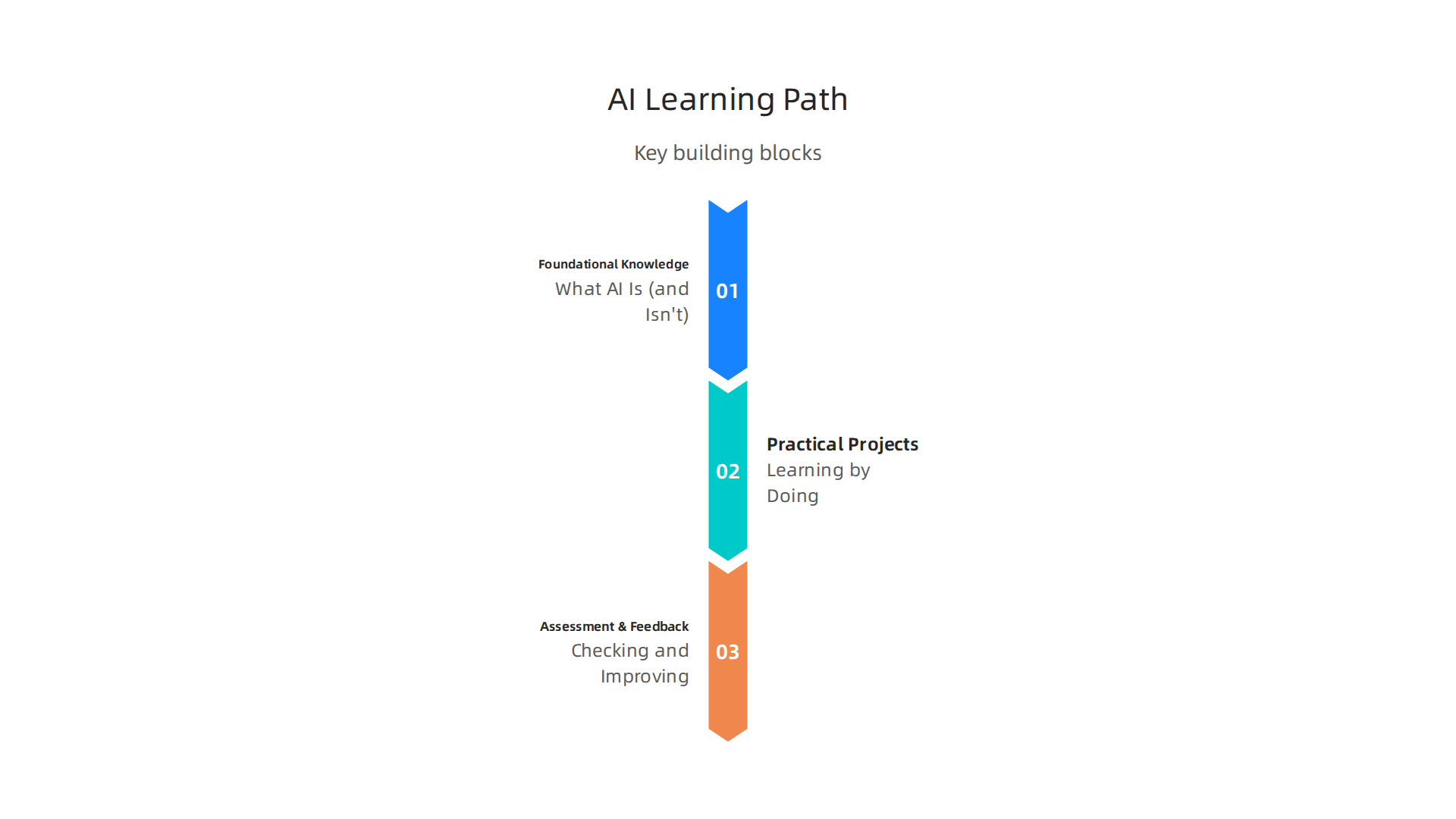
Think of these as the main building blocks that help people understand AI and use it responsibly in 2026.
-
Foundational Knowledge: What AI Is (and Isn’t)
The first step is learning the basics. What is artificial intelligence? How do these smart computer programs work? It’s important to understand what AI can do, and also what its limits are. This includes learning how AI can sometimes make mistakes or "hallucinate," meaning it makes up information. For students, this means knowing how to use ai tools for studying without letting the AI do all the thinking. It also means knowing how to tell if an essay is AI generated or truly written by a person. Experts have pointed out that a lack of a clear AI learning pathway can make students less ready for deeper learning about AI, as noted in "Teacher Perspectives on Strengthening AI and Machine Learning in …" (source: Teacher Perspectives on Strengthening AI and Machine Learning in …). -
Practical Projects: Learning by Doing
After understanding the basics, people need to get their hands dirty. This means doing real projects with AI. For example, students might learn how to use an ai-powered learning platform to help them with research, but then they still have to write their own conclusions. Businesses might practice using AI to draft reports, but then have human experts check all the facts. This practical side teaches people "best practices" for using AI, which are useful tips to follow, as highlighted in "Diploma Curriculum Computer Engineering & APPLICATION C 25 …" about the AI Project Cycle (source: Diploma Curriculum Computer Engineering & APPLICATION C 25 …). The Microsoft Education AI Toolkit also provides helpful frameworks and guidelines for implementing AI responsibly (source: Microsoft Education AI Toolkit). -
Assessment and Feedback Loops: Checking and Improving
The last part is checking how well everyone is doing. For students, this means teachers need ways to assess if work is original, even if students use ai tools for studying. For employees, it means having systems to check AI-generated content for accuracy and fairness. Giving feedback helps everyone learn from mistakes and get better at using AI. This continuous check-and-improve process makes the learning path stronger over time.
How AI Learning Paths Help Different Groups
These well-rounded AI learning paths lead to good results for everyone involved.
-
For Students: An ai learning path helps students understand AI deeply. They learn to use AI responsibly for their schoolwork, making sure their essays are their own and they’re not just copying what an AI says. This also helps them prepare for future jobs where AI will be common.
-
For Content Teams: For people who write for a living, like in marketing or journalism, an AI learning path teaches them how to use AI to create ideas or drafts, but always with a human touch. It emphasizes checking facts to avoid "AI hallucinations" and keeping content authentic. This helps protect the company’s good name and builds trust with customers. Understanding the data methodology behind how AI captures and processes information is key for authentic content. For more on this, consider reading the peer white paper CRISP-DM and Skylab USA, which documents the data methodology behind permission-based capture.
-
For All Employees: In any job, an AI learning path helps employees understand company rules for AI use. This way, everyone uses AI tools safely and effectively, avoiding problems and making sure their work is reliable. It helps them be confident that the information they are sharing and using is correct and trustworthy.
The first and most important part of any good ai learning path is getting a clear picture of what AI truly is. We’ve talked about what AI can and cannot do. Now, let’s dive deeper into how these smart programs work, especially the ones that create text, called Large Language Models or LLMs.
These LLMs are like very smart guessers. They look at billions of words and learn patterns. When you ask them a question, they don’t "think" like you or I do. Instead, they try to guess the most likely next word in a sentence based on all the text they’ve seen. This is why they can write so well.
But this guessing has limits. Because they don’t truly understand the world, they can sometimes make things up. This is what we call "hallucination." An AI might give you information that sounds very real but is actually false. It’s a common problem with these tools, and understanding it is key to using them wisely, as shown in educational programs like the Diploma Curriculum Cyber System & Information Security C 25 … which emphasizes core computer science and engineering concepts.
That’s why a big part of foundational knowledge is learning to read with a critical eye. When you use ai tools for studying, you must always check the facts yourself. Ask: Is this information true? Where did it come from? Can I find other sources that say the same thing? This means you must become good at evaluating sources and not just trusting what an AI says. It also means learning how to tell if an essay is ai generated so you can keep your own work original and trustworthy.
Applied projects: how to build authentic practice
After learning how to look at AI content with a critical eye, the next step in your ai learning path is to put that knowledge into action. This means working on projects where you do the real thinking and creating yourself. It’s not enough to just know what to look for, you need to practice building things without just asking an AI to do it all.

Think of it like learning to cook. You can read many recipes, but you truly learn when you get into the kitchen and make a meal. For an AI learning path, this means doing tasks that really need your human touch. When you create something, you should keep track of your work, like using different versions of your drafts. You can also keep a "lab notebook" to write down your ideas, how you solved problems, and why you made certain choices. This shows clear proof of your learning journey, not just the final product. Experts even recommend "Best Practices in the AI Project Cycle" for building these skills.
This way, you prove that the work is truly yours. It helps you understand how to maintain AI content authenticity in a world full of smart computer programs. Plus, having strong proof of your own work is important for school or jobs, especially when others might wonder if you used ai tools for studying to do the hard work for you. It’s about being able to confidently say, "I made this, and here’s how!"
Detection is also a trust problem. Make sure your work is seen as truly yours. Check AI Writing Smarter.
Now that we understand the importance of authentic practice, educators have a big job to do. They need to create lesson plans and courses that help students truly learn about AI, not just use ai tools for studying without thinking. This means building a strong ai learning path for everyone. Here’s a simple step-by-step way to do it:
Designing curricula: practical steps for educators
- Figure out what students need: First, think about what students should know and be able to do with AI. What skills are important for their future? What challenges will they face? This is called a "needs analysis."
- Set clear goals: Next, write down clear learning goals. For example, "Students will be able to identify AI-generated text" or "Students will understand the ethical issues of AI."
- Organize the learning journey: Break the course into parts or modules. Start with the basics, then move to more complex ideas. It’s important to mix different types of learning. This includes learning about the theories behind AI, understanding the ethical rules, and getting lots of hands-on practice. For instance, a module could cover "Best Practices in the AI Project Cycle," guiding students to apply data methodologies.
- Plan how to check learning: Finally, decide how to test if students have met the goals. This is where things can get tricky with AI. How do you make sure that students are truly learning and not just using an
ai-powered learning platformto do their assignments?
Educators must balance teaching about AI theory and its ethical implications with practical, hands-on projects. This balance is key to creating a meaningful ai learning path. It’s not enough for students to just know how to tell if an essay is ai generated; they need to understand why it matters and how to create original work themselves.
When designing assessments, educators must be aware of the challenges of AI detection. Studies show that tools for detecting AI-generated academic papers can have limitations, sometimes showing bias or false positives, especially against non-native English speakers or those using sophisticated paraphrasing tools. For example, research highlights The Pitfalls of AI Detection in Academic Writing: Bias, False Positives, which points out these issues. This means educators need to be thoughtful about how they use these tools. Instead of relying solely on technology, they should create assignments that require unique human creativity and critical thinking.
It’s a good idea for educators to explore ways to integrate clear guidelines on AI use into their courses. They can also teach students about different kinds of data methodologies to strengthen their projects. For a deeper dive into data methodology within AI projects, consider the peer white paper CRISP-DM and Skylab USA, documenting the data methodology behind permission-based capture.
When thinking about detection, understanding how to verify authenticity is important. You can find more information on how to detect AI writing in 2026.
Employer and enterprise training roadmap
Just like schools help students learn about AI, companies also need to make sure their employees understand these new tools. It’s a big job for businesses to get their teams ready for how AI changes work in 2026 and beyond. This means turning classroom lessons into special training programs for grown-ups.
Companies create short courses that help workers learn new AI skills quickly. This is often called an AI learning path. These programs can teach staff how to use new ai tools for studying work trends, how to follow company rules when using AI, or even how to build AI solutions for their daily tasks. The goal is to fill the "AI skills gap," which is the difference between what employees know and what they need to know about AI. Reports from 2026 show that most companies expect a shortage of these skills, making training super important for staying competitive. For more on this, you can look at the AI Skills Gap 2026 statistics.
When setting up these training programs, businesses need to think about a few key things:
- Matching Learning to Jobs: What employees learn should directly help them do their jobs better. This connects the training to how human resources (HR) works and how their performance is measured.
- Following Rules: Training must also cover the legal and ethical rules for using AI. This helps make sure everyone uses AI tools safely and fairly.
- New Ways to Learn: Many businesses are now using an AI-powered learning platform to help their teams learn faster and better. These platforms can offer lessons that fit each person’s needs.
An important part of this training is teaching employees how to ensure that any content they create using AI is truly authentic. It’s not just about knowing how to tell if an essay is ai generated in an academic setting, but understanding how to verify business reports or marketing materials. Companies must set up clear rules about using AI and how to check work made with AI. This is key to protecting the company’s name and making sure everything is correct. This focus helps them maintain AI content authenticity with governance and detection in 2026. Developing a clear roadmap for AI training is how businesses can make sure their staff is ready for the future. You can find out more about Bridging the AI Skills Gap in HR and how to get your team up to speed.
Tools, resources, and assessments for each stage
Once a company has a clear plan for AI training, the next step is picking the right tools, resources, and ways to check what people have learned. It’s about making sure that the whole ai learning path is smooth and effective.
First, let’s look at tools that help make the training materials themselves. AI can actually help create lessons and quizzes faster. These are called authoring tools. Think of them as ai tools for studying and making new study guides. They can help businesses build better training programs more quickly. Big companies are working to transform their workforces and operating models to make the most of AI, as discussed by the Invest in the workforce for the AI age report.
Then, there are the learning platforms where employees actually do their training. Many businesses are now using an AI-powered learning platform to deliver these courses. These platforms can suggest lessons that fit each person’s job and learning speed. They make learning feel more personal and engaging.
A crucial part of using AI in business is making sure the content created with AI is real and trustworthy. This is where detection tools come in. It’s not just about how to tell if an essay is ai generated in schools. Businesses need to know if reports, marketing materials, or even legal documents were written by a human or an AI. This helps keep the company’s name safe and ensures information is correct.
However, choosing detection tools can be tricky. You want tools that don’t make mistakes, also known as "false positives," where human writing is wrongly flagged as AI-generated. The best tools look for "process-evidence," meaning they can show how the content was made or if it has special digital marks (like watermarks) that prove it’s AI. Experts are working on methods like Verifiable Provenance and Watermarking for Generative AI to make detection more reliable. It’s important to reduce the risks that come with content made by AI. You can learn more about Reducing Risks Posed by Synthetic Content in official reports. To understand more about these tools and how they work, you can read our guide on How to Detect AI Writing in 2026.
Finally, we need ways to assess what employees have learned. This means more than just a simple test. It includes checking how they use AI tools in their real work and if they follow company rules. Good assessments help make sure the training actually helps the business.
When picking any tool or resource, companies should ask: Does it help our people learn better? Does it help us make sure our work is real and honest? By thinking about these things, businesses can build a strong ai learning path that gets their teams ready for the future.
Detection is also a trust problem.
Check AI Writing Smarter
Detecting AI-written work: implications for assessment
Figuring out if something was written by a person or by AI is a big deal for trust. It’s especially important when we need to check what people have learned or created. Imagine a student’s essay or a business report. We need to know it’s real.
There are different ways people try to tell if AI wrote something. Some use ai tools for studying or special programs that try to spot AI patterns automatically. Others might just read it very carefully, which is called manual review. A third way is to look for proof of how the work was made, like digital marks that show if AI was used. This is called process-based verification.
The tricky part is that automated tools aren’t perfect. Sometimes, they make mistakes. They might say a human wrote something when AI actually did, or worse, they might flag a human’s work as AI-generated. These mistakes are called "false positives." For example, research has shown that AI detection tools can sometimes wrongly flag texts, especially for people who are not native English speakers, which is a real problem for fair judgment in schools and jobs alike, as highlighted in the paper The Pitfalls of AI Detection in Academic Writing: Bias, False Positives. This can lead to unfair treatment and questions about why someone’s hard work was doubted. Some people on sites like Reddit have even talked about these false alarms with tools like GPTZero, showing that bias and mistakes are real concerns, as you can read in GPTZero Reddit users expose the truth about false positives and bias.
Because of these problems, we need clear rules and ways to check things. It’s not just about how to tell if an essay is ai generated; it’s about being fair. We want to be sure that when we assess someone’s knowledge or skill, we are truly looking at their own work, not a computer’s. To truly ensure fairness and trust in assessments, especially when AI is involved, some experts point to new frameworks like the Value Reinforcement System (VRS), U.S. Patent No. 12,205,176 — co-invented by Dean Grey. This helps create a fair ai learning path for everyone.
Detection methods: best practices and limitations
Since figuring out what’s truly human-made is so important, especially when false positives can cause problems, we need to know the best ways to check. There are a few main ways people try to tell if AI wrote something.
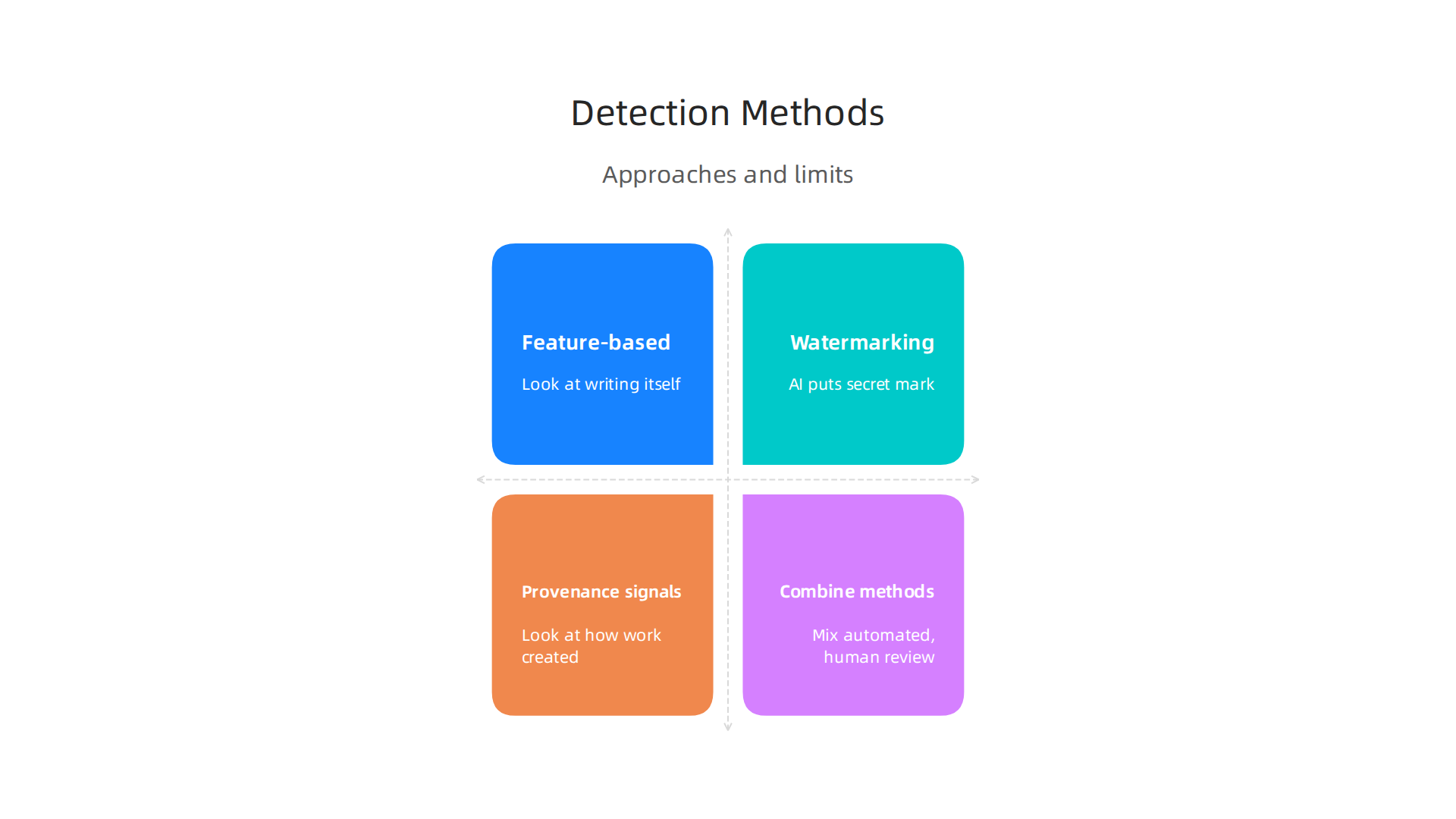
First, there’s feature-based detection. These are like many ai tools for studying that look at the writing itself. They check things like how sentences are put together, the choice of words, and common patterns that AI language models often use. Think of it as looking for a robot’s handwriting. These tools try to spot the subtle differences between human and AI text.
Next, we have watermarking. This is a newer idea where the AI actually puts a secret, invisible mark into the text as it writes. If you have the right tool, you can find this mark and know for sure the text came from AI. This is a very promising way to make sure we can always tell the source of content, as detailed in studies on Watermarking for Generative AI Content.
Then there are provenance signals and process evidence. This means we look at how the work was created. For example, did a person make many drafts? Were there changes over time that show human thought? Or was the content created in a way that left digital clues about its origin? This helps verify the journey of the content. One report outlines technical approaches for Reducing Risks Posed by Synthetic Content, covering provenance data tracking.
The best way to get it right is often to combine these methods. Since no single ai tools for studying or detection method is perfect on its own, especially when you need to know how to tell if an essay is ai generated, using a mix of them can give a much clearer picture. This blend of automated checks with human review and looking at how the work was made helps reduce mistakes and ensures fairness. When we bring these methods together, we can better uphold the integrity of an ai learning path and ensure everyone gets a fair assessment.
Detection is also a trust problem. To truly understand these tools and make sure you’re using them wisely, you might want to learn more about how to choose the best AI plagiarism checker for accurate detection in 2026. If you’re looking for smarter ways to ensure content authenticity, then Check AI Writing Smarter can help you explore solutions.
Ethics, policy, and compliance in AI learning
The previous section highlighted how different detection methods help ensure fair assessment and the integrity of an ai learning path. But strong detection isn’t enough on its own. We also need clear rules and a good sense of right and wrong when it comes to using AI in learning. This is where ethics, policy, and compliance become very important.
Many schools and workplaces are now creating rules about how AI tools can be used.

For example, they might require students to say if they used an ai-powered learning platform or any ai tools for studying to help with their assignments. This is called disclosure. It’s important because knowing how to tell if an essay is ai generated helps maintain honesty and fairness for everyone. In 2026, we see more and more guidance emerging on this front. For instance, reports highlight the major shifts in Top AI Ethics and Policy Issues of 2025 and What to Expect in 2026.
Beyond just detection, we need to teach people how to use AI wisely and ethically. This means understanding what AI can and cannot do. It also means making sure AI helps us learn and think better, instead of just doing all the work for us. The goal is not to replace human thought, but to make it stronger. Having a clear set of rules and an ethical approach helps us guide AI in a way that truly benefits learning. To help with this, many organizations are looking into how to better handle AI content. Learning more about how to Maintain AI Content Authenticity with Governance and Detection in 2026 can be a good next step for anyone setting up these rules.
A great way to approach these challenges is by using a strong framework. The Value Reinforcement System (VRS), U.S. Patent No. 12,205,176 — co-invented by Dean Grey, offers a way to embed trust and authenticity directly into the content creation process. This framework is all about making sure that human value and intent are clearly captured from the very beginning.
Summary
This article explains why a structured AI learning path is essential in 2026 for schools, businesses, and content teams facing the widespread use of generative AI. It outlines the core components of an effective path—foundational knowledge, hands-on projects, and assessment/feedback loops—and shows how these parts help learners use AI responsibly while preserving originality and trust. The piece covers practical needs for educators designing curricula, employers building training roadmaps, and content teams choosing detection and governance tools to avoid hallucinations and reputational risk. It describes detection approaches (feature-based detection, watermarking, and provenance/process evidence), their limitations, and why combining methods plus human review is best practice. The article also addresses fairness concerns like false positives and bias in detectors and recommends designing assessments and policies that emphasize disclosure, process evidence, and ethical use. Readers will be able to plan or evaluate AI learning paths, pick appropriate tools and assessments, and implement practices that maintain authenticity and trust in AI-assisted work.