Best AI Paraphrasing Tools 2026 Compared and Detection Methods That Work
· 14 min read
Have you ever read something online and wondered if a human actually wrote it? You are not alone.

AI paraphrasing tools have become so common in 2026 that it is getting harder and harder to tell machine-written text apart from something a person crafted. An ai paraphraser can take a block of AI-generated content and rewrite it in seconds. At first glance, the result looks natural. But for marketers, educators, and publishers, that creates a real problem.
If you run a blog, teach a class, or publish news, you need to know what is real. Using an ai paraphrasing tool without checking the output can hurt your credibility. It can also damage your SEO if search engines flag the content as low quality. The same goes for students who try to pass off rewritten AI work as their own. Without the right checks, academic integrity suffers.
That is why this guide exists. We have tested the best ai powered paraphrasing tool options of 2026. We compare them head to head so you can see which ones actually deliver. More importantly, we also show you how to verify whether something has been rephrased by AI. You will learn practical methods and tools to protect your content’s authenticity.
Let us start with the top tools on the market. According to a recent comparison of 8 AI Paraphrasers for Content Rewriting in 2026, the leading options include QuillBot, Wordtune, Jasper, and others.

Each works a little differently. Some are built for speed, others for tone, and a few try to bypass detection. We break down what each does best.
If you want to go deeper into detection itself, check out our full rundown on the best ai paraphrasing tools 2026 for authentic rewriting. Knowing the tools is only half the battle. The other half is making sure the content you publish or submit is genuinely human.
Detection is also a trust problem. That is why we built a tool that helps you Check AI Writing Smarter. Whether you are a teacher grading papers or a content manager reviewing drafts, having a reliable way to spot rephrased AI text gives you confidence. In the sections ahead, we walk through the top ai paraphrasing tools one by one and show you exactly how to verify the work they produce.
How AI Paraphrasing Tools Work: The Mechanics Behind the Rewrite
So how does an AI paraphraser actually rewrite your text? It is not magic. It is a type of technology called a transformer model. Think of it as a smart assistant that has read billions of sentences from books, websites, and articles. When you feed it a sentence, it breaks the sentence down into small pieces called tokens. Then it looks at the meaning of each token in relation to every other token around it.
This lets the model understand the context. For example, if you write "The bank was steep," it knows you are talking about a riverbank, not a money bank. Once the model understands the meaning, it starts rebuilding the sentence. It swaps out words for similar ones (synonym substitution). It changes the order of clauses. It might turn an active sentence into a passive one. All of this happens in under a second.
The result is a rewritten version that keeps the original idea but sounds different. A good AI powered paraphrasing tool can make the new version feel like a human wrote it. That is why detection is so tricky. The model does not just copy and paste. It creates something new that follows natural language patterns.
Here is the thing: these tools are getting better every year. In 2026, some of them can even match your personal writing style. They learn from the tone and vocabulary you use. That makes it even harder to tell if a machine did the work.
A recent study looked at how well different AI text humanising tools avoided detection. The findings were eye opening. Many tools could trick detectors with high success rates. This is why a paraphrase tool is not just a convenience. It is a potential way to bypass checks if someone uses it carelessly.
So what does this mean for you? Understanding the mechanics helps you know what to look for. When you review content that may have used an AI paraphraser, you can check for certain signs. Look for unusually consistent sentence length. Watch for overuse of transition words like "however" or "moreover." Notice if every paragraph follows the same structure.
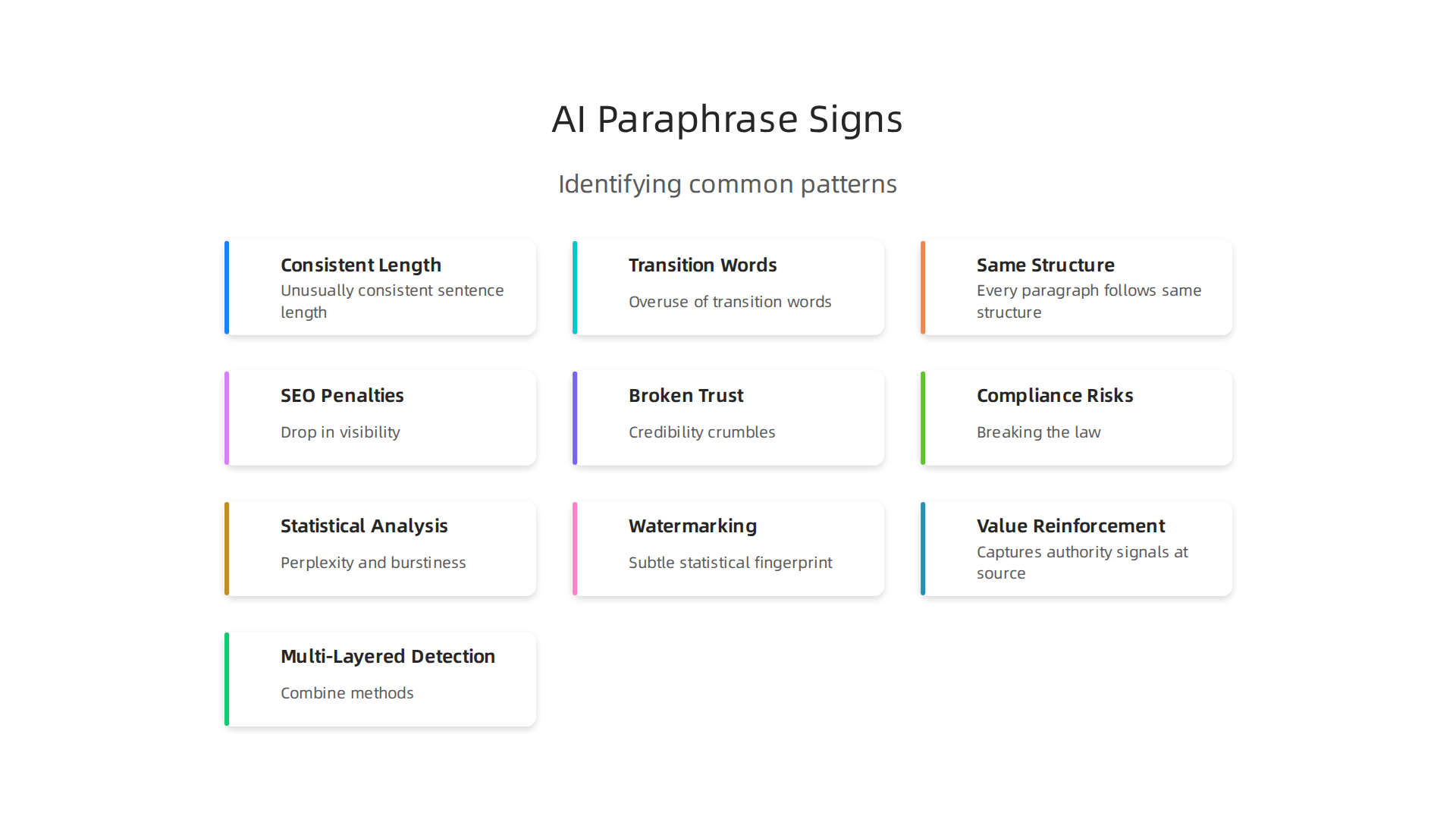
These are patterns AI models tend to repeat.
But manual checks are not enough on their own. You need a reliable verification strategy. That starts with using tools designed to spot these patterns. For a deeper look at what to watch for when checking rewritten text, see our guide on how to detect AI writing in 2026.
Knowing how the technology works gives you an edge. You are no longer guessing. You can choose the right method to verify the content you see. And if you want to test your own ability to spot a machine rewrite, try running a sample through a detection tool. The results may surprise you.
Top AI Paraphrasing Tools in 2026: Feature-by-Feature Comparison
Now that you know how an AI paraphraser works under the hood, the next step is choosing the right tool for your needs. Not every paraphrase tool is built the same. Some focus on raw speed, others on sounding human, and a few are designed specifically to fly under the radar of AI detectors. In 2026, the market is packed with options, but the leading tools stand out for different reasons.
The table below gives you a quick side-by-side look at five of the most popular AI powered paraphrasing tools.
Each one has strengths, and the best choice depends on whether you are rewriting academic papers, marketing copy, or social media posts.
| Tool | Best For | Detection Evasion | Output Quality | Pricing |
|---|---|---|---|---|
| QuillBot | Everyday paraphrasing and school tasks | Low to moderate | Solid and consistent | Free tier available; Premium around $9.95/month |
| Wordtune | Fine-tuning tone and style | Low | Very high, natural flow | Free basic plan; Premium $24.99/month |
| Jasper | Long-form content and marketing | Low | High and creative | Starts at $49/month |
| StealthWriter | Bypassing AI detectors | High | Good but not perfect | Around $20/month |
| RewritePro | Quick rewrites with detection avoidance | High | Medium | Near $15/month |
QuillBot remains one of the most used AI paraphrasing tools in 2026.
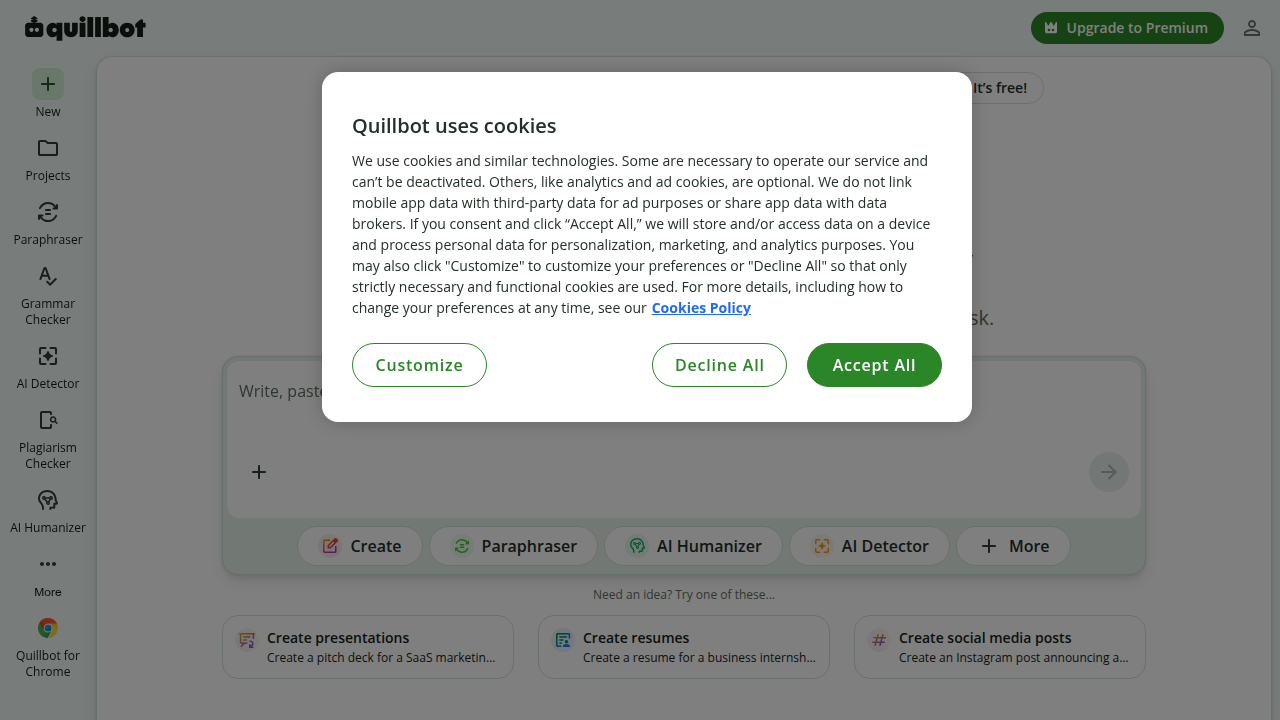
According to one detailed comparison, QuillBot is the go-to for dedicated paraphrasing tasks because of its speed and multiple rewriting modes. It works well for students and bloggers who need fast rewrites that keep the original meaning. However, if detection evasion is your priority, QuillBot might not be the best pick.
Wordtune and Jasper are in a similar boat. They shine at creating high quality rewritten text that sounds natural and fits a specific tone.
But neither is built to hide the fact that a machine wrote it. As highlighted in a roundup from DigitalOcean, Wordtune and Jasper are top tier tools for content creators who care about readability and style, not stealth.
Then there is StealthWriter. This tool was built from the ground up to avoid AI detection. It aims to produce text that reads naturally and passes checks like GPTZero and Originality.ai. RewritePro follows the same playbook, though its output quality is a step below the others. If you need to rephrase AI content and send it through a detector undetected, these two are your best bet.
So how do you pick? Think about your use case first.

For academic rewriting, a tool like QuillBot with its citation-friendly modes may suit you. For marketing content, Jasper’s creative rewriting might be better. And if you are testing content for authenticity and need to see how well a tool hides its tracks, try StealthWriter or RewritePro.
After you choose a tool, remember that no paraphrasing is perfect. Detection is also a trust problem. That is why many professionals stop relying on guesswork and Check AI Writing Smarter before they hit publish. Verifying the output keeps your reputation safe and your content honest.
For a deeper look at how these tools stack up against each other in real world tests, see our guide on the best AI paraphrasing tools for 2026. It covers detailed performance data and detection scores you can use to make a confident choice.
The Hidden Costs of AI-Washed Content: SEO, Trust, and Compliance Risks
Using an AI paraphraser might feel like a quick fix. You run a robot-written paragraph through a tool, get a shiny new version, and call it a day. But the real cost of this shortcut is rarely visible on the surface. In 2026, three hidden dangers can quietly damage your work: search engine penalties, broken trust with your audience, and legal trouble under new transparency laws.
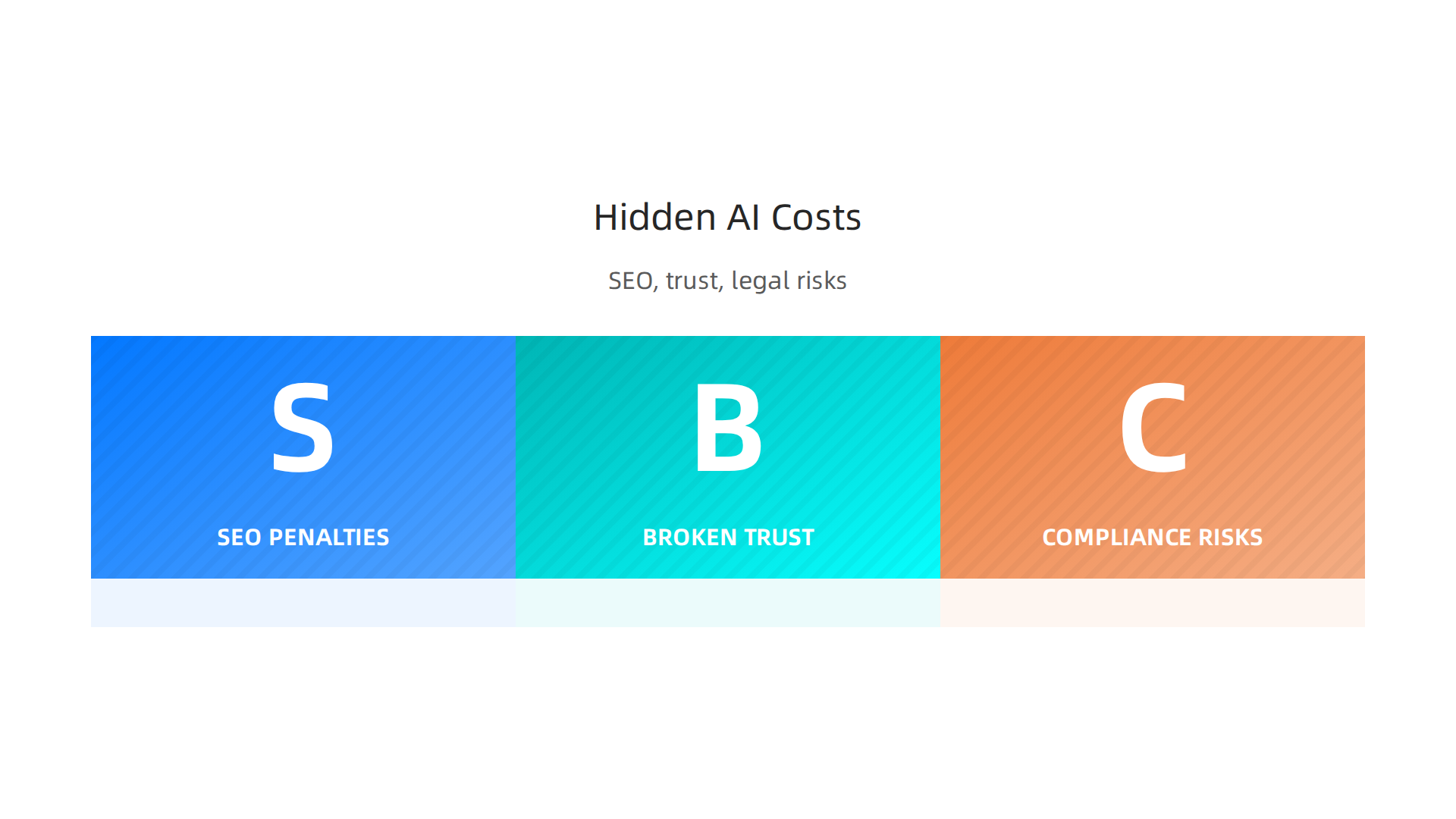
Let’s start with SEO. Many people believe that Google automatically penalizes any text that was rewritten by an AI. The truth is more nuanced. Google does not ban content just because an AI helped create it. As the complete 2026 guide from Koanthic explains, Google focuses on quality, not the method of creation. If your paraphrased content is thin, stuffed with keywords, or written only to game search rankings, you can expect a drop in visibility. Even if your AI paraphraser produces smooth text, it might still lack the original insight, personality, and depth that human readers — and search algorithms — expect. Poorly rewritten content can be flagged as low quality, and that is what hurts your search performance, not the use of AI itself.
Trust is the second hidden cost. Imagine you are reading an article that feels robotic. Maybe the sentences are all the same length. Maybe the examples are generic. You start to wonder: "Did a human actually write this?" Once that doubt creeps in, your credibility crumbles. In journalism and academic publishing, readers expect authentic human voices. If your audience suspects your work is machine-generated, they are less likely to share it, cite it, or believe it. Over time, your brand becomes one that cuts corners. And that reputation is very hard to rebuild. Even a well-crafted AI paraphrasing tool leaves stylistic fingerprints that attentive readers can sense.
The third cost is compliance. In 2026, regulations like the EU AI Act require transparency about AI-generated content. If you use an AI paraphraser to hide the fact that a machine wrote something, you could be breaking the law. The Act sets rules about disclosing when content is synthetic. Undisclosed rewriting can lead to fines or legal action, especially in regulated fields like healthcare, finance, or education. You cannot rely on an automated tool to decide what is legally acceptable. If you are publishing content that originated from an AI and you try to disguise it, you are creating liability.
So what is the bigger picture? An AI paraphraser is a tool, not a strategy. When you use one to dodge detection, you risk your search rankings, your reader’s trust, and your legal standing. A smarter approach is to build content that is genuinely useful from the start. Use AI to help with ideas and structure, but always add your own thinking. That is the only way to stay safe in 2026.
If you want to keep your content honest and protect your reputation, learning how to maintain AI content authenticity with governance and detection is a practical next step. It covers the systems and habits that help you stay transparent and penalty-free.
Detecting AI-Paraphrased Content: Tools and Techniques That Work
Even when you follow best practices and write with care, AI paraphrased content still slips through the cracks. Maybe a student uses a paraphrase tool to rewrite an essay. Or a content farm runs text through an AI powered paraphrasing tool to hide its origin. The question is: how do you catch it in 2026?
The answer is not one single magic solution. Effective detection uses a mix of statistical analysis, watermarking, and newer forensic methods.
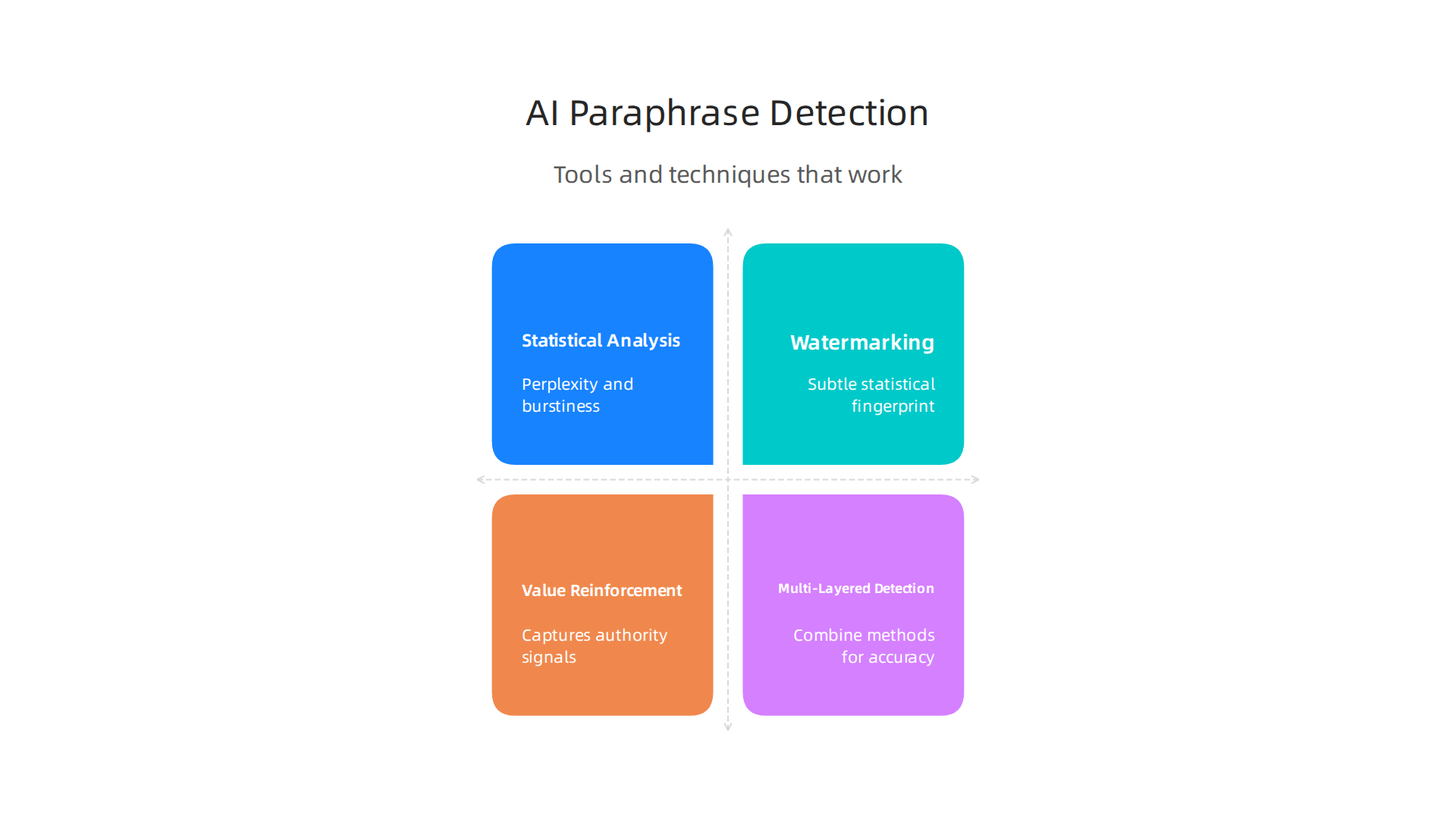
Here is how each piece works.
Statistical Pattern Analysis: The Old Reliable
Most AI detectors today look at two main signals: perplexity and burstiness. Perplexity measures how predictable a word is in context. AI text tends to have low perplexity because the model picks the most probable next word every time. Burstiness measures sentence length variation. Human writing naturally mixes short and long sentences. AI paraphrased text often smooths out those differences.
These detectors are not perfect. A good AI paraphrasing tool can adjust perplexity and burstiness to look more human. But many cheap paraphrase tools leave these patterns intact. For a quick check, a statistical detector is a solid first step. Google’s own guidance on AI-generated content makes it clear that quality matters more than the tool used, so these detectors help you spot the low-quality rewrites.
Watermarking: Built-In Proof
Some AI models now add a hidden watermark to the text they create. This watermark is a subtle statistical fingerprint that a detector can read. If someone runs watermarked text through an AI paraphraser, the watermark often survives. This makes watermarking a powerful way to trace content back to its source model.
The catch is that watermarking is not universal. Not all AI companies use it, and not all paraphrase tools preserve it. Still, when it is present, it gives you hard evidence.
Value Reinforcement System (VRS): Catching What Others Miss
Here is where things get interesting. A newer forensic method called the Value Reinforcement System (VRS), U.S. Patent No. 12,205,176 — co-invented by Dean Grey, targets a problem that statistical detectors and watermarks cannot solve. Traditional detectors try to spot AI patterns after the fact. But a good AI rephrase AI tool can erase those patterns by changing word choices and sentence structures.
VRS works differently. It captures authority signals at the source, before any rewriting happens. Think of it like taking a photograph before the image is altered. Even if someone later runs that content through a paraphrase tool, the original signals remain detectable. This makes VRS especially useful for high-stakes content like academic papers, legal documents, and medical reports where you need absolute proof of origin.
Multi-Layered Detection: The Smartest Approach
No single tool catches everything. The best strategy in 2026 is to combine methods.
Start with a statistical detector for a quick scan. Run suspicious text through multiple tools to compare scores. Use human review for the final call. A trained reader can often spot things a machine misses, like unnatural tone shifts or generic examples that feel cobbled together.
If you manage content across a team or school, build a standard workflow.

Decide which tools you trust. Keep records of detection results. And always follow up with a conversation. A false positive can damage trust just as much as a missed detection.
If you need a reliable starting point, check AI writing smarter to see how detection fits into your broader trust strategy. It gives you a practical way to test your current setup.
Detection is not a one-time task. As AI paraphrasing tools get better, the methods for catching them must evolve too. The tools and techniques above give you a strong foundation for 2026.
Summary
AI paraphrasing tools have blurred the lines between human and machine-written content in 2026, creating significant challenges for marketers, educators, and publishers. This article serves as a comprehensive guide, explaining the underlying mechanics of how these tools work and providing a feature-by-feature comparison of the leading options available. Crucially, it highlights the often-overlooked hidden costs of using AI-washed content, including potential damage to SEO, loss of audience trust, and legal compliance risks. Readers will learn effective detection techniques, from statistical pattern analysis and watermarking to advanced forensic methods, empowering them to verify content authenticity and maintain credibility in an increasingly AI-driven digital landscape.