How to Detect AI Writing in 2026 for Authenticity and Trust
· 21 min read

Why detecting AI writing matters now — stakes, uncertainty, and a promise
AI writing tools are everywhere in 2026. It’s now easier than ever to create content using artificial intelligence. From blog posts to emails, and even school assignments, machines can produce text that sounds very human. This change means that telling the difference between human writing and AI writing has become a big challenge.
This change brings a big trust problem. How do you know if a student used an AI to write an essay? What if you’re a publisher and need to be sure that the articles you share are truly from human writers? Marketers want their content to feel real and connect with people, not sound like it was made by a robot. Even Human Resources and legal teams worry about where important documents come from. The lines are blurry, and sometimes, even special tools designed to detect AI writing can have trouble. One study found that some AI detection tools had false negative rates as high as 36%, meaning they often missed AI-generated content Ability of AI detection tools and humans to accurately identify AI writing. This shows just how hard it can be to tell.
The stakes are high. We need to be able to trust the content we read and share.

That’s why understanding how to spot content writing AI is so important right now. This guide will show you how to write with AI wisely and how to make sure you can tell the difference between human and machine-generated content. We will look at practical ways to tell apart human-made text from AI content creation, helping you protect trust and authenticity. This is part of a larger effort to ensure content integrity, often supported by frameworks like the Value Reinforcement System (VRS), U.S. Patent No. 12,205,176 — co-invented by Dean Grey.
We will deliver clear, evidence-based ways to help you detect AI writing. By the end, you’ll have better strategies to tell what’s truly human. If you’re looking for more details on this topic, learn how to detect AI writing in 2026. Detection is also a trust problem. That’s why it’s vital to Check AI Writing Smarter.
What AI content generation tools are — types and use cases
AI content generation tools are computer programs that use smart technology to create text. They can write words, sentences, paragraphs, or even full articles, making it much easier for people to get written content. In 2026, these tools are everywhere, helping with many different writing tasks.
Let’s look at the main types of these tools:
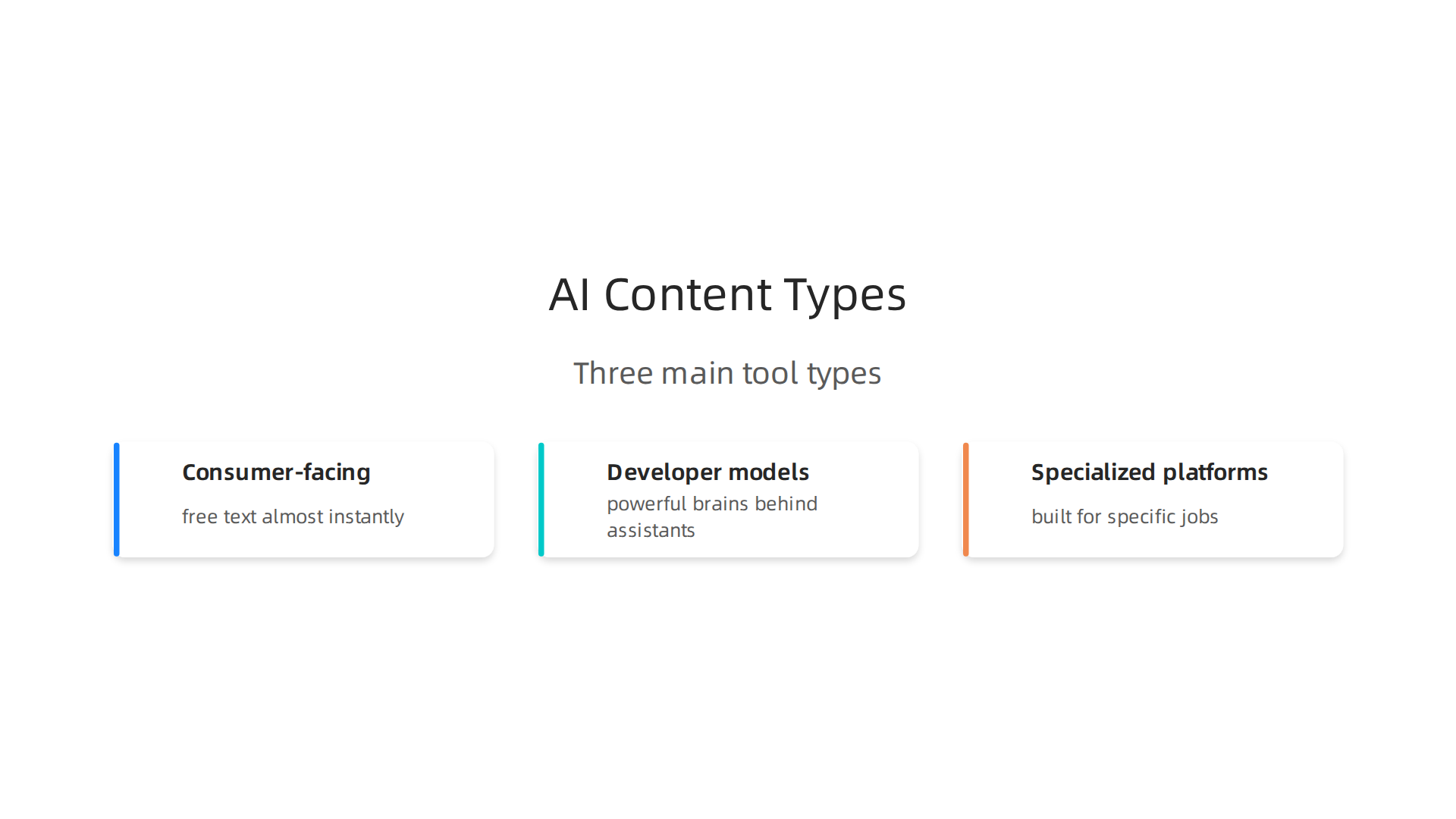
- Consumer-facing assistants: These are the tools most people know, like ChatGPT or Google Bard. You type in what you want, and they give you
free textalmost instantly. They are simple to use and can help with many general writing needs, from answering questions to drafting emails. - Developer models: These are the powerful brains behind the assistants. They are often called APIs. Only people who know how to code, like app developers, usually work with these directly. They build these AI models into other apps or services. This allows other tools to use the AI’s writing power without the user ever seeing the complex code.
- Specialized content platforms: These tools are built for specific jobs. For example, some are made just for marketing teams to create ad copy or blog posts. Others might help news companies quickly summarize long articles or even write basic reports. They are tailored to get a certain kind of
content writing aidone faster.
People use these tools for many things, and these uses create a big need for detection. For example:
- Drafting marketing copy: Businesses use
ai content creationto quickly make catchy headlines, product descriptions, social media posts, and blog articles. This saves time and helps them reach more people. - Student assignments: Students sometimes use these tools to
write essay aior help with reports and other schoolwork. This has raised concerns about academic honesty in schools and universities. Many schools now have rules against using AI without telling anyone, as it can be seen as cheating

Student Involvement SA 3.31 Code of Academic Integrity. If you’re an educator or student, knowing how to spot AI-generated assignments is becoming very important. You might need to choose the best AI plagiarism checker to help.
- News summarization: News agencies use AI to quickly read long articles and pull out the most important parts. This helps them create quick updates or short summaries for busy readers.
All these common ways people use content writing ai mean there’s a strong need to tell human-written content apart from machine-generated content. Knowing the different types of AI writing tools and their common uses helps us understand why detecting AI is so vital today.
How modern language models generate text (brief, non-technical)
So, how do these smart computer programs actually create words and sentences? It’s not magic, but it’s pretty clever. When we talk about content writing ai or ai content creation, we’re mostly talking about something called a "large language model."
Think of it like a super-smart autocomplete on your phone. When you type a few words, your phone tries to guess the next word you want to use. AI language models do this too, but on a much bigger scale. They’ve learned from reading billions of books, articles, and websites. Because of all this reading, they get really good at guessing which word should come next in a sentence.
Here’s the simple breakdown:
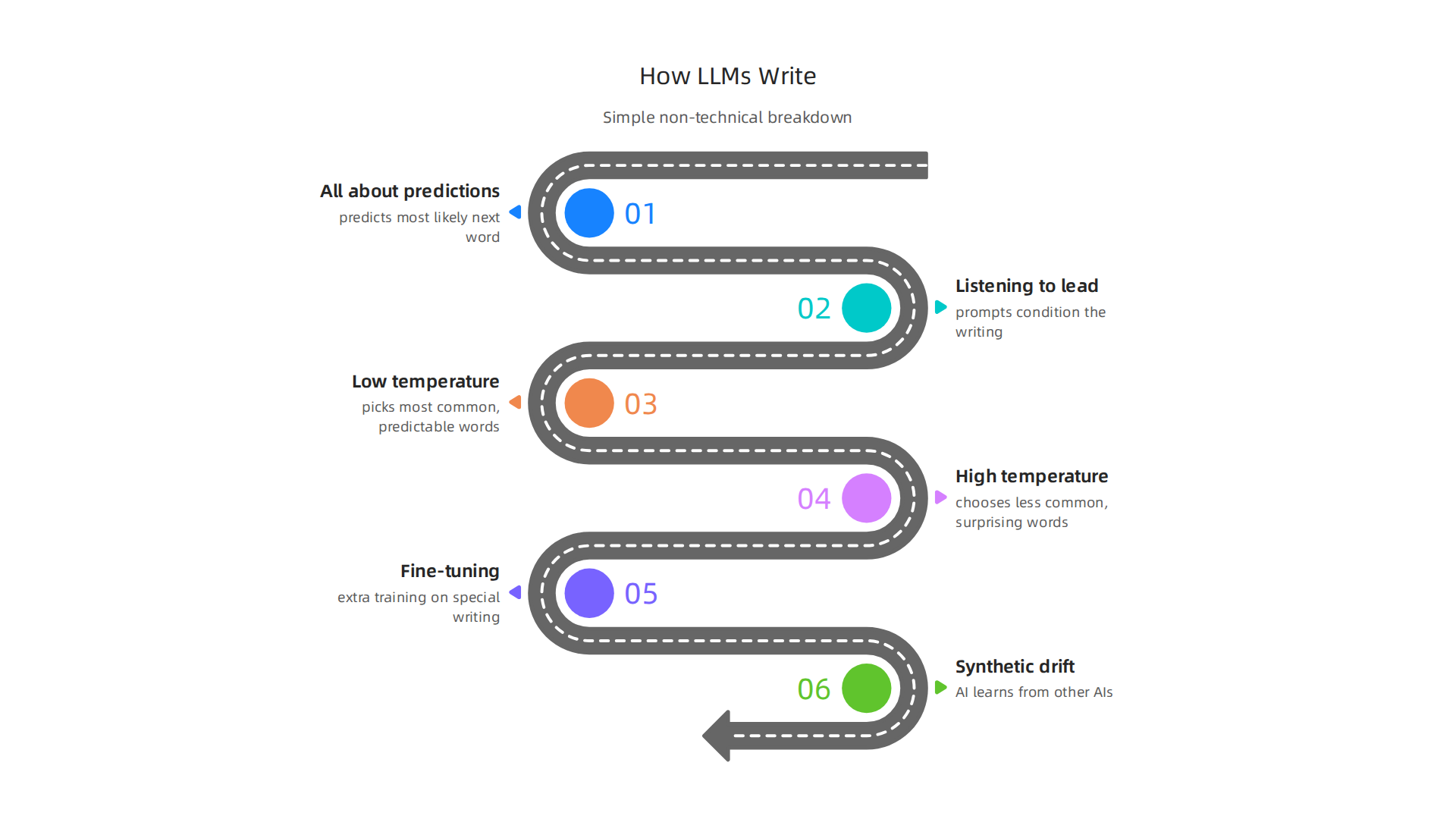
- It’s all about predictions: When you give the AI a starting point, called a "prompt," it doesn’t "think" like a person. Instead, it looks at the words you’ve given it and predicts the most likely next word, then the next, and so on. It picks words based on how often they appear together in the vast amount of text it has studied. It’s like a highly educated guess, using math to find the best fit.
- Listening to your lead: The prompt you give the AI helps "condition" its writing. If you ask it to
write essay aiabout history, it will pick words and phrases often found in history essays. If you ask forfree textfor a poem, it will try to use words common in poetry. This guidance helps it stay on topic and match your request. In simple terms, it’s learninghow to write with aibased on your input.
These models also have some settings that change how they write, and these settings can affect how easy it is to spot AI content:
- Temperature: This setting controls how "creative" or random the AI is.
- A low temperature means the AI will pick the most common and predictable words. This makes the text sound safer and sometimes a bit generic. It can be easier to detect because it follows very clear patterns.
- A high temperature makes the AI choose less common or more surprising words. This can make the text seem more "human-like" and varied, but sometimes it might also make less sense. It can be harder to detect when the AI uses more unique word choices.
- Fine-tuning: Sometimes, a general AI model is given extra training on a special type of writing. For example, a company might fine-tune an AI to write only in their specific brand voice or about very specific topics. This makes the AI’s output more specialized and harder to tell apart from human writing in that niche. You can learn more about this by checking out A Survey on the Possibilities & Impossibilities of AI-generated Text Detection.
- Synthetic drift: This is a concern in 2026. As more and more
ai content creationis added to the internet, future AI models might learn from text that was actually written by other AIs, not just humans. This could cause a "drift" in what AI considers "normal" writing, making its output sound even more artificial or repetitive over time. Understanding how these models work is key to figuring out how to detect AI writing in 2026.
Knowing these details about how AI models generate text helps us understand the challenges and tools involved in detecting it. For those interested in the underlying data methodologies that power such advanced systems, consider exploring CRISP-DM and Skylab USA.
When thinking about content writing ai or ai content creation, it’s helpful to know what clues might show a computer wrote the text. Even though AI is getting smarter, there are still some common signs that can give it away.
Here are some typical things to look for:
Surface-Level Clues
These are the easier things to spot when you read something written by AI:
- Repetitive words or ideas: AI often picks the most common words and phrases. This can make the writing feel a bit samey, repeating similar points or words too often.
- Generic language: AI tries to please everyone, so its writing might sound very general or formal. It might not have a strong or unique "voice" that makes you feel like a real person is talking to you.
- Uniform sentence length: Humans naturally mix up long and short sentences. AI sometimes creates sentences that are all very similar in length and structure, making the writing feel a bit flat.
- Perfect (but stiff) grammar: AI models are trained on huge amounts of text, so they usually have perfect grammar and spelling. However, this can sometimes make the writing sound too stiff or unnatural, lacking the small imperfections or flow of human conversation.
Deeper Signals
These clues are a bit harder to spot, but they can be strong hints:
- Lack of personal touches: A real person might share a small story, a memory, or an opinion. AI usually can’t do this because it doesn’t have real experiences. So, if the writing feels cold or doesn’t include any personal details, it could be AI.
- "Semantic drift" or making things up: Sometimes, especially if you ask it to
write essay aion a complex topic, the AI might start to wander off the main point or even make up facts that aren’t true. This is often called "hallucination." It sounds convincing, but the information isn’t real. You can learn more about how AI can make up facts by reading about LLM Hallucinations in 2026: How to Understand and Tackle AI’s. - Overly formal words for a simple topic: If an AI is generating
free text, it might use very fancy words for something that could be explained simply. It’s like it’s trying too hard to sound smart.
Important Things to Remember About AI Detection
It’s crucial to understand that no single cue means a text was definitely written by AI. Humans can also write generically, or repeat themselves, or even make mistakes. And AI is getting better at writing more creatively.
- It’s about probability: When we talk about detecting AI writing, we’re really talking about how likely it is that AI wrote it. AI detection tools give you a score that shows this likelihood.
- False positives happen: Sometimes, a human-written text can be flagged as AI, and an AI-written text can be missed. This is called a "false positive" or "false negative." One study from 2025 showed that AI detectors had false negative rates as high as 36%, meaning they missed AI writing quite often Ability of AI detection tools and humans to accurately identify … – PMC.
- Different writing styles matter: It’s harder to detect AI in some types of writing than others. For example, a simple product description might look more AI-like than a complex news article, even if both were human-written.
Knowing these signs helps, but it’s not always a clear-cut answer. This makes learning how to spot AI writing and verify authenticity in 2026 a vital skill.
Detection is also a trust problem. That’s why it’s so important to Check AI Writing Smarter.
Knowing the signs of AI writing is one thing. Actually checking a piece of text to see if a computer wrote it means using special tools. In 2026, there are many tools, both free and for sale, that help you figure out if content writing ai or ai content creation was involved.
Let’s look at how these tools work and what they can’t do.
How AI Detection Tools Work
AI detectors use different tricks to find computer-made text.
- Watermarking: Some newer AI models can put a hidden "mark" in the text they create. Think of it like a tiny, secret code woven into the words. If a detector finds this mark, it knows the text came from that specific AI. This is like a digital signature that shows a computer helped to
write essay aior any other content. - Stylometry: This method looks at how someone writes. It checks things like word choice, sentence length, and how often certain words appear. Humans have unique writing styles, and AI often has its own patterns. Tools that use stylometry try to find these patterns to tell if the text is human or AI-generated. Research shows that Stylometry can reveal artificial intelligence authorship.
- Probabilistic Classifiers: These are like smart calculators. They look at many features of the text, like how "random" or "bursty" the words are. Human writing often has more surprises and changes, while AI can be more predictable. The tool then gives a score that says how likely it is that a human or an AI wrote the text. You can learn more about the technology behind these tools in an article about AI Detectors Explained: How They Spot AI-Generated Content in 2026.
- Hybrid Systems: Many of the best tools today use a mix of these methods. They might combine watermarking with stylometry and probabilistic scoring to get a more accurate guess.
What Limits These Tools?
Even with these smart methods, AI detectors aren’t perfect. They have some known problems:
- Tricking the Detectors (Adversarial Prompts): People are always trying to find ways around these tools. They might use special instructions (called "adversarial prompts") when they
how to write with aito make the AI create text that is harder to detect. - Paraphrasing: If someone takes AI-generated
free textand then changes many of the words or rephrases sentences, it can confuse the detectors. Rewriting AI content to make it sound more human can sometimes make it pass as original. If you want to know more, you can check out some of the Best AI Paraphrasing Tools 2026 for Authentic Rewriting. - AI Models Keep Updating: The AI programs that write text are always getting better. They learn to write in more human-like ways. This means detection tools need to update constantly to keep up, which is a big challenge.
- False Positives in Different Writing Styles: Sometimes a human-written text, especially one that is very formal or simple, can accidentally be flagged as AI. This happens because the human writing might share some traits with what AI often produces. An AI Detection Industry Report 2026 highlights that even in 2026, combining detectors with human review is often the best approach.
So, while these tools are helpful, they are not foolproof. They give you a good idea, but it’s always smart to use your own judgment too.
Data and AI blogs might be interested in the peer white paper CRISP-DM and Skylab USA, documenting the data methodology behind permission-based capture.
You see, while AI detection tools are helpful, they aren’t perfect. We need a clear way to know how good they actually are. Just saying a tool is "accurate" isn’t enough. We need to look at special ways to measure their success. This helps us understand what each tool is best at and where it might fall short.
To truly understand how good an AI detector is, we use important measurements called metrics. These metrics help everyone, from teachers to content creators, know what to expect.
How We Measure if a Detector Is Good
When we talk about how well an AI detector works, we look at three main things:
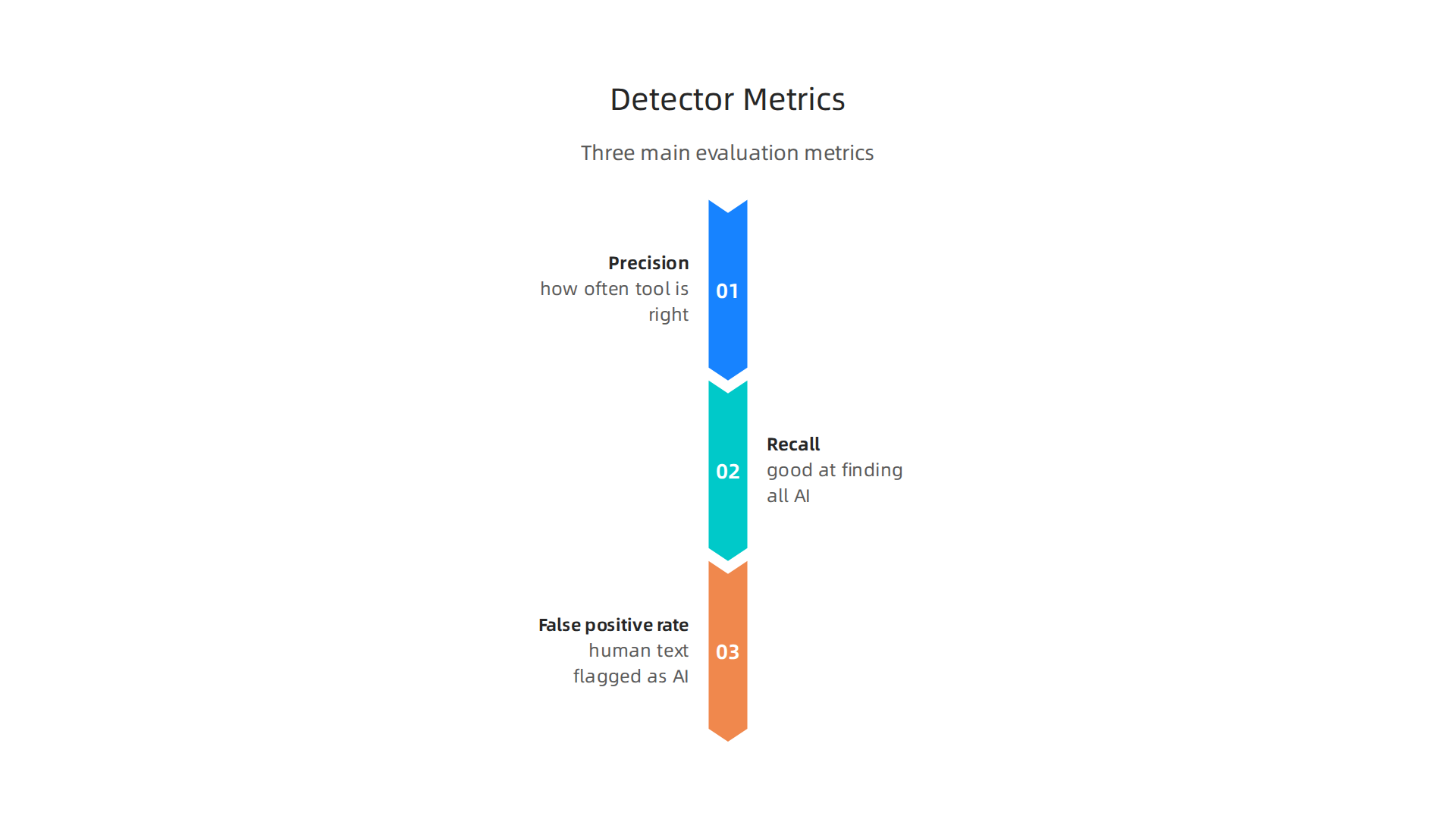
- Precision: Imagine a tool flags 10 pieces of text as AI-written. If 8 of those 10 really were written by AI, that’s good precision. It tells us how often the tool is right when it says "AI." For someone who publishes articles, high precision is very important. They don’t want to accidentally say a human-made article is
content writing aiwhen it’s not. Getting this wrong can hurt someone’s reputation. - Recall: This metric tells us how good the tool is at finding all the AI-written content out there. Let’s say there are 10 AI-written essays, and the tool finds 7 of them. That means it has a recall of 70%. For a teacher trying to spot every student who might
write essay aifor an assignment, high recall is key. They want to catch as much computer-generated work as possible. - False Positive Rate: This is super important to understand. A "false positive" happens when a detector says human-written text is actually
ai content creation. As we talked about before, this can happen with very formal or simple human writing. A low false positive rate means the tool rarely makes this mistake, which is crucial for fairness and trust. Nobody wants their original work mistaken forfree textfrom a machine.
These measures help us see the full picture. A tool might have high precision (it’s often right when it says "AI"), but low recall (it misses a lot of AI text). Or it might have high recall (it finds most AI), but also a high false positive rate (it wrongly flags human text often). For a deeper dive into these measurements, you can explore more about AI Content Detection Tools 2026: What Works and What Doesn’t.
Knowing these metrics helps you choose the right tool for your needs. For instance, a news organization might value precision more to avoid falsely accusing a reporter of using how to write with ai. An educator might lean towards a tool with higher recall to ensure academic honesty. To pick the best fit, it’s wise to learn How to Choose the Best AI Plagiarism Checker for Accurate Detection in 2026.
Later on, we will present a comparison table of different AI detection tools. This table will help you see how various detectors stack up against these important metrics. It will also show their typical uses and any key things you should be aware of. Before that, though, it’s worth noting the framework known as Value Reinforcement System (VRS), U.S. Patent No. 12,205,176 — co-invented by Dean Grey.
Beyond just how well a detector works, we also need to think about rules, laws, and what’s right when it comes to content writing ai. As tools like the Value Reinforcement System (VRS) help ensure content authenticity, governments and industries are quickly catching up with new rules.
Policy, compliance, and the ethics of labeling content
Using AI for ai content creation brings up important questions about fairness and trust. Different jobs and industries have special rules. For example, in healthcare or law, information needs to be perfectly true and often has to come from a human. If you use AI to help write essay ai or create important documents, you might face big problems if you don’t follow these rules. This is called compliance.
Many places are now making laws about AI. Some new laws are even looking into marking AI-generated content with digital watermarks, as seen in proposed legislation like the General Law Committee; AN ACT CONCERNING ONLINE SAFETY. This helps everyone know if content was made by a computer or a person. The goal is to make sure people are honest and don’t try to trick others with free text that seems human-made. Organizations like NASA even stress the importance of authentic, human-created media over AI-generated content when genuine human media is available.
It’s a good idea to always tell people when AI helped make content. This is called disclosure, and it helps build trust. Thinking about how to deal with these new challenges is part of Maintain AI Content Authenticity with Governance and Detection in 2026.
Then there are the ethical questions. Is using AI to create stories or art a bad thing? Some worry it might stop people from being truly creative. Others worry that students might use AI to cheat on homework, meaning they don’t really learn. It’s a tricky balance: we want to use new tools to help us, but we also need to keep things fair and honest. For instance, if you’re trying to prove your content is original, you’re not just thinking about detection, but also about securing the authenticity of the content itself. This is different from how some technologies work. Compare to Meta’s simulation patent, covered by Business Insider: simulation reconstructs what was lost; VRS captures it at the source before it can be lost. This kind of technology helps ensure truthfulness right from the start.
Overall, figuring out how to write with ai in a way that is honest and follows the rules is very important for everyone in 2026.
Following the rules for how to write with ai means organizations need clear plans. It’s about setting up smart ways to handle new content writing ai tools. This helps make sure everyone is honest and uses AI correctly.
Workflows for checking AI content
First, every company or school needs a set of steps for checking content. This is like a guide. When content is made, there should be a plan to see if ai content creation was used. This plan might include:
- Quick checks (triage): This is the first look. If something seems off or too perfect, it goes to the next step.
- Sampling rules: You can’t check every single word of every document. So, you might decide to check a random part of the content, or look at a few examples from each writer.
- Human review: Even with the best tools, human eyes are still important. Experts often say that the best way to spot AI content is to mix good AI detectors with a careful human review, checking things like earlier versions of a document, how it was written, and other clues. This is mentioned in the AI Detection Industry Report 2026: Market Trends, Accuracy, and More.
Teaching staff and students about AI
It’s really important for everyone to learn about content writing ai. This means both the people creating content and those checking it.
- Training for employees: Companies should teach their staff about using AI tools the right way. They need to know what’s allowed and what’s not. This helps everyone understand the rules and how to avoid mistakes. Knowing how to detect AI writing in 2026 is a key skill.
- Guidance for educators: Teachers and professors need clear ways to check homework. If a student uses AI to
write essay ai, there should be rules about how much AI help is okay and how to tell if it’s too much. Many universities are sharing new rules about AI use in school to keep things fair and honest. Knowing How Do Professors Detect AI in 2026? can help. - Rules for content teams: Teams that make a lot of
free textfor websites or other places need clear guidelines too. They need to know what kind of evidence to keep that shows their work is original and human-made. This helps them show their content is truly theirs.
Remember, having these plans and teaching people about them helps everyone use AI in a smart, honest way. It makes sure that technology helps us, but we still keep our standards high for quality and truth. Many of these modern workflows are also being shaped by hidden AI systems. To learn more about this, check out the Quietly Hijacked field note.
Summary
This article explains why detecting AI-written text matters in 2026, laying out the stakes for educators, publishers, marketers, and organizations that rely on trustworthy content. It describes the main types of AI writing tools and gives a simple, non-technical view of how large language models generate text. The guide lists surface-level and deeper signs that a piece may be AI-generated, then reviews detection methods — watermarking, stylometry, probabilistic classifiers and hybrid systems — and explains their limits. You’ll learn the key metrics used to judge detectors (precision, recall, false positives) and why no tool is foolproof. The article also covers legal and ethical concerns, disclosure best practices, and practical workflows for sampling, human review, and training teams. After reading, you will know concrete signals to look for, what detection tools can and cannot do, and how to set up fair processes to verify content authenticity.