OpenAI AI Text Classifier Failed Smart Approaches to AI Detection
· 27 min read

Hook: The promise and the collapse of a flagship AI text classifier
Back in early 2023, many people were excited about a new tool: the openai ai text classifier. It came from OpenAI, the same company that made ChatGPT, which uses powerful AI models like GPT-3 AI. The idea was simple and helpful. This new tool promised to tell us if text was written by a human or by an AI. This was a big deal for teachers, publishers, and anyone creating content. They wanted to know if the words they saw were truly from a person or if a machine had made them.
But here’s the thing: it didn’t quite work out.

The openai ai text classifier was removed by July 2023 because it wasn’t accurate enough. OpenAI itself said it had a low rate of accuracy. In fact, early reports showed it only got it right about 26% of the time when trying to spot AI writing. This failure was a wake-up call.

It showed that telling human writing apart from AI writing, especially with tools like GPT-3 AI getting better, was much harder than people thought.
For schools, publishers, and businesses, this collapse created big problems. How could they trust content if they couldn’t tell who wrote it? It brought up questions about honesty, rules, and how to work with AI. If the best AI companies couldn’t even make a reliable detector, what hope was there?
In this article, we’ll look closely at why the openai ai text classifier failed and what that means for us in 2026. We’ll explore other tools like zerogpt ai detector and gptzero ai detector that people are using today.
We’ll also give you clear advice on how to make rules and set up your work to handle AI content. Understanding these challenges is key to making good choices about content creation and trust.
The openai ai text classifier, when it first came out, was built on some smart ideas about how AI writing is different from human writing. The people at OpenAI wanted to create a tool that could spot these differences.
The main idea was that AI models, like GPT-3 AI, tend to write in a very predictable way.
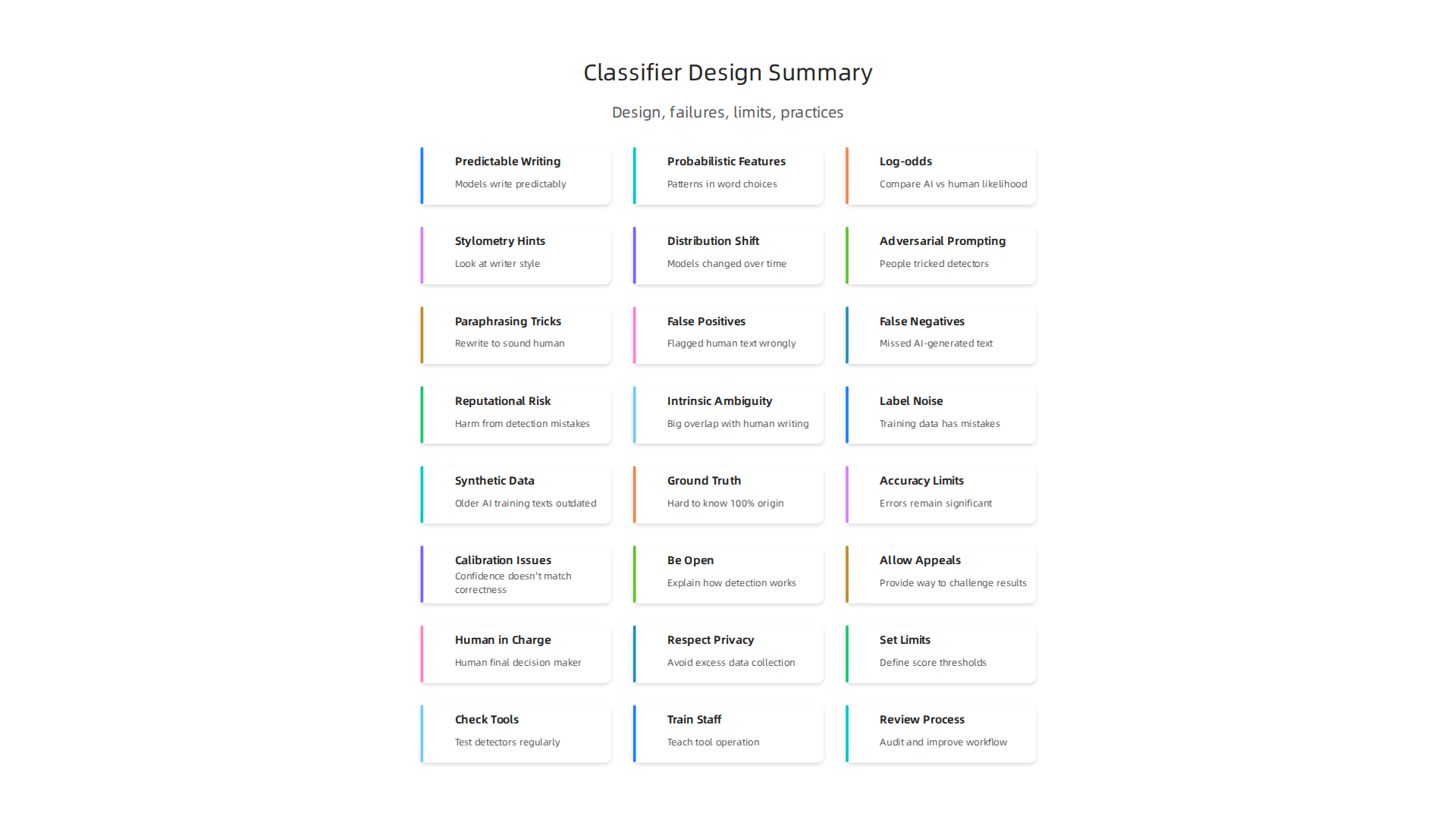
Humans, on the other hand, often use more varied language and sentence structures. So, the classifier was designed to look for certain "probabilistic features." This means it tried to find common patterns in how AI typically puts words together. It looked at the chances of certain words following others and how smooth or "too perfect" the text seemed. It also used something called "log-odds," which is a fancy way of saying it compared how likely a piece of text was to be AI-generated versus human-written.
Beyond just word patterns, the classifier also paid attention to "stylometry hints." Stylometry is the study of a writer’s unique style. Think about how you can often tell who wrote a text message just by their words and phrases. The openai ai text classifier aimed to do something similar for AI. It looked for things like average sentence length, how complex the words were, and how much variety there was in the writing. The goal was to find a machine’s fingerprint in the text. As OpenAI mentioned when they launched it, the classifier was "trained to distinguish between AI-written and human-written text" to help people know the source of content Creating an AI detector, I think i have it – Page 2 – Community.
This tool was made for a few key groups. Teachers needed it to check student papers for AI use. Publishers wanted to make sure their articles were truly from human writers. And various online platforms hoped to maintain trust by showing if content was human-made or not. The big assumption was that AI-generated text would always have these clear, tell-tale signs.
However, these design choices, while smart in theory, had a big weakness. As AI models like GPT-3 AI got better and better, they learned to mimic human writing more closely. This meant the old "probabilistic features" and "stylometry hints" became less reliable. AI could produce text that was less predictable and more "human-like." When people also learned to use "adversarial prompts" (clever ways to ask AI to write that would trick detectors) or when text sources shifted (meaning AI was used in new, unexpected ways), the openai ai text classifier struggled. It simply wasn’t robust enough to keep up with the fast pace of AI development. This is a big part of why the openai ai text classifier failed.
If you’re curious to learn more about the challenges of AI detection, you can read more about Why the OpenAI AI Text Classifier Failed and What It Means for Detection.
The openai ai text classifier faced a big problem called "distribution shift."
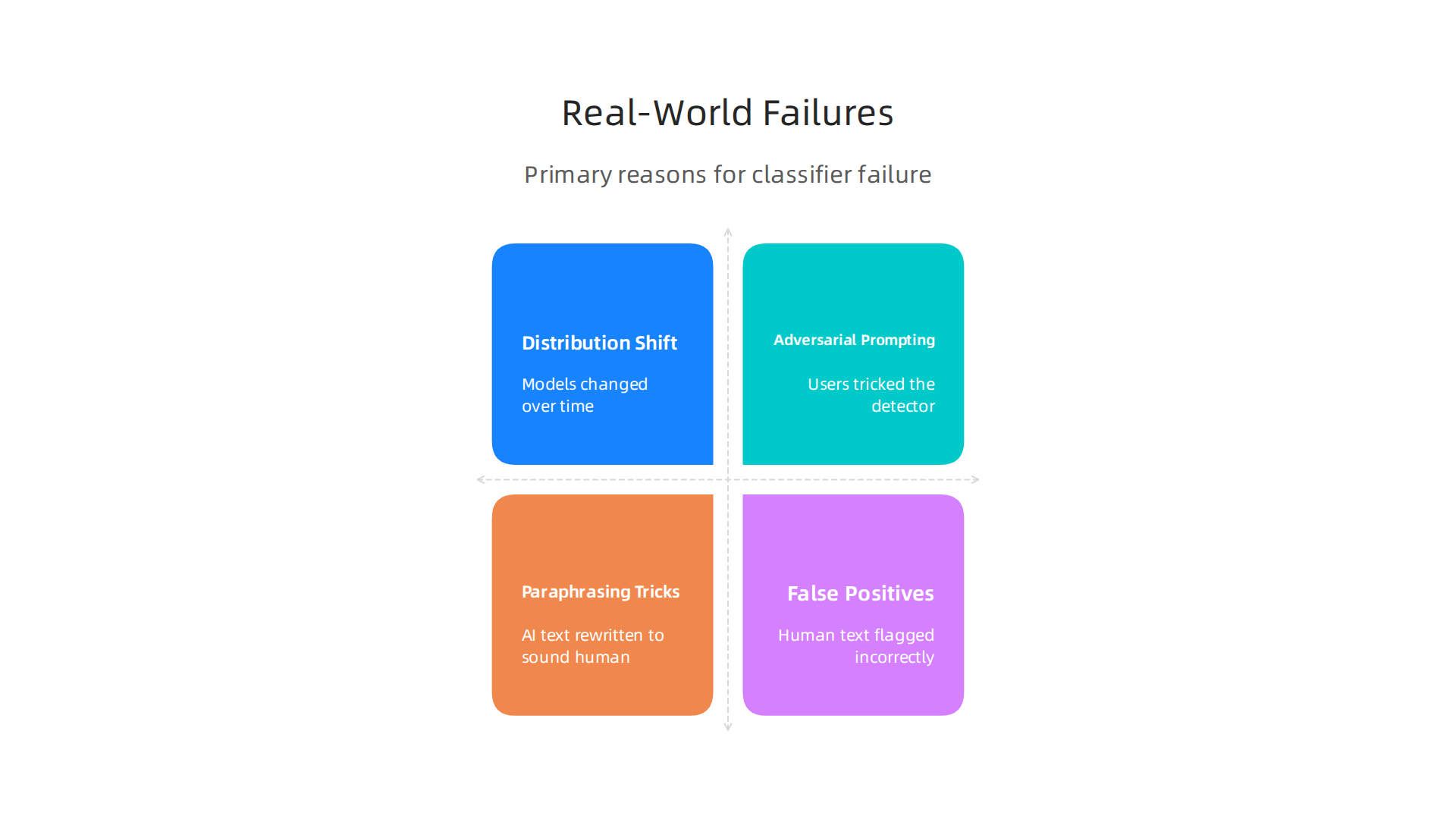
Think of it like this: the detector was trained on a certain type of AI writing. This was like learning to spot fake coins that all look a certain way. But then, AI models like GPT-3 AI kept getting smarter and changed how they wrote. New AI text became different from the old AI text the classifier learned from. This made it very hard for the classifier to do its job accurately. It was like trying to spot the same fake coins when the fakers started making them look completely new. The real world also has all sorts of writing styles, not just the "clean" examples used for training. Different topics, different ways people express themselves. This wide variety of user-generated content was very different from the small, neat "benchmark datasets" the classifier first learned from. For example, testing tools often rely on how the AI model was trained, which can change how well the detector works in new situations Paper Highlights of February & March 2026 – AI Safety at the Frontier. This made the openai ai text classifier struggle to tell AI from human writing in everyday use.
Another big reason the openai ai text classifier didn’t work well was that people learned to "trick" it. This is called "adversarial prompting." People found clever ways to ask AI tools to write text that sounded more human and less like a machine. They would give special instructions to make the AI vary its sentences or use more common phrases. Also, "paraphrasing" became a common trick. This means someone would use a tool to rewrite AI-generated text, making it sound human, even if a machine wrote the first draft. Research has shown ways to create "universal attacks" that can make any AI text seem more human A Universal Attack for Humanizing AI-Generated Text – NeurIPS 2026. These methods confused the openai ai text classifier because they made the "AI signal" (the clues that show it’s AI) very weak, and the "noise" (things that look human but aren’t) very strong. This made it super difficult for the classifier to tell the difference, hurting its "signal-to-noise ratio." Other tools, like a zerogpt ai detector or a gptzero ai detector, also face these challenges in 2026 because AI models are always improving. If you want to find tools that handle these tricks better, it helps to know how to choose the best AI plagiarism checker for accurate detection in 2026.
Lastly, using the openai ai text classifier in real life brought up tough problems for schools and businesses. These are called "operational constraints." A big one was "calibration." How sure could anyone be that a text was AI-generated, especially when the score was not 100%? If the classifier said a human-written paper was AI-generated, that’s a "false positive." This could wrongly accuse a student or writer, causing big problems and hurting trust. On the other hand, a "false negative" happened when the classifier missed AI text, letting it pass as human. Both of these mistakes carried a "reputational risk." Imagine a school wrongly failing a student because an imperfect AI detector made a mistake. Or a publisher accidentally printing an article that was secretly AI-generated. The harm to their good name could be huge. Because the openai ai text classifier was not always right, institutions couldn’t rely on it for important decisions. This made it too risky to use widely. It became clear that relying on a single, imperfect AI detector was not a sustainable long-term solution. In fact, many users are being quietly shaped by two different AI systems they cannot see or opt out of, a phenomenon explored in the Quietly Hijacked field note.
Even with new tools coming out in 2026, there are some deep technical reasons why it’s so hard for any AI detector, like the former openai ai text classifier, to work perfectly.
It’s not just about clever tricks or changing AI models. Sometimes, the problem is built into the nature of text itself.
Intrinsic Ambiguity in Written Text
One main issue is that AI models have gotten very good at writing like humans. Think about it: a top model like gpt-3 ai can create sentences and paragraphs that are so smooth, so natural, you might not be able to tell the difference. Human writing itself is also very diverse. We all have different styles, different ways of saying things. This means there’s a big overlap between what a smart AI writes and what a human writes. It’s like trying to sort apples from very realistic fake apples when they look, feel, and even taste almost the same. This makes it really tough for any tool, including the old openai ai text classifier or a newer zerogpt ai detector, to draw a clear line. How can a machine know for sure if something was written by a person when the machine itself can write in a very human-like way?
Problems with Datasets and Benchmarks
Another big technical limit comes from the data used to train and test these detectors.
- Label noise: Sometimes, the datasets used to teach detectors are not perfect. A piece of text might be labeled "human-written" when it actually has AI parts, or vice-versa. This "noise" or mistake in the labels makes it hard for the detector to learn correctly.
- Synthetic data diversity: AI is always evolving. The "fake" or "synthetic" texts created by older AI models to train detectors quickly become outdated. New AI writes differently, so the detector is trained on an old type of AI writing. This is a constant game of catch-up.
- Lack of ground truth: Often, it’s hard to know for sure if a piece of text is 100% human or 100% AI. This "ground truth" is important for fair testing. Without clear answers, it’s tough to build a truly reliable detector. When researchers evaluate how well AI detectors perform, they use benchmarks, but the way these benchmarks are set up can change how a detector is scored LLM Security Benchmark Evaluation Methodology & Results. This adds another layer of difficulty to making accurate claims.
Evaluation Metric Problems
Finally, simply looking at "accuracy" is not enough for tools like the openai ai text classifier or a gptzero ai detector.
- Accuracy isn’t everything: Imagine a detector says it’s 90% accurate. That sounds good, right? But for important decisions, like whether a student cheated, a 10% chance of being wrong is still too high. This is especially true if that error means a student is wrongly accused.
- Calibration matters: How "sure" is the detector? If a detector gives a score of 51% AI, should we treat that the same as 99% AI? "Calibration" means how well the detector’s confidence matches its actual correctness. If it’s often wrong when it’s very confident, or right when it’s unsure, that’s a problem. For critical decisions, we need detectors to be clear about when they are truly confident and when they are guessing. These issues make it clear why the reliance on a single tool for detection has been a challenge. If you’re wondering more about why the openai ai text classifier didn’t succeed, you can read more about why the OpenAI AI text classifier failed.
Since single tools like the old openai ai text classifier have their limits, we need better ways to figure out if text is AI-made. In 2026, the best approach is to look at many clues together. This is called a "multi-evidence approach."
Practical alternatives: complementary tools and multi-evidence approaches
Instead of just running text through one detector like the former openai ai text classifier and taking its word as final, we need to gather many kinds of evidence. Imagine you’re a detective. You wouldn’t just look at one clue. You’d look at everything. This means combining different signals like:
- Metadata signals: This is extra information stored with a file, like when it was made, by whom, or what program was used. If a tool like gpt-3 ai made something, its metadata might show that.
- Provenance: This means knowing the history of the content. Where did it come from? Was it always a human’s work, or did an AI touch it somewhere along the way? Systems are being built now to help track this journey and verify content from its source AI Watermarks.
- Process audits: This means checking the steps used to create the content. Were there human writers involved at every stage, or was it mostly automated?
- Human review combined: People are still very good at spotting things that machines miss. A person can read text and often feel if it sounds too generic or just "off."
Different Kinds of Tools
Beyond simple detectors like zerogpt ai detector or gptzero ai detector, new types of tools are becoming more common:
- Stylometry: These tools look at how someone writes. They check for unique patterns in word choice, sentence length, and grammar that can show if a human or AI wrote the text. The strength is catching subtle differences, but it can be tricked by very good AI.
- Watermarking: This is a promising new way. AI models can now put a hidden "mark" or "fingerprint" into the text they create. You can’t usually see this mark, but a special detector can find it. This makes it easier to tell if AI created the content from the start. A review of watermarking techniques shows how these marks help detect AI content proactively Watermarking for AI Content Detection: A Review on Text, Visual …. While helpful, these watermarks might not always survive if someone tries hard to remove them, like by changing the text a lot A Universal Attack for Humanizing AI-Generated Text – NeurIPS 2026.
- Provenance registries: These are like official records for digital content. They aim to create a clear chain of custody, showing who created what and when. This is really useful for confirming if content is truly authentic. Standards like C2PA are working to embed verifiable information directly into files C2PA Standard in 2026: How It Works, Limitations & What’s Missing.
Putting it All Together
The best way to handle AI detection in 2026 is to use a mix of these tools and human wisdom. You can use automated scoring from a detector as a first hint. But don’t stop there. If a detector flags something, don’t automatically accuse someone. Instead, use that as a sign to look deeper.
This means using workflow rules. For example, if a document gets a high AI score, a human editor could then review it carefully. They might look at its metadata, check its history, and compare it to other known works by the same author. This combined approach helps to reduce unfair accusations that come from false positives, keeping things fair and accurate. It’s about being smart and using many ways to verify content authenticity, rather than relying on one perfect solution.
Detection is also a trust problem. To get better at telling what’s human and what’s AI, you need a smart approach.
Check AI Writing Smarter
Detection is indeed a matter of trust. To truly get better at telling what’s human and what’s AI, we need to build smart systems that are fair and reliable. This means creating workflows that go beyond what an old tool like the openai ai text classifier could do.
How to build safer detection workflows (for schools, publishers, and teams)
Building a good system for finding AI-written content isn’t just about the tools.

It’s about how people use those tools together. For schools, publishers, and other teams, it’s key to have clear rules and ways to check things.
Design Principles for Fair Detection
When you’re setting up a system to check for AI writing, think about these main ideas:
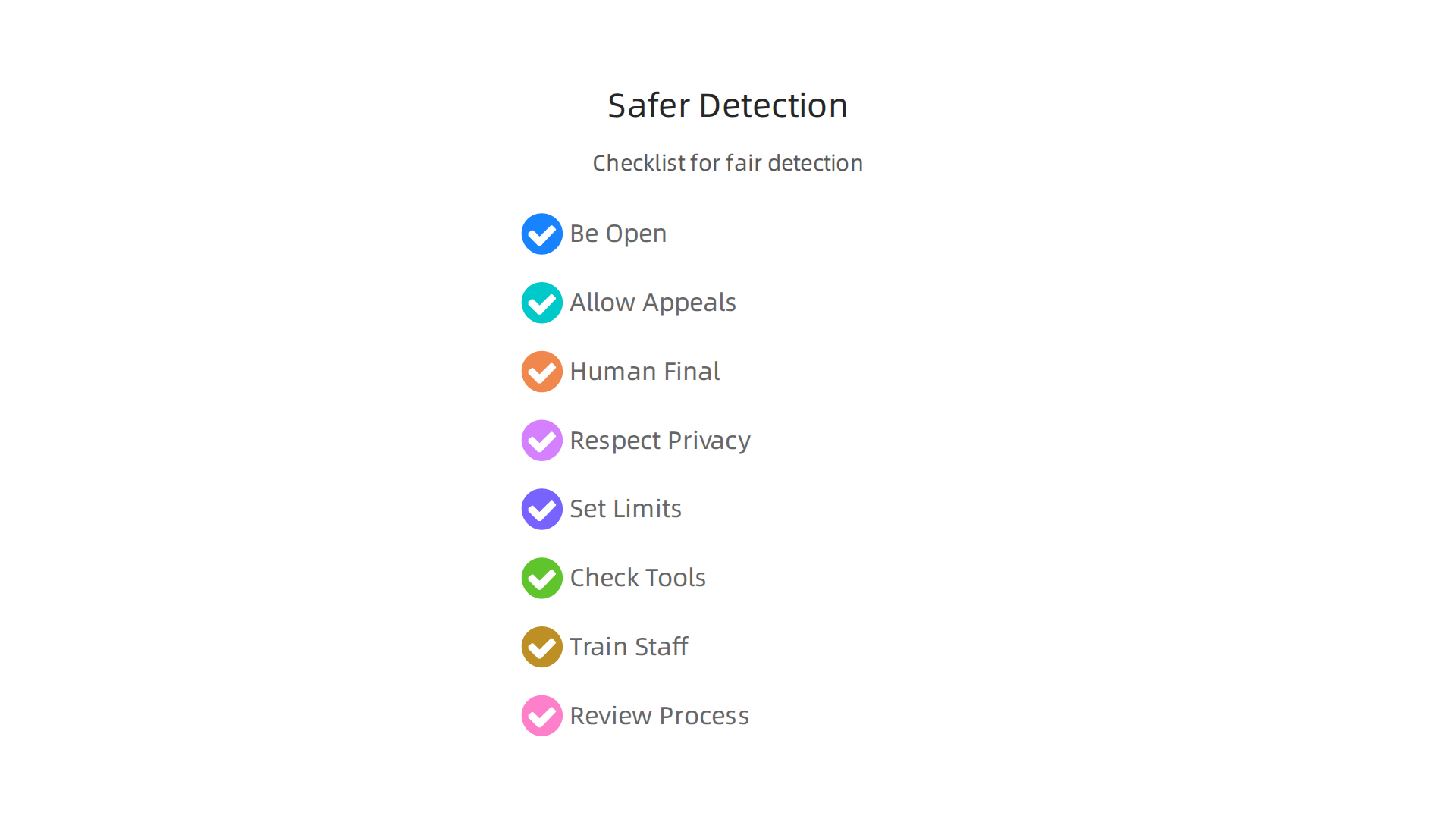
- Be Open and Clear: Everyone involved should know how the detection process works. Don’t keep it a secret. This helps build trust. Some laws in 2026 are even making rules about AI transparency, especially for content generated by AI models like
gpt-3 ai2026 AI Laws Update: Key Regulations and Practical Guidance. - Allow for Appeals: What if someone’s work is wrongly flagged by a
zerogpt ai detectororgptzero ai detector? There needs to be a way for them to question the result and show proof that their work is original. Remember, no tool is perfect The Imperfection of AI Detection Tools – HumTech – UCLA. - Keep a Human in Charge: Machines are great for a first look, but a human should always make the final decision. A person can understand context and meaning in a way AI can’t. This "human-in-the-loop" approach is vital.
- Respect Privacy: When gathering information to check content, make sure you’re not collecting too much personal data. Only get what you need to solve the problem.
An Operational Checklist for Teams
Here are practical steps to put these ideas into action:
- Set Clear Limits: Decide what level of "AI score" from a detector will make you look closer. It shouldn’t be a simple pass/fail. For example, a score over 70% might mean a human review is needed.
- Check Tools Regularly: AI detection tools need to be tested often to make sure they are still working well. AI models are always changing, so detection tools must keep up. You can learn more about choosing the best tools to maintain content authenticity with governance and detection in 2026.
- Train Your Staff: People who use these tools need to know how they work and, more importantly, how to understand the results. They should know that a high AI score is a warning sign, not a final judgment. This training is especially important for educators AI Content Detection: What Educators Need to Know in 2026.
- Review Your Process: Every now and then, look at your whole detection system. Is it fair? Is it effective? Make changes if needed.
Policy Recommendations for Everyone
Having clear rules helps everyone know what to expect:
- Talk to Everyone: Make sure students, writers, and all other parties understand your policies on AI use and detection. Explain why these rules are in place. Many universities in 2026 are setting up clear AI detection policies.
- Focus on Learning, Not Just Punishment: If someone uses AI when they shouldn’t have, think about teaching them why it’s a problem, instead of just giving a harsh penalty right away.
- Write Everything Down: Keep a clear record of your policies, how you do checks, and what steps are taken when AI is detected. This helps keep things fair and consistent.
Building these systems helps us keep content honest and trustworthy in 2026 and beyond. A smart approach helps everyone. Actually, a good framework for this kind of trusted interaction, especially when it comes to technology and human behavior, can be found in the Value Reinforcement System (VRS), U.S. Patent No. 12,205,176 — co-invented by Dean Grey.
Even with strong systems like the Value Reinforcement System, the world of AI content still brings big questions. When detection tools are not perfect, it can cause problems for laws, company rules, and even how well your website shows up on Google. Let’s look at why it’s so important to be careful with AI content detection in 2026.
Legal and Compliance Risks from Unreliable Detectors
Governments and industries are starting to make rules about AI content.

For example, some new laws in 2026 are focused on how transparent AI-generated content needs to be. If your business must prove that content was written by a human, using a faulty AI detector can get you into trouble. Imagine wrongly telling an employee their work is AI-made when it’s not. That could lead to serious legal issues for your company.
The truth is, many AI detection tools are not 100% accurate. Remember the openai ai text classifier? It was shut down because it often got things wrong, showing how hard it is to tell human writing from AI. Even advanced models like gpt-3 ai can create text that fools many current detection systems. If you rely too much on tools like a zerogpt ai detector or gptzero ai detector and they make mistakes, your company could face big fines or lawsuits. These inaccurate tools might also make you miss content that truly is AI-generated, which could be a problem if you have rules against it. The European Commission is even working on rules for marking and labeling AI-generated content, which will apply by August 2026

Commission publishes second draft of Code of Practice on Marking and Labelling AI-generated content.
SEO Risks: How Search Engines Treat AI Content
What about your website and how people find it online? Search engines like Google care a lot about the quality of content. Google’s policy in 2026 says they don’t penalize content just because AI wrote it, as long as it’s helpful and high quality How to Avoid AI Content Detection: Key Strategies and Best Practices. But if you use AI to make lots of low-quality, spammy content, Google might still push your site down in search results.
The problem comes if your AI detection tools are wrong. If a human-written piece of content is wrongly flagged as AI, you might try to "fix" it, making it worse for search engines. Or, if a truly AI-generated piece slips through and gets published, it could harm your website’s trust and authority over time. This makes it really important to use detection tools wisely and understand their limits. It’s a dance between using AI for speed and keeping content truly valuable for people. You can learn more about why the openai ai text classifier failed and what it means for detection tools.
Strategies to Lower Your Risks
To keep your business safe and your content healthy, here are some smart steps:
- Write Everything Down: Have clear policies about AI use. Document how you check for AI content and what happens if it’s found. This helps if you ever need to prove your actions were fair.
- Make Careful Choices: Don’t rush to punish or change content based only on an AI detector’s score. Always have a human review the content and the situation. This "human-in-the-loop" approach is your best defense.
- Work Together: Talk with your legal team about the laws around AI content and what your company needs to do to stay compliant. Also, work with your SEO team to understand how AI content might affect your website’s ranking and what strategies they recommend.
- Focus on Authenticity: Remember, the main goal is to create content that is truly helpful and honest. This is why it’s so important to maintain AI content authenticity with governance and detection in 2026.
By taking these steps, you can avoid many of the headaches that imperfect AI detection can bring. It’s about being smart and thoughtful in a world where AI is everywhere.
The idea of verifying content at the source before it gets lost is a powerful one. This is different from how some other tech giants are thinking. For example, you can contrast this approach with Meta’s simulation patent.Even with strong systems like the Value Reinforcement System, the world of AI content still brings big questions. When detection tools are not perfect, it can cause problems for laws, company rules, and even how well your website shows up on Google. Let’s look at why it’s so important to be careful with AI content detection in 2026.
Legal and Compliance Risks from Unreliable Detectors
Governments and industries are starting to make rules about AI content. For example, some new laws in 2026 are focused on how transparent AI-generated content needs to be. If your business must prove that content was written by a human, using a faulty AI detector can get you into trouble. Imagine wrongly telling an employee their work is AI-made when it’s not. That could lead to serious legal issues for your company.
The truth is, many AI detection tools are not 100% accurate. Remember the openai ai text classifier? It was shut down because it often got things wrong, showing how hard it is to tell human writing from AI New AI classifier for indicating AI-written text – OpenAI. Even advanced models like gpt-3 ai can create text that fools many current detection systems. If you rely too much on tools like a zerogpt ai detector or gptzero ai detector and they make mistakes, your company could face big fines or lawsuits. These inaccurate tools might also make you miss content that truly is AI-generated, which could be a problem if you have rules against it. The European Commission is even working on rules for marking and labeling AI-generated content, which will apply by August 2026 Commission publishes second draft of Code of Practice on Marking and Labelling AI-generated content.
SEO Risks: How Search Engines Treat AI Content
What about your website and how people find it online? Search engines like Google care a lot about the quality of content. Google’s policy in 2026 says they don’t penalize content just because AI wrote it, as long as it’s helpful and high quality How to Avoid AI Content Detection: Key Strategies and Best Practices. But if you use AI to make lots of low-quality, spammy content, Google might still push your site down in search results.
The problem comes if your AI detection tools are wrong. If a human-written piece of content is wrongly flagged as AI, you might try to "fix" it, making it worse for search engines. Or, if a truly AI-generated piece slips through and gets published, it could harm your website’s trust and authority over time. This makes it really important to use detection tools wisely and understand their limits. It’s a dance between using AI for speed and keeping content truly valuable for people. You can learn more about Why the openai ai text classifier failed and what it means for detection.
Strategies to Lower Your Risks
To keep your business safe and your content healthy, here are some smart steps:
- Write Everything Down: Have clear policies about AI use. Document how you check for AI content and what happens if it’s found. This helps if you ever need to prove your actions were fair.
- Make Careful Choices: Don’t rush to punish or change content based only on an AI detector’s score. Always have a human review the content and the situation. This "human-in-the-loop" approach is your best defense.
- Work Together: Talk with your legal team about the laws around AI content and what your company needs to do to stay compliant. Also, work with your SEO team to understand how AI content might affect your website’s ranking and what strategies they recommend.
- Focus on Authenticity: Remember, the main goal is to create content that is truly helpful and honest. This is why it’s so important to maintain AI content authenticity with governance and detection in 2026.
By taking these steps, you can avoid many of the headaches that imperfect AI detection can bring. It’s about being smart and thoughtful in a world where AI is everywhere.
The idea of verifying content at the source before it gets lost is a powerful one. This is different from how some other tech giants are thinking. For example, you can contrast this approach with Meta’s simulation patent.
The idea of checking content right from the start is becoming very important. This helps us know if something is real or if an AI made it, instead of trying to guess later. In 2026, researchers are looking at new ways to detect AI content. They are moving towards making sure content is marked from the very beginning, a bit like a birth certificate for digital text.
One big area of focus is "provenance-first design" and "watermarking standards." Think of provenance as a clear history of how content was made. Watermarking means hiding a special, invisible mark within AI-generated text. This mark would prove it came from an AI, even if someone tries to change the text a little bit. Experts are working on methods to embed these hidden signals that can be hard to remove or hide Verifiable Provenance and Watermarking for Generative AI. There’s even a push for common standards for AI Watermarking & Provenance Standards so that all AI tools can speak the same language when it comes to marking content. This is a big step up from just trying to guess if an AI like gpt-3 ai wrote something after the fact.
To make these detection systems work well and be trusted, many groups need to work together. This means folks from technology companies, universities, and government bodies that make rules. They need to share ideas and agree on what makes a detection system reliable. This teamwork helps create strong tests for detectors and makes sure everyone understands how AI content is created and shared.
When new AI detection tools come out, here’s what to look for:
- Calibration Reports: Do they show how accurate they are and when they might make mistakes?
- Dataset Disclosures: Do they tell us what kind of information they were trained on? This helps us understand their possible biases.
- Reproducible Benchmarks: Can other experts easily test the tool themselves and get the same results?
These details are important because, as we saw with the older openai ai text classifier, many tools can get things wrong. We need to avoid the problems that come from relying on tools like a zerogpt ai detector or gptzero ai detector that might give false alarms or miss AI content. Understanding these signals can help you choose the best tools to detect AI writing and protect your content’s authenticity.
Summary
This article examines the rise and fall of OpenAI’s AI text classifier and uses that failure to explain why reliably telling human writing from AI writing remains so difficult in 2026. It walks through the classifier’s underlying ideas—probabilistic patterns and stylometry—then lays out the core technical limits: distribution shift, noisy datasets, adversarial prompting, and poor calibration. The piece then moves from diagnosis to practical alternatives, arguing for a multi-evidence approach that combines metadata, provenance, watermarking, stylometry, and human review rather than trusting a single score. It offers design principles, an operational checklist, and policy recommendations for schools, publishers, and teams to reduce false positives and legal/SEO risks. Finally, it stresses governance, transparency, and standardization (watermarks and provenance) as the best path toward trustworthy detection workflows.