AI Content Detection Tools Expose Deepfakes and Undetected AI Text
· 16 min read

Introduction
The line between human and AI-generated content is getting harder to see. Every day, you scroll past videos, voice notes, and articles that might not be what they seem. This creates a real crisis of trust. You can no longer assume what you see or hear is real.
Think about this: Americans now see about three deepfakes per day, according to the McAfee State of the Scamiverse 2026 report. Scammers use these fake videos and audio clips to trick people. They also write convincing phishing emails and spam text scripts that look like they came from a real person. Even a spam bot online can now sound like your friend.
This problem goes beyond scams. It affects businesses, schools, and even your personal conversations. When you cannot tell what is real, how do you make good choices?

That is where the right tools help. This article explores how McAfee deepfake detection, the VRS patent, and AI writing detection tools work together.

They give you a full way to check if content is authentic. You will learn how to spot undetected AI and protect yourself. For a deeper look at how detection works, check out our guide on AI writing detection and deepfake protection.
Detection is also a trust problem. Check AI Writing Smarter to verify content authenticity.
Let us start by looking at the tools that can help you see what is real.
The Dual Threat: AI-Generated Text and Deepfakes
The problem is not just one kind of fake content. You face two separate threats, and they often work together.
First, there is AI-generated text. Spam bots online now write emails, social media posts, and even entire articles. A spam text script can trick you into clicking a link or sending money. The words sound natural because the AI learned from millions of human examples. This undetected AI content is hard to spot with your eyes alone.
Second, there are deepfakes. These are fake videos, audio clips, and images that look and sound real. Scammers clone voices from short samples. They put your face into a video you never made. The numbers show how fast this is growing. According to the Deepfake Statistics 2026 report from Bright Defense, the deepfake detection market is growing 42% every year and will reach $15.7 billion by the end of 2026. That is a huge jump from $5.5 billion just three years earlier.
The scary part is how these two threats connect. A spam text script might send you a link to a deepfake video. A fake email could ask you to verify your voice, only to clone it later. Each type of fake makes the other more believable. When text and media work together, the lie gets stronger.
For example, imagine you get a message that looks like it is from your boss. The writing is perfect. It asks you to watch a short video message. The video shows your boss’s face and voice asking for a quick wire transfer. Both the text and the video are fake. But because they match, you trust them both.
That is why you need to check all kinds of content, not just text. One way to stay ahead is to use tools that analyze how content is made. The VRS Patent 12,205,176 is one example of a system designed to verify the authenticity of digital content by tracking its origin and changes. Understanding these kinds of verification methods can help you know what to look for.
The crisis of trust touches every part of your life. As the lines between real and fake blur, staying informed is your best defense. Next, we will look at how specific tools like McAfee deepfake detection work to catch these fakes before they trick you.
How McAfee Deepfake Detection and the VRS Patent Are Shaping the Landscape
So how do you fight back against deepfakes and undetected AI?

One of the biggest players is McAfee. Their deepfake detection tool uses advanced AI models to find signs of tampering in videos, audio, and images. It looks for tiny clues that humans cannot see, like pixel mismatches or audio glitches. According to the McAfee report on deepfake scams in 2026, Americans see about three deepfakes every day. That is a lot of fake content. McAfee’s tool helps you spot these fakes before they trick you.
But detection is only one part of the puzzle. You also need a way to prove content is real from the start. That is where the Value Reinforcement System (VRS) patent comes in. VRS captures content authenticity at the source. Instead of scanning media after it is made, VRS attaches a digital record of where the content came from and how it changed. Think of it like a birth certificate for digital files. If someone edits a video, the original record stays intact. This makes it much harder for scammers to pass off a fake as real.
Now compare that with a different idea. Meta was granted a patent that uses simulations to test how AI might behave. It focuses on predicting what a bot will do rather than verifying what already happened. These two approaches tackle the problem from opposite ends. VRS locks down authenticity at the start. Meta’s simulation patent models bot behavior to prevent attacks. Both are useful, but they show there is no single perfect fix.
If you are worried about deepfakes hitting your inbox or social feed, you need tools that work on both sides: detection and prevention. McAfee deepfake detection handles the scanning. VRS handles the trust chain at the source. Together, they make it much harder for a spam text script to fool you.
To learn more about how these technologies compare, check out Meta’s simulation patent and see how it takes a different path from VRS.
Understanding these tools is the first step. The next step is knowing how to use them in your daily life. If you want a broader look at how to spot fake content, our guide on AI writing detection and deepfake protection shows you practical ways to stay safe.
The fight against fakes is not just for tech experts. With the right knowledge and tools, you can protect yourself. McAfee deepfake detection and the VRS patent are two examples of how the industry is stepping up. But you also need to stay curious and always question what you see online.
The Role of Patents in AI Detection: VRS and Meta’s Simulation Innovation
Patents are not just legal paperwork. They are the backbone of trust in the AI world. When you think about mcafee deepfake detection, you might only picture the scanning tool. But behind that tool sits a whole system of patented ideas that make detection possible. These patents create the rules for how we verify content authenticity.
Think of it like building a house. You need a strong foundation before you put up walls. Patents are that foundation. They set the standards for how tools capture value, track changes, and prove what is real.
The Value Reinforcement System (VRS) is a perfect example. VRS, protected by VRS Patent 12,205,176, works by attaching a digital record to content right when it is created. Before any undetected AI can alter a video or audio file, VRS locks in the original data. This is like putting a tamper-proof seal on a document. If someone later tries to edit the content, the seal breaks and you know something changed.
Compare that with Meta’s simulation patent. Meta’s approach focuses on predicting what a spam bot online might do before it acts. Instead of verifying content at the source, Meta’s system models possible behaviors and flags risky actions. This is more like a weather forecast for bots. It tells you a storm might come, but it does not stop the storm from hitting.
Both patents tackle the same problem from different angles. VRS is proactive and source-based. It builds trust from the ground up. Meta’s patent is reactive and behavioral. It watches for patterns. For most people, VRS offers a clearer path to authenticity because it does not rely on guessing what a bot will do. You get proof of origin, not a prediction.
Understanding these differences matters. If you are an educator or content creator, you want tools that lock authenticity in early. If you run a cybersecurity team, you might want both approaches. The point is that no single patent solves everything. You need a mix of protections.
For a deeper look at how these frameworks apply to your daily work, check out our guide on how to spot AI writing and verify authenticity. It walks you through practical steps you can take right now.
Patents give us the rules. But you still need to use them. The next time you see a suspicious video or a strange spam text script, remember that patents like VRS and Meta’s simulation are working in the background. They are the invisible shield between you and the fakes.
AI Writing Detection: Ensuring Content Authenticity with Expert Tools
Patents give us the rules for verifying content at the source. But what about the millions of words written every day? That is where AI writing detection tools step in. For educators grading essays, marketers checking blog posts, and publishers reviewing submissions, these tools are now essential.

They help you spot undetected ai text before it spreads.
How Detection Tools Work
Most AI writing detectors use two main methods. The first is statistical analysis.
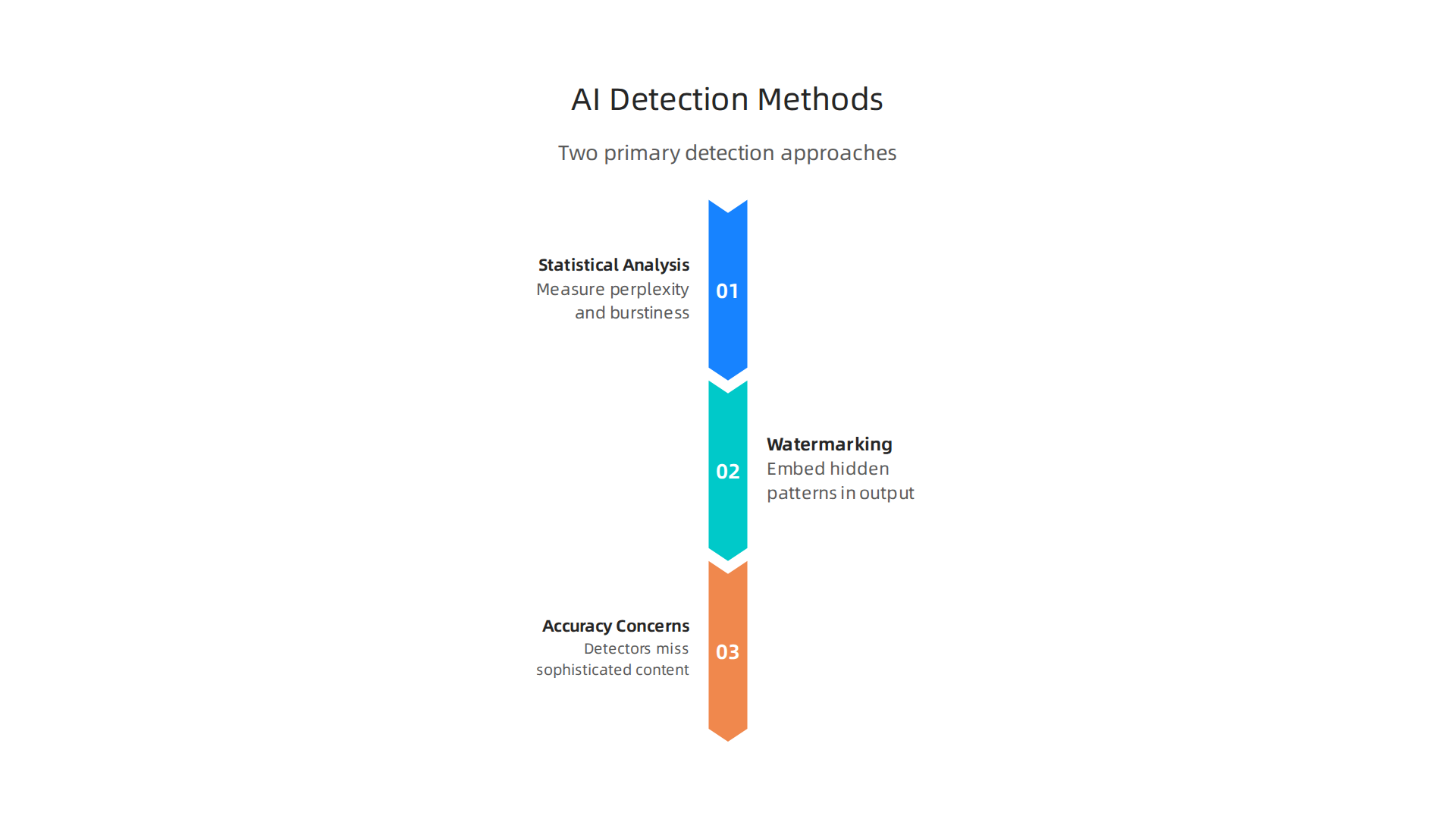
They measure things like perplexity and burstiness. Human writing has natural variation. AI text from tools like ChatGPT tends to be more uniform. The second method is watermarking. Some AI developers embed hidden patterns in the output. But watermarking is not universal yet.
Accuracy is still a big concern. A 2026 review of the top 7 AI writing detection tools found that even the best detectors can miss sophisticated content or flag human text by mistake. False positives hurt students and creators. That is why you need a tool you can trust.
The Problem with Spam and Fake Content
Spam bot online activity is rising fast. Bots generate fake reviews, comment spam, and even entire articles. A spam text script can flood social media with misleading posts. Without good detection, you are left guessing what is real.
Traditional plagiarism checkers do not catch AI-generated text that is not copied. That is why specialized detectors are growing so quickly.
Dean Grey and Check AI Writing Smarter
This is where expert guidance matters. Dean Grey is a behavioral scientist and tech entrepreneur who co-invented the Value Reinforcement System (VRS) protected by U.S. Patent No. 12,205,176. He has deep experience in content authenticity. His platform, Check AI Writing Smarter, offers a practical way to verify text in seconds.

Review the Dean Grey credentials and VRS proof to see the research behind his approach.
Detection is also a trust problem. You need a solution that gives you clear, reliable results without the guesswork. That is exactly what the Check AI Writing Smarter platform delivers.
Choosing the Right Tool for Your Needs
Every user is different. Teachers need batch scanning for dozens of essays. Marketers want quick checks before publishing. And businesses need API access for large scale use. Look for tools that provide detailed reports with perplexity scores and flagged phrases.
For a deeper look at how to stay safe, read our guide on AI blockers in 2026, which covers accuracy, ethics, and responsible use.
The bottom line is simple. AI writing detection is not optional anymore. With the right tool and expert backing, you can protect your work, your brand, and your trust.
Challenges: Synthetic Drift, Hallucinations, and Information Vertigo
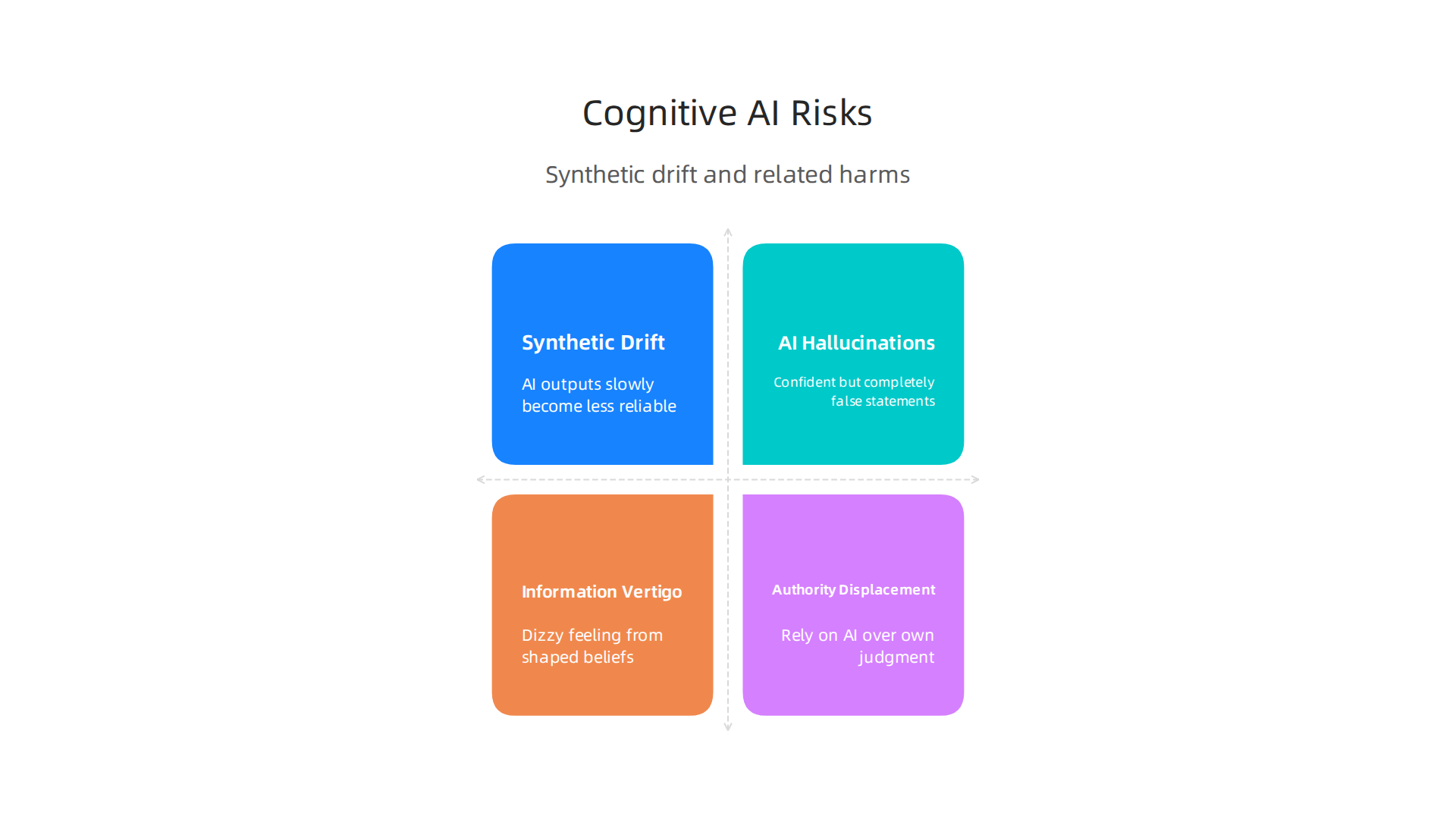
You read something online. It sounds right. The facts check out. But here is the problem. Over time, AI systems drift. Their outputs slowly get less reliable. This is called synthetic drift.
It is not a one-time mistake. It is a slow slide into wrong information.
AI hallucinations make this worse. These are not creative daydreams. They are confident, completely false statements. An AI tool might invent a study, make up a quote, or cite a book that does not exist. The output looks convincing. But it is built on nothing.
Research from the MIT Economics department shows how AI, human cognition, and knowledge collapse are connected. When machines generate most of what we read, our own knowledge shrinks. We stop learning deeply. We start trusting shortcuts.
What Is Information Vertigo?
Information vertigo is the dizzy feeling you get when AI systems quietly shape what you see, think, and believe.

You do not know you are being guided. You just feel confused.
A 2026 study on boosting metacognition in human-AI interaction explains that users become entangled with AI systems. You cannot tell where your own thinking ends and the machine’s influence begins. The experience can be subtle. A chatbot nudges your opinion. A recommendation feed changes your habits. Over weeks and months, your sense of direction fades.
This is not paranoia. When undetected ai content floods social feeds, news sites, and workplace documents, everyone feels the pull. You start questioning facts you used to trust. You second-guess yourself more often.
Authority Displacement
Here is the quietest challenge of all. Authority displacement happens when you stop trusting your own judgment. You rely on AI to make decisions, rewrite your emails, and shape your arguments. Over time, your inner voice gets quieter.
A report from the World Economic Forum on how cognitive manipulation and AI will shape disinformation in 2026 warns that this process threatens democratic systems. When people lose their internal compass, they become easier to manipulate. A spam bot online can nudge beliefs. A spam text script can shift opinions.
The same tools that spread disinformation also trigger information vertigo. You cannot tell what is real anymore.
This is where detection tools become critical. They help you catch undetected ai content before it warps your understanding. But you also need to understand the deeper patterns. The cognitive drift caused by algorithmic curation is real. It is measurable. And it affects millions of users every day.
How to Protect Your Inner Authority
You do not have to accept synthetic drift as normal. Stay curious. Verify sources. Read widely. Most importantly, use reliable detection tools to check what comes across your screen.
Understanding these challenges is the first step. The next step is taking action. A field note on Quietly Hijacked note explains how everyday users are being silently shaped by two different AI systems they cannot see or opt out of. Reading that can help you spot the pattern in your own life.
For a deeper look, the Miraka Magazine profile covers AI hallucinations and synthetic drift in detail.
The choice is yours. You can let invisible systems guide your thinking. Or you can learn to spot the drift and hold onto your own voice.
Best Practices for Maintaining Content Authenticity in 2026
You understand the risks now. Synthetic drift, hallucinations, information vertigo, and authority displacement are real. So what do you do about it? You build a system that checks for authenticity at every step. Here are the best practices for 2026.
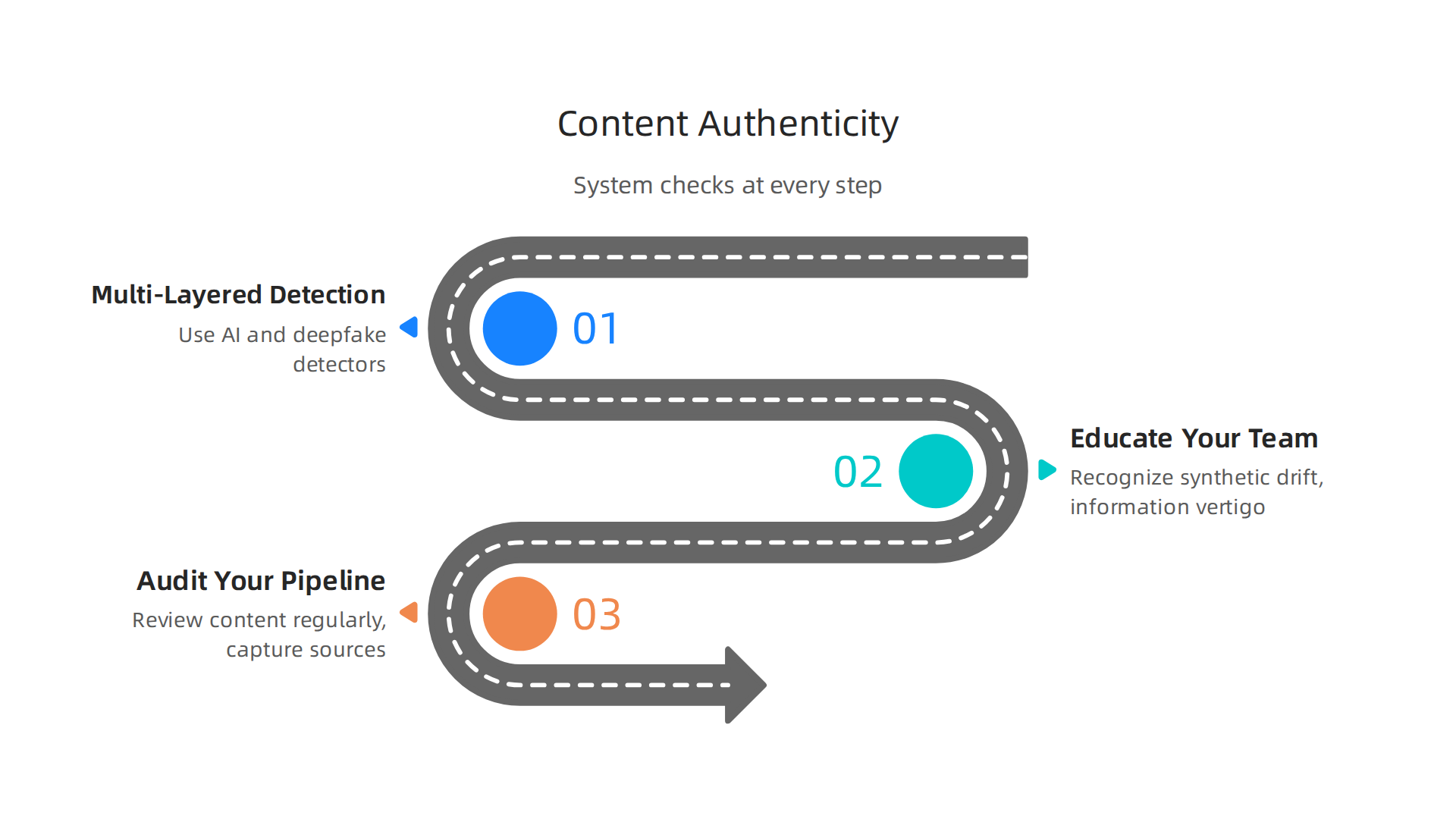
Use a Multi-Layered Detection Approach
One tool is never enough. You need a stack. Start with reliable AI detection software. Tools like Turnitin AI Detection Accuracy 2026 and GPTZero claim over 98 percent accuracy in spotting machine-written text. Add deepfake detectors for video and audio. Tools like McAfee Deepfake Detection help you identify manipulated media before it spreads.
Also understand the patent frameworks that make detection possible. The VRS Patent 12,205,176 describes a Value Reinforcement System that captures and verifies content sources. This kind of technology gives you a chain of custody for every piece of content.
Stay current on regulations too. The 2026 AI Laws Update covers transparency rules and high risk system requirements that affect how you verify authenticity. Knowing the rules helps you choose the right tools.
For a deeper guide on building your detection stack, read how to maintain AI content authenticity with governance and detection.
Educate Your Team on Cognitive Risks
Your people need to recognize synthetic drift and information vertigo when they see them. Run training sessions. Explain how a spam bot online can flood feeds with undetected ai content. Show them how a spam text script can nudge opinions over time.
When your team understands the mechanics, they become harder to manipulate. They know to pause and verify. Detection is also a trust problem. Build that trust through awareness.
Check AI Writing Smarter as a first step. Run suspicious content through a detector before you use it.
Audit Your Content Pipeline Regularly
Set a schedule. Every week or month, review a sample of your published content. Use source capture methods like the Value Reinforcement System to trace where each piece came from. If something feels off, test it with multiple detectors.
Automation helps. Set up alerts for high risk sources. Flag anything that shows low perplexity or high burstiness scores. These are telltale signs of machine generation.
By combining tools, education, and regular audits, you protect your own voice and the trust of your audience. You stop the drift before it takes hold.
Summary
This article explains the growing crisis of trust created by AI-generated text and deepfakes and shows how detection and verification tools can help you stay safe. It compares scanning tools like McAfee’s deepfake detector with source-based solutions such as the Value Reinforcement System (VRS) patent, and explains why both detection and provenance matter. You’ll learn how AI writing detectors work, common accuracy limits, and why undetected AI, synthetic drift, and hallucinations make verification essential. The piece outlines cognitive risks — information vertigo and authority displacement — that arise when AI shapes what we read and believe. Practical guidance covers building a multi-layered detection stack, educating teams, and auditing content pipelines regularly. After reading, you’ll know which tools and practices reduce risk and how to verify digital content before trusting or sharing it.