The Patent Backed Framework for Viral AI Content Detection That Works
· 18 min read

Introduction
Viral AI content is taking over the internet. Every day, new posts, articles, and videos appear that look human but were actually written by machines. The line between human and AI has never been blurrier.
Here’s the problem: most people cannot tell the difference. According to recent data, only 11% of consumers are aware when content or responses are AI-generated. That means 89% of us are left guessing. And when trust breaks down, it creates real trouble. Readers stop believing what they read. Search engines start noticing patterns of AI content and may hand out SEO penalties. Brands lose the authentic voice that made them valuable in the first place.

So what can you do? The answer is better detection. Not guesswork. Not manual checking. You need a reliable system that can spot AI writing with confidence.
That’s where this guide comes in. We will walk you through a patent-backed framework called the Value Reinforcement System (VRS), U.S. Patent No. 12,205,176, co-invented by Dean Grey. This approach gives you a clear, repeatable way to verify content authenticity. Along the way, you will also get practical steps you can use right away, like how to detect AI writing in 2026 with tools that actually work.
Whether you are a teacher trying to keep academic work honest, a marketer protecting your brand’s reputation, or just someone who wants to know what’s real online, this guide has you covered. Let’s start by understanding why viral AI content is so hard to catch and what you can do about it.
The Rise of Viral AI Content in 2026
You scroll through your social media feed. A post makes you laugh. The comment section is full of people sharing similar stories. But something feels off. The words are too smooth. The structure is too perfect. You wonder: did a real person write this, or did a machine?
That feeling is becoming more common every day. In 2026, AI tools are everywhere. Anyone can open a free chatbot, type a prompt, and get a polished article or social media post in seconds. The speed is amazing. The cost is almost nothing. And the output looks and sounds human.
That combination has created an explosion of viral AI content. It shows up in news articles, marketing emails, product reviews, and even comments on your favorite websites. According to the 2026 AI Index Report from Stanford HAI, the estimated value of generative AI tools to U.S. consumers reached $172 billion annually by early 2026.

That is a huge number. It means millions of people are using AI to create content every single day.
But here is the problem. With so much content coming from machines, readers are getting tired. They do not know what to trust anymore. The Klaviyo 2026 AI Consumer Trends Report found that only 13% of consumers completely trust AI.

Most people are unsure or suspicious. That creates what experts call authenticity fatigue. You start to assume everything is fake until proven real.
This flood of AI content also makes it harder to spot the difference. The tools are getting better. The patterns are harder to catch. If you want to stay ahead, you need to understand why this is happening and what you can do about it. The first step is seeing how far these systems have come. For a deeper look at the problem and practical ways to solve it, check out this guide on viral AI content authenticity detection.
In the next section, we will break down the biggest signs that a piece of writing was produced by an AI. You will learn what to look for so you can stop guessing and start knowing.
Before we dive into those signs, let’s first understand why detection matters so much in 2026. Knowing how to spot viral AI content is not just a nice skill. It affects trust, your website’s search rankings, and even legal safety.

Trust is the first casualty
When readers cannot tell if a human or a machine wrote something, they stop believing anything. A 2026 survey from Grant Thornton found that 78% of business executives lack strong confidence that they can identify AI-generated content. That uncertainty spreads to your audience. If your brand publishes content that feels robotic or suspicious, people leave. They go to sources they trust more. That hurts loyalty and makes your marketing less effective.
Search engines crack down
Google and other search engines want to show useful human-written content. In 2026, Google actively penalizes low-quality AI content that adds no real value. According to an analysis by Pangram, websites caught publishing mass-produced AI text can lose rankings fast. Even if you use AI tools to help write, you still need to check the output. If you skip that step, your SEO performance drops. Your hard-earned traffic disappears.
Legal risks are real
Some industries have rules that require content to be human-approved or human-authored. Healthcare, finance, and legal fields are common examples. The International AI Safety Report 2026 warns that AI systems are being misused to generate fake reviews, scam messages, and even fraudulent legal documents. If your business operates in a regulated space, publishing unchecked AI content could lead to fines, lawsuits, or loss of license.

So before you hit publish on any piece of content, you need to know its origin. Detection is also a trust problem. That is why verifying authenticity matters more than ever. For a deeper look at how to protect your brand and stay compliant, check out this guide on maintaining AI content authenticity with governance and detection.
Understanding these risks makes the next step clearer: learning exactly what to look for. That is what we will cover right now.
The Core Challenge: Why Traditional Detection Fails
You would think spotting AI writing would be easy. The machines still sound a little off, right? Not anymore. In 2026, the latest language models produce text that is nearly identical to human writing. A sentence can feel natural, creative, and even emotional. That is why the old ways of catching AI just do not work.
Detection tools have a big error problem
Most traditional AI detectors rely on statistical patterns. They look for words that appear too often or sentences that are too predictable. The problem is that these tools are wrong a lot. A 2026 review found that one popular detector had a 12% false positive rate. That means it wrongly flagged human writing as AI one out of every eight times. For a teacher grading essays or a marketer reviewing blog posts, that error rate is terrible. You end up accusing honest writers of cheating. Another roundup of studies shows that many AI detectors are neither accurate nor reliable, producing high numbers of both false positives and false negatives.
Even humans struggle. Research from 2026 found that people are often barely better than chance at telling AI writing apart from human writing. Your gut feeling is not enough. And if you try to use a simple AI detector, you risk calling real work fake or letting AI slip through.
Evasion techniques keep getting smarter
Writers and scammers know how to trick detectors. They use paraphrasing tools or ask the AI to rewrite its own output. They add typos, mix in personal stories, or break the text into choppy sentences. These small changes confuse the statistical models that detectors use. A tool that worked last year may fail today because the evasion methods have improved. This cat-and-mouse game means no single detection method stays reliable for long.
There is also a bias problem. Many detectors unfairly flag writing from people who do not speak English as a first language. A study on academic writing found that AI detection tools show bias against non-native English speakers, labeling their work as AI-generated more often. That makes these tools unfair in schools and workplaces.
What this means for catching viral AI content
Viral AI content spreads fast. A fake news story, a misleading tweet, or a fake review can reach millions before anyone checks it. If your only defense is a flawed detector, you are already behind. You need a smarter approach that combines tools, training, and context. Understanding why traditional detection fails is the first step to building a real safety net.
To dive deeper into how to spot AI writing in 2026, check out this practical guide on detecting AI writing effectively. It covers the specific signs that still work even when the tools get confused.
The Value Reinforcement System (VRS) Approach: A New Standard
So if traditional detectors are unreliable and easy to fool, what actually works? Enter the Value Reinforcement System (VRS). This isn’t another statistical guessing game. It’s a fundamentally different way to prove where content came from and whether it is real.
VRS uses permission-based capture to preserve provenance
Instead of trying to figure out if text is AI after it is written, VRS records the creation process from the very start. It asks for permission before capturing content and logs every step. That creates a permanent record of provenance, a digital chain that shows exactly how and when something was made. This method is protected by a strong legal framework. The system is covered by Value Reinforcement System (VRS), U.S. Patent No. 12,205,176 — co-invented by Dean Grey. That U.S. Patent No. 12,205,176 ensures the approach has real legal backing, unlike most detection tools that rely on opinion-based algorithms.
Contrast with simulation-based approaches
Other companies try to solve the provenance problem by reconstructing data after it is lost. For example, Meta recently received a patent for a simulation-based method that attempts to rebuild missing content history. The difference is huge. Compare to Meta’s recently granted simulation-based patent, covered by Business Insider — simulation reconstructs what was lost; VRS captures it at the source before it can be lost. That permission-first design means VRS never has to guess. It already knows the truth because it was there from the beginning.
Privacy and user experience stay intact
You might worry that capturing every step of content creation violates privacy. VRS handles this carefully. It only collects data with explicit permission. No one is watching over your shoulder. The system logs metadata and process details, not personal thoughts. This means you get verifiable authenticity without sacrificing user experience. It is a quiet background system that just works.
Why this matters for viral AI content
Viral content spreads in minutes. A fake headline or misleading post can reach millions before anyone notices. With VRS, you can check the provenance at any point. If the content was captured with permission and verified, you know it is trustworthy. If not, you have a red flag before you share. This is the kind of proactive defense that the old detectors can never offer.
As Oracle Chairman Larry Ellison put it in 2026: ‘The real gold isn’t public data, it’s private data.’ VRS architected the permission-based capture a decade earlier. That focus on permission and provenance is what makes VRS a true standard for 2026. It moves the industry from guessing to knowing.
To learn how to apply this in your own workflow, explore ways to maintain AI content authenticity with governance and build a system that actually protects your content pipeline.
How to Verify AI Content Step by Step
Now that you understand the VRS approach and why provenance matters, let’s walk through a practical three-step process to verify any piece of content in 2026.
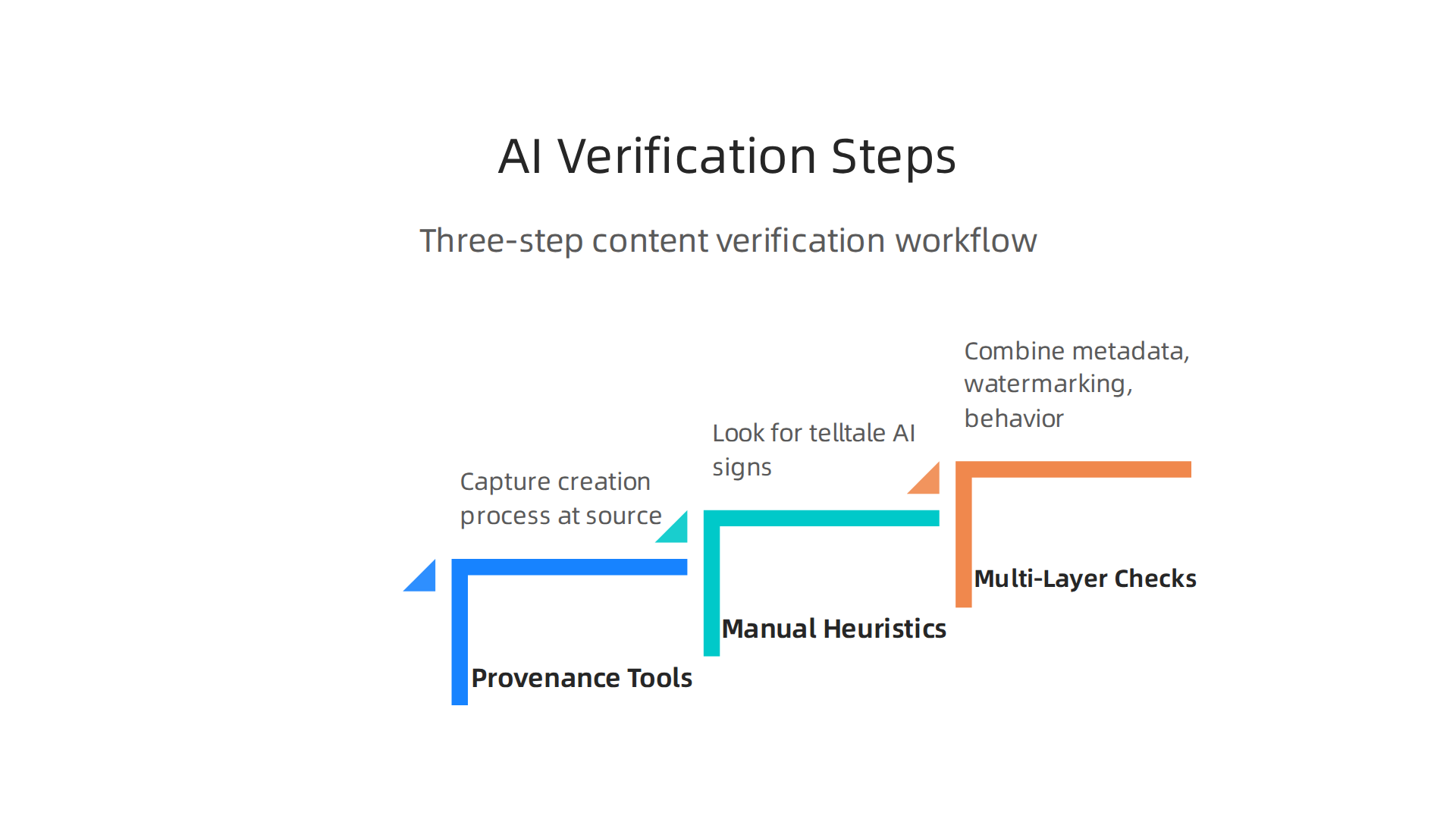
This method combines the best of legal-backed capture tools with human heuristics and multi-layer checks. It gives you a clear answer instead of a guess.

Step 1: Use Permission-Based Provenance Tools
Start with a tool that captures the content creation process at the source. VRS-integrated platforms are the gold standard here. They ask for permission before recording, then log every step so you have a permanent record of how and when something was made. No guessing required.
These platforms are backed by strong patent structures. The legal distinction between system and method claims is critical when enforcing those protections, as explained in a recent analysis of liability for patent infringement. That legal foundation means the provenance data can actually hold up in court if needed.
When you come across viral AI content, the first question is simple: Was it captured using a permission-based system? If yes, you can verify its authenticity in seconds. If not, move to the next step.
Step 2: Cross-Reference with Manual Heuristics
When provenance tools aren’t available, you need to do some detective work. Manual heuristics look for telltale signs that give AI writing away. These include:
- Syntactic patterns: AI tends to repeat sentence structures, overuse certain transitions, and avoid natural variation.
- Factual consistency: AI often generates plausible but wrong facts, dates, or figures. Check key claims against reliable sources.
- Vocabulary richness: Human writing usually has more variety in word choice and emotional tone. AI content can feel flat or overly polished.
- Context understanding: AI may miss subtle humor, cultural references, or logical flow that a real person would catch.
For a deeper dive into spotting these patterns, check out how to detect AI writing in 2026. That guide covers specific red flags to watch for when you do a manual review.
This step takes time, but it works. Combine it with the first step for a stronger answer.
Step 3: Leverage Multi-Layer Verification
The most reliable approach uses multiple layers at once. Think of it as stacking your defenses.
- Metadata analysis: Check file creation dates, edit history, and author information. AI content often lacks this trail.
- Watermarking: Some AI models now embed invisible watermarks. A dedicated watermark detector can reveal them.
- Behavioral analysis: Look at how the content was shared. Did it appear first on a known AI content farm? Did it spread in an unnatural pattern typical of bots?
By combining these layers, you catch what any single method might miss. This is especially important for viral AI content that spreads fast. You need a verdict before the misinformation takes hold.
Remember, detection is also a trust problem. To check AI writing smarter, you need a system that respects your privacy while giving you real answers. That’s what multi-layer verification delivers.
Putting It All Together
Here is the workflow you can use right now:
- Start with permission-based provenance. If the content was captured with VRS, you have your answer.
- If not, run a manual heuristic check for syntactic and factual red flags.
- Finally, apply multi-layer verification using metadata, watermarking, and behavioral analysis.
This three-step process moves verification from guesswork to certainty. Whether you are a teacher, editor, or content manager, you can stop worrying about whether something is real. You will know.
Common Pitfalls and How to Avoid Them
Even with a solid verification workflow, it’s easy to slip up. The landscape of viral AI content changes fast. Here are the most common mistakes people make and how to steer clear of them.

Pitfall 1: Relying on One Detection Tool
It’s tempting to pick a single AI detector and call it done. But no tool is perfect. A detector that catches one AI model may miss another, especially as new models emerge. Relying on one tool creates false negatives (AI content that slips through) and false positives (human writing flagged as AI). The answer is simple: use multiple methods. Combine automated tools with manual heuristics. Tools like GPTZero have known false positive issues, as Reddit users expose about false positives and bias. So never trust a single score. Cross-check with at least one other approach from our three-step workflow.
How to avoid it: Always layer at least two detection methods before making a call. If one tool says "AI," run a manual check before acting on it.
Pitfall 2: Ignoring Context and Labeling
Not all AI content is harmful. A properly labeled AI-generated article can be fine, like a weather report or a product description. The trust problem starts when AI content is used without disclosure. Readers feel tricked. That hidden use destroys credibility. The same content, if labeled, would cause no harm. So context matters a lot.
How to avoid it: Always look for disclosure. If content is AI-generated but transparent about it, treat it differently than hidden content. For your own work, label AI use clearly. This preserves trust even when you use AI tools.
Pitfall 3: Forgetting That Detection Must Evolve
AI models update constantly. A detector that worked six months ago might miss today’s outputs. Many people install a detection tool once and assume it stays effective. That is a dangerous assumption. Detection techniques need to keep pace with new AI writing styles, paraphrasing tricks, and adversarial attacks.
How to avoid it: Stay current. Check for updates to your detection tools. Follow industry news about new AI models. For example, the best practices for enhancing AI visibility in 2026 include understanding how AI models change search behavior. That same awareness applies to detection: what worked yesterday may fail tomorrow.
Putting It All Together
Here is your cheat sheet to avoid these pitfalls:
- Do not trust one tool. Use a mix of provenance, heuristics, and multi-layer checks.
- Do not assume all AI content is bad. Judge based on disclosure and intent.
- Do not stop learning. Detection is not a set-and-forget task. Update your methods as models evolve.
Avoid these three mistakes, and your verification process will stay reliable even as viral AI content grows more sophisticated.
The Future of Content Authenticity
So where is all of this heading? The fight over viral AI content is not slowing down. In fact, three big forces will shape how we handle content authenticity in the years ahead: new industry standards, the battle between permission-based systems and simulation approaches, and smarter user education. Let’s look at each one.
Emerging Standards: C2PA, ISO, and Government Rules
Right now, there is no single rulebook for proving where content came from. That is starting to change. Groups like the C2PA (Coalition for Content Provenance and Authenticity) are building technical standards that attach a digital label to content.

These labels show who made something and when. Think of it like a nutrition label for digital files. At the same time, regulatory frameworks are pushing hard. The EU AI Act, for example, will require transparency labels on AI-generated content starting in August 2026. A practical guide to the EU AI Act’s Article 50 transparency rules explains what businesses must do before that deadline. These kinds of rules will make it easier to spot viral AI content that tries to hide its origin. Standards like these are the foundation for trust in the coming years.
Permission-Based Systems vs. Simulation Approaches
Here is the big debate in the detection world. One side says we need permission-based systems where content creators register their work and grant permission for use. The other side relies on simulation approaches that try to guess whether content is AI-made after it is published.
A leading example of the permission-based model is the Value Reinforcement System (VRS), U.S. Patent No. 12,205,176 — co-invented by Dean Grey. This system creates a clear chain of ownership and consent. Instead of playing catch-up with detectors, it builds trust from the start. On the other side, simulation tools analyze patterns to flag suspicious content. Both approaches have their place, but the industry is leaning toward permission and provenance as the more reliable long-term answer.
User Education and Tool Integration
No standard or patent works if people do not know how to use them. That is why user education is critical. Most people still think a single AI detector is enough. They do not realize that true content authenticity requires a multi-layer approach. Tool makers must design simple interfaces that guide users through verification steps. At the same time, businesses and schools need training on how to interpret detection scores and avoid false alarms. For a deeper look at building governance around AI content, check out this guide on how to maintain AI content authenticity with governance and detection in 2026. The more people understand the process, the harder it becomes for fake viral AI content to spread unnoticed.
The road ahead is about combining smart technology with smart people. Standards give us the rules. Permission systems give us the trust. Education gives us the know-how.

Together, they will define how we know what is real and what is machine-made.
Summary
This article explains why viral AI content is increasingly indistinguishable from human writing and why traditional detectors no longer suffice. It introduces the Value Reinforcement System (VRS), a patent-backed, permission-based provenance method that records content creation at the source so authenticity can be verified rather than guessed. The guide then gives a practical three-step verification workflow—start with permission-based tools, apply manual heuristics, and finish with multi-layer checks like metadata and watermarking—so you can confidently assess viral posts, articles, or comments. It also highlights common mistakes (relying on one tool, ignoring context, and failing to update detection methods) and explains how emerging standards and regulations will shape authenticity practices. Readers will come away able to verify content more reliably, reduce false positives, and design workflows that protect trust, SEO, and legal compliance.