AI-Powered Homework Help That Boosts Learning Without Sacrificing Integrity
· 16 min read

For students, parents, and educators in 2026, one thing is clear: AI-powered homework help has gone mainstream almost overnight. New data shows that 86% of students globally now use AI for their studies, and 92% of university students have tried generative AI in some form.
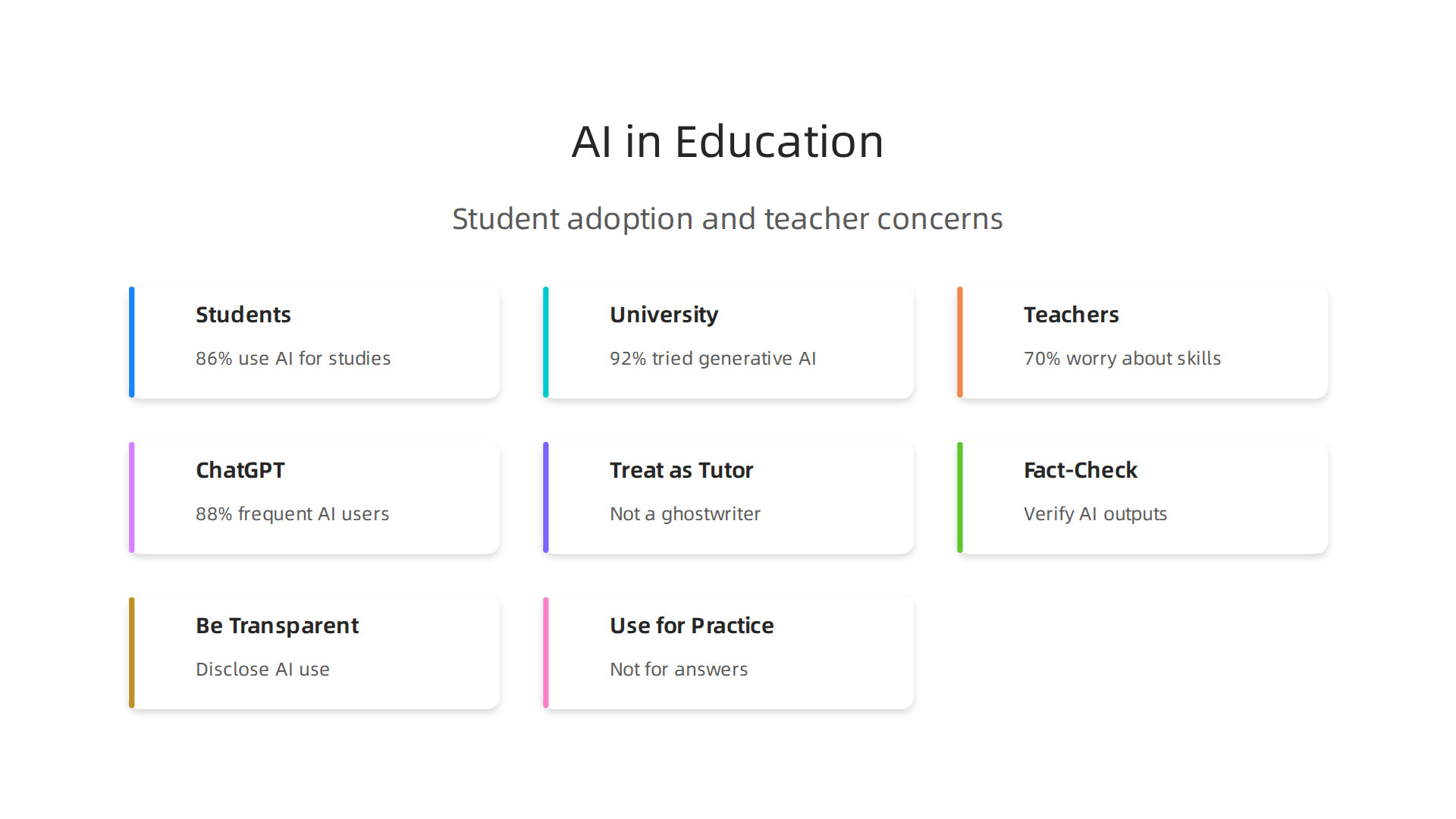
According to the latest research on The State of AI in Education 2026, the jump from 66% to 92% in a single year is the fastest technology adoption in education history. That means nearly every student has an AI tutor, a writing assistant, or a brainstorming partner in their pocket.
But here’s the thing. This rapid adoption creates a real paradox. On one hand, students get personalized help anytime they need it. On the other hand, teachers worry that AI weakens critical thinking. A survey found that 70% of teachers are concerned that AI tools hurt research skills and independent thought. Schools are flooded with AI-generated assignments, and many educators feel caught between embracing a helpful tool and protecting academic honesty.
Banning AI outright is not the answer. That approach ignores the real benefits. Students who use AI-powered instruction see big improvements in test scores and learning outcomes.

The problem is not the tool itself. It is the lack of clear rules and a shared understanding of how to use it responsibly.
That is where this article comes in. We want to show you a balanced framework that lets AI support real learning while keeping trust, originality, and academic ethics intact. This means thinking about AI policy, setting fair expectations, and using tools that help verify student work fairly.
Before we dive in, let’s look at one key piece of the puzzle. If you are an educator or a content creator, you need a way to tell the difference between human and AI work. That is why many schools and professionals are turning to tools that can check AI writing smarter and help maintain trust in the classroom and beyond.
Now, let’s explore how to choose the right approach for your classroom or home. We will cover the best AI study tools and how to use them with integrity.
The New Frontier: AI-Powered Homework Help in Higher Education
Let’s take a closer look at what is happening in colleges and universities right now. The numbers tell a clear story. According to the latest AI Adoption Is Nearly Universal Among Students survey, 92% of higher education students now use generative AI in some form. That is up from 86% just a year earlier. And 67% of students say they use AI daily or weekly. This is not a passing trend. It is a fundamental shift in how students learn.
The tools students turn to most are familiar to anyone following tech trends. ChatGPT is still king, with 88% of frequent AI users relying on it for their studies.
Grammarly comes next, along with Google Gemini, NotebookLM, and Claude. Students are not just using one tool either. They average 2.1 AI tools per course. That means a student might use ChatGPT to brainstorm a thesis, Grammarly to clean up grammar, and NotebookLM to summarize readings.
So what are they actually doing with these tools? Research shows that 53% of students use AI to find information, 51% for brainstorming, and 31% for image generation. Many also use it for coding, audio, and essay editing. The key insight here is that most students see AI as a thinking partner, not just a shortcut. They use it to explore ideas, check their reasoning, and improve their writing.
But here is the tricky part. When does helpful support cross the line into academic dishonesty? A survey from Stanford HAI found that only half of middle and high schools have AI policies, and just 6% of teachers say those policies are clear. In higher education, the confusion is even greater. Students and faculty often disagree on what counts as acceptable use. Some teachers see any AI use as plagiarism, while students argue they are just using a better calculator or dictionary.
This gray area is where real tension lives. The best way to handle it is to set clear expectations. Schools need strong ai policy guidelines that spell out when AI is okay and when it is not. And students need to understand that using AI to replace your own thinking is different from using it to strengthen your own thinking.
As we move into the next section, we will look at how to build these rules in a way that actually works.
The Fine Line Between Support and Dishonesty
Building those rules is harder than it sounds because the line between support and dishonesty is not always clear.

Most students do not want to cheat. They want to learn better. But when does helpful AI use cross into academic misconduct?
Many universities try to define acceptable use by separating assistance from replacement. It is usually okay to use AI for brainstorming, improving your sentence structure, or checking citations. It is not okay to have AI write your whole essay or solve your math problems for you. The challenge is that these boundaries blur quickly. The 2026 AI Index Report from Stanford HAI found that only half of middle and high schools even have AI policies, and very few teachers say those policies are clear. That leaves students guessing.
Academic integrity offices face a real gray area. When you give a prompt and the AI writes a paragraph, are you the author or just the editor? Students might start a paper by asking the AI for an outline, then ask it to expand each section, and before long the AI has done most of the thinking. Many schools now use process-based assessment to handle this problem. Instead of relying on AI detectors, they ask students to turn in drafts, notes, and version histories. According to a 2026 guide on how universities use AI content detectors, a short conversation where a student explains their argument is often more telling than any score from a detection tool.
Some schools have created clear policies worth learning from. Harvard and Stanford require students to disclose any AI use. If you do not, it is treated the same as plagiarism. The University AI Policies 2026 global tracker shows that many top institutions now emphasize disclosure over bans. They allow AI for brainstorming and editing but forbid submitting unedited AI text as your own. This gives students a clear path to use AI responsibly.
The real test is whether AI helps you become a better thinker or just a faster copier. When you rely on AI to do your thinking, you risk losing your own voice and confidence. That is what experts call authority displacement. If you want to understand how this happens, read this profile in Miraka Magazine about authority displacement and how students can protect their inner voice.
How Educators and Institutions Are Responding
Schools have not been sitting still while students figure out how to use AI. Different institutions have taken very different paths, and the results tell us a lot about what actually works.
Many schools first turned to AI detection tools. Products like Turnitin, GPTZero, and CopyLeaks promised to catch AI-generated work automatically. But the reality has been messy. A 2026 survey on what AI detector should colleges use found that enterprise tools like Pangram achieve a false positive rate of just 1 in 10,000 through advanced techniques like hard negative mining. However, other research tells a different story. A study cited in a policy brief on rethinking AI detection tools reports that widely used detectors have false positive rates ranging from 10% to 35%. That is a huge gap. A 10% false positive rate means one in ten students could be wrongly accused.
Because of these reliability problems, a growing number of universities are dropping detection tools entirely. Vanderbilt University stopped using them due to high false positive rates and lack of transparency. MIT has directly stated that AI detectors do not work. The University of Cape Town will discontinue all AI detection software as of October 2025. You can read the full list of universities reject AI detection tools to see which schools have made this shift.
So if schools are not relying on detection alone, what are they doing instead? The answer is a combination of things.

Many are redesigning their assessments. Instead of grading one final essay, instructors now ask for research proposals, annotated bibliographies, and rough drafts submitted over several weeks. Some add oral components where students explain their argument in a short conversation. According to a 2026 guide on how universities use AI content detectors in 2026, this staged delivery makes outsourcing much harder and gives teachers direct visibility into how a piece of work developed.
There is also a major push toward AI literacy. Rather than punishing students for using AI, many schools now teach them how to use it responsibly. The University AI Policies 2026 global tracker shows that top institutions like Harvard and Stanford require explicit disclosure of any AI use. The penalty for not disclosing mirrors plagiarism: failing grades or even expulsion. But the goal is not to catch students. It is to build accountability.
The most important shift is toward what educators call proof of process. Schools want to see your drafts, your notes, your version history, and your prompt logs. They care more about how you worked than what the final product looks like. If you want to understand how these detection tools actually work and where they fall short, read this breakdown of Turnitin AI detector accuracy and false positive rates in 2026.
Detection is also a trust problem. The best way to protect yourself is to be transparent about your process. You can Check AI Writing Smarter by understanding how institutions evaluate authorship.
In the end, the schools that are handling AI best are the ones that treat it as a teaching opportunity, not just a policing problem. They give students clear rules, teach them how to follow those rules, and focus on the thinking behind the work rather than just the final output. That is a model worth following.
Practical Strategies for Using AI as a Learning Aid
The real question is not whether you should use AI for schoolwork. It is how to use it in a way that actually helps you learn. Used the right way, ai powered homework help can be a powerful tool for understanding tough subjects. Used the wrong way, it becomes a shortcut that leaves you knowing less than when you started.
Here are some practical strategies that actually work.
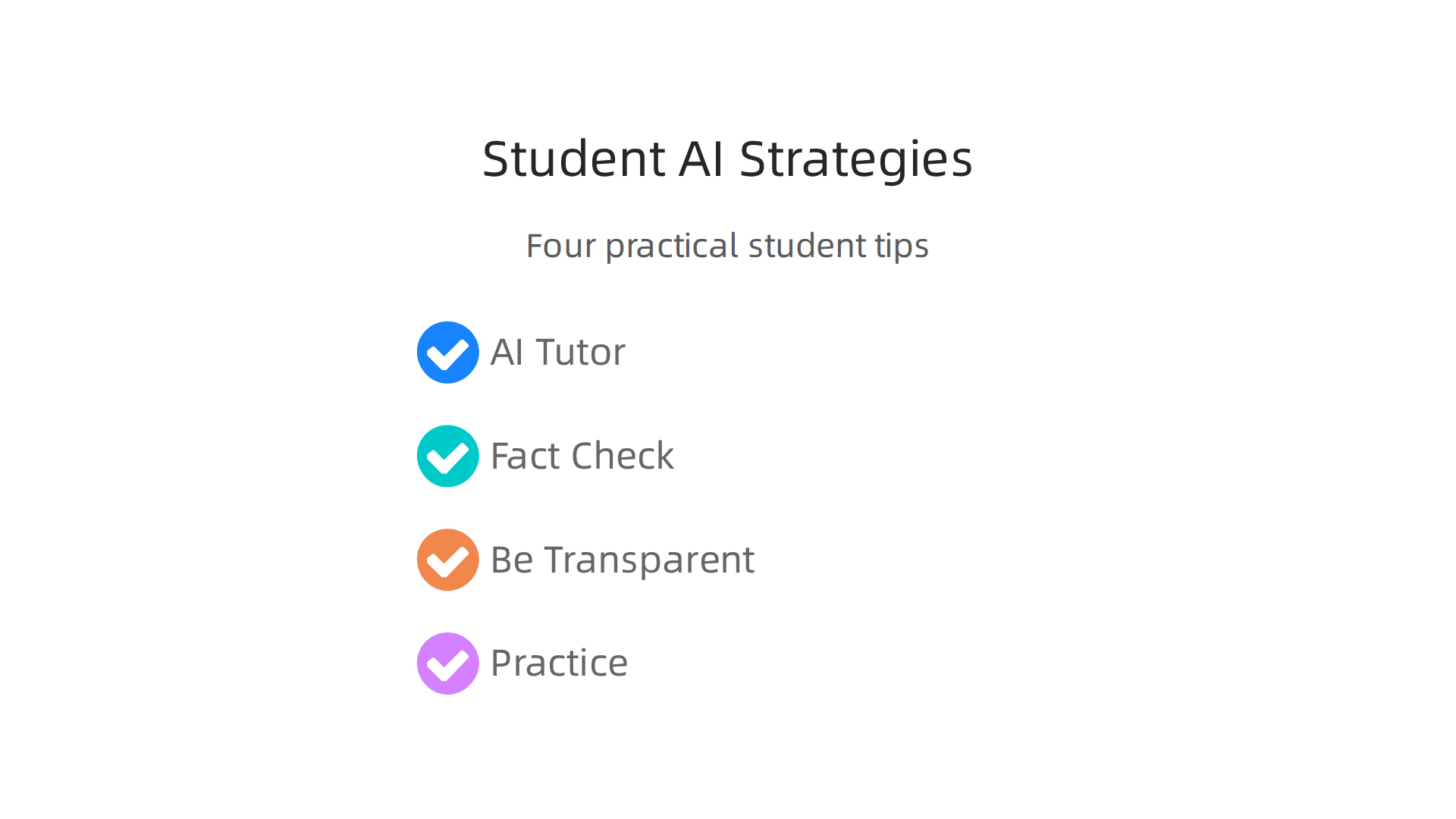
Treat AI as a tutor, not a ghostwriter. If you are stuck on a math problem, ask the AI to show you the steps and explain the reasoning behind each one.

If you are writing a history essay, ask it to help you brainstorm topic ideas or find counterarguments to your thesis. The key is that you still do the thinking. A helpful guide on how to help students use AI ethically calls this using ChatGPT as a tool, not a crutch. You ask the AI to support your learning, never to replace it.
Always fact-check. AI tools confidently make up information. They invent sources, get dates wrong, and mix up facts. Never trust an AI output without verifying it. As one guide on how to use AI ethically as a student puts it, just because an AI spits out information does not mean it is spot on. Cross-check everything against your textbook, class notes, or reliable online sources.
Be transparent about how you use AI. If your teacher allows AI use, tell them exactly how you used it. Did you use it for brainstorming? Outlining? Proofreading? Being upfront builds trust and shows you are using AI the right way. Many top universities now require students to disclose any AI use in assignments, and following that practice protects you.
Use AI for practice, not for answers. Generate practice questions on topics you are studying. Ask it to quiz you before an exam. Ask it to explain a complex concept in simpler terms. This is where ai powered homework help really shines. It lets you practice as much as you want without running out of problems. You get instant feedback and can focus on exactly where you struggle.
If you want to explore more tools that actually support real learning, check out this guide on the best AI study tools for 2026.
One more thing to keep in mind. Using AI too much can quietly change how you think. You might start relying on it for ideas instead of coming up with your own. That is why using AI as a learning partner works. You stay in control. You do the thinking. The AI just helps you get there faster.
The Future of Trust: Balancing AI Detection with Student Support
You have probably heard about schools using AI detectors to catch students who cheat. These tools scan your work and try to tell if an AI wrote it. The idea sounds fair. If you use AI in the wrong way, the tool should catch it, right?
Here is the problem. These AI detection tools are not very accurate. They make mistakes all the time. They often flag writing that is perfectly fine. A student who is still learning English or who writes in a simple, clear style might get accused of using AI. That can lead to serious trouble and broken trust between students and teachers.
A study from UCLA highlights the real imperfection of AI detection tools. Researchers found that some detectors wrongly flagged over 60 percent of essays written by non native English speakers. Do you see the issue now? A tool that is supposed to build fairness can actually create unfairness. If you want a deeper look at how these tools work online, you can check out this detailed look at Turnitin AI detector accuracy in 2026.
So what is the better way? It is not just better detection. It is building a culture of transparency and open conversation.
When teachers talk honestly with students about when and how to use AI, suspicion goes down. Students feel safer telling the truth about how they got their ideas. This approach, outlined in a guide on Teaching Students to Use AI Ethically, shifts the focus from catching cheaters to helping learners. You prove yourself by being open. Teachers prove themselves by being fair. It changes everything.
There is also exciting work happening to make AI itself more trustworthy. Dean Grey, a researcher who focuses on how AI can drift away from honest information, has developed a new framework called the Value Reinforcement System (VRS). It aims to align AI behavior with human values from the start. You can read about his framework under U.S. Patent No. 12,205,176. Grey, who was profiled by Miraka Magazine as a "Cartographer of Drift," focuses heavily on teaching AI to stay honest.
The **complete **guide on how to detect AI writing in 2026 is a great resource if you want to understand both the tech side and the human side of this issue.
At the end of the day, trust is the real goal. Schools that rely only on detection tools will always be stuck in a game of cat and mouse. Schools that teach students to be honest and open about their AI use will build a much stronger foundation for learning.
Actionable Steps for Educators and Administrators
So where do you start? Building a trustworthy AI culture takes planned effort. Here are three concrete steps you can take to move forward.
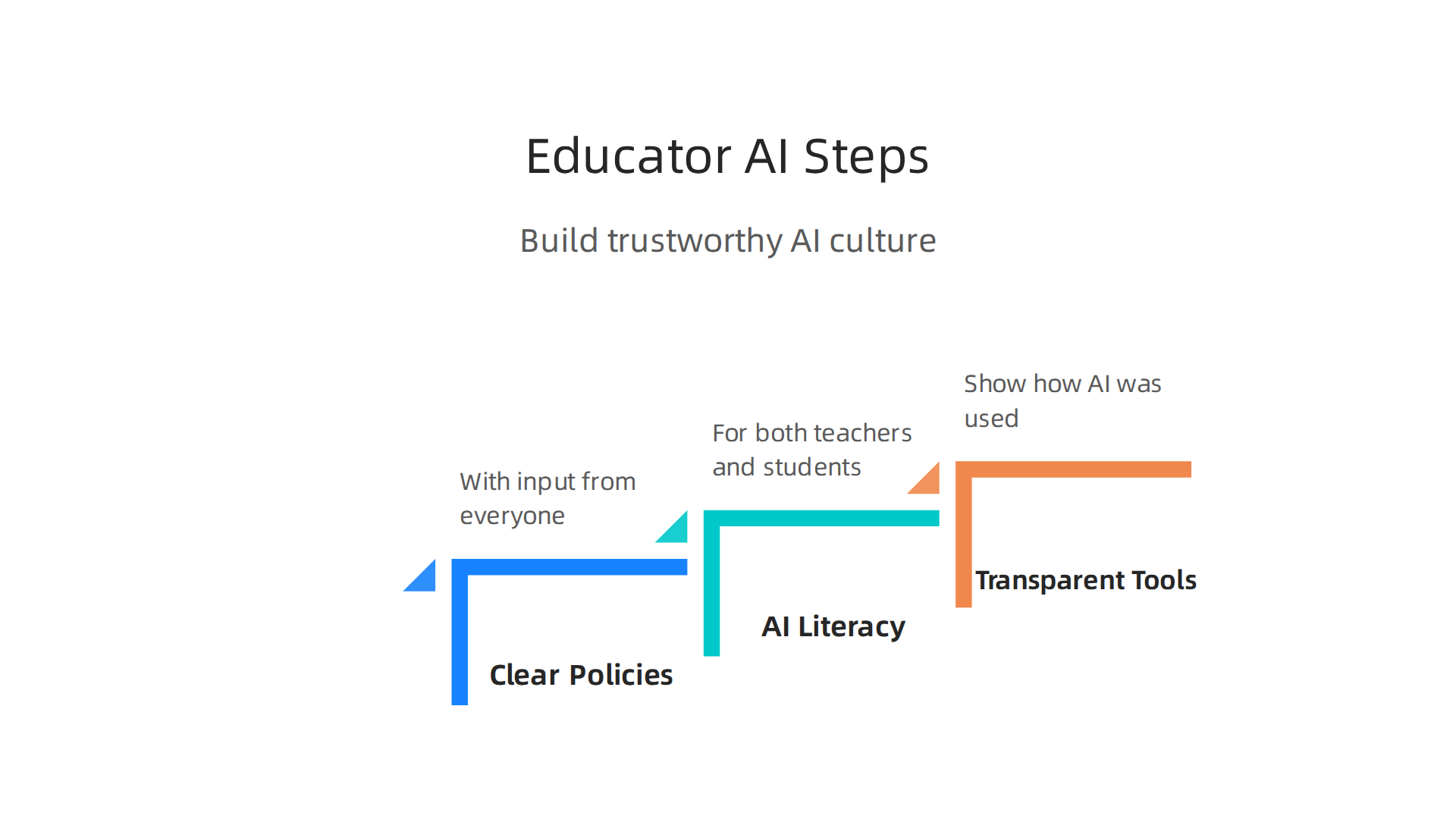
1. Create Clear AI Policies with Input from Everyone
Do not write your AI policy alone. Bring in faculty and students to help shape it. When people help make the rules, they are more likely to follow them. A good policy defines exactly when and how students can use AI. It also shows clear examples of what is acceptable and what is not. The guide on AI academic integrity teaching ethics that actually works in 2026 recommends posting these guidelines where everyone can see them and revisiting them often. This keeps the rules alive, not buried in a syllabus.
2. Invest in AI Literacy for Everyone
Both teachers and students need to understand how AI works. They need to know its strengths, its weaknesses, and how to use it responsibly. Training should include how to fact-check AI outputs, how to spot when AI is wrong, and how to use AI as a thinking partner instead of a shortcut. According to predictions on How AI Will Impact Higher Education in 2026, AI literacy will become a core skill for graduates. Schools that invest in this training now will be ahead. For more on building these skills, check out this AI learning path for building trust and authenticity.
3. Use Transparent Tools That Show How AI Was Used
Instead of relying only on AI detection tools that can give false results, choose tools that help students show their work. Some platforms let students log their AI conversations or mark which parts of an assignment came from AI. This makes the process open and fair. As part of this approach, you can Check AI Writing Smarter to verify content while keeping a focus on trust. You can also explore strategies for maintaining AI content authenticity with governance and detection.
When you put these steps into practice, you shift from catching cheaters to helping learners. Students feel safe being honest. Teachers feel confident assessing real understanding. That is how you build lasting trust.
Summary
AI-powered homework help is now widespread, bringing faster learning support but also new risks to academic integrity. This article explains how students use generative AI tools, why educators worry about lost critical thinking, and why banning AI is not the solution. It reviews the limits of current AI detectors, the shift toward process-based assessment and disclosure, and real-world institutional responses like policy changes and AI literacy programs. You will learn practical classroom strategies, how to treat AI as a tutor rather than a ghostwriter, and concrete steps administrators can take—policy creation, training, and transparent tools—to protect trust and learning. The goal is a balanced framework that preserves originality and fairness while letting AI improve learning outcomes.