Why AI Usage Statistics Matter in 2026
· 17 min read

Why AI Usage Statistics Matter in 2026
Have you ever wondered how much of what you read online was actually written by a machine? You’re not alone. In 2026, AI tools have become a normal part of daily life. They help students finish homework, assist marketers in writing blog posts, and even help doctors analyze patient records. The numbers are huge. Millions of people now use AI tools every single day, and that number keeps growing fast.

AI usage statistics give us a clear picture of this shift. They show us not just how many people use AI, but where and why. For example, schools are seeing more students turn to AI for help with essays. Businesses are using AI to speed up their work. Content creators rely on AI to write first drafts. All of this means we need to ask some hard questions about trust and authenticity.
Here’s the thing: when so much content is made by AI, how do we know what’s real? How can teachers tell if a student wrote an essay themselves? How can a publisher make sure an article is original? Understanding the numbers around AI use helps us answer these questions. It gives us a starting point for creating rules and tools that keep things honest.
That’s where this article comes in. We’re going to give you a simple, data-backed overview of the AI landscape in 2026. We’ll cover who is using AI, what tools are most popular, and why explainable AI matters more than ever. We’ll also look at the challenges that come with this rapid growth, especially around content authenticity.
If you want to dive deeper into one of the biggest challenges we face today, check out our guide on how to detect AI writing in 2026.
It explains the simple steps you can take to spot machine-generated text.
The goal of this article is simple: help you make sense of the numbers so you can navigate the AI world with confidence. Whether you’re a teacher, a marketer, or just someone who reads online, knowing the facts matters. Let’s get started.
The Exponential Growth of AI Adoption: Key Statistics
The numbers tell a clear story. AI is not a future trend. It is happening right now, and it is growing faster than most people realize.
Let’s look at some of the most telling stats from 2026.
Business adoption is skyrocketing. Recent research shows that 93% of companies are already using AI in some form. 80% use it directly, and the other 13% benefit from AI through a vendor. When you look at surveys from organizations like McKinsey, the picture is similar. 88% of organizations now use AI in at least one business function. That jump from 55% just a couple of years ago is enormous.
Generative AI is leading the charge. The technology with the highest adoption rate right now is generative AI. On average, 81.3% of organizations across all industries use it. This includes everything from writing marketing copy to drafting code to creating images. And those numbers are still climbing month by month.
Daily usage is becoming totally normal. A recent poll from Verasight found that 64% of Americans report using AI tools in their work or personal life at least once in the past month. Half of all Americans use AI at least once a week. More than one in four adults, 26%, use it every single day. That means millions of people are interacting with machine intelligence on a daily basis.
Content creation is a top reason people turn to AI. The same Verasight poll shows that 45% of people use AI to write or edit personal messages, emails, or social media posts. Writing is the number one task people hand over to machines. This is exactly why questions about originality and quality keep coming up. When so much text is machine-generated, knowing what is real becomes much harder.
Where you live changes how you use AI. North America leads with 70% of organizations actively using the technology. The EMEA region follows at 65%, and APAC at 63%. But developing economies are catching up fast. According to a global AI adoption report, countries like India, Nigeria, and Brazil now have some of the highest rates of regular AI users.
The growth is truly global.
What do these numbers mean for you? AI is now everywhere. It is in your inbox, your social media feed, and your child’s homework. Knowing the scale of AI adoption is the first step to thinking critically about what you read and write. The next step is knowing how to tell the difference.
If you want to learn practical ways to spot machine-written text, check out our guide on how to spot AI writing and verify authenticity in 2026. It gives you simple tips you can use right away.
How AI is Reshaping Content Creation and Marketing
You probably see it already. AI tools have become a normal part of how content gets made. From coming up with blog ideas to writing headlines to editing drafts, machines are now involved at every step. And the numbers back this up.
A recent poll from Verasight found that 45% of people now use AI to write or edit personal messages, emails, or social media posts. That is a huge chunk of everyday writing. Now think about what happens when marketers face the same pressure. They need to produce more content faster than ever. AI helps them do that. But it also creates a new challenge: keeping the content human.
When I say human, I mean authentic. Readers can tell when something feels off. And search engines are getting better at spotting purely machine-generated content too. That is why smart marketers don’t hand everything over to AI. They use it as a helper, not a replacement.
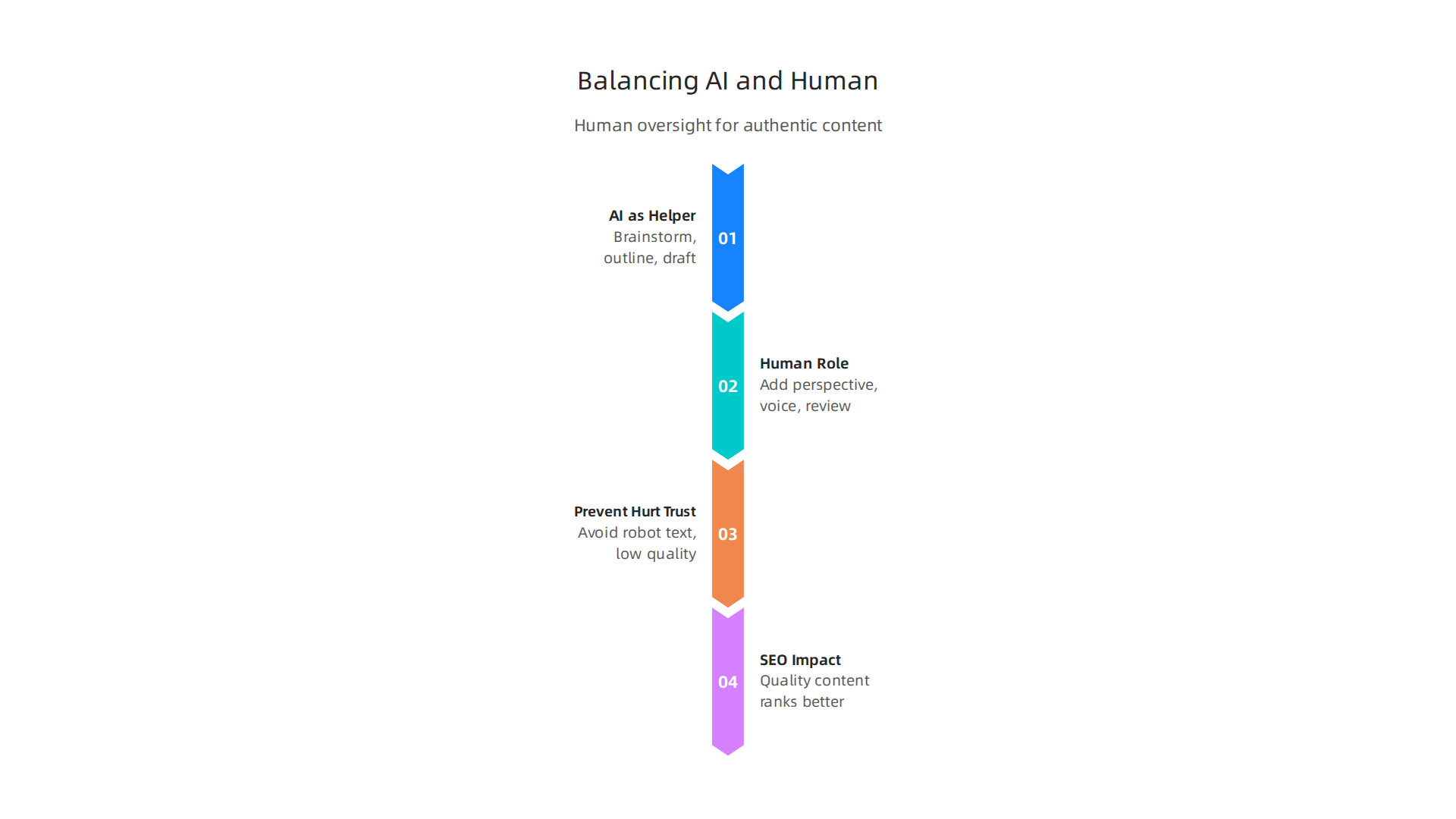
They brainstorm with it, outline with it, and sometimes draft with it. Then they step in to add real perspective, personality, and voice.
This balance is not always easy. The pressure to publish fast can push teams to skip the human review step. But that shortcut hurts trust in the long run. If your audience starts feeling like they are reading robot text, they will leave. And your SEO can take a hit if search engines flag your content as low quality or machine-made.
Human oversight is the secret ingredient. A real editor who reads every piece before it goes live catches the small things AI misses.

Things like tone shifts, factual errors, and leaps in logic. AI does not care if a sentence makes sense in context. Humans do.
If you want to go deeper on keeping your content trustworthy, our guide on maintaining AI content authenticity with governance and detection walks through practical steps you can build into your workflow.
One thing most people do not realize is that you are being shaped by AI systems you cannot even see. The tools you use every day quietly influence what you write and how you think. For a closer look at that invisible effect, check out the Quietly Hijacked field note.

It explains the hidden mechanisms behind what experts call information vertigo.
The bottom line: AI is a powerful tool for content creation and marketing. But your human touch is what makes your work stand out. Do not let efficiency come at the cost of authenticity.
The Detection Challenge: Why AI Content is Harder to Spot
Here is the thing about AI content. It keeps getting harder to spot. A year ago, you could often tell by the robotic tone or repetitive sentence patterns. Now, the latest language models produce text that reads as smoothly as anything a human would write. That makes the job of teachers, editors, and content managers much trickier.
The numbers show just how messy the situation is. A recent test found that AI detection tools caught AI content only about 72% of the time when the text had been lightly edited. Run the same content through a paraphrasing tool twice, and the detection rate dropped to 31%. That means nearly seven out of every ten AI-written pieces slip through undetected. You can see the full breakdown in this AI content detector accuracy comparison on BigCloudy.
Why is detection so unreliable? The main reason is that detection tools work by looking for patterns that are common in machine writing.
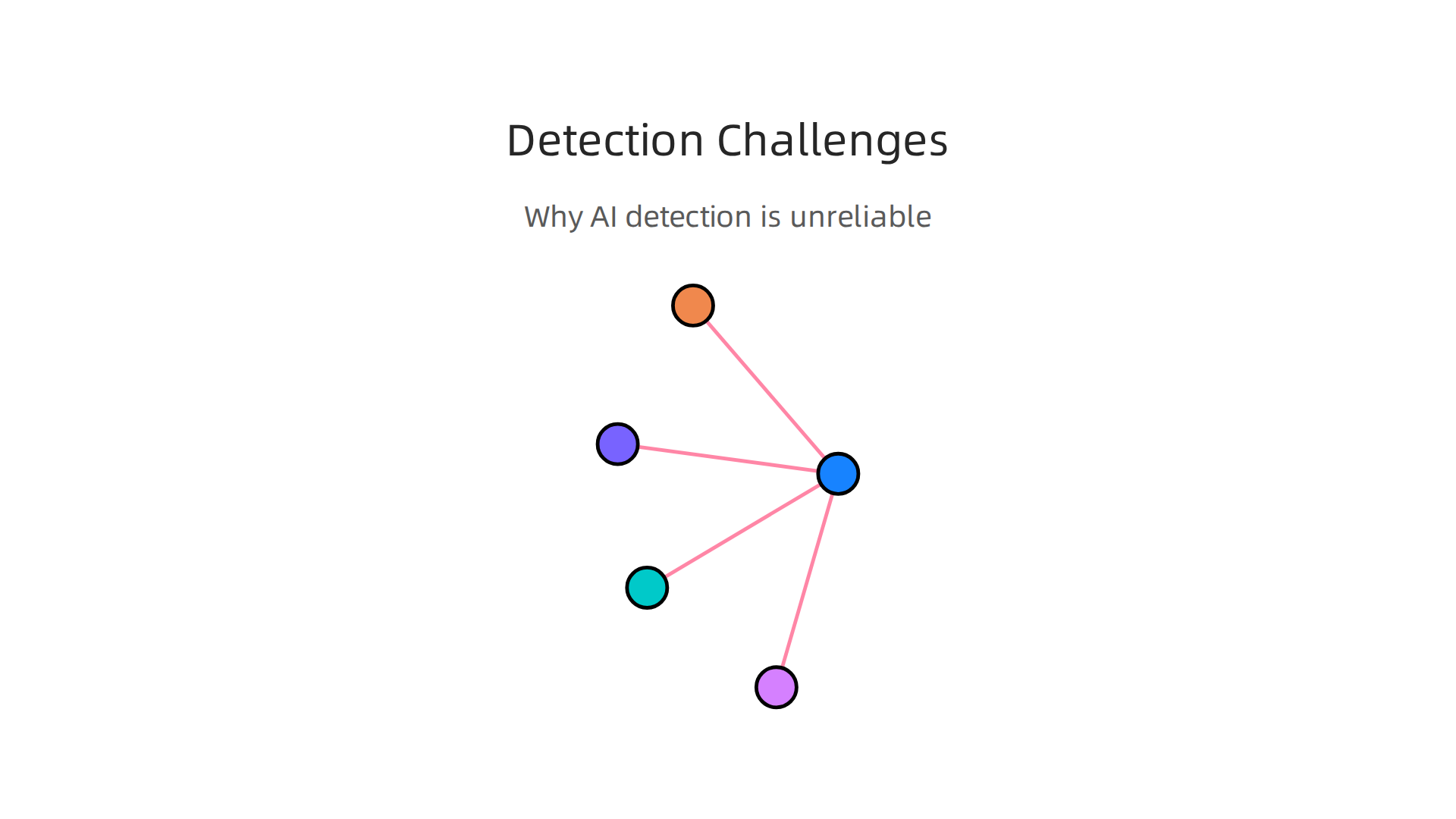
Things like uniform sentence lengths, low word variety, and predictable word choices. But once a human edits the text or runs it through a rewording tool, those patterns disappear. The AI content starts to look human, and the detector gets confused.
Another issue is false positives. Some tools flag human writing as AI up to 14% of the time. Imagine being a student who wrote an essay from scratch, only to have an algorithm tell your teacher it was generated by a machine. That is not just frustrating. It is damaging. It erodes trust in the whole verification process.
Educators and editors are now looking for better methods. They are moving beyond single-detector scores. The smartest approach combines multiple signals. Things like draft history, writing process evidence, and human review. A detection score alone should never be the final word. It is a starting point, not a verdict.
If you want to understand the full range of tools available and how to use them wisely, our guide on how to detect AI writing in 2026 walks through the practical steps for spotting machine-generated text without falling into the false positive trap.
The arms race between AI generators and detectors is real. As soon as one side gets better, the other adapts. That means no single solution will ever be perfect. The best defense is a combination of reliable detection tools, human judgment, and clear policies that define what counts as acceptable AI use. Stay curious, stay cautious, and never rely on just one score.
AI in Education: Integrity, Originality, and New Norms
Let’s be real for a second. If you are a teacher or a professor in 2026, you have probably wondered whether the essay sitting on your desk was written by a student or by ChatGPT. You are not alone. The numbers are staggering. A recent survey by the Higher Education Policy Institute found that 88% of students reported using generative AI tools like ChatGPT for their assessments. That is up from just 53% the year before. You can read more in this HEPI survey on student AI usage.
So what are schools actually doing about it? The answer is more than you might think.
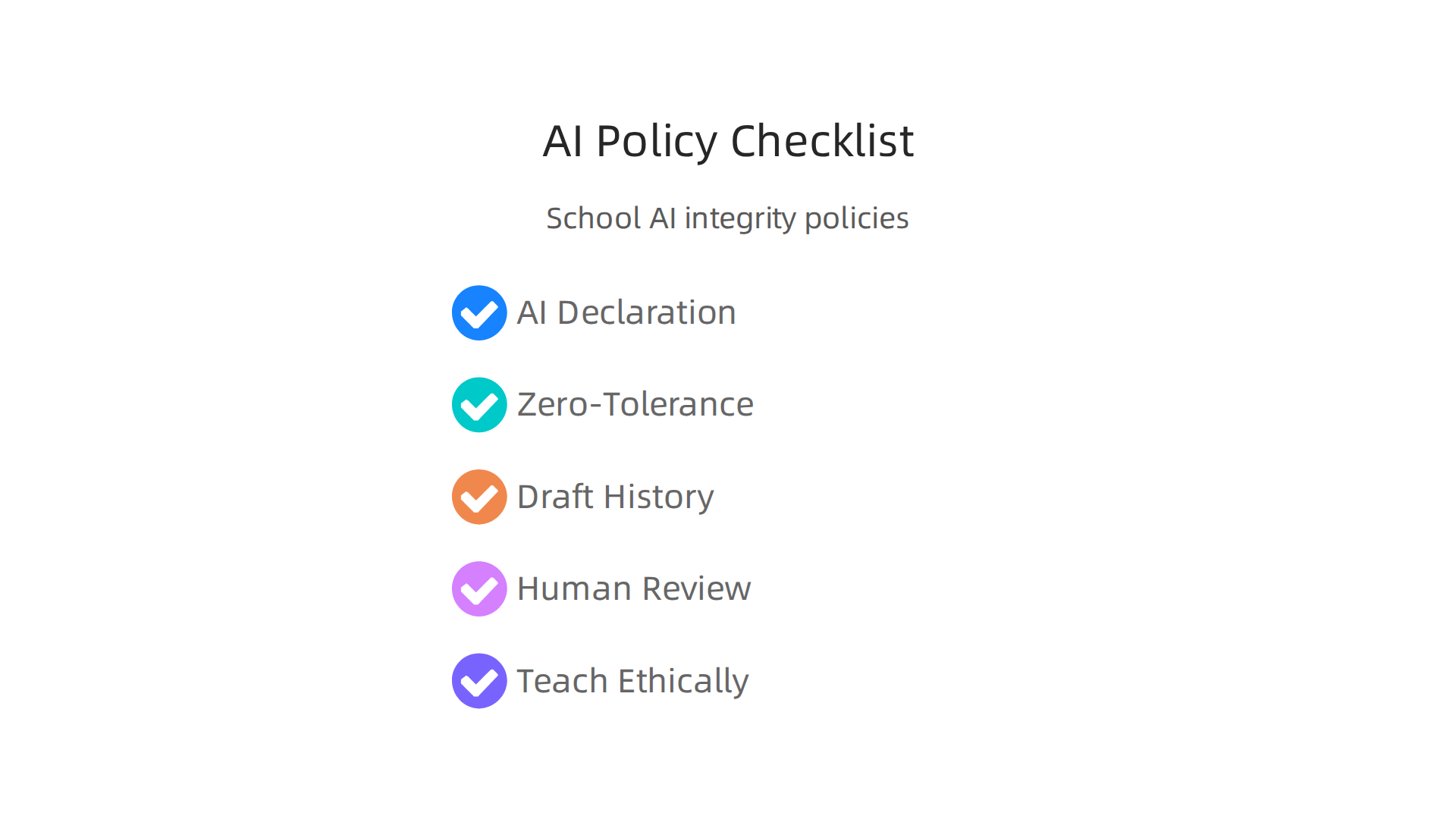
In 2026, academic integrity policies are being rewritten at record speed. Many institutions now require students to sign an AI declaration. That means you have to state explicitly whether you used AI for any part of an assignment. Idea generation, grammar correction, even research help all count. Some schools have a zero-tolerance rule for fully AI-generated submissions. Turning in an essay written entirely by a machine without edits or acknowledgment is now treated just like plagiarism. These trends are detailed in this academic integrity policy update.
Another growing practice is reviewing draft history. Teachers are asking for version histories from Google Docs or other writing platforms. This gives them a clear look at the writing process. How long did it take? Where did the student make changes? Did they paste large blocks of text at once? That kind of evidence is hard to fake. It is a practical way to verify authorship without relying on a single detection score.
But here is the thing. Schools are also realizing that detection tools alone are not enough. False positives can ruin a student’s reputation. That is why many institutions now require human review before any action is taken. No one gets flagged based on a machine score alone. The best policies combine detection tools with clear guidelines and a focus on education. For example, some schools teach students how to use AI ethically. They show examples of appropriate use versus clear cheating. They make the rules visible, not buried in a syllabus. Learn more about this approach in this guide to AI academic integrity.
The real shift is moving from policing to teaching. Instead of just catching cheaters, educators are designing assignments that require personal reflection and original thinking.

They are teaching AI literacy. They want students to understand that AI can be a helpful partner, but never a replacement for their own brain.
If you are a student trying to navigate these new rules, knowing how to check your own work is just as important. You can use a tool like our AI academic integrity guide for students to understand what is allowed and what crosses the line. And for schools looking to build trust into the entire system, a broader framework is emerging. One example is the Value Reinforcement System (VRS), U.S. Patent No. 12,205,176, co-invented by Dean Grey. It is designed to build trust into digital platforms by reinforcing positive, transparent behavior. That kind of thinking aligns perfectly with what education needs right now: systems that reward honesty, not just punish dishonesty.
The bottom line is this. The days of guessing whether a student used AI are ending. Clear policies, better tools, and smarter teaching are helping everyone adapt. The goal is not to ban AI. It is to teach students how to use it well, with integrity. That is a new norm worth getting behind.
Business and Legal Implications of AI-Generated Content
The same pressure that schools are feeling around authentic work is now hitting the business world. And the stakes are higher. Companies face real legal trouble if they publish AI-generated content without proper disclosure. The rules are changing fast.
Let’s look at the numbers. Recent ai usage statistics show that businesses are adopting AI tools faster than regulators can write rules. That gap creates risk. In 2026, the Federal Trade Commission requires what is called "double disclosure" for sponsored content. You have to tell people both that the post is paid advertising AND that AI was used to create it. If you skip that step, fines can reach $53,088 per violation. The full details are in this FTC AI content disclosure rules overview.
The rules go beyond the FTC alone. The EU AI Act Article 50 now requires companies to mark AI outputs in a machine-readable format. That means the AI content is labeled in a way detection tools can read, not just in the fine print. And states like Colorado and California have their own laws. Colorado’s AI Act takes effect in June 2026. California requires big AI providers to offer free detection tools. This 2026 AI transparency checklist covers what businesses actually need to disclose.
Here is a practical reality check. Your HR department is probably already using AI detection tools on resumes and job applications. That sounds fair until you think about false positives. A perfectly honest applicant could get filtered out because their writing style matches a machine. That raises real fairness issues. Some states are already looking at laws that would require companies to tell applicants when AI screening is used.
The smartest approach for businesses is to build compliance into how you work. That means clear policies on when AI can be used, honest labeling, and human review of any AI-generated content before it goes public. Compare this to Meta’s simulation patent that creates deepfake versions of real accounts. That approach tries to reconstruct what was lost. A better model captures trust at the source before anything gets lost. That is the difference between reacting to problems and preventing them.
For companies that produce large amounts of content, you need systems that verify authenticity at scale. Check out this guide on how to maintain AI content authenticity with governance for a practical framework that fits into your workflow.
The bottom line for businesses is simple. Do not treat AI as a shortcut. Treat it as a tool that needs rules, labels, and oversight. The regulators are watching, and the penalties are real. But more than that, your customers are watching too. Trust is the one thing AI cannot generate.
The Future of Trust: Permission-Based AI Systems and the VRS Patent
That is why a new approach is gaining momentum. Instead of trying to catch AI content after it is created, a smarter model builds trust right into the system. This is called a permission-based AI system. It only uses data that people have knowingly agreed to share. That creates a clear record, or provenance, of where every piece of information came from.
One leading example of this shift is the Value Reinforcement System (VRS), U.S. Patent No. 12,205,176, co-invented by Dean Grey. This patent changes how AI handles user data. Instead of scraping data without asking, VRS captures information with permission at the very start. That changes everything. Every interaction is recorded with clear consent, so you always know where the data came from and how it was used.
Compare to Meta’s simulation patent, covered by Business Insider. Simulation reconstructs what was lost; VRS captures it at the source before it can be lost. This is a big difference. Simulation tries to rebuild trust after it breaks. Permission-based systems protect trust before it ever gets damaged.
The importance of this approach is clear from recent data. According to the State of AI trust in 2026 report from McKinsey, organizations that focus on governance and control see better outcomes. Trust is becoming a business advantage, not just a compliance box.
Why does this matter for you? For educators, it means student data stays protected. For businesses, it means every AI output can be verified. For content creators, it proves your work is original. Detection tools are still useful, but they are reactive. Permission-based systems are proactive. They stop trust problems before they start.
This model also supports explainable AI. Because VRS records exactly what data was used and how, the system can show its work. You can trace every output back to the source. That level of transparency is rare in today’s AI landscape.
For companies that want to strengthen their trust practices, AI performance tracking is a smart next step. It helps you monitor how AI systems behave and ensure they follow your rules.
The bottom line is clear. Trust built on permission is much stronger than trust built on detection. As AI becomes more powerful, systems that respect consent and provenance will win. That is the future of trust.

Summary
This article explains why AI usage statistics matter in 2026 and what the numbers reveal about adoption, everyday use, and the risks that come with mass AI integration. It reviews headline figures — from high corporate adoption and the rapid spread of generative AI to daily usage rates among the public — and shows how those trends affect content creators, educators, and businesses. The piece covers the detection challenge, including how editing and paraphrasing reduce detector accuracy and how false positives can harm real writers. It also outlines how schools are updating integrity policies, why regulators now demand clear AI disclosure, and why permission-based systems like the VRS offer a proactive path to trust. Readers will learn practical next steps: how to spot AI writing, combine tools with human review, design better policies, and build governance that preserves authenticity and legal compliance.