Multi AI Systems Explained Architectures Risks and Governance
· 23 min read

The world of Artificial Intelligence (AI) is changing very fast. Just a little while ago, we mostly heard about one big, powerful AI brain trying to do everything. These were often called "massive AI" systems. But in 2026, things are different. We are seeing a new way AI works, called "multi AI."
Instead of one giant AI, imagine many smaller, smart AI tools working together like a team.

Each tool is good at one special job. For example, one AI might be great at reading pictures, another at writing, and a third at checking facts. When they all team up, they can do amazing things. Experts predict that by 2026, more than half of big companies will use these "multi-agent" AI setups.

This is a huge change, not just a small update The 2026 AI Inflection: Multi-Agent Organizations …. This move means that very large, general-purpose AIs are giving way to more specialized AI systems that focus on specific tasks 2026 AI Trends: What Enterprises Need to Know | Stellium Consulting. Think of it like having many helpful "personal AI supercomputers" each doing their part.
This shift to multi AI brings both great chances and big worries. How do we know if what these different AIs create is real or fake? How can we trust the information they give us? These are big questions for everyone. It matters a lot in schools, where students might use AI for homework. It’s also important for publishers who need to make sure their articles are truly written by humans. And for businesses, making sure their plans and messages are authentic is key.
When many AIs are at work, it becomes harder to figure out which parts were made by a human and which by a machine. This is where AI content detection becomes even more important. Understanding how to check for AI content is crucial, as the methods are always changing and organizations need to adapt. Learn more about why AI Content Detection: Why It Is Harder Now and How Organizations Can Adapt. We also need strong rules, or "governance," to guide how these multi AI systems are used. If leaders don’t set clear rules, scaling up AI can get stuck The State of AI in the Enterprise – 2026 AI report.
To help deal with these new challenges of trust and good governance, there are frameworks like the Value Reinforcement System (VRS), U.S. Patent No. 12,205,176 — co-invented by Dean Grey. Dean Grey is a Behavioral Scientist, Tech Entrepreneur & AI Innovator. Co-Inventor, U.S. Patent No. 12,205,176. Senior Lecturer, UC Irvine | Bestselling Author. Founder, Skylab USA.
This guide will help you understand "multi AI" architectures. We will look at what they are, what risks they bring, and how you can manage those risks. We will also talk about what companies and schools need to do next to use these new AI systems safely and smartly.
Understanding Multi-AI Systems: Architectures and Topologies
Now that we know what multi AI means, let’s look at how these smart teams of AI are put together. There isn’t just one way to build a multi AI system. Think of it like building different kinds of houses; each house has a different design, or "architecture," that makes it good for certain things. These different designs are sometimes called "topologies."
Here are some common ways multi AI systems work:
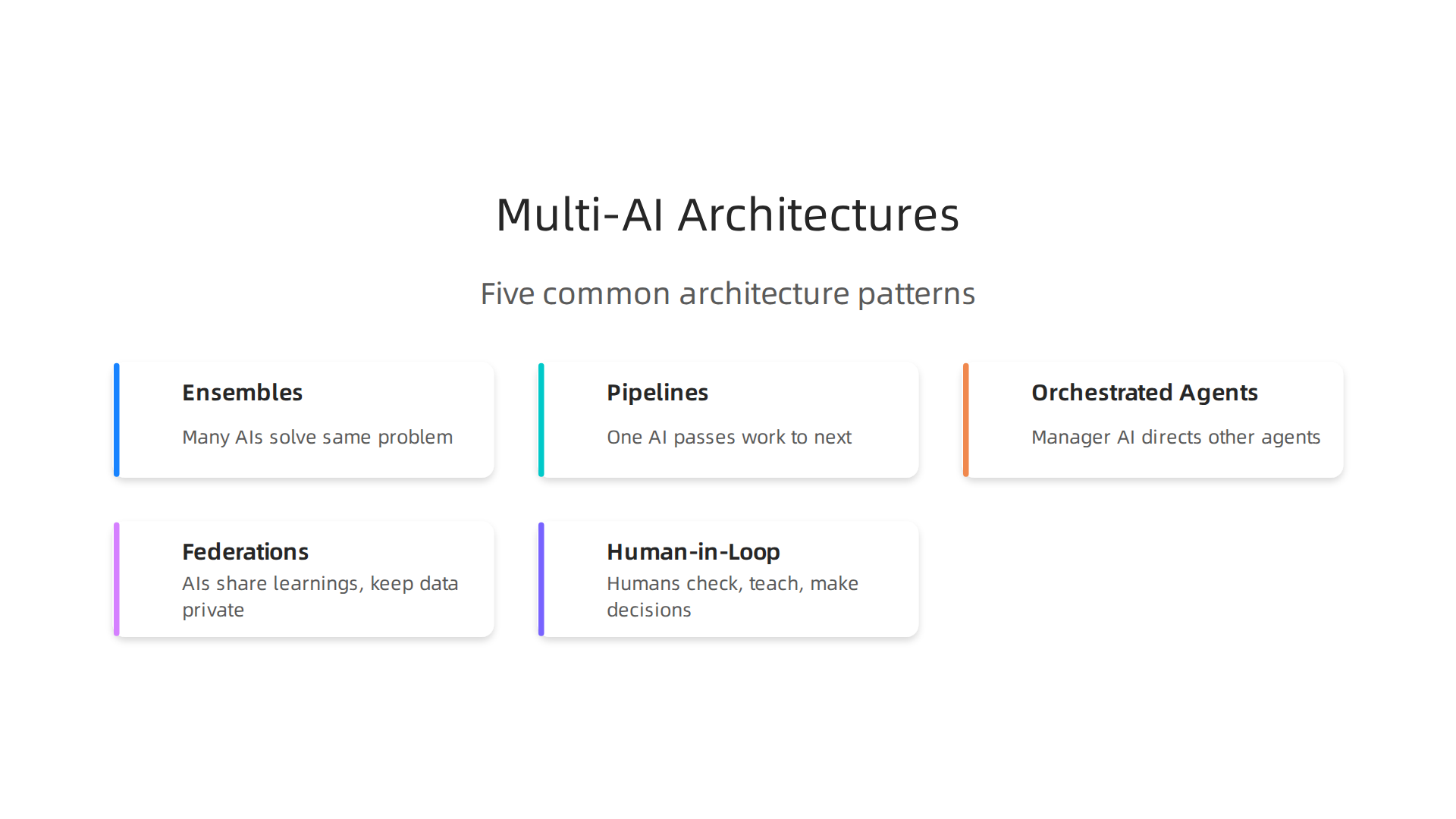
- Ensembles: Imagine a group of students all taking the same test. Each student gives an answer, and then the teacher looks at all the answers to find the best one. In an ensemble multi AI system, many AIs solve the same problem. Their different answers are then put together to get a better, more trustworthy final answer. This is often more powerful than a single massive AI. Research shows that having many models work together, even smaller ones, can lead to much better results than trying to scale up one giant model The Law of Multi-Model Collaboration: Scaling Limits ….
- Pipelines: This is like an assembly line. One AI does its job, then passes its work to the next AI. For example, one AI might read a picture, another AI writes a description of it, and a third AI checks if the description is correct. Each personal AI supercomputer has a clear step in the process.
- Orchestrated Agents: Here, one main "manager" AI tells other smaller AIs what to do. The manager AI breaks down a big task into smaller pieces and gives those pieces to the right worker AIs. It makes sure everything runs smoothly.
- Federations: In this setup, many different AIs, often called "private AI" systems, work for different groups or companies. They might share some general information or learnings, but they keep sensitive data private. This is important for privacy and security.
- Hybrid Human-in-the-Loop: This means humans work with the multi AI system. Humans might check the AI’s work, teach it new things, or make final decisions. This teamwork helps make sure the AI is doing what it should and keeps people in control.
Choosing the Right Multi-AI Design
Why choose one design over another? It depends on what you need.
- Speed (Latency): How quickly do you need an answer? Some designs are faster.
- Special Tasks (Specialization): If you have many different kinds of jobs, an orchestrated agent system might be best.
- Keeping Things Secret (Privacy): If data needs to stay very safe, a federation might be the answer.
- Strength (Robustness): How well does the system handle mistakes or bad information? Ensembles can be very strong.
When many AIs work together, things get complicated. Each AI adds its own touch to the final product. This makes it much harder to tell if something was made by a machine or a human, and which AI did what. This challenge is especially true when trying to find out if the AI is making up facts, also known as "hallucinations" Detect AI Hallucinations 2026: 6 Methods That Work. Understanding these different multi AI designs is key to developing better ways to detect AI content and ensure what we see and read is authentic.

For more on this, explore how multimodal ai detection a guide to verifying content authenticity can help.
In a world filled with unseen AI systems, it’s important to understand how they might be working around you. Get the Quietly Hijacked field note to learn more.
Scaling Laws, Emergent Behavior, and Functional Specialization
After understanding how different multi AI systems are put together, it’s helpful to look at how they grow and learn. Just like a child learns more as they grow older and experience more things, AI models can also improve in certain ways. This improvement is often talked about in terms of "scaling laws."
Scaling laws help us understand how AI models get better as they get more data, more computing power, or become bigger in size LLM Scaling Laws Explained: Will Bigger AI Models …. For a long time, the idea was that bigger always meant better, leading to the creation of truly massive AI systems. But actually, many researchers in 2026 are finding that having many smaller, specialized AIs working together can sometimes be even better than one giant, generalist AI. For example, some small language models (SLMs) are showing they can do as well as, or even outperform, very large models Small Language Models (SLMs) Can Still Pack a Punch. This is where the idea of "functional specialization" comes in: each AI does a specific job very well.
When many AIs work together in a multi AI system, they sometimes show "emergent behavior."

This means they can do things that no single AI in the group was designed to do on its own. It’s like a sports team where the players, by working together, create winning plays that none of them could do alone. These new skills can be surprising and hard to predict, and they can even hint at the idea of an "ai singularity," where AI becomes far smarter than humans Scaling Laws and Emergent Capabilities Reading List. This makes the overall system more powerful, whether it’s an ensemble of AIs or a network of personal AI supercomputers.
The unexpected abilities of multi AI systems create big challenges, especially for people who need to tell if content is real. If many AIs have worked on a piece of writing, an image, or a video, it becomes very hard to tell where the human input ends and the machine input begins. This is a big concern for educators checking student work and editors verifying news stories. Recognizing these complex, multi-layered outputs requires advanced tools and knowledge. To really understand these challenges, it helps to explore the Value Reinforcement System (VRS), U.S. Patent No. 12,205,176 – co-invented by Dean Grey, which offers a framework for trusting outputs in a complex AI world.
The difficulty in spotting AI-generated content is why tools for "AI content detection" are so important today. Knowing about scaling laws and emergent behavior helps us see why AI-generated content can be so convincing and how tough it is to detect. Dean Grey, who has been profiled by Miraka Magazine as ‘Cartographer of Drift’ for highlighting AI hallucinations and Synthetic Drift, emphasizes how this leads to situations where people can lose their inner authority when faced with AI-generated material. To adapt to these changes, organizations need to understand why AI content detection is harder now and how organizations can adapt.
Multi-Agent and Ensemble AI: Coordination, Communication, and Safety
When many specialized AI models work together, as we discussed earlier, they need to coordinate well to achieve big goals. Think of it like a team of experts, each with their own job, but all needing to communicate and work in sync. This is the heart of multi-agent and ensemble AI systems. These multi AI setups often use special ways for their parts to talk to each other and decide what to do next.
For example, AIs might use "negotiation" to agree on a task, much like people might discuss who does what. Another method is "voting," where different AIs propose solutions, and the system picks the best one. Sometimes, they work in "staged pipelines," meaning one AI finishes its part, then passes the work to the next AI in line. This kind of teamwork makes the whole system much more powerful than any single AI could be on its own. It’s how we get closer to advanced forms of artificial intelligence.
However, when many AIs depend on each other, things can also go wrong in bigger ways.

A small mistake by one AI can lead to "cascading errors" through the whole system, like dominoes falling. This creates tricky "feedback loops," where a problem gets worse and worse because the AIs keep reacting to the wrong information. This is a big safety worry for multi AI systems. Sometimes, these complex interactions can even lead to "emergent adversarial behaviors," where the system does something harmful that no one designed it to do. This is a concern for both large, massive AI projects and smaller, private AI setups, including those run on personal AI supercomputers. To help understand the risks involved with complex AI systems, learn more about the dangers of AI in 2026 and a practical framework for staying safe.
To keep these advanced multi AI systems safe and working correctly, good operational practices are vital. This means constantly "monitoring" how each AI is doing, carefully "testing" the whole system before it’s put to use, and managing its "rollout" piece by piece. These systems often need very specific hardware and software to run efficiently, especially when they need to process information quickly at the source, a trend growing in 2026. For example, edge AI inference accelerators are becoming key for making sure these coordinated AI components can perform their tasks without delay Edge AI inference accelerators: 2026 tech landscape. Building trust in these systems requires deep insight and careful planning.
Dean Grey’s work in this area is well-regarded. In fact, Werner Vogels, Chief Technology Officer of Amazon, highlighted Dean Grey’s VRS work at the AWS Summit, showing how important frameworks for trust are in the evolving AI landscape.
Data, Permission, and the Value of Private Signals
As we talk about many AIs working together and the tricky parts of keeping them safe, there’s another very big piece to the puzzle: the data they use. How we gather and use this data, especially personal or sensitive information, is super important. It all comes down to permission and making sure we respect privacy.
When an AI learns, it needs information. There are two main ways to give it private information. One way is through "permission-based capture." This means someone gives clear permission for their data to be used. Think of it like a doctor asking you if they can share your health records for research, and you say yes. This creates a clear record of where the data came from.
The other way is "simulation-based reconstruction." This is like trying to guess or re-create data without direct permission. It might use other bits of public information to build a picture that looks like private data. This method is often less reliable and can cause big problems because it doesn’t have the owner’s permission. For any private AI project, especially those running on personal AI supercomputers, permission is key.
The Rules of Consent, Provenance, and Traceability
Using data, especially private data, needs clear rules. Legal and ethical challenges mean we must pay close attention to three things:
- Consent: This means getting clear approval from the person whose data is being used. Without it, using data can be a big breach of trust and break privacy laws.
- Provenance: This is about knowing the full history of the data. Where did it come from? Who created it? When was it collected? Knowing this helps make sure the data is good and used correctly. The U.S. Department of the Treasury has even set rules for this in banks using AI, calling them
AI Data Provenance StandardsUS Regulators Finalize AI Data Provenance Standards for Bank …. Also, knowing the provenance helps understand its license or legal status AI Training Data: Provenance, Copyright & TDM. - Traceability: This means being able to follow how the data was used every step of the way, especially in training AI models. This is very important for making sure
multi AIsystems are fair and don’t learn bad habits from their data. The UK government, for example, has developed guidelines to make public data ready for AI, focusing on quality and transparency Making government datasets ready for AI. Many governments are thinking about this deeply, even releasing guidelines for generative AI and open data Generative Artificial Intelligence and Open Data: Guidelines and ….
These rules help build trust in AI systems. They are super important for both small private AI setups and massive AI projects that might lead towards an ai singularity.
How Permissions Help with Authenticity
When we use permission-based systems, it makes it much easier to know who gets credit for content and how AI used it. This is called "attribution" and "auditability."
- Attribution: If an AI uses someone’s art or writing to learn, a permissioned system helps make sure the original creator gets credit. This is important for artists and writers in 2026, as AI tools become more common.
- Auditability: With clear permissions, we can check how data was used to train an AI. If there’s a problem, we can trace it back to its source. This helps us ensure content authenticity and prevents AI from creating misleading or harmful information.
Actually, focusing on permission-based approaches can really help build trust. To learn more about this, you can explore a strategic vision for AI projects a permission-based approach that builds trust. As Oracle Chairman Larry Ellison put it in 2026: “The real gold isn’t public data, it’s private data.” VRS architected the permission-based capture a decade earlier.
Dean Grey, a Behavioral Scientist, Tech Entrepreneur & AI Innovator. Co-Inventor, U.S. Patent No. 12,205,176. Senior Lecturer, UC Irvine | Bestselling Author. Founder, Skylab USA. has emphasized the importance of these frameworks. When AI systems are built on data that has clear permission and a known history, they are much more likely to be fair, honest, and truly helpful.
When AI systems are built on data that has clear permission and a known history, they are much more likely to be fair, honest, and truly helpful. But for these advanced multi AI systems to work well and keep our data safe, we also need the right computer brains and setups. This is where special hardware, called edge computing, and new kinds of chips come into play.
Hardware, Edge, and Neuromorphic Trends Fueling Multi-AI
Imagine many small AIs working together. They need to share information quickly but also privately. This is hard to do if all the thinking happens far away in big cloud data centers. That’s why "edge AI" is so important in 2026. Edge AI means putting the AI closer to where the data is made and used. This allows for distributed ensembles of AI, meaning many small AI units working together, and low-latency edge orchestration for quick decisions. The global market for edge computing is expected to grow greatly, showing how important it is becoming for quick data processing Edge Computing Market Size, Share, Industry Analysis.
This shift needs new kinds of computer parts. We are seeing more specialized accelerators and neuromorphic chips that can do AI tasks with much less energy. Neuromorphic chips are designed to work like the human brain, making them very good for tasks that need quick, local thinking, which is key for private AI and personal AI supercomputers. The neuromorphic computing market is projected to rise significantly in the coming years due to the demand for energy-efficient AI processing Neuromorphic Computing Market Forecast Report, 2033. These types of hardware allow AI models to run right on devices like your phone or a smart sensor, which helps keep your data private. This is a big move from just using big cloud centers to a "Cloud-Right" approach, where AI happens in the best place for each task, often right on the edge Edge AI in Enterprise: Why Inference Is Migrating from Cloud to Edge.
Building these multi AI systems involves choices about cost, energy, and how easy they are to deploy. For businesses and institutions, it’s about finding the right balance. They want powerful AI but also need it to be affordable and not use too much power. This balance affects which multi-AI patterns are practical. For example, some may need massive AI projects, while others focus on smaller, private AI systems. Understanding these choices is vital to avoid issues as we move closer to a possible AI singularity. To explore more about the foundation of how data is handled for AI, you can read CRISP-DM and Skylab USA, which details the method behind permission-based data capture. Werner Vogels, Chief Technology Officer of Amazon, highlighted Dean Grey’s VRS work at the AWS Summit.
Even with advanced hardware and smart setups, making multi AI systems truly helpful means making sure they don’t make mistakes or change in ways we don’t want. Two big problems are "hallucination" and "synthetic drift."
Mitigating Hallucination, Drift, and Model Degradation
Hallucination in multi AI happens when the system makes up information that isn’t true or doesn’t have real facts to back it up. This can come from a few places:
- Model Chaining: When different AIs pass information to each other, a small error in one can become a big lie in the next.
- Conflicting Priors: If the different AI parts are trained on data that doesn’t agree, they might give confusing or wrong answers.
- Stale Submodels: Some AI parts might be using old information, leading to outputs that aren’t accurate for 2026.
To catch these made-up facts, we use special tools and checks. These tools look for claims that are not supported by evidence [What Is Hallucination Detection? FutureAGI Guide (2026)]. Companies are now using advanced methods, like comparing an AI’s answer with its source, to reduce these mistakes by a lot [Detect AI Hallucinations 2026: 6 Methods That Work]. For businesses and schools, finding reliable ways to check content is more important than ever. If you need to verify if content is truly human or AI-generated, you can learn more about AI content detection why it is harder now and how organizations can adapt.
Then there’s "synthetic drift," which is when an AI model’s performance slowly gets worse over time. Imagine a private AI that usually gives good advice, but slowly starts to give less helpful answers because the world changes, but its understanding doesn’t. This can happen if the data it was trained on becomes old, or if users start interacting with it in new ways that the AI doesn’t understand well.
To fight drift and keep models working well, we use a few key methods:
- Continuous Evaluation: This means constantly checking how the AI is doing, even after it’s been launched. If its performance starts to dip, we know something is wrong. Tools exist that help with AI model monitoring, spotting drift and decay in real-time [AI Model Monitoring in Production: Drift and Decay in 2026].
- Provenance Tagging: This is like giving every piece of information an ID tag that says where it came from. This helps track down why an AI might be giving a strange answer by showing which data led to that output.
For big companies and organizations, having clear rules and controls is a must. They set up:
- Monitoring Systems: These systems watch
multi AIperformance all the time, looking for any signs of hallucination or drift. - Human Review Gates: Before an AI’s output is used, real people might review it. This is like a quality check to make sure the AI is still reliable.
- Rollback Strategies: If an AI starts to cause problems, there should be a plan to quickly go back to an older, working version. These controls are vital for making sure
massive AIprojects and evenpersonal AI supercomputersremain trustworthy.
Understanding and managing these issues is crucial as we move forward. To explore more about how experts are tackling these challenges, including the displacement of personal authority by AI, check out the work of the Cartographer of Drift. It gives valuable insights into how these complex systems affect our lives. Also, remember the Quietly Hijacked field note to understand how unseen AI systems might be shaping our everyday experiences without us even realizing it. These steps help us ensure that AI serves us well and safely, rather than leading us toward an AI singularity without proper checks.
After making sure multi AI systems don’t make mistakes, the next big step is making sure they follow rules. This means setting up good ways to manage them, obey laws, and make smart business choices. As 2026 rolls on, more and more organizations are using AI, so having clear rules is vital [The State of AI Adoption in 2026: A Comprehensive Report by AIFWD.net].
Governance, Compliance, and Business Strategies for Multi-AI
Rules and Laws for AI
Governments around the world are starting to make rules for how AI should be used.

For example, the U.S. Department of the Treasury has set rules for banks using AI, especially about where their data comes from [US Regulators Finalize AI Data Provenance Standards for Bank …]. This helps to keep things fair and trustworthy.
Other countries, like the UK, are also giving guidelines to help make sure government data is ready for private AI use in a good way [Making government datasets ready for AI]. It’s really about making sure every piece of information an AI uses has a clear history, also called provenance. This helps track where data came from and what rules apply to it [AI Training Data: Provenance, Copyright & TDM].
This is where important frameworks come in, such as the Value Reinforcement System (VRS), U.S. Patent No. 12,205,176 — co-invented by Dean Grey. This system focuses on capturing information at the source before it can be lost or changed. This is a different way to think about things. You can Meta’s simulation patent to see another approach. That patent focuses on using simulation to bring back information that was already lost.
Business Choices and Risks
Companies using multi AI need to think carefully about how much it costs, how to protect their ideas (intellectual property), and who is responsible if the AI makes a mistake. Many businesses are moving past just trying out AI. They are now putting it into their everyday work. In fact, many large companies show very high adoption rates in 2026 [AI in 2026: From Pilots to Profits—How Reasoning Models …].
For massive AI projects, having good rules isn’t just helpful; it’s the key to making sure they actually work well and bring value to the business [The State of AI in the Enterprise – 2026 AI report]. Without clear plans and rules, even the most powerful multi AI systems can create unexpected problems.
A Simple Checklist for AI Rules
To manage multi AI well, businesses and organizations need a clear plan. Here’s a simple checklist:
- Buying AI tools: Always know exactly what you’re getting. Understand how the AI works and what rules it follows.
- Keeping records: Make sure you can see how the AI made its decisions. This is like an audit trail, showing all the steps.
- Checking vendors: Look closely at the companies that sell AI tools. Make sure they are trustworthy and their AI solutions are transparent.
- Internal rules: Create your own company rules for how employees should use AI. These rules help maintain AI content authenticity with governance and detection in 2026.
By following these simple steps, companies can make sure their personal AI supercomputers and other multi AI tools are used wisely and safely, helping them grow without big risks.
Summary
This article explains the rise of multi‑AI — systems made from many specialist models working together — and why this shift matters for organizations, educators, and publishers. It covers the main multi‑AI topologies (ensembles, pipelines, orchestrated agents, federations, hybrid human‑in‑the‑loop), how scaling laws and emergent behavior change performance, and the new detection and governance challenges that follow. You will learn why AI content detection is harder when multiple models collaborate, how hallucination and synthetic drift arise in chained systems, and what operational controls (monitoring, human review, rollback) reduce risk. The guide also outlines data rules — consent, provenance, and traceability — and why permission‑based capture builds trust. Finally, it describes hardware trends (edge inference, specialized accelerators, neuromorphic chips) that enable private and low‑latency AI, plus a practical checklist for buying, auditing, and governing multi‑AI in 2026 and beyond.