How to Detect AI Writing with Proven Methods and Reliable Tools
· 15 min read
Introduction
AI-generated content is everywhere. In fact, experts estimate that 90% of online content could be synthetically generated by 2026 according to a 2026 report.

That number might surprise you, but it makes sense when you think about how fast ai tools have become part of everyday writing.
Distinguishing human writing from machine output gets harder every single day.

An ai assistant can draft a full blog post in seconds. Word prediction software now sounds almost human. Even a simple ai writing prompt can produce something that reads like it came from a real person.
This flood of AI text creates real problems. For educators, it means academic dishonesty becomes much harder to catch. For marketers and publishers, it brings risks like search engine penalties and lost reader trust. And for anyone who values authentic content, the sheer volume of machine-generated material makes you wonder what you can actually believe.
We put together this guide to help you cut through the confusion. We will walk you through practical methods and reliable ai tools to spot AI text and restore content trust. Whether you are a teacher checking student work, a content manager reviewing submissions, or just someone who wants to know what is real online, you will find actionable advice here.
If you want a deeper look at the basics first, check out our complete guide on how to detect AI writing in 2026. Detection is also a trust problem. That is why Check AI Writing Smarter matters so much in today’s content landscape.
Let us start with the biggest question: how can you tell if something was written by a human or an AI?
The Growing Challenge of AI-Generated Content
You have probably read something recently that felt a little off. The sentences flowed too smoothly. The tone never changes. It might have been written by an AI assistant, and you would never know for sure. That is the core of the problem.
AI tools have become so good that most people cannot tell the difference anymore. In 2026, 97% of content marketers plan to use AI writing tools in their work.

That means most of what you read online has some form of machine help behind it. And when trust erodes, everyone loses.
The education world feels this crisis first. Teachers now face a wave of AI-assisted plagiarism that older detection methods miss. A student can paste a prompt into an AI assistant, get a full essay in seconds, and submit it as their own. Schools have started using tools like Turnitin, but those systems still struggle with false positives and constantly changing ai writing patterns. If you work in education, you know the frustration of not being sure what is real. Check our guide on how to choose the best AI plagiarism checker for accurate detection in 2026 to understand what actually works.
Businesses face their own set of risks. Publishing AI-generated content without checking it can hurt search rankings, damage brand reputation, and even lead to legal trouble.

Studies show that 52% of shoppers now distrust content that seems too perfect or generic. One wrong post can undo years of customer trust.
The challenge is not going away. AI content creation keeps getting faster and harder to spot. But understanding the problem is the first step to solving it.
Key Linguistic and Structural Markers of AI Writing
Have you ever read something that felt too perfect? Like every sentence follows the same pattern, and the words never stumble or hesitate? That smoothness is one of the clearest signs you are reading text from an ai assistant.
AI writing has a telltale habit of repeating the same sentence structures again and again. Human writers mix things up naturally. They use short sentences. Then long ones. They change their rhythm without thinking about it. AI tools, on the other hand, tend to hit the same beat over and over. They also overuse transition words like "furthermore," "however," and "moreover" in places where a person would just say "but" or "and."
Another big giveaway is the lack of real emotion. Human writing carries subtle mood shifts, small inconsistencies, and genuine passion that comes through in word choice. AI tools struggle to replicate that feel. A study on linguistic and cognitive markers of AI-generated communication found that machine text lacks the emotional depth and context that human writers naturally bring.
Linguistic researchers have found measurable differences too. A linguistic comparison between human- and AI-generated content showed that AI text has less variety in word choice and sentence length. Human writing is messier in a good way. It jumps around. It uses idioms. It breaks grammar rules on purpose for effect.
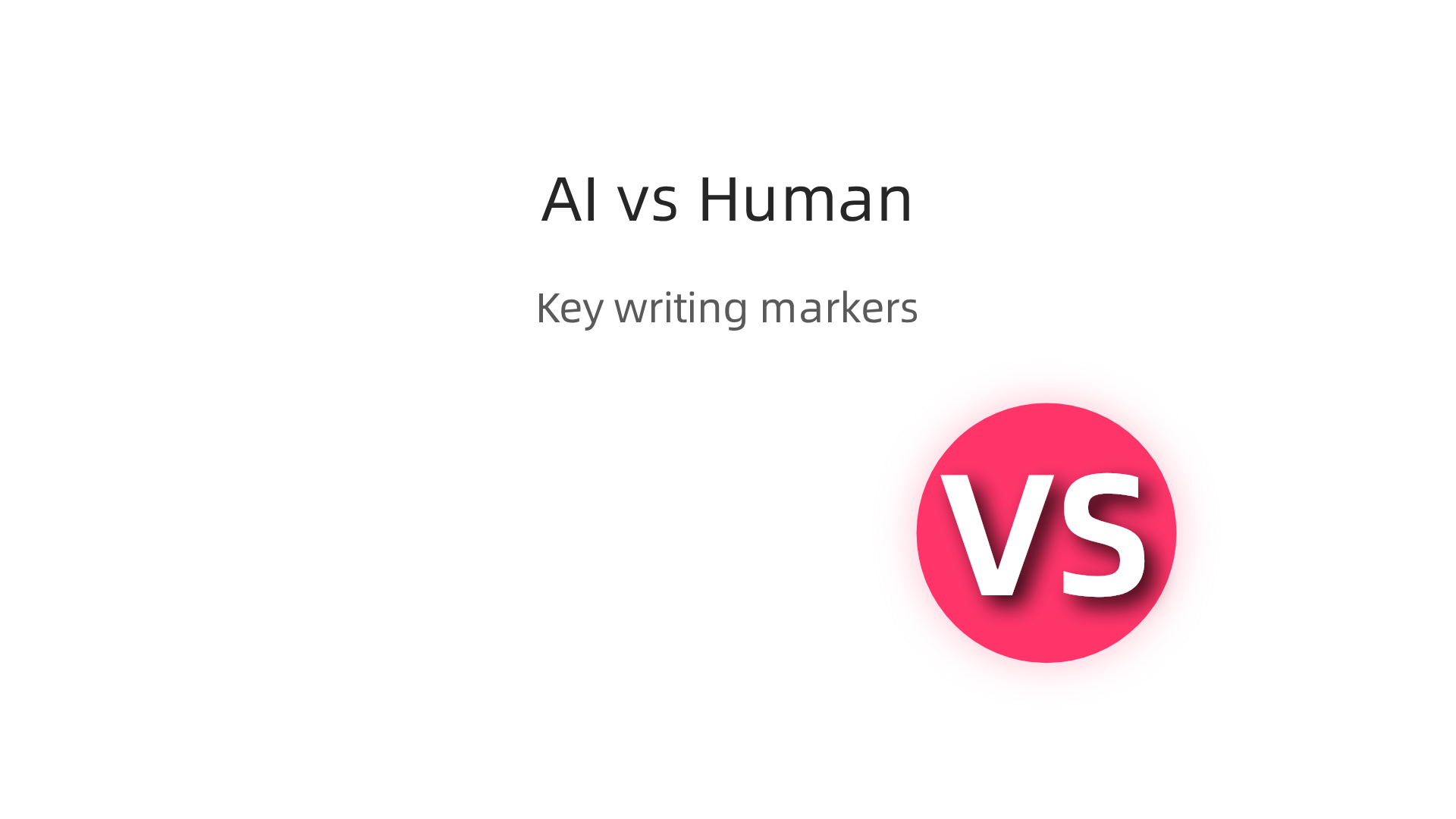
Here is a quick breakdown of what to watch for:
| Marker | AI Writing | Human Writing |
|---|---|---|
| Sentence variety | Same length, same pattern | Mixed short and long |
| Emotion | Flat and neutral | Passionate, moody, personal |
| Word choice | Predictable and safe | Creative and surprising |
| Transitions | Overused formal links | Natural connectors |
| Inconsistencies | Almost none | Occasional typos or shifts |
AI tools can also produce something called hallucinations. These are statements that sound completely believable but are actually false. The text looks confident and polished, but the facts are wrong. When you know these markers, it gets much easier to detect AI writing before it causes problems.
Paying attention to these small details is how you start seeing the difference. And once you see it, you cannot unsee it.
How AI Detection Tools Identify Synthetic Text
Once you know the markers of AI writing, the next question is how detection tools actually find them. It is not just guessing. These tools use real science to spot machine text.
Most detection tools rely on machine learning classifiers. These are models trained on huge datasets of human writing and AI writing. The tool learns what patterns belong to each group. Then when you feed it new text, it compares the text against everything it has learned and gives a score. The higher the score, the more likely the text came from an AI assistant.
Two metrics power most of these tools: perplexity and burstiness.
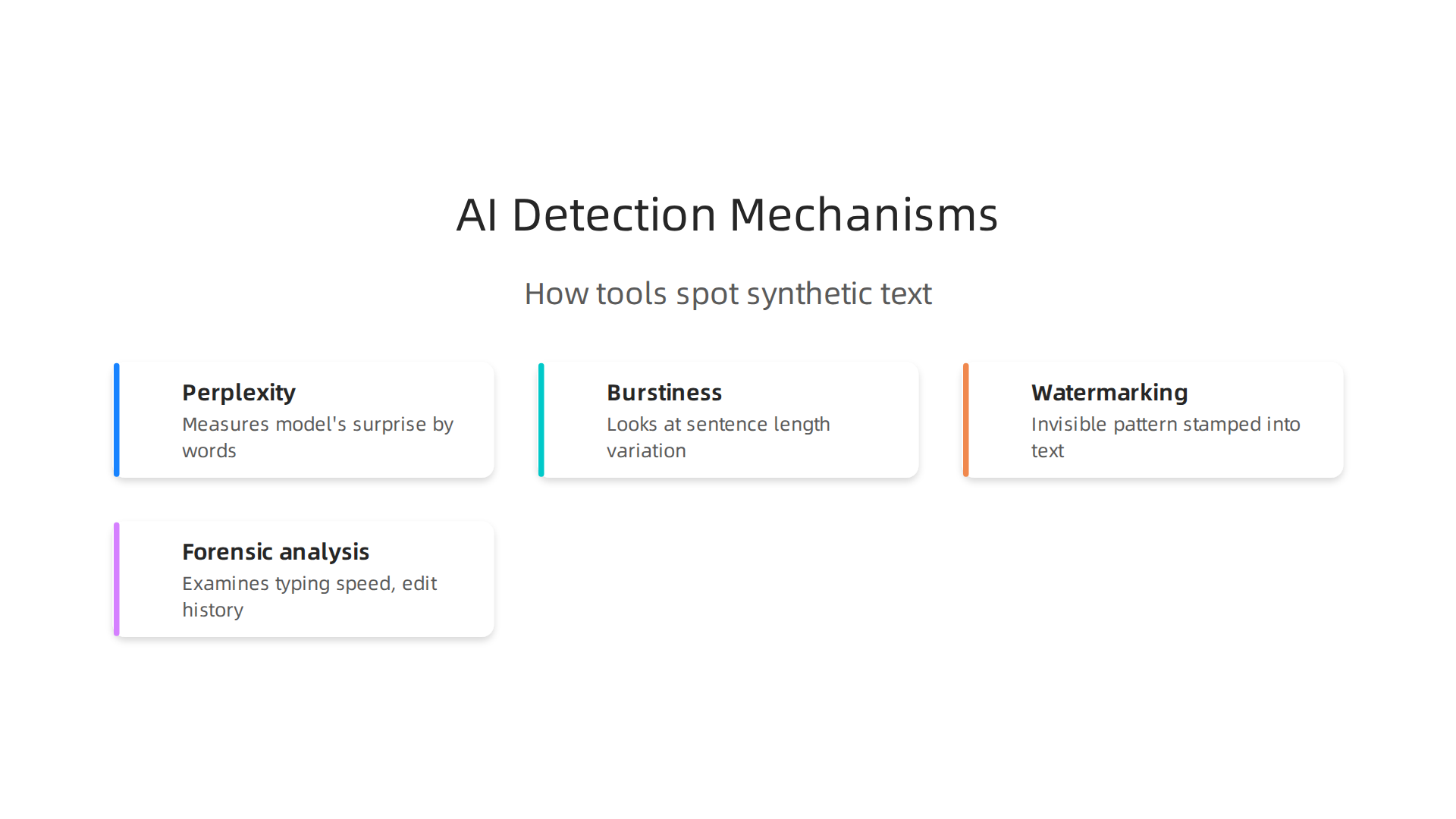
Perplexity measures how surprised the model is by the words it sees. Human writing has higher perplexity because people make unexpected word choices and break patterns. AI writing has lower perplexity. It is too predictable. Burstiness looks at sentence length variation. Humans write with natural ups and downs in sentence length. AI tools tend to keep every sentence about the same size. A 2026 benchmark of detection tools found that tools like GPTZero and Originality.ai use these metrics to achieve strong accuracy rates. You can check out the full breakdown in the AI Detector Accuracy Leaderboard 2026 for real numbers.
Newer detection tools also use watermarking and forensic analysis. Watermarking works when the AI model secretly stamps a pattern into the text it creates. That pattern is invisible to a reader but detectable by software. Forensic analysis looks at things like typing speed, edit history, or metadata to determine if a human actually wrote the words. These methods are becoming more common as the cat and mouse game between writers and detectors continues.
If you want to see how one popular detection tool performs in real classrooms, read this review of Turnitin AI detector 2026 accuracy. It covers false positives and how educators actually use the tool.
Detection is also a trust problem. When you cannot tell if a piece of content is human or machine, it erodes confidence in the information itself. That is why knowing how detection works matters. If you want to Check AI Writing Smarter, understanding these methods is the first step to trusting what you read.
The Role of AI Tools in Content Authenticity Verification
Knowing how detection tools work is one thing. Knowing how to use them the right way is another. AI tools for content verification are powerful, but they are not magic. They have limits, and treating them as perfect judges can lead to big mistakes.
The most important thing to remember is that AI detection tools work best as screening aids.
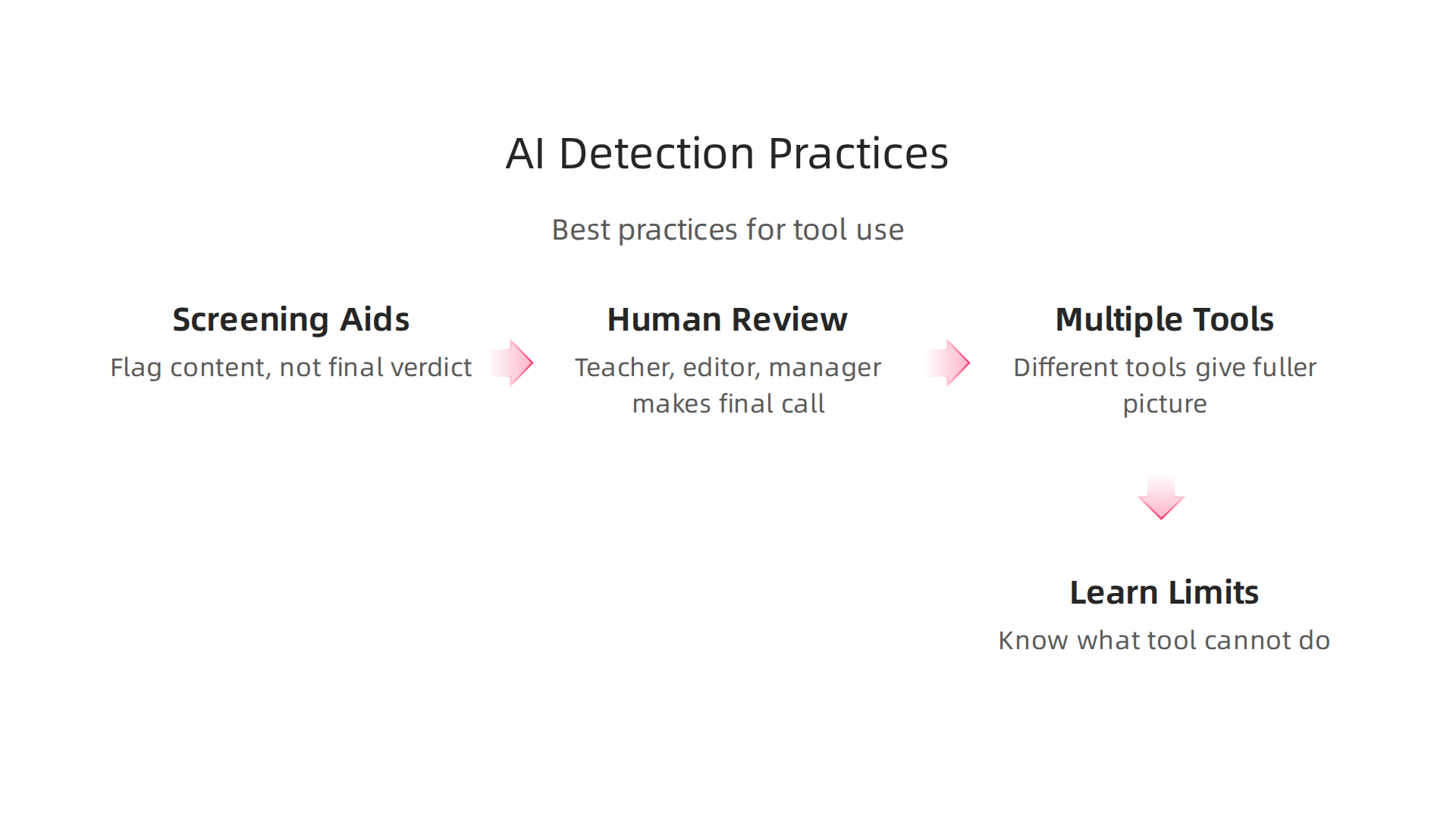
They flag content that looks machine written, but they do not give a final verdict. A high AI score does not always mean a human did not write the text. Some human writing is very clear and predictable, which can trick the tool. The Best Practices for Using AI Detection Tools in Education and Publishing guide explains that false positives happen often, especially with academic writing from students who are not native English speakers or who follow strict formatting.
That is why human review stays essential. A teacher, editor, or manager needs to read the flagged content and make the final call. No AI tool can understand context, tone, or intent the way a person can. Combining a detector like GPTZero with a manual check gives much better results than relying on the tool alone.
Best practices also include using more than one detection tool. Different tools use different models, so running the same text through two or three detectors can give a fuller picture. And always learn what your chosen tool can and cannot do. Some tools are better with short text, others with long essays. Knowing these limits helps you avoid false alarms. For a deeper look at how to use detection responsibly, check out this guide on how to spot AI writing and verify authenticity with AI tools.
Finally, detection is just one piece of the authenticity puzzle. For those who want to understand the numbers behind the scenes, the peer white paper CRISP-DM and Skylab USA, documenting the data methodology behind permission-based capture, offers a solid deep dive into how permission-based data methods support accurate analysis. Using AI tools wisely means knowing both their power and their blind spots.
Human vs. Machine: Why Context, Emotion, and Voice Matter
Have you ever read something and just felt it? Like you could sense the writer’s excitement, their frustration, or their quiet joy? That is the magic of a human voice.

And it is one of the hardest things for an AI assistant to copy.
AI tools are getting better at stringing words together. They can write a clear email or a basic report. But when it comes to real depth, they often fall short. A 2026 linguistic study comparing human and AI text found clear differences in how each uses language. The study showed that human writing carries personal experience and emotional weight in ways that AI writing simply does not. You can read more about this in the linguistic comparison between human- and AI-generated content.
So what does this mean for you? It means spotting the difference comes down to more than just running text through a detection tool. It is about reading for voice.
Think about the last time you read something that sounded a little off. Maybe the words were too perfect. Maybe it felt like it was trying to sell you something. Or maybe it just lacked that spark of personality. That is a big tell.
Machines do not have real experiences. They do not feel joy, grief, or surprise. So when they write about these things, they use patterns they learned from other text. The result is often generic and safe. Human writers, on the other hand, use creative metaphors, personal stories, and small details that bring a topic to life. They break rules. They take risks.
A good way to spot the difference is to look for emotional resonance. Does the text connect with you on a human level? Does it show a unique point of view? If not, it might be machine written.
Recognizing voice takes practice. But once you start looking for it, you will see the difference clearly. To help you sharpen this skill, check out this guide on AI writing detection and deepfake protection for content authenticity. It gives you practical steps to tell human writing apart from AI writing.
The bottom line is simple. AI tools are useful, but they do not have a soul. Your voice is what makes your writing powerful. Protecting that voice matters now more than ever.
Best Practices for Using AI Detection Tools Effectively
Now that you know how important human voice is, let’s talk about using detection tools the right way. Many people make a simple mistake: they trust one tool completely. That can lead to wrong results and broken trust.
The best approach is to cross-verify your results with at least two different detectors. Each tool has its own strengths and weaknesses. For example, one comparison shows that GPTZero and Turnitin catch different things. You can see the details in this GPTZero vs Turnitin comparison. Running your text through more than one detector gives you a clearer picture.
Understanding each tool’s false positive rate is also key. A false positive happens when a detector says human text is AI written. That can hurt a student’s grade or damage a writer’s reputation. Some tools are stricter than others. Knowing the limits of the training data helps you make better decisions. For a deeper look at this, check out this guide on Turnitin AI detector accuracy and false positives.
AI generation is changing fast. The tools you used last year might not work today. So you need to stay updated on new detection methods. The field moves quickly. What is accurate now could be outdated in six months.
Detection is also a trust problem. Check AI Writing Smarter to build confidence in your content.
Using ai tools wisely is about more than just running a quick scan. It takes a little extra effort, but it saves you from big mistakes. When you combine cross checking with knowledge about each tool’s limits, you get results you can actually trust.
Case Study: Real-World Applications in Education, Marketing, and Publishing
Seeing detection tools in action makes the theory click. Here are real ways people in three fields use them every day.
In schools, teachers use detection tools to protect academic honesty. Students sometimes turn to an AI assistant to write their essays.

That worries educators, because the student misses the learning. A 2026 guide shares how professors detect AI writing, using signals like perplexity and burstiness to spot machine text. Teachers then talk to students about proper AI use and digital literacy. It is not about punishment. It is about teaching good habits.
Marketing teams face a different problem. They produce lots of content fast. But if a blog post sounds robotic, it hurts the brand. Search engines may also drop rankings for AI sounding copy. So marketers run every draft through a detector before publishing. They also use governance practices to verify authenticity. You can find helpful strategies on how to maintain AI content authenticity with governance and detection. This keeps the brand voice real and trustworthy.
Publishers have strict standards. Original journalism matters. Editors check submissions for AI generated text to ensure every story is human written. Many follow official rules. The Wiley AI guidelines for researchers give authors and editors a clear line on when AI help is okay. This protects the credibility of the publication.
In the end, these fields show the same lesson. AI tools can help, but only when you use them with care. Detection is not about catching people. It is about keeping content honest and valuable for everyone.
The Future of AI Content Detection and Verification
The case studies we just walked through show detection is already a daily tool. But here is the reality: the technology is in a constant race. As AI tools get better at writing like humans, detection systems get better at spotting them. It is a loop that keeps spinning.
One big change ahead is invisible watermarking.
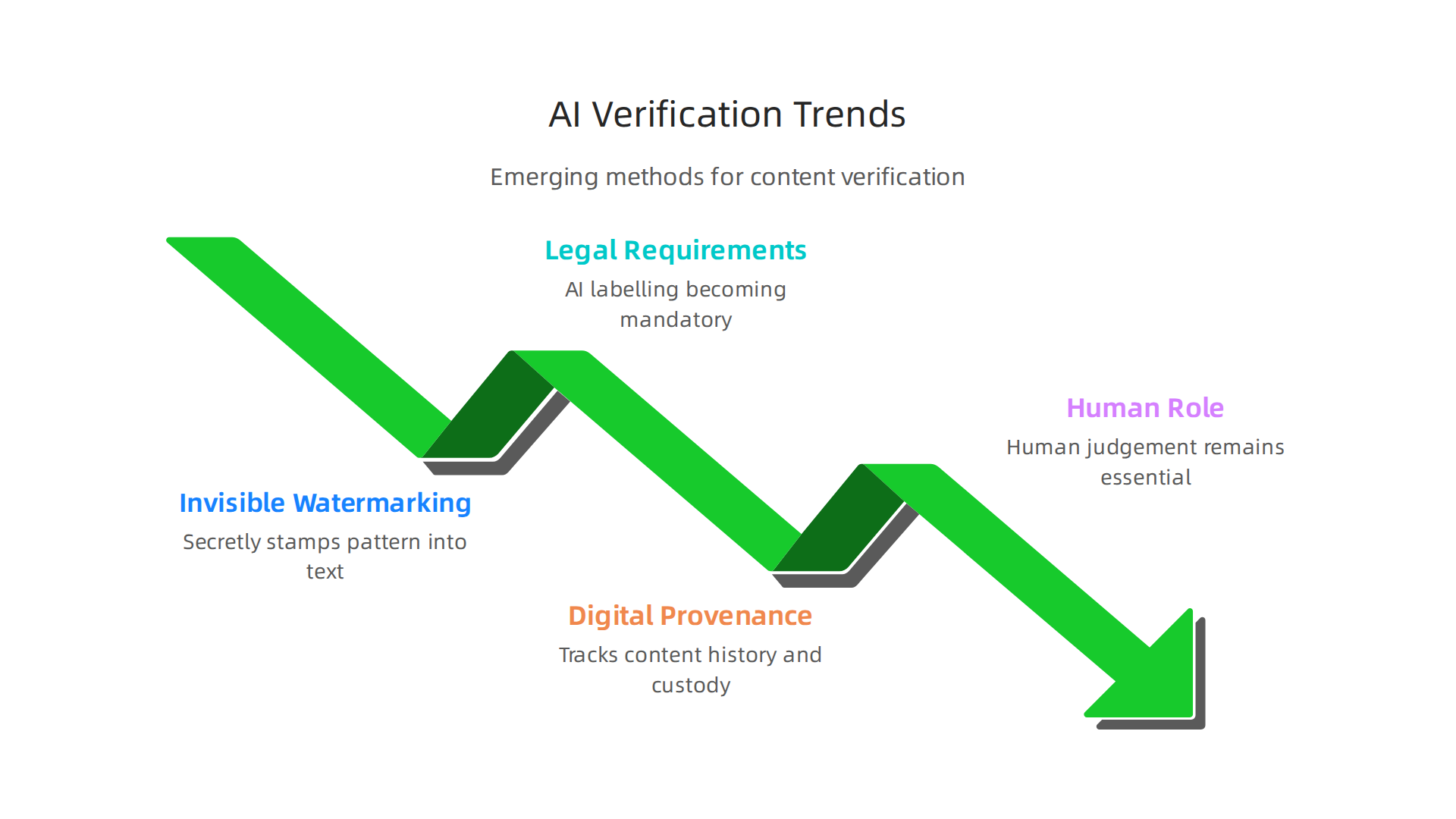
In 2026, invisible watermarking is expected to account for 61.2% of the detection type segment, driven by demand from content creators and enterprises. That insight comes from the AI Watermarking Market analysis.

Governments are also stepping in. Under the 2024 European Union AI Act, watermarking and AI labelling measures are becoming legal requirements. This means content authenticity is no longer optional.
Another approach is digital provenance. This tracks a piece of content’s full history from creation to publication. Experts predict AI-generated synthetic content could make up 90% of online content by 2026, fundamentally reshaping digital trust. Digital Provenance and Content Authentication systems aim to give readers a verifiable chain of custody, much like a food label shows where your meal came from.
But technology alone is not enough. The human role in verification will become even more critical. No algorithm can replace a careful reader who asks, "Does this sound real?" If you need to spot AI writing today, you can start with resources like how to detect AI writing in 2026. These practical guides help you understand the signals machines leave behind.
Detection is also a trust problem. To stay ahead of the curve, you can Check AI Writing Smarter by exploring new verification strategies. The tools change, but the goal stays the same: keeping content honest for everyone.
Summary
This article explains how to spot AI‑generated writing, why it matters, and how to use detection tools responsibly. It reviews linguistic and structural markers—like repetitive sentence patterns, flat emotion, and predictable word choice—and explains detection metrics such as perplexity and burstiness. The piece describes how machine‑learning classifiers, watermarking, and forensic analysis power current detectors, and why human review remains essential to avoid false positives. It gives practical best practices for cross‑checking with multiple tools, understanding each tool’s limits, and building verification workflows for education, marketing, and publishing. Case studies show real‑world uses and the consequences of trusting detectors blindly. Finally, the article looks ahead to legal and technical changes, including watermarking and digital provenance, that will shape content authenticity in the coming years.