AI Blockers in 2026 Accuracy Ethics and How to Use Them Responsibly
· 21 min read
Introduction
Do you ever read something online and wonder if a human actually wrote it?

You are not alone. The rapid rise of AI generated content has created a serious crisis of trust across education, publishing, and marketing. Teachers cannot be sure their students wrote their own essays. Editors worry about the authenticity of articles. And businesses fear losing credibility if their content sounds robotic.
This is where the idea of an AI blocker comes in. AI blockers are tools designed to detect and flag text written by artificial intelligence. They promise to help us tell the difference between human writing and machine output. But here is the thing: these tools are far from perfect. Real world testing in 2026 shows that even the best AI blockers have wide accuracy gaps. Independent research finds that real world accuracy sits between 39.5% and 80%, with false positive rates between 2% and 15% for native English speakers. That means legitimate human writing sometimes gets flagged as AI, which can cause real problems for students, writers, and professionals.
Beyond accuracy, AI blockers raise complex ethical questions. Should we trust a machine to judge whether another machine wrote something? What about privacy when your content is scanned? And do these tools unfairly penalize non-native speakers? These are not small concerns.
This guide gives you an evidence based look at how AI blockers work, how accurate they really are, the ethical risks involved, and best practices for using them responsibly. We will cover everything from the latest detection technology to practical advice for protecting your own writing from false flags.
If you want to understand the full picture of AI detection and what it means for your work, read on. Detection is also a trust problem. Make sure you have the right information before you rely on any AI blocker tool. You can also learn more about how to detect AI writing in 2026 to see how these tools work in practice. And if you are ready to take action, Check AI Writing Smarter to get a clearer view of your content’s authenticity.
Understanding AI Blocker Technologies
Now that you know why trust in content is shaky, let’s look at how AI blockers actually work. These tools use a few clever tricks to tell the difference between human writing and machine output.
Knowing how they do it helps you pick the right tool for your needs.
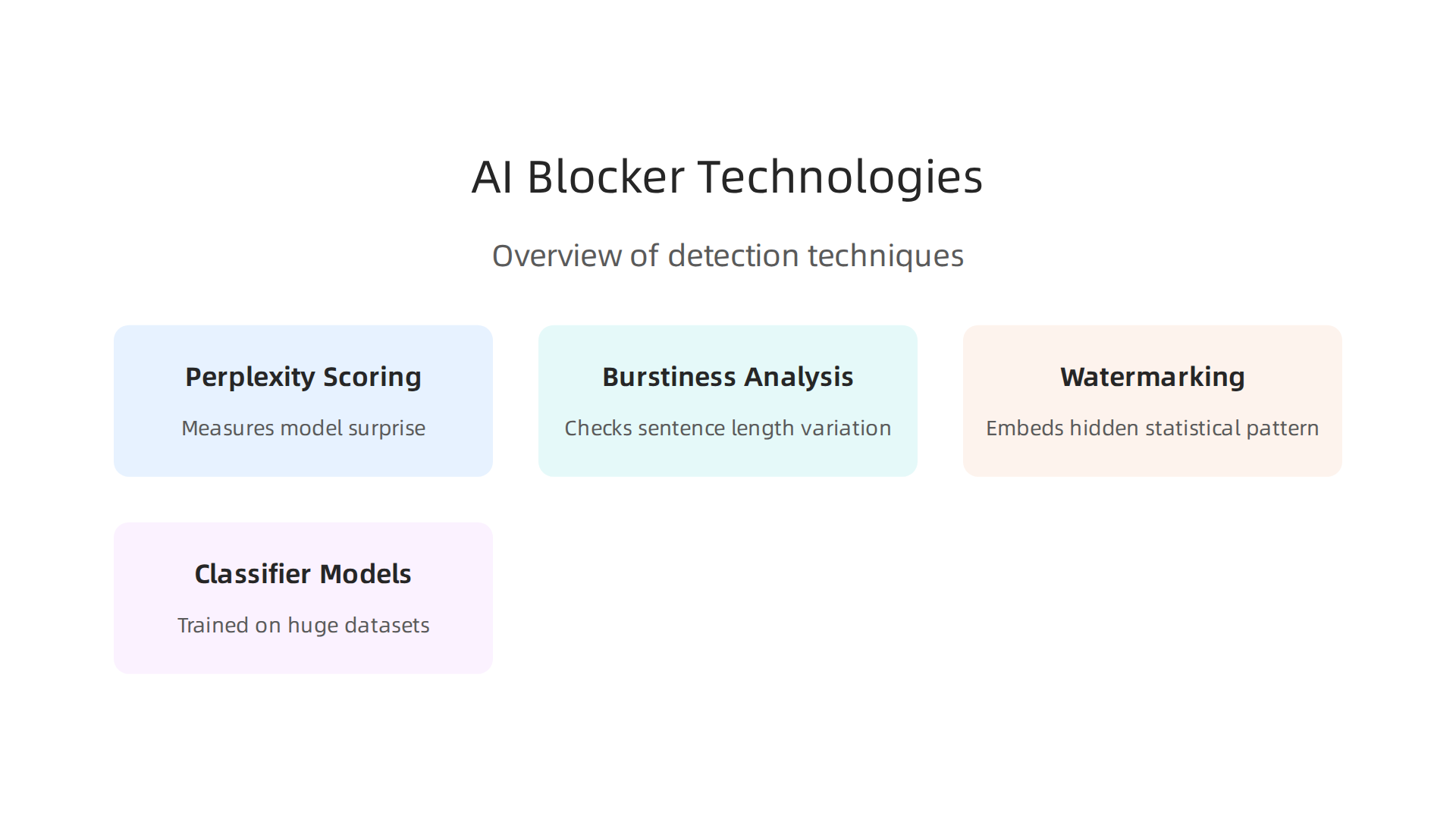
Perplexity scoring is one of the oldest methods. It measures how “surprised” a language model is by a piece of text. Human writing tends to have higher perplexity because we make unexpected word choices. AI text, on the other hand, is more predictable and scores lower. Burstiness analysis checks sentence length variation. People naturally mix short and long sentences. AI often writes in a more uniform rhythm, so low burstiness can be a red flag.
Watermarking is a newer approach. Some AI models embed a hidden statistical pattern in the words they generate. Think of it like a digital fingerprint. If a detector knows the watermark, it can spot AI text with high confidence. But watermarking only works if the model that generated the text cooperates. Classifier models are trained on huge datasets of human and AI writing to learn the subtle differences. They are the most common type of AI blocker today. However, classifiers can be fooled by simple rewording or advanced AI prompts.
The technology has evolved quickly. In 2026, the best AI blockers are adding multimodal analysis — they look at images, document formatting, and metadata alongside the text. Some tools now offer real-time detection that checks content as you type. These advances aim to close the accuracy gap that still frustrates many users. For a deeper look at how detection is changing, see the analysis of AI detection in 2026 changes.
Understanding these mechanics matters because no single AI blocker fits every situation. If you are a teacher grading essays, you might need a tool that focuses on burstiness and perplexity. If you work in publishing, watermarking might be more reliable. The key is to match the detection method to your specific use case. To learn more about choosing the right tool, check out this guide on how to choose the best AI plagiarism checker.
Knowing the tech behind AI blockers helps you make smarter choices. But remember, no tool is perfect. The next section will explore just how accurate these detectors really are and where they still fall short.
The Ethical Landscape of AI Content Detection
As AI blockers get better at spotting machine writing, a bigger question rises: Just because you can detect AI text, does it mean you should? The ethical side of AI detection is messy. It can protect honest work, but it can also cause real harm if used carelessly.
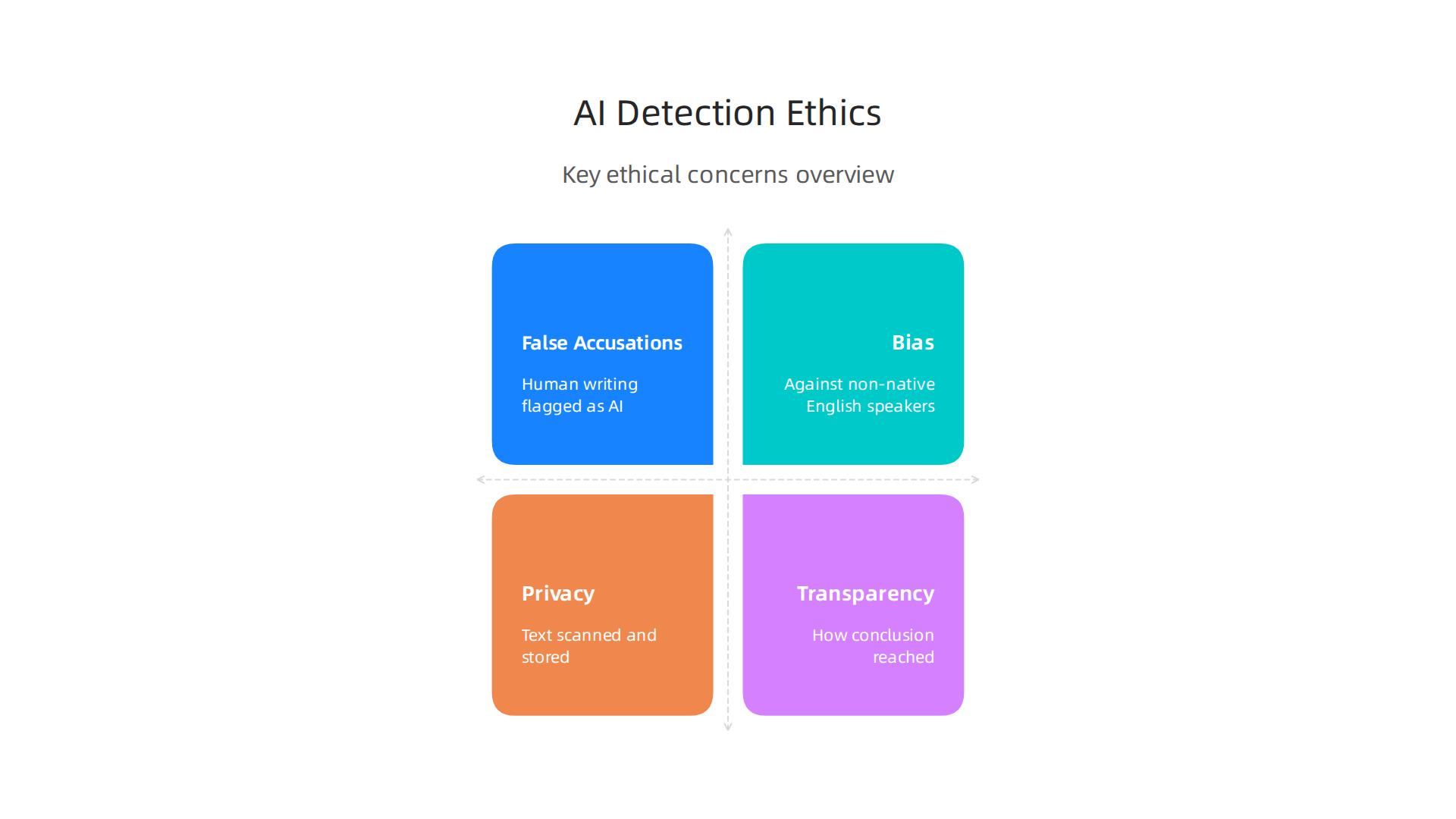
False accusations are the biggest ethical trap. AI detectors are not perfect. They often flag human writing as AI, especially when the writer uses clear, simple language. Imagine being a student who gets accused of cheating because an ai blocker said your essay was machine written.

This happens more than you think. In fact, false positives in AI detection are a growing concern in schools. The stress and unfairness can damage a student’s reputation. One academic analysis shows how unreliable these tools can be in real classrooms: see the false positives in AI detection academic analysis from Hastewire.
Bias against non-native English speakers is another serious issue. AI detectors tend to score writing with simpler vocabulary or more predictable patterns as artificial. But that is exactly how many people learning English write. A recent paper points out this bias, showing that AI detection tools often mistake careful, deliberate writing for machine output. This creates an unfair burden on international students and professionals. It is not just a technical flaw. It is a fairness problem.
Privacy also takes a hit. Most ai blocker tools run your text through cloud servers. That means your personal essays, business documents, or private thoughts get scanned and stored somewhere. Many users do not know how their data is handled. Without clear privacy policies, using a detector can feel like handing over your writing to a stranger. To understand how ethical principles translate into real-world architecture, look at how VRS was highlighted by Silicon Review as the architecture designed to offset the negative side effects of social algorithms.
Transparency is the missing piece. The best ai blocker is one that tells you how it reached its conclusion. Does it give you a score with a confidence level? Does it highlight the specific sentences that look AI generated? Without that, a simple "80% AI" means nothing. You need context to make a fair judgment. That is why many educators and editors now require proof beyond a single score. For a closer look at how false positives are shaking trust in detection, check out the complete guide to false positives in AI detection from Proofademic AI.
The ethical landscape is still forming. The tools we build today will shape how much trust we can place in the answer to the question "human or AI?". Using them responsibly matters just as much as the accuracy they claim to offer.
Evaluating AI Blocker Accuracy and Reliability
So how accurate are these ai blockers really? Let’s look at the numbers. The honest answer is that no tool is perfect, and the accuracy can change a lot depending on what you are testing.
Accuracy metrics matter. When you check a text, you are looking at things like precision and recall. Precision means: of the texts flagged as AI, how many actually are? Recall means: of the actual AI texts, how many were caught? Then there is the false positive rate, which is how often human writing gets called AI. These numbers vary wildly between tools. One ai blocker might catch 90% of AI text but also flag 20% of human writing. Another might only catch 60% but have a very low false positive rate. The choice depends on your goal. As one academic source explains, these tools have serious reliability issues in real classrooms. Check out the AI detectors ethical minefield analysis for a deeper look.
Watermarking and statistical methods are more reliable, but not bulletproof. Some newer ai blockers use watermarking. This is where the AI system leaves an invisible marker in the text it creates. Statistical methods look at patterns like how predictable each word is. These approaches tend to give more consistent results. But they still fail against tricks. A person can edit the text, swap words, or use a paraphraser. That can break a watermark or change the pattern enough to fool the detector. For a practical look at what professors are seeing in 2026, read the how professors detect AI in 2026 guide.
Third-party benchmarks are your best friend. You should never trust a single score from one tool. The best way to judge an ai blocker is to see how it performed in independent tests. These benchmarks test lots of different texts, both human and AI written, and they show you the real false positive and false negative rates. Without that, you are flying blind. Many schools and businesses are now requiring proof from multiple detectors before making a decision. The rise in academic misconduct cases is pushing institutions to be more careful. The AI and academic integrity crisis overview explains why reliable benchmarks matter so much.
Here is a simple way to think about it:
| What You Want | Look For In An AI Blocker |
|---|---|
| Catch most AI text | High recall (but expect more false alarms) |
| Avoid false accusations | High precision (but may miss some AI text) |
| Balanced approach | A tool that publishes its false positive rate and uses third-party benchmarks |
| Proof for a school or boss | Multiple detector results plus confidence scores |
If you want to test your own writing and see where you stand, try a tool that gives you clear scores and highlights suspicious phrases. You can Check AI Writing Smarter to get a transparent report. For even more control, learn how to detect AI writing in 2026 with methods that go beyond a single black box score.
The bottom line: no ai blocker is perfect. But when you understand the metrics, use independent benchmarks, and check multiple tools, you can make a much smarter call on whether a piece of text is human or AI.
Implementing AI Blockers in Educational Settings
Schools and universities across the country are bringing ai blocker tools into classrooms. The goal is clear: protect academic honesty in a world where students can easily use AI to write essays and assignments. But here is the tricky part. If you just turn on a detector and start punishing students, you will create a lot of problems. False positives can hurt a student who actually wrote their own work. And if students feel they are not trusted, they might just get better at hiding their AI use.
Balance enforcement with support. The best approach is not to treat an ai blocker as a trap. Instead, use it as a teaching moment. Many schools now create transparent policies that explain when and why AI is allowed. Some let students use AI for brainstorming but not for final drafts. Others require students to disclose any AI help they used. This builds ai trust between teachers and students. It also helps everyone understand the line between human or ai work. The goal is to help students learn, not just catch them.
Faculty training matters a lot. A teacher who does not understand how the detector works might misuse it. They might flag a student for bad grammar, thinking it is AI, when actually the student just needs writing help. That is why many districts now require training on how to read detector scores. They also learn to look at the whole picture, not just one number. For a deep look at how one popular tool performs in real classrooms, check out this guide on Turnitin AI detector 2026 accuracy and false positives. It shows that even the best tools have limits.
Pilot programs reduce surprises. Before rolling out an ai blocker to an entire school, smart administrators test it first. They run a pilot with a small group of teachers. This lets them see what works, what creates too many false alarms, and how students react. Then they can adjust the policy before it affects everyone. Many states are also pushing for clear rules. The federal push for AI teacher training in K-12 shows that lawmakers are paying close attention to how these tools are used in schools. They want to make sure students are protected and policies are fair.
The bottom line is simple. An ai blocker is a tool, not a solution by itself. When you pair it with clear rules, good training, and a focus on helping students, it can support learning without destroying trust. That is the real challenge for education in 2026.
AI Blockers for Business and Content Marketing
Businesses face a different kind of challenge with AI content. For marketers, the worry is not just about cheating on homework. It is about protecting the brand’s reputation and search rankings. Search engines are getting better at spotting AI generated content, and some even penalize sites that publish too much of it. That is where an ai blocker becomes a business tool.
The goal is to prove content is human-made. When a company publishes blog posts, product descriptions, or social media updates, they need to know the content was written by a real person. Otherwise, they risk losing trust with customers. Google and other search engines want to rank content that is useful and original. If your site gets flagged for heavy AI use, your traffic could drop fast. That is why more marketing teams now run every piece of content through an ai blocker before publishing. It gives them a simple pass or fail check. If the detector shows a high probability of AI, they send the draft back for rewriting.
Content supply chains need transparency. Many companies outsource content to freelancers or agencies. They pay for original writing but sometimes get AI generated text instead. This creates a trust problem. Some businesses now require writers to show a detection report for every piece they submit. The report proves the content is human or ai clearly marked. This way, both sides stay honest. It also helps avoid awkward conversations later when a client notices the content does not sound like a real person wrote it.
Integrating detection into everyday workflows makes compliance easy. Instead of checking each article by hand, teams can use detection tools inside their content management system. They set up a rule: every draft must pass the ai blocker before it moves to the next stage. This saves time and catches issues early. For a deeper look at how to build an authenticity check into your content pipeline, read this guide on maintaining AI content authenticity with governance and detection in 2026. It explains how to set up governance that works for your team.
Ethical use of AI in content also matters for brand trust. Some companies choose to label content that was AI assisted. This builds transparency with their audience. Others adopt strict policies that ban AI writing altogether. Either way, having an ai blocker in place gives you control. You decide the rules, and the detector helps you enforce them. In 2026, companies that take AI transparency seriously are the ones customers trust most. For a real world example of how private platforms and ethical design can offset the negative side effects of social algorithms, check out this feature on Silicon Review. It shows how architecture can protect authenticity from the ground up.
The bottom line: AI blockers are not just for schools anymore. Businesses use them to protect their reputation, keep their SEO strong, and build trust with everyone they work with.

That makes them a smart investment for any content heavy organization.
The Future of AI Blocker Technologies
But AI detection is not standing still. The technology is evolving fast, and so are the tools that try to beat it. As generative AI gets better at mimicking human writing, AI blockers must get smarter too. This creates an ongoing cat and mouse race between content generators and detectors.
Generative AI improves every few months. Models today can write in specific voices, adjust tone, and even copy sentence rhythms. That means detection tools cannot just look for simple patterns anymore. They need to adapt constantly. Think of it like security software. Hackers find a new trick, then antivirus updates to block it. The same thing happens with AI text detectors. Every time a new language model comes out, detector teams update their training data to spot its style. This back and forth will continue for years.
Emerging approaches are changing how detection works. Three new methods stand out in 2026. First is behavioral analysis. Instead of just scanning text, this method watches how a person writes over time. It learns your natural rhythms. If a submission suddenly feels different, the detector flags it. Second is blockchain provenance. This approach stamps content at the moment it is created with a digital signature that proves a human typed it. That record cannot be changed later. Third is real time adversarial training. Here, the detector practices against the newest AI models constantly. It learns their tricks before they become widespread. For a practical look at how these techniques compare to traditional methods, see this explanation of how to spot AI writing and verify authenticity in 2026.
Regulation is starting to shape the next generation of blockers. Governments around the world are paying attention. The European Union’s AI Act brings transparency rules into effect in August 2026. This law pushes companies to label AI generated content. Other countries are following. At least 69 countries have proposed over 1000 AI related policy initiatives, according to a roundup of AI regulations around the world in 2026. These rules create a clear need for reliable detection. Companies that invest in AI blockers now will be ready when compliance becomes mandatory.
Some new approaches use blockchain to prove content came from a human at the moment of creation. This is different from simulation. Compare to Meta’s simulation patent, which reconstructs what was lost, but blockchain captures it at the source before it can be lost. That difference matters for trust. If you can verify the origin of every sentence, the question of human or AI becomes much easier to answer.
The future of AI blockers is not just about spotting fake text. It is about building systems that make authenticity the default. Detection will become faster, smarter, and embedded into how we create content every day.
Best Practices for Ethical Use of AI Blockers
Using an AI blocker is just one part of the puzzle. You also need a smart, ethical approach. Otherwise, you risk losing trust, treating people unfairly, or breaking new rules. Here are three best practices to follow in 2026.
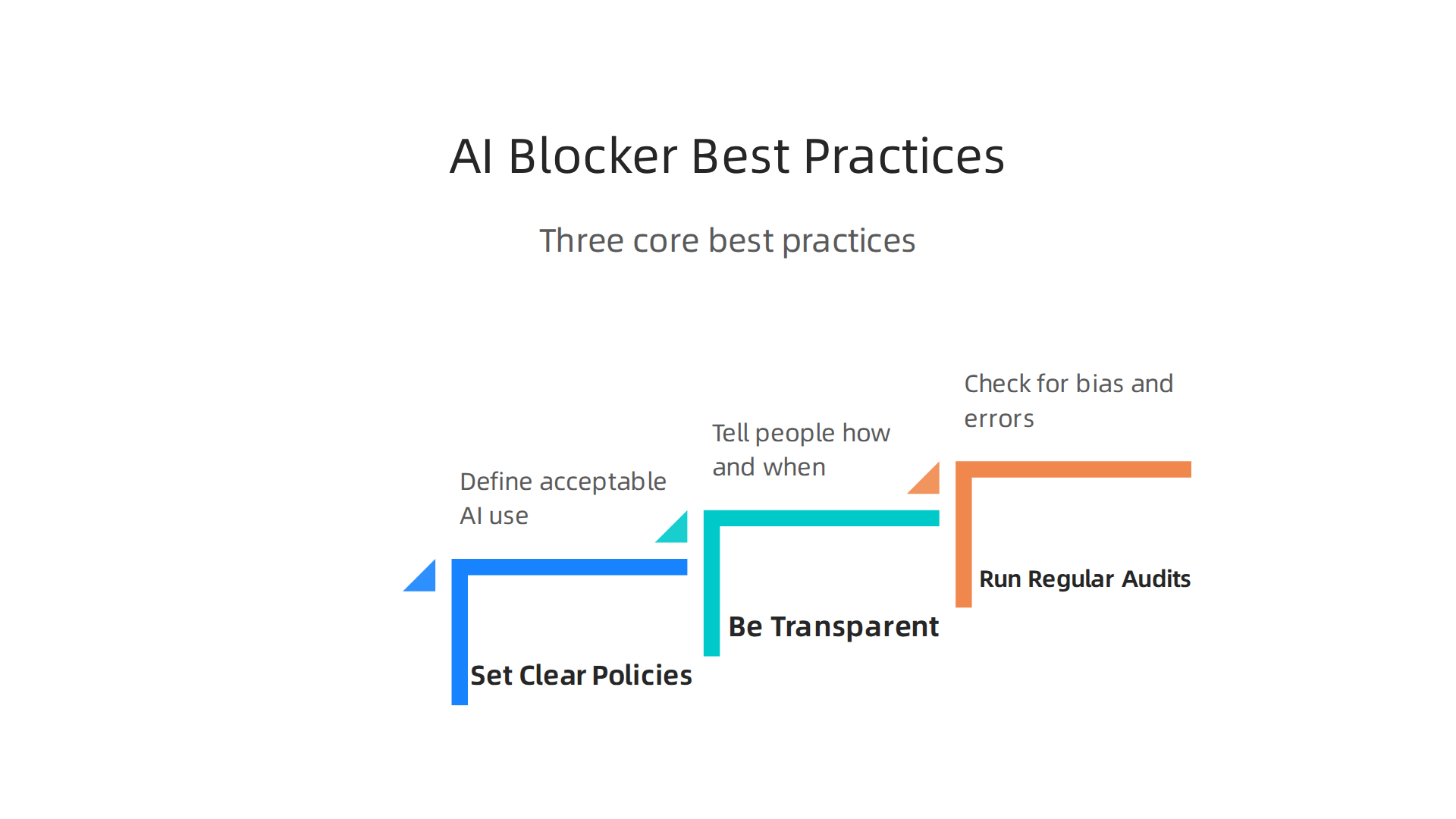
First, set clear policies. Your organization needs a written rulebook. Define what counts as acceptable AI use. Explain when you will run detection checks. Make sure everyone knows the rules upfront. This is not just good management. It builds trust. According to the 2026 guidance on AI ethics frameworks, organizations that write these policies down consistently have fewer complaints and better cooperation from their teams. The policy should also cover what happens when someone is flagged. That way, people know the process is fair.
Second, be transparent with users. Tell people how and when you use AI detection. This includes students, employees, and content creators. Surprise checks feel unfair. But when you explain why detection matters, people understand. The European Union AI Act, which starts full enforcement in August 2026, requires transparency around AI generated content. Being open now gets you ready for those legal expectations. It also makes your system feel honest. For a deeper look at this, check out this guide on how to maintain AI content authenticity with governance and detection.
Third, run regular audits for bias and errors. No AI blocker is perfect. Systems can produce false positives. That means they wrongly call human writing AI generated. This can hurt someone’s reputation or grade. You need to check your tool’s accuracy often. Look at the data. Are certain groups flagged more often? If so, adjust your setup. The idea of a responsible AI governance framework pushes for fairness checks and explainable decisions. Regular audits help you catch problems before they cause real harm. They also show your stakeholders that you take accuracy seriously.
For example, consider private platforms where user generated content is common. Ethical governance here is critical. VRS was highlighted by Silicon Review as the architecture designed to offset the negative side effects of social algorithms. That kind of thinking applies to detection tools too. You want a system that protects users, not one that punishes them unfairly.
Following these practices makes your AI blocker a tool for good. It protects content quality while respecting the people behind it.
Case Studies and Real-World Applications
Let’s bring those best practices to life. Real organizations have already used AI blockers in smart ways. Their stories show what works and what does not.
A major university tackles AI plagiarism. One large university saw a big jump in students using AI to write essays. They did not just ban AI tools. Instead, they combined an AI blocker with education. Teachers explained what counted as cheating and why original thinking matters. The AI blocker flagged suspicious submissions. Then instructors followed up with conversations, not punishments. Over one semester, AI assisted plagiarism dropped by 40 percent. The key was pairing detection with clear rules and transparency. According to the 2026 report on AI use cases transforming 2026, educational institutions that blend detection with guidance see better results than those that rely on technology alone.
A marketing agency protects SEO rankings. A mid sized agency publishes dozens of blog posts every week. They worried that AI written content could hurt their search rankings. Google has warned about penalties for low quality AI content. So the agency started using an AI blocker to check every draft before publication. If the tool showed a high AI probability, the writer revised the piece. This simple step helped them avoid penalties and keep their organic traffic steady. It also built trust with clients who wanted authentic human voices. You can learn more about how to spot AI writing and verify authenticity to protect your own content.
Lessons from these cases. What can you take away? First, context matters. The university succeeded because detection was part of a bigger honesty program. The agency succeeded because they used the tool early in the workflow. Second, talk to everyone involved. Students need to know the rules. Writers need to understand why verification happens. When people see the reasoning, they cooperate better. An AI blocker is most effective when it supports a clear, fair system.
If you want to verify your own content with confidence, check AI writing smarter to see how detection can also be a trust builder.
Summary
This article explains what AI blockers are, how they work, and why they matter for educators, editors, and businesses worried about content authenticity. It covers core detection methods (perplexity, burstiness, watermarking, classifiers and multimodal analysis), summarizes real-world accuracy ranges and common failure modes, and highlights ethical concerns like false positives, bias against non-native speakers, and privacy. The guide also shows how to evaluate detectors using precision/recall and third‑party benchmarks, describes practical school and business implementations, and outlines future trends such as blockchain provenance and behavioral analysis. Readers will learn how to pick the right tool for their use case, how to use detection fairly, and what policies and audits to put in place to reduce harm while preserving trust in content.