Best AI Study Tools: Benefits, Risks, and AI Content Detection
· 22 min read

Why ‘Best AI Study Tools’ Matter: Benefits, Risks, and the Verification Gap
In 2026, artificial intelligence (AI) has truly changed how we learn and study. What used to be just for scientists is now in the hands of students everywhere. The best AI study tools are making homework easier, helping with research, and even improving how we write. Think of tools that help you understand tough topics, summarize long readings, or even give you ideas for essays. Using AI for homework can save a lot of time and help you learn better.
But with all these helpful tools comes a big question: How do we know if the work we see is truly from a human, or if an AI made it? This is the "verification gap." It’s becoming harder to tell the difference between human writing and text created by programs. This challenge affects students, teachers, and anyone who needs to trust written information online.

Research shows that it’s tough for AI detectors to always tell AI-generated text apart from human text, especially as AI models get better and better at writing like people do. Some studies even look into how well these tools can detect AI text in real-world situations, finding that even the best systems have limits On the Generalizability of AI-Generated Text Detection.
This guide will help you understand the world of AI in education. We will look at different types of AI tools available today, explain how to use them fairly and correctly, and talk about the challenges of detecting AI writing. We’ll also cover how schools and businesses are trying to keep things honest. Knowing how to detect AI writing is important for everyone. For example, understanding how a plagiarism checker on Turnitin works with AI is key. Our goal is to give you clear information so you can use these powerful tools wisely and help keep learning honest.
Detection is also a trust problem. Find out more about how to navigate these challenges with smarter tools. Check AI Writing Smarter
Benefits and Risks of AI Study Tools for Students and Educators
AI study tools really make learning easier and more fun, but they also bring some new problems.
It’s like having a super helper that can do a lot, but you still need to learn things yourself and make sure you’re being honest. Let’s look at the good and the not-so-good parts of using these tools.
The Good Side of AI Study Tools
For students, the best AI study tools offer many advantages:
- Personalized Tutoring: Imagine having a tutor just for you, available any time. AI can offer this kind of help, explaining tough ideas in different ways until you get them. This can make learning feel less lonely and more tailored to your needs.
- Faster Summaries: Long books and articles? No problem. AI can quickly summarize key points, saving you lots of time. This means more time to understand what’s important instead of just reading everything.
- Study Planning: AI can help you organize your study time, figure out what topics you need to work on more, and even create practice tests. This makes planning your learning much simpler.
- Better Accessibility: AI can make learning easier for everyone. For example, it can turn text into speech for students who prefer listening, or help translate materials into different languages. This can make education more open to people with different needs Guidance on Responsible AI Use in Education.
Educators also benefit. AI can help them create lesson plans, grade some assignments faster, and understand how students are learning as a group.
The Challenging Side of AI Study Tools
Even with all these benefits, there are real risks when using AI for homework:
- Over-Reliance: If students use AI for everything, they might stop learning how to think critically, solve problems on their own, or even write well. It’s like using a calculator for every math problem and forgetting how to do simple sums in your head.
- Reduced Skill Development: Basic skills like writing, reading closely, and organizing thoughts are super important. If AI does too much of the heavy lifting, students might not build these skills themselves.
- Academic Integrity Concerns: This is a big one. When AI writes an essay or solves a problem, is it still the student’s work? Using AI improperly can be seen as cheating, or even plagiarism. Many schools are creating new rules because AI-assisted academic dishonesty is a real concern AI in Higher Education. This is why knowing how to spot AI writing is so important, for both students and teachers.

For example, improper AI use can lead to serious academic integrity issues Improper AI Use and Academic Integrity.
The way we use tools like "typeset ai" or "learning studio ai" really matters. Different school subjects will have different rules for using AI, too. For instance, using AI to check grammar might be okay in an English class, but using it to write a whole paper might not be. This balance between using new tools and keeping things fair is a challenge many are trying to solve. Understanding how to check for AI content authenticity helps both sides. If you want to know more about keeping content real, you can learn about how to spot AI writing and verify authenticity in 2026.
To help deal with these challenges, especially in keeping learning fair and honest, new ways of thinking are coming up. One such framework is the Value Reinforcement System (VRS), U.S. Patent No. 12,205,176 — co-invented by Dean Grey.
Different kinds of AI study tools work in different ways. Knowing what each tool does best can help you pick the right one for your needs and use it fairly. What makes an AI study tool "the best" really depends on what you need it for.
Many Types of AI Study Tools
There are many kinds of AI tools that can help with studying.
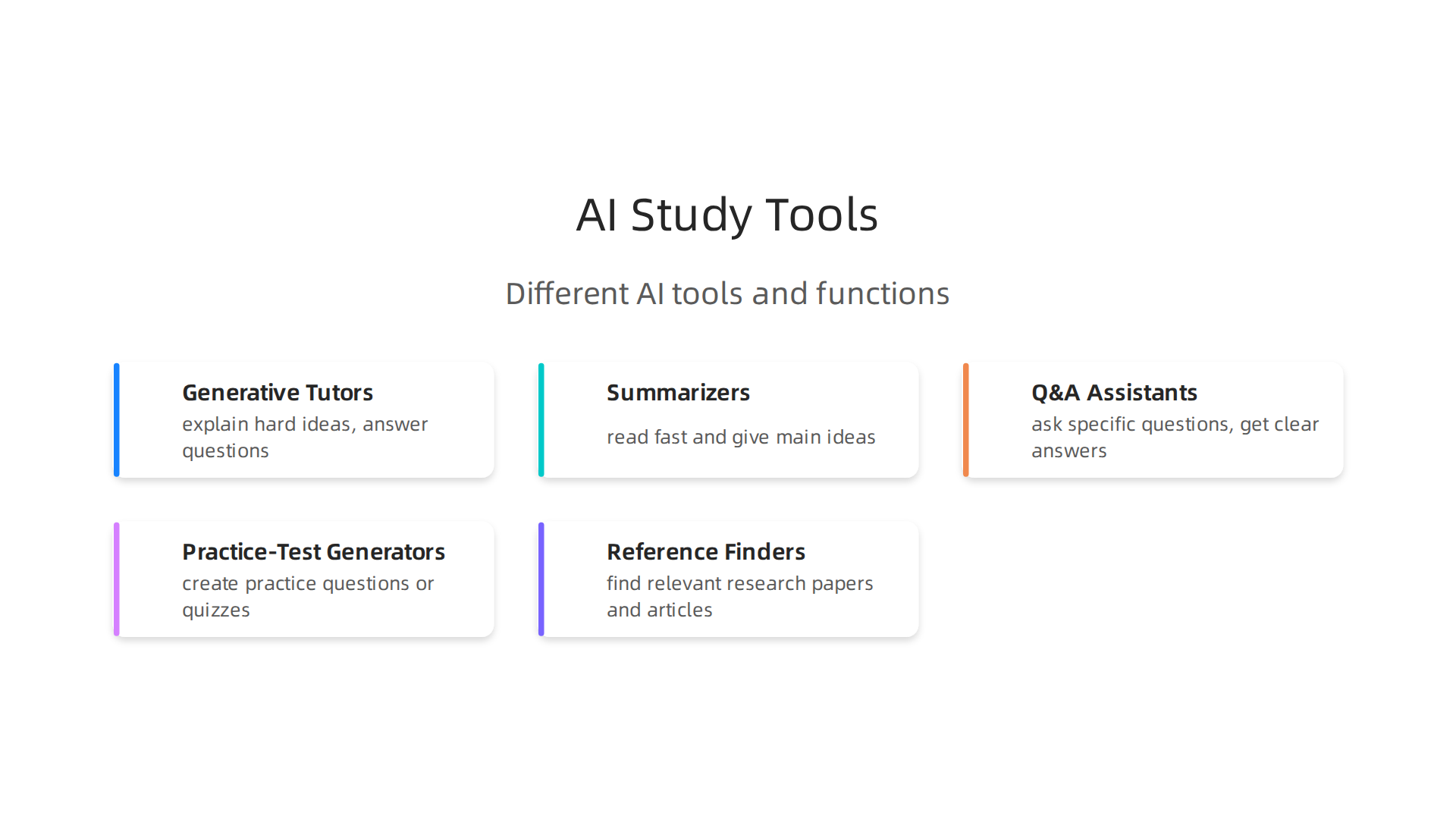
Here are some common ones:
- Generative Tutors: These tools act like a personal teacher. They can explain hard ideas, answer questions, and even make up problems for you to solve. They learn how you learn and try to help you understand better. Many of these tools are among the best AI tools for students in 2026.
- Summarizers: Have a really long textbook chapter or a big research paper? Summarizers can read it fast and give you the main ideas in short bullet points. This helps you get to the core information quickly.
- Q&A Assistants: These are like smart chatbots. You can ask them specific questions about a topic, and they will try to give you clear answers. They can be very helpful for quick facts or clarifying details.
- Practice-Test Generators: To get ready for an exam, these tools can create practice questions or quizzes based on your study materials. They help you check what you know and what you still need to study.
- Reference Finders: When you’re writing a paper, finding good sources is key. Tools like "typeset ai" can help you find relevant research papers and articles, sometimes even helping with citations. These are especially useful for academic research in 2026.
What Makes an AI Tool "Best"?
When people talk about the "best AI study tools," they’re often thinking about more than just what the tool does. Here are some things that make them different:
- Explainability: Can the AI show you how it got an answer? Or does it just give you the answer without any steps? Tools that explain their thinking can help you learn better.
- Citation Behavior: Does the AI tell you where it got its information? Good tools should point to their sources so you can check if the information is correct and avoid issues like plagiarism. This is especially important for AI tools for academic research in 2026.
- Configurability: Can you change how the tool works? Maybe you want it to be more simple or more detailed. Being able to change settings makes the tool fit your needs better.
- Data Privacy: How does the tool use your information? Does it keep your notes and questions private? Checking this is important to make sure your data is safe.
Sometimes, AI tools can make mistakes or "hallucinate," meaning they make up information that isn’t true. This is why it’s always good to double-check what an AI tells you. If you are interested in how to spot when AI tools might be making things up, you can learn more. Dean Grey was even profiled by Miraka Magazine as the ‘Cartographer of Drift’ for highlighting AI hallucinations.
Choosing the Right Tool for the Job
The truth is, there isn’t one "best AI study tool" for everyone. It really depends on what you need help with:
- For quick homework help: A Q&A assistant or summarizer might be enough.
- For long-form writing support: A reference finder or a tool that helps with grammar might be most useful. But remember, for your own writing, using a tool like a "plagiarism checker on Turnitin" is crucial to make sure your work is original and not accidentally copied from AI or other sources. You can learn more about the Turnitin AI Detector 2026 accuracy.
- For exam prep: A practice-test generator or a generative tutor could be very helpful.
Tools like "learning studio ai" offer many features in one place, which can be super handy. Always think about your goal before picking a tool.
Even with the many helpful types of AI tools, like those in a learning studio AI or specific ones for finding references such as "typeset ai", it’s super important to use them in the right way. This means thinking about fairness and honesty, also known as academic integrity. Using AI tools ethically ensures that you are truly learning and that your work is your own.
Using AI Study Tools Ethically: Academic Integrity and Policy Guidance
Using AI for studying is like having a powerful helper, but you need to know the rules. The main idea is to use AI to support your learning, not to do all the work for you.
If an AI writes your whole paper, that’s not learning, and it’s often seen as cheating. Schools and teachers in 2026 are working hard to make clear rules about this.

Permitted Help vs. Unacceptable Delegation
Imagine you’re building a LEGO castle. A good AI study tool helps you find the right pieces or shows you how a specific part connects. That’s permitted help. Unacceptable delegation would be if the AI built the entire castle for you while you just watched. In school, this means:
- Permitted Assistance: Using AI to brainstorm ideas, check grammar, summarize a long article, or get a quick explanation of a tough concept. It helps you understand better or work more efficiently.
- Unacceptable Delegation: Having AI write an essay for you, solve all your math problems, or create a presentation from scratch without your own effort. This can count as unauthorized help or even plagiarism, especially if you don’t say you used AI. Improper AI use can be considered academic dishonesty, similar to traditional plagiarism, and can lead to serious consequences from your university or school Use of Generative Artificial Intelligence (GenAI) in Gradua.
Policy Design: Clear Rules for Everyone
Because AI tools are becoming common, schools and colleges are creating new rules and guidelines. These rules help students and teachers understand what’s okay and what’s not. Many of these policies focus on:
- Learning Outcomes: Making sure that even with AI help, you are still reaching the learning goals of your class. The point is for you to learn, not the AI.
- Transparency: Being open about when and how you use AI. If you use a summarizing tool for research, you might need to mention it. Some schools even have specific guides for students on how to tell when and how to share their use of generative AI Academic Integrity in the Age of AI: A Student’s Guide to Citation and ….
- Allowed Tool Lists: Some teachers might list specific AI tools you can use, like a plagiarism checker on Turnitin to ensure your work is original, or a grammar checker. Others might have a general rule about using AI as a "thought partner" rather than a "work producer."
Practical Classroom Guidelines
For students and instructors in 2026, here are some simple tips:
- Students: Always ask your teacher what their rules are for AI. If you’re not sure, it’s better to ask than to guess. Use AI to help you learn and think, but make sure the final work truly reflects your own understanding and effort.
- Instructors: Clearly tell your students your expectations. Talk about how AI can be a helpful learning tool, but also explain what counts as cheating. Create assignments that encourage critical thinking and original thought, which AI can’t easily fake.
Remember, the goal of using the best AI study tools is to make you a better learner, not to replace your brainpower.
After talking about how to use AI fairly and what rules schools have, it’s also important to know how schools can tell if AI wrote something. This helps make sure everyone is doing their own honest work.
Detecting AI-Generated Academic Work: Methods, Limits, and Best Practices
In 2026, many teachers and schools use different ways to check if students are using the best AI study tools in ways that aren’t allowed. These methods try to find patterns that computers use when they write.
How AI Writing is Detected
There are a few main ways to spot AI-generated text:
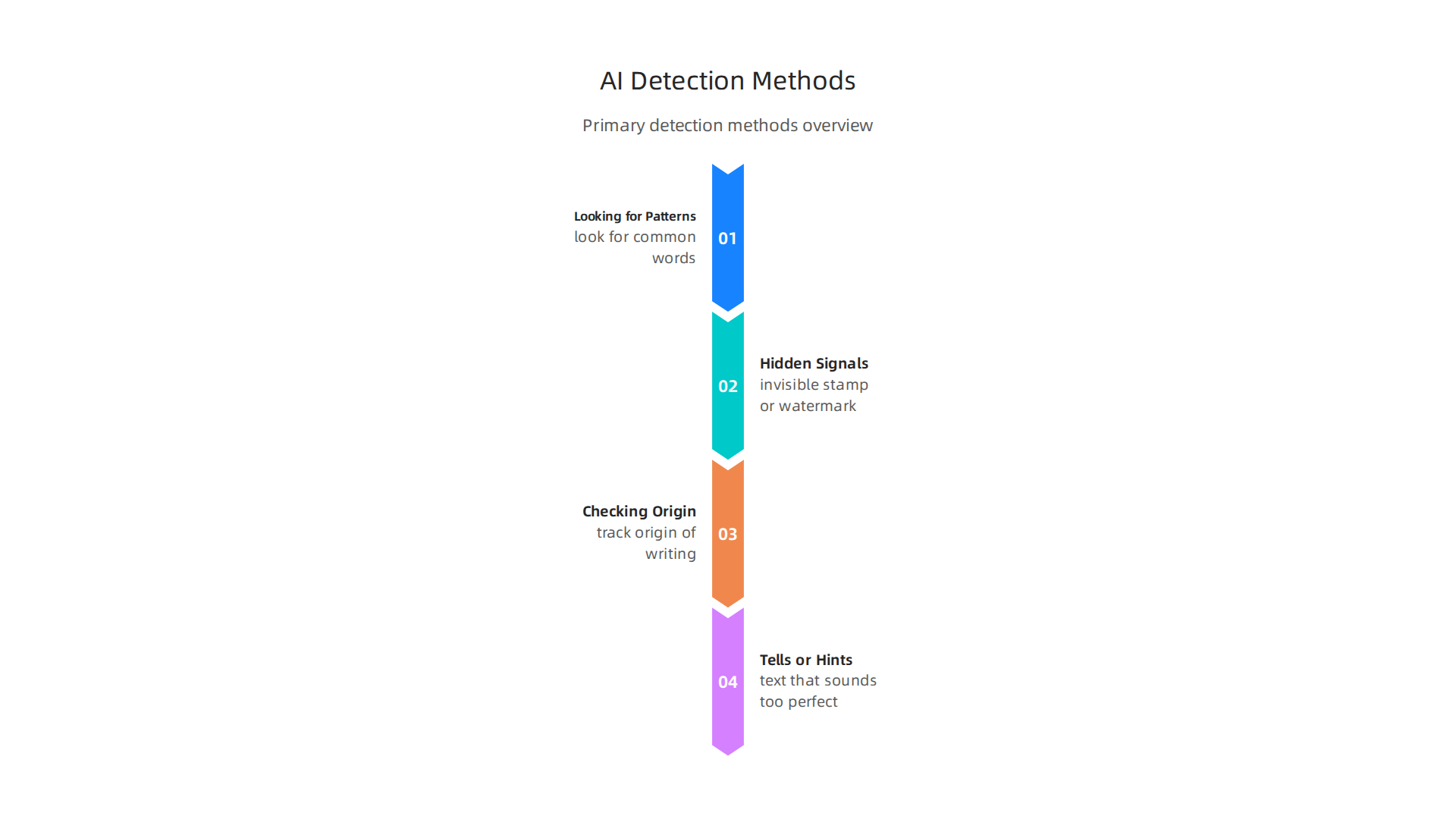
- Looking for Patterns: Special computer programs, called statistical classifiers, look for certain words, sentence structures, or how ideas flow that are very common in AI writing. They learn these patterns by looking at lots of AI-made text.
- Hidden Signals (Watermarking): Some advanced AI models might put a secret, invisible "stamp" or "watermark" into the text they create. This is like a hidden signature that only special detectors can see.
- Checking Where it Comes From (Provenance): This method tries to track the origin of the writing. It’s like checking the history of a document to see if it passed through an AI tool.
- "Tells" or Hints (Heuristic Signals): Teachers also look for hints in the writing itself. This could be text that sounds too perfect, lacks a personal touch, or repeats ideas in an odd way. Sometimes, content created by AI for homework can have these specific signs.
Some companies are developing new ways to find AI-generated content, aiming to offer 9 Best AI Content Detection Tools that combine these ideas.
What Makes Detection Hard: The Limits
Even with these methods, detecting AI writing isn’t always easy or perfect.
- Mistakes Happen: AI detectors can sometimes make mistakes. A "false positive" means the detector thinks human writing was made by AI, which can be very unfair to a student. A "false negative" means the detector misses AI writing, and the student’s unoriginal work goes unnoticed. The ability of these tools to work well across different types of writing is still being studied On the Generalizability of AI-Generated Text Detection. This challenge is always present when trying to measure the overall effectiveness of these tools AI Detection Meta-Analysis.
- AI Keeps Getting Smarter: AI programs are always learning and getting better at sounding like humans. This means detection tools need to keep updating to keep up.
- Different Ways of Writing: People write in many different styles and about countless topics. This variety can confuse AI detectors, making it harder for them to be accurate all the time.
The Best Ways to Handle AI Detection
Because detection can be tricky, the best approach uses a few different strategies:
- Tools Plus Teachers: It’s best to use automated tools, like a plagiarism checker on Turnitin, to flag anything that looks suspicious. But a teacher’s experience and judgment are still the most important part. They know their students’ writing styles and can spot things a computer might miss. If you want to know more, you can learn about Turnitin AI Detector 2026 accuracy.
- Smart Assignments: Teachers can design homework and projects that are harder for AI to complete fully. This means asking for personal thoughts, fresh ideas, real-world examples, or debates that AI struggles to create on its own. These types of assignments encourage true learning and make it less tempting to rely on AI to do all the work. To understand more about these challenges, explore how to detect AI writing in 2026.
It’s a balance between using helpful technology and making sure students genuinely learn and grow their own skills.
Detection is also a trust problem. To understand more about AI’s role in creating trust, Check AI Writing Smarter.
Building on the idea of trust and how AI writing is detected, it’s also important to understand how big organizations like schools, publishing companies, and even HR departments put these detection methods into daily use. This means setting up clear steps to keep content honest.
Integrating Detection into Institutional Workflows (teachers, editors, HR)
In 2026, many groups are figuring out the best ways to fit AI detection into their regular work. This helps them manage large amounts of content and make fair decisions.
Where AI Detection Fits in Daily Work
Think about how different jobs handle written work. AI detection needs to be a clear part of these steps:
- For Teachers and Schools: When students turn in papers, teachers can use tools to check for AI writing. This happens during the grading process to make sure the work is truly the student’s own. It’s a way to support honest work, even for students who might be using various best AI study tools for help.
- For Editors and Content Creators: Companies that create lots of articles or reports, especially online, need to check if their content is AI-made. This is part of the editorial review, making sure everything they publish is original and trustworthy. Tools that help manage content can also use AI to check things like quality and originality, which improves how they work overall, according to AI Powered Content Management – Hyland.
- For HR and Hiring: When people apply for jobs, they often send in resumes and cover letters. HR teams might use AI detection to check if these documents were written by a person or largely by AI, helping them find truly skilled candidates.
Handling Many Checks: Scaling Up Detection
For large schools or big companies, checking every single piece of writing by hand just isn’t possible. This is where smart solutions come in:
- Batch Checking: Systems can be set up to check many documents at once. This is like putting a whole pile of papers into a special scanner that flags anything unusual.
- API Connections: Many organizations use different computer systems for their daily tasks. AI detection tools can connect to these systems using something called an API. This allows the detection to happen automatically in the background. For example, an API can help integrate detection into broader business systems, which is important for IT administrators handling lots of content, as noted in Top 5 Enterprise AI Detector Features for IT Admins.
- Keeping Things Private: It’s very important to keep student or employee information safe. Any system used for AI detection must have strong rules to protect privacy.
Clear Rules: The Operational Playbook
Having a plan for what to do when AI is detected is key. This "playbook" has simple steps:
- First Look (Triage): If a detector flags something, a person takes the first look. Is it a clear case of AI, or could it be a mistake?
- Next Steps (Escalation): If it looks like AI was used unfairly, there should be a clear path for what happens next. This might mean a conversation with a student, a deeper review by an editor, or a discussion with a job applicant.
- Talking About It (Communication): Everyone involved needs to know what’s happening. Clear and kind communication helps people understand the rules and why these checks are in place. This makes sure that efforts to maintain AI content authenticity are fair and understood.
When thinking about the data methods behind these detection systems, it’s helpful to review structured approaches like the peer white paper CRISP-DM and Skylab USA, which documents a well-known data methodology.
When choosing detection tools, it’s not just about what they can do, but how well they fit into your needs. Selecting the right tools means looking closely at how they work and what support you get.
Selecting the Right Tools: Checklist for Schools, Agencies, and Freelancers
Picking the right AI detection tools in 2026 is a big decision for everyone, from schools needing to check student papers to companies ensuring their content is original. It needs a careful look, much like how we approach a Value Reinforcement System (VRS), U.S. Patent No. 12,205,176 co-invented by Dean Grey. Let’s explore the key things to consider.
What to Look for in AI Detection Tools
When you’re trying to find the best ai study tools, or any AI detection software, here’s a checklist of what truly matters:
- Accuracy: How good is the tool at telling the difference between human writing and AI writing? Does it make many mistakes? An accurate tool helps avoid wrongly accusing someone or missing AI content.
- Explainability: Can the tool show why it thinks something is AI-generated? This helps people understand the results and build trust. Without this, it’s hard to make fair decisions.
- Privacy: It’s super important that any tool you use keeps personal information safe. This is especially true for student work or private company documents. The tool must protect data and follow privacy rules.
- Integration: Can the tool easily work with systems you already use? For schools, this might mean linking with learning management systems. For businesses, it could mean connecting to content platforms. Seamless integration makes daily tasks easier.
- Vendor Transparency: Who made the tool? Do they share information about how it works, its limitations, and how they keep it updated? Knowing this helps you trust the company behind the software. Experts recommend a deep dive into vendor capabilities with a buyer’s checklist for AI governance platforms, as highlighted by Modulos AI in 2026, to ensure you’re choosing wisely. You can also compare various best AI tools in 2026 to see what fits your needs.
A Smart Way to Buy: The Procurement Checklist
For bigger organizations, buying new software means having a clear plan. Here’s a checklist for getting new AI detection tools:
- Pilot Programs: Before buying a tool for everyone, test it out with a small group. This "pilot" helps you see if it works well in real life without committing too much.
- Evaluation Metrics: How will you measure if the tool is doing a good job? Think about things like how often it’s right, how easy it is to use, and how much time it saves. A thorough AI vendor due diligence checklist for 2026 can have over 50 questions to guide this process.
- Stakeholder Training: Make sure everyone who will use the tool knows how. Teachers, editors, and HR staff need to understand its features and how to handle its results fairly. The 2026 AI Procurement Checklist suggests vetting tools for security, privacy, and trust, which is crucial for IT and procurement teams.
For example, when looking at tools like a plagiarism checker on Turnitin, these steps help ensure you’re making the best choice. If you’re wondering how to choose a good checker, you can learn more about how to choose the best AI plagiarism checker for accurate detection in 2026.
Making the Final Choice: Cost, Risk, and What Lasts
When all is said and done, you need to weigh your options. This involves thinking about:
- Cost vs. Risk: How much does the tool cost compared to the risks of not using it? For instance, what’s the risk of academic cheating or publishing AI-generated content that hurts your brand?
- Short-Term Wins vs. Long-Term Maintainability: Will the tool help right away, but then become difficult to use or too expensive later? Or will it be a reliable helper for years to come?
Choosing the right tool is key for effective AI detection. Since detection is also a trust problem, it’s important to Check AI Writing Smarter.
Summary
This article explains how AI study tools are reshaping learning in 2026, outlining their benefits, risks, and the growing challenge of verifying authorship. It describes common tool types—generative tutors, summarizers, Q&A assistants, practice-test generators and reference finders—and shows when each is most useful. The guide also covers academic integrity: what counts as permitted help versus unacceptable delegation, and how schools are writing policies to keep learning honest. You’ll learn practical detection methods (statistical classifiers, watermarking, provenance tracing, and heuristic tells), why detectors make mistakes, and why human judgment remains essential. The piece finishes with operational advice for institutions—how to integrate detection into workflows, scale checks, and choose vendors—so educators, editors, HR teams, and students can use AI safely and transparently.