Why AI Performance Tracking Is Essential for Trust and Compliance
· 15 min read

Introduction: The Urgent Need for AI Performance Tracking
AI-generated content is everywhere now. From marketing emails to academic papers, machines are writing more than ever. But here’s the thing: consumers are starting to push back. According to Klaviyo’s 2026 AI Consumer Trends Report, 58% of consumers trust brands less for using AI-generated content.

That number is a warning sign. Trust is fragile, and simple disclosure labels are not enough. We need real systems to track how AI performs and verify what is human work. This is where tracking AI becomes essential.
Robust frameworks like the Value Reinforcement System (VRS), U.S. Patent No. 12,205,176, co-invented by Dean Grey, are showing us a better way. These systems help organizations monitor AI behavior, measure performance, and prove authenticity.
This article will walk you through the key metrics, tools, and frameworks for building a strong tracking system. We will explore real research and practical steps you can take today. Whether you are an educator checking student work or a marketer protecting your brand, AI writing detection and deepfake protection are essential tools in your toolbox.
Without proper tracking, even the best AI tools can damage credibility. Let’s start by understanding why simple detection is no longer enough.
Why Tracking AI System Performance Matters
You wouldn’t drive a car without a dashboard. But many organizations run AI systems without tracking how well they perform. That is a risky move. Without tracking, you have no way to catch low-quality or misleading AI content before it goes live.
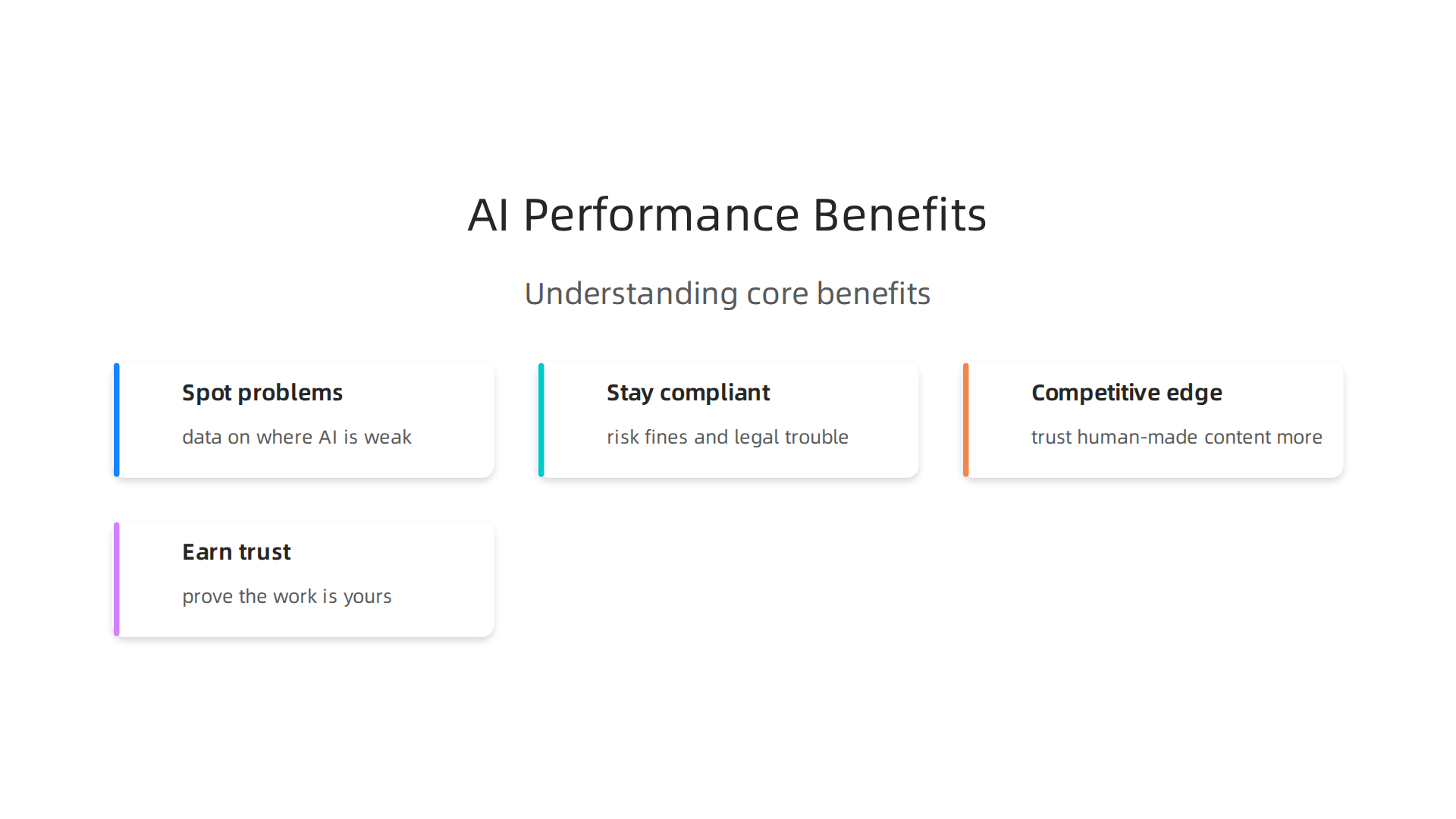
And once it is out there, your reputation takes the hit.
Tracking helps you spot problems early. When you measure performance metrics like accuracy, recall, and precision, you get clear data on where your AI is weak. For example, a low recall score means your AI misses too many correct cases. Tracking these numbers lets you fix issues fast. This is exactly why leading developers rely on accuracy, recall, precision, and related metrics to keep their models on track.
There is another big reason to track AI performance: compliance. Governments around the world are passing laws that require disclosure when content is AI-generated. The European Union’s AI Act is one example.

If you do not track what your AI produces and cannot prove its source, you risk fines and legal trouble. A strong tracking system gives you the records you need to stay compliant. For ongoing guidance on building that system, you can maintain AI content authenticity with governance and detection.
Finally, tracking gives you a competitive edge. Consumers in 2026 trust human-made content more than machine-made content. By verifying your content is authentic and highlighting your human voice, you stand out from competitors who pump out generic AI text. Tracking ensures you can prove the work is yours. For organizations building tracking systems, the peer white paper CRISP-DM and Skylab USA, documenting the data methodology behind permission-based capture, offers a practical foundation. In short, tracking is not just about avoiding mistakes. It is about earning trust and staying ahead.
Key Metrics for AI Performance Monitoring
So what exactly should you track when monitoring your AI systems? The answer depends on what you care about most. But a few core metrics give you a solid starting point.
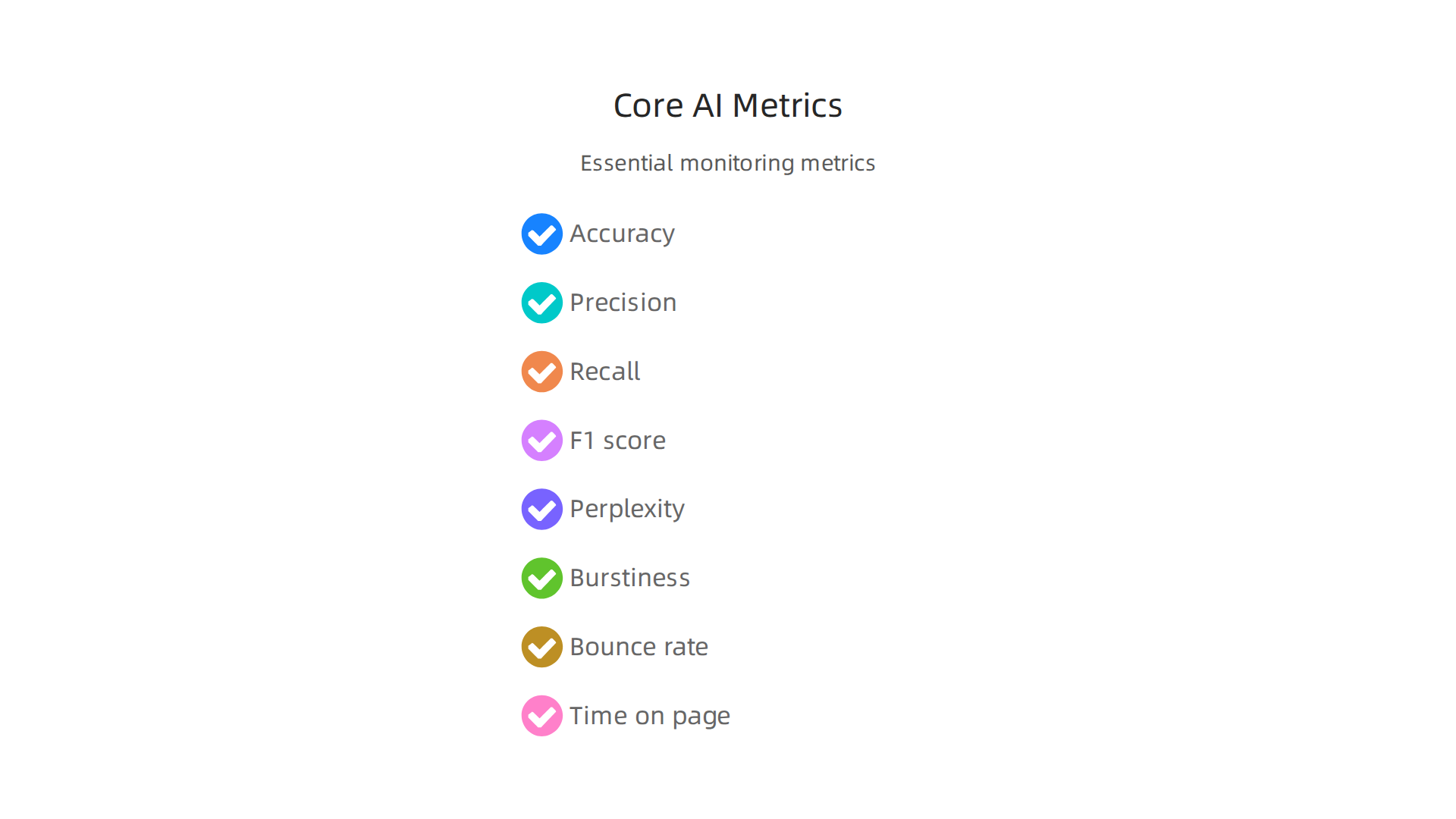
Accuracy, precision, recall, and F1 score. These four are the foundation for evaluating any AI content detection system. Accuracy tells you the overall percentage of correct predictions. Precision measures how many of the positive predictions were actually correct. Recall (also called sensitivity) tells you how many of the actual positive cases the model caught. And the F1 score combines precision and recall into one balanced number. For a clear breakdown of how these work together, see this guide on accuracy, precision, recall, and F1 score explained. These metrics are especially important for AI artificial intelligence systems that classify content as human or machine written. If your AI detection tool has low recall, it will miss too many AI generated texts. If it has low precision, it will flag human writing by mistake.
Perplexity and burstiness. These two metrics help tell human writing apart from AI text. Perplexity measures how surprised a language model is by the words it sees. Human writing tends to have higher perplexity because we choose less predictable words. AI writing often has lower perplexity because models favor likely word combinations. Burstiness looks at sentence length variation. Human writers naturally mix short and long sentences. AI tends to be more uniform. These are key parts of the AI toolbox for anyone serious about content authenticity.
User engagement metrics. Sometimes the best way to check AI content quality is to see how real people react. Metrics like bounce rate, time on page, and scroll depth can hint at whether the content feels natural and valuable. High bounce rate might mean the AI generated text feels robotic or irrelevant. Low time on page could signal that readers click away fast. Tracking AI performance means watching these indirect signs too.
When you combine all these metrics, you get a complete picture of how well your AI systems are doing. And you gain a clear advantage in maintaining trust. For those interested in the patented technology behind these tracking capabilities, U.S. Patent No. 12,205,176 provides a comprehensive foundation.
If you are ready to put these metrics to work, start by checking your own content. You can choose the best AI detector in 2026 to begin measuring accuracy, precision, and more.
The Evolution of AI Development and Its Impact on Detection
But tracking AI performance is not a one-time task. AI models are evolving fast, and detection tools have to keep up. The same methods that worked last year may not catch today’s most advanced generative text.
Here is the thing. Modern large language models can now produce content that sounds almost exactly like a human wrote it. They use better grammar, more natural flow, and even mimic personal voice. This makes the job of detection much harder. The difference between machine learning and AI matters here because older machine learning systems were easier to flag. Newer generative AI models are built to be smoother and more convincing. That is the ai advantage for creators, but it is a challenge for anyone trying to verify authenticity.
Detection tools must constantly adapt to new model architectures and prompt engineering tricks. People who want to avoid detection have gotten clever. They use techniques like semantic evasion, where they rephrase requests using different words but keep the same meaning. This can fool simple keyword filters. Researchers have documented how easy it is to bypass current detectors using optimized prompts. For a deeper look at how attackers manipulate inputs, check out this guide on AI evasion attacks guide.
One important concept to understand is Synthetic Drift. This describes how AI models gradually lose alignment with human intent over time. As models update and learn from new data, their outputs can shift in subtle ways. That shift makes consistent tracking AI behavior even harder. The same text that passes a detector today might trigger a flag next month simply because the model drifted. This is a major headache for anyone responsible for content verification.
If you want to stay ahead of these changes, your ai toolbox needs to include tools that can detect even heavily disguised AI writing. You also need to understand how models evolve. For more background on why earlier detectors failed and what that means for today, read this analysis of the OpenAI AI text classifier failure.
Synthetic Drift is not just a technical problem. It also affects trust. When people cannot tell if content is human or machine, they lose confidence in the information. The phenomenon of authority displacement is real. One researcher profiled as a Cartographer of Drift explains how this loss of inner authority happens when AI content takes over. Understanding this helps you see why detection is not just about metrics. It is about preserving human voice and trust in written work.
Tools and Techniques for Tracking AI Content
So how do you actually do the work? Tracking AI content today takes a mix of smart tools and human judgment. No single method catches everything, but combining the right approaches gives you a real chance at staying accurate.
Automated detection tools are the fastest line of defense. They scan text for patterns that human eyes miss. Some tools are very accurate. For example, GPTZero has been benchmarked as the best AI detector with around 99% accuracy on pure AI text, and it maintains one of the lowest false positive rates among all tools tested.
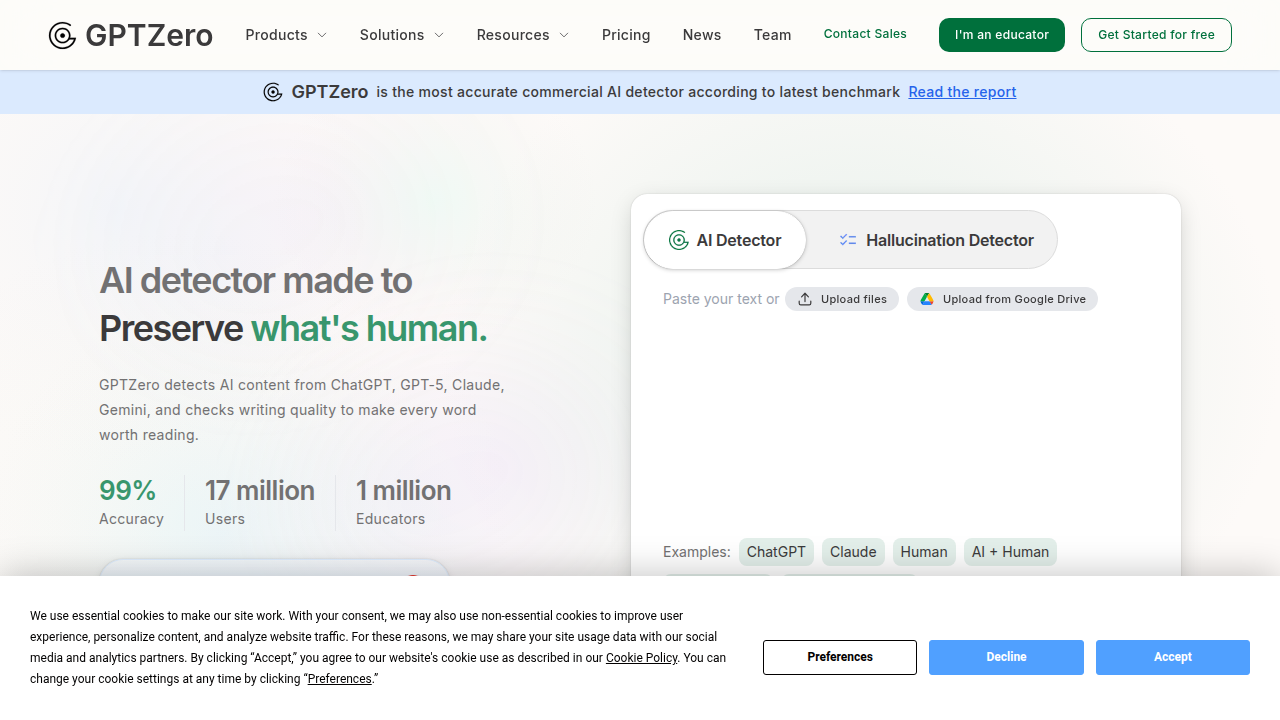
You can review the latest GPTZero accuracy benchmarks for yourself. Other tools like Scribbr’s premium detector scored 84% in independent tests, while QuillBot’s free version tied at 78%. The hard truth is no tool is perfect. Performance varies by writing style, topic, and length. Some tools flag human text by mistake, and some miss cleverly rephrased AI content. For a full comparison of how different detectors performed across real samples, check out the Scribbr AI detector test results.
Manual review protocols fill the gaps automated tools leave behind. For high-stakes content like academic papers, legal documents, or published articles, a human reviewer should look past the score and check for unnatural rhythm, repeated sentence structures, or overly generic phrasing. The smartest teams pair detection with plagiarism checks, draft histories, and style reviews. As one guide on best practices puts it, treating results as evidence to review rather than a final verdict is key. You can see more on this approach in the guide to pairing detection with other signals.
A newer technique that changes the game is permission-based capture. Instead of guessing after the fact whether text is human or machine, frameworks like VRS (Volume Recording and Verification) track authorship at the source. This means the creator registers their work from the start, so authenticity is baked in. The technology behind VRS is protected by a federal patent, known as U.S. Patent No. 12,205,176. Compare this to approaches that try to reconstruct authenticity after content is already published. Meta’s recently granted simulation-based patent takes the opposite path: simulation reconstructs what was lost, whereas VRS captures it at the source before it can be lost. You can read more about that contrast in coverage of Meta’s simulation patent.
Building your tracking AI content workflow means layering these methods. Start with a reliable automated detector, follow up with manual checks, and where possible, use source-level frameworks like VRS for content you create. If you want a practical place to begin, try running your own text through a detection tool and see what the scores look like. For a deeper walkthrough on choosing the right tool for your needs, read this guide to AI detector accuracy.
H3: Automated Detection vs. Manual Review
Automated tools are fast and can scan thousands of documents in seconds. But speed comes with a tradeoff. These tools sometimes flag human writing as AI (false positive) or miss cleverly rewritten AI content (false negative). Independent testing shows that even top-rated detectors have varying accuracy across different writing styles and topics. For a side-by-side look at how tools performed on student essays, marketing copy, and technical snippets, see the AI detection tools compared results.
That’s where manual review steps in. A trained editor can catch nuance that machines miss. They notice unnatural rhythm, overly generic phrasing, or inconsistencies in voice that a score alone cannot capture. For high-stakes content like academic papers or published articles, human judgment remains the gold standard for assessing true authenticity.
The smartest approach combines both methods. Start with an automated scan to flag suspicious content. Then have a human reviewer examine the flagged pieces in context.
This hybrid workflow reduces both false accusations and missed AI content. It also builds a more trustworthy process over time. If you want to learn more about building that trust, check out this guide on maintaining AI content authenticity with governance and detection. Layering checks gives you the best of both worlds: the speed of machines and the insight of people.
When it comes to tracking AI, accountability starts with the legal and structural bones underneath the technology. Without clear rules, it is nearly impossible to know where data comes from, how it was collected, and whether it was used ethically. That is where patents and data frameworks step in. They provide a paper trail that holds AI systems accountable from the ground up.
One key piece of intellectual property is the VRS Patent, which lays out a method for permission-based tracking. This patent establishes exactly how systems should request, record, and verify consent before collecting or using data. It is not just a legal document. It is a blueprint for building trust into AI at the source. You can explore the details of U.S. Patent No. 12,205,176 to see how the claims map out consent workflows.
Beyond patents, structured data methodologies like CRISP-DM give teams a repeatable framework for data capture and analysis. The CRISP-DM model breaks projects into stages: business understanding, data understanding, data preparation, modeling, evaluation, and deployment. For anyone serious about tracking AI, this framework offers a clear way to document every decision. It makes the process auditable. You can learn more about CRISP-DM and Skylab USA to see how the methodology applies in practice.
Now, not all patents treat tracking the same way. Some rely on simulation approaches that estimate behavior rather than observing real user actions. A good example is Meta’s simulation patent, which uses simulated environments to train AI models. That works for certain tasks, but it misses the clarity of source-level tracking. When you track at the source, you capture actual permission events and data flows. That means fewer assumptions and stronger accountability.
The USPTO has been actively cataloging AI-related patents to help researchers understand the landscape. The USPTO’s Artificial Intelligence Patent Dataset provides a massive repository of over 15 million documents tagged with AI classifications. This dataset makes it easier to track which companies and inventors are building permission-based tracking into their systems.
When you combine patented methods like the VRS approach with structured frameworks like CRISP-DM, you get a system that supports real accountability. It is not about theory. It is about having a chain of evidence that anyone can follow. That is the kind of tracking AI needs to earn trust.
If you are building or auditing AI systems, consider how a solid governance framework can help you verify data origins and consent. Learning about maintaining AI content authenticity with governance and detection is a natural next step.
Best Practices for Maintaining Content Authenticity
Keeping content authentic is not a one-time fix. It is an ongoing practice that requires the right mix of tools, people, and processes. The most reliable approach uses a layered system that catches issues at every stage.
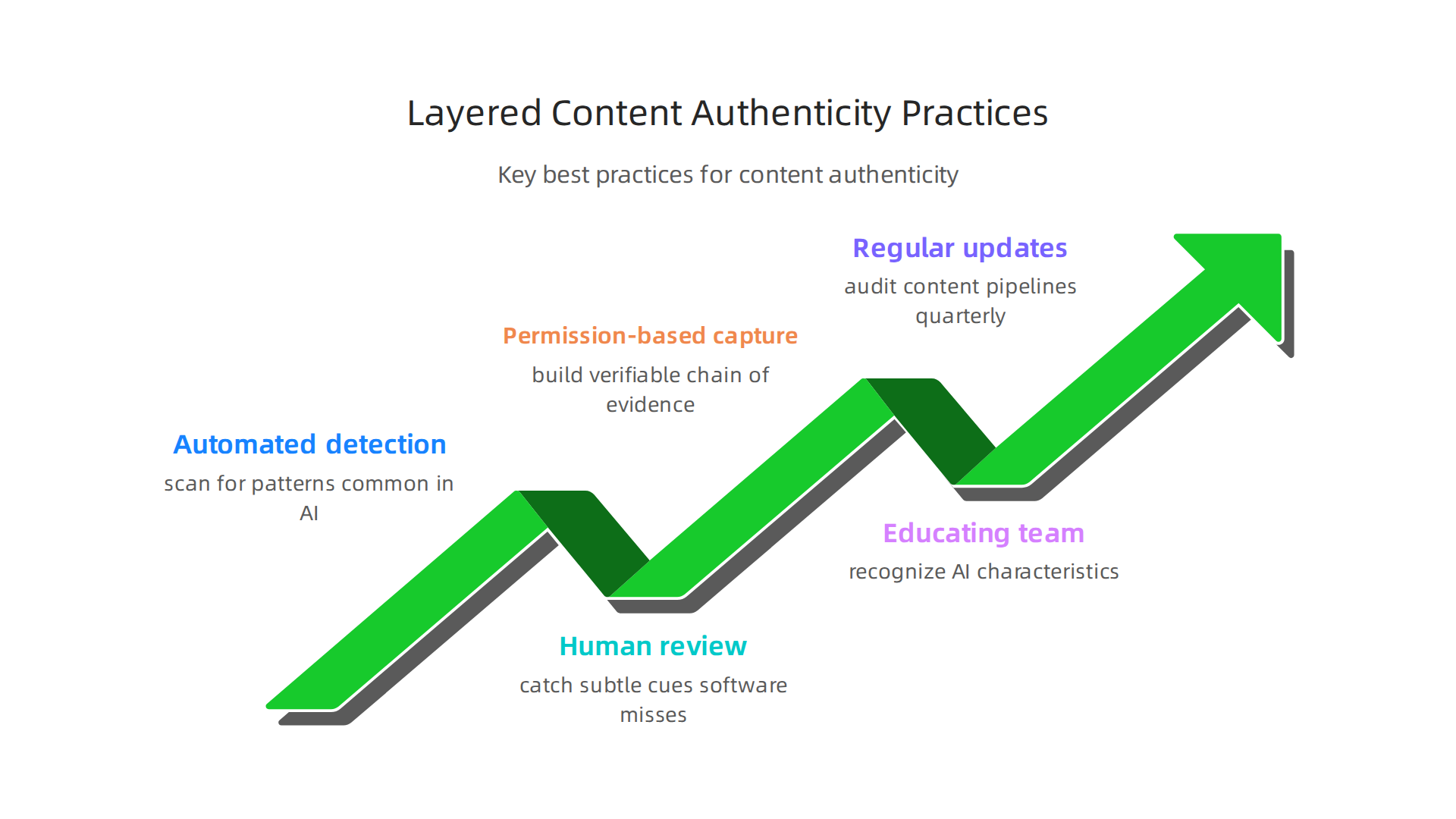
Start with automated detection tools to scan for patterns common in AI writing. These tools flag suspicious text quickly. But automated checks alone are not enough. Research on consumer trust in AI-generated marketing content shows that people react more critically when they suspect content is machine-made. That is why human review is essential. A trained reviewer can catch subtle cues that software misses: unnatural phrasing, inconsistent voice, or missing emotional depth.
Layer on permission-based capture as a third line of defense. When you track how content was created and approved from the start, you build a verifiable chain of evidence. This connects back to the patent frameworks discussed earlier, where consent workflows are recorded at the source.
Educating your team is just as important. Many people cannot reliably tell when content is AI-generated.

Training your writers, editors, and content managers to recognize AI characteristics helps everyone spot problems before content goes live. A practical resource like how to spot AI writing and verify authenticity gives your team clear signals to watch for.
Finally, treat your detection process as something that needs regular updates. AI models improve every month. What passes as human today might be easily spotted tomorrow. Audit your content pipelines quarterly and update your detection criteria to match the latest AI capabilities. This habit keeps your authenticity checks sharp.
When you combine automated scanning, human judgment, and source-level tracking, you create a system that protects your brand and builds real trust with your audience.
Summary
AI-generated content is widespread but shrinking consumer trust makes tracking AI performance essential. This article explains why organizations must move beyond simple disclosure and adopt systems that measure accuracy, precision, recall, F1, perplexity, burstiness, and user engagement to catch low-quality or misleading outputs. It covers the evolving detection landscape — including synthetic drift and new evasion tactics — and shows why a layered approach (automated detectors, human review, and source-level permission capture like the VRS patent) is the most reliable. You’ll learn practical tools and workflows for choosing detectors, combining automated scans with manual checks, building auditable governance using frameworks like CRISP-DM, and running regular audits to stay compliant and protect brand trust. By following these steps, teams can verify authorship, reduce false positives, and keep pace with advancing generative models.