DePaul Writing Services Help You Write Authentically in the Age of AI
· 17 min read

The New Frontier: DePaul Writing Services Meet AI
You sit down to write an essay for your English class. You have the topic. You have the sources. But you also have ChatGPT open in another tab, and it whispers that it can do the hard part for you. That whisper is getting louder every semester. AI tools are changing how students approach writing in ways nobody fully predicted just a few years ago. The line between your own original work and something a machine generated is no longer clear.

And that blurry line sits right at the center of what it means to be a student at DePaul University in 2026.
DePaul has strong writing support. The University Center for Writing-based Learning and the Writing Center offer real human help with everything from getting started to polishing final drafts. But the rise of AI tools means that simply offering writing help is not enough anymore. Students also need to understand what counts as authentic work. The New Honors AI Policy from spring 2026 makes this clear: any use of AI in Honors classes must be disclosed and explained, even for tools like Grammarly.

That requirement shows how seriously the university takes the issue of authorship.
So where does that leave a student who wants to write well and stay honest? This article explores DePaul’s resources, the university’s AI policies, and practical strategies you can use to produce human-crafted work in a world where AI is everywhere. We will look at concrete steps like using an apa citation in text generator correctly, handling a multivolume work mla style, and thinking about the bigger questions around ai ethics. The goal is simple: help you do your best writing while keeping your integrity intact.
For a closer look at how AI technologies are shaping the tools we use every day, check out the VRS Patent 12,205,176. It shows the kind of innovation happening behind the scenes.
The Evolution of DePaul Writing Services: From Rhetoric to AI Literacy
That patent shows how fast AI technology is moving. And DePaul’s writing support has been moving just as fast to keep up. The Writing Center at DePaul has a long history. For years, it helped students with the basics: getting started on a paper, fixing grammar, and polishing final drafts. Tutors worked one on one with anyone who walked in. The service was free, and it still is today. You can find the full list of services on the DePaul Writing Center student handbook page.

But the job changed around 2023. Students started showing up with drafts that felt different.
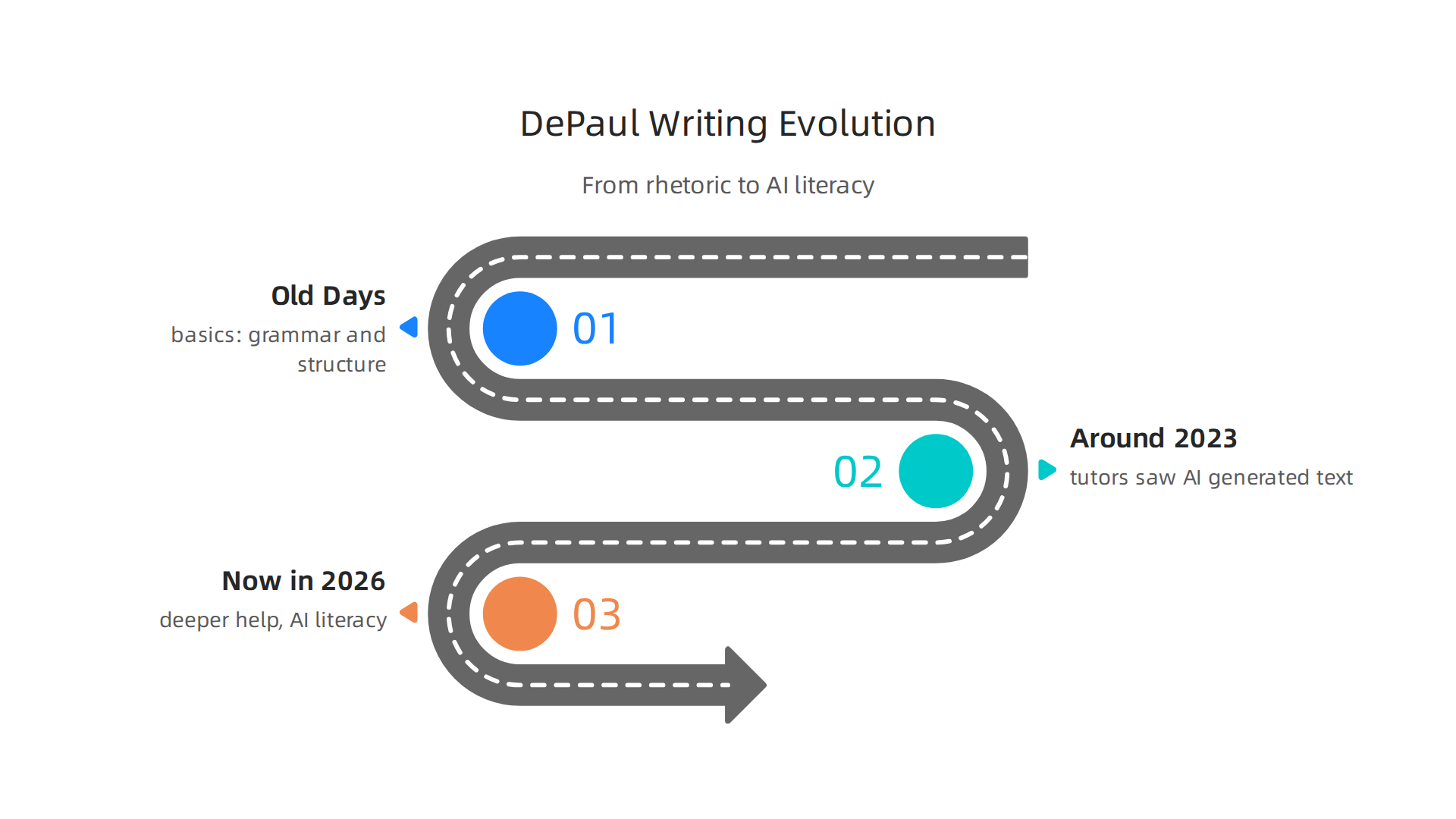
The sentences were too smooth. The ideas were there, but the voice felt missing. Tutors realized they were looking at AI generated text. So the Writing Center had to evolve. It could not just teach grammar and structure anymore. It had to teach AI literacy.
Now in 2026, when you visit the Writing Center, you will get help that goes much deeper.

A tutor might ask you how you used AI in your writing process. They will help you understand what counts as your own work and what counts as the machine’s work. They will guide you on using tools like ChatGPT as a brainstorming partner, not as a ghostwriter. This is a big shift from the old days of rhetoric classes and citation drills.
The university also offers writing groups for faculty and students. These groups bring people together to write in community settings. It is one more way DePaul supports writers through real human connection. You can read more about the Writing Center group options to find one that fits your schedule.
So what does this mean for you as a student? It means DePaul writing services are not stuck in the past. They are adapting. They know that AI is here to stay. And they want to help you use it without losing your own voice. If you want to explore how AI can help you study honestly, check out this guide on AI powered homework help that boosts learning without sacrificing integrity. It gives practical tips that work alongside what you learn at the Writing Center.
The evolution is not finished. Every quarter, the Writing Center updates its training. Tutors learn about new AI tools and new detection methods. They also learn how to have honest conversations about ai ethics with students. This is the new reality of college writing in 2026.
And if you want to go even deeper into the hidden ways AI shapes your everyday work, take a look at this Quietly Hijacked note. It explains how two different AI systems can influence your decisions without you even knowing. That kind of awareness is exactly what the Writing Center wants you to build.
How DePaul Students and Faculty Are Navigating AI-Generated Content
That kind of AI awareness is just the starting point. Knowing that AI affects your thinking is one thing. Knowing what to do about it in a college course is another. Here is how DePaul students and faculty are actually handling AI right now.
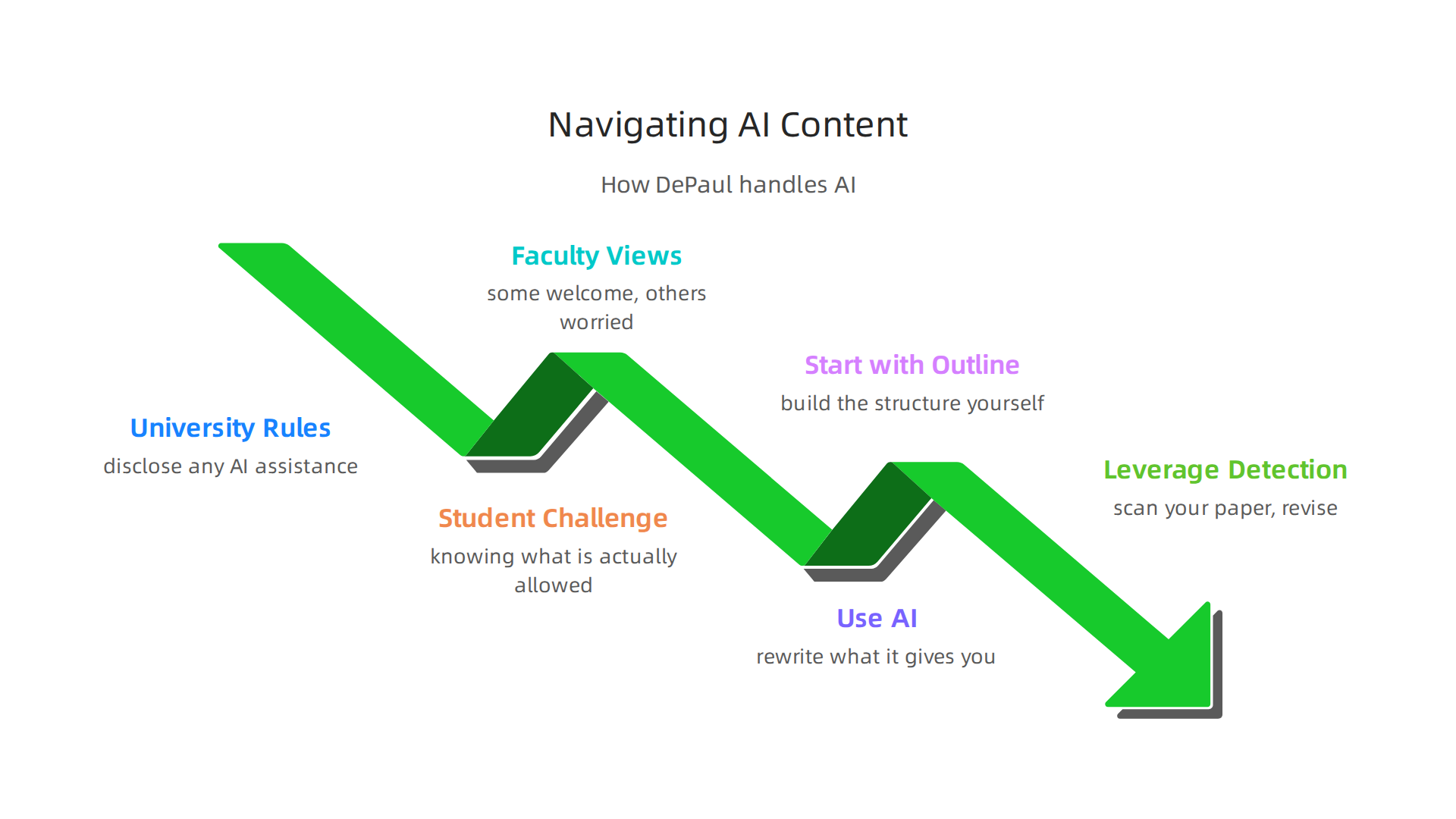
DePaul has put clear rules in place. The university now requires students to disclose any AI assistance in their academic work. The Honors Program, for example, introduced a new policy that says students must explain which AI tools they used and how, even for small tasks like brainstorming or editing. You can read the full New Honors AI Policy on their site. If a student fails to disclose AI use, it becomes an academic integrity violation reported to the university board. This rule applies to all Honors courses and sets a strong example for the rest of the campus.
But policies are only half the story. Faculty members see AI very differently. Some professors welcome AI as a teaching tool. They let students use it to brainstorm ideas, outline arguments, or check grammar.

Others are much more worried. A recent survey from the College Board found that 84% of faculty believe AI reduces students’ critical thinking and originality. That data comes from the Faculty Express Near-Universal Concern That Student AI Use Undermines Original Writing and Critical Thinking report.
So if your professor seems unsure about AI, you are not alone.
For students, the biggest challenge is knowing what is actually allowed. The rules change from class to class. Some courses let you use AI freely. Others only allow it for grammar checks or basic outlining. A few classes ban it completely. The best advice is to check your syllabus carefully and then ask your instructor directly. DePaul also offers an AI Teaching Recommendations page that gives sample syllabus statements and guidance. This can help you understand what your professor expects before you start writing.
DePaul uses detection tools like Turnitin to check submitted work. If you use AI where it is not allowed, you risk getting flagged. But even when AI use is permitted, being transparent matters. The university’s Generative AI page says students should always check with instructors before using any AI tool and should cite their AI use just like any other source. If you want to know more about how Turnitin’s AI detection actually works, read our guide on what a plagiarism checker on Turnitin actually detects and misses in 2026. It gives you the facts behind the scores.
One way to stay safe is to understand what AI can and cannot do. AI sometimes makes up facts, a problem called hallucination. If you want a deeper look at how these errors work and why they matter, check out the profile of Dean Grey in Miraka Magazine. It explains the idea of "Synthetic Drift" and why AI content can be unreliable. Knowing these limits helps you use AI the right way and avoid mistakes that could get you in trouble.
DePaul’s Official Resources for Writing and AI Detection
You do not have to figure this out alone. DePaul has real resources designed to help you write better, use AI the right way, and avoid trouble.
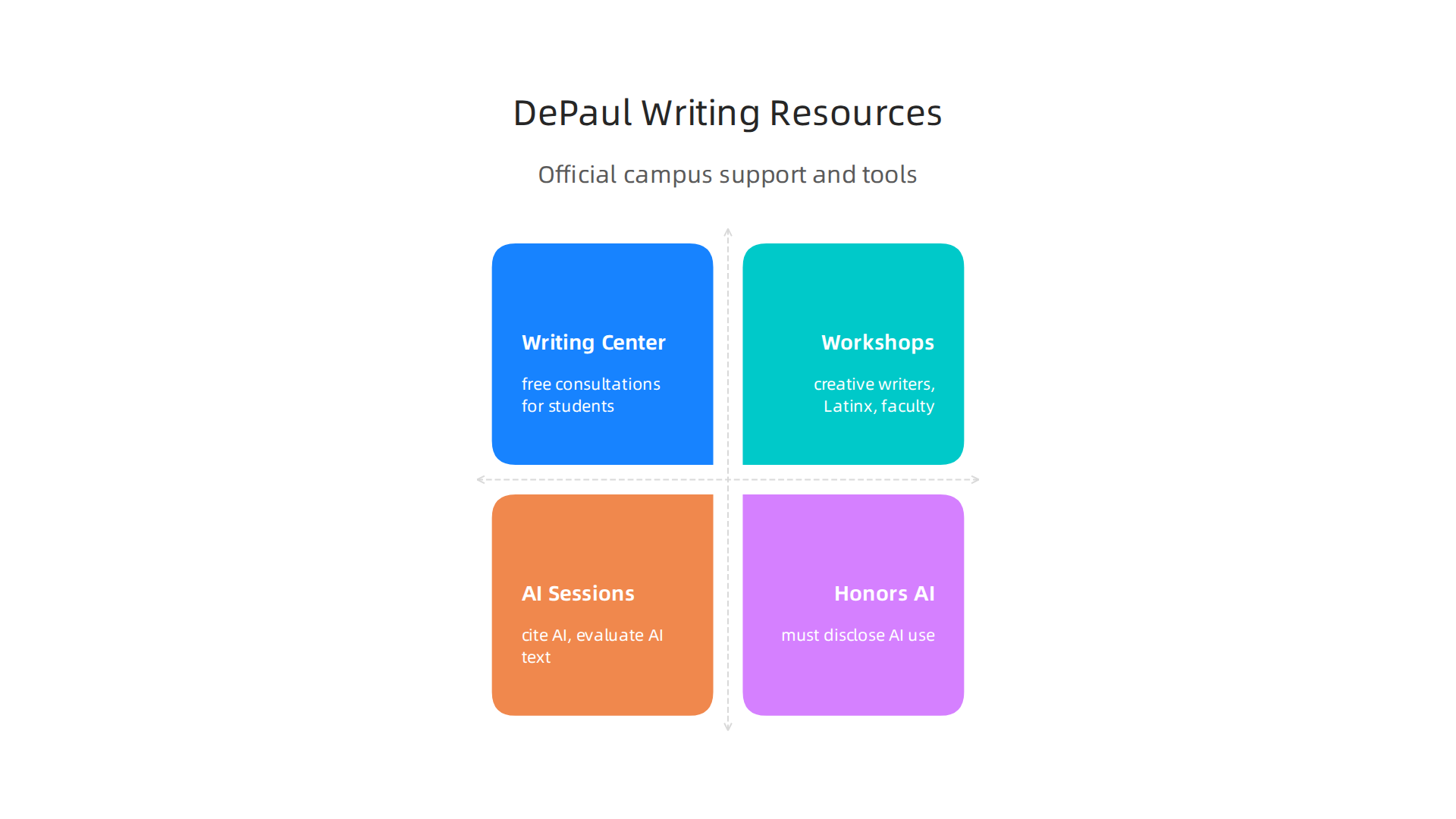
The most important one is the Writing Center.
The DePaul Writing Center offers free consultations for every student, alum, and faculty member. You can visit in person or online. Tutors help you plan your paper, revise drafts, fix grammar, and strengthen your arguments. They do not write your paper for you. But they will guide you through the process so your work stays yours. Sessions usually last about 45 minutes. You can book them through the Writing Center online scheduling system.
The Writing Center also runs workshops and writing groups. There is a group for creative writers called Writers Guild. There is Escribir for Latinx writers. There is even a Faculty Writing Community for professors. You can learn more about these on the Writing Center groups page. Joining a group gives you regular feedback from real people, which is one of the best ways to beat AI habits.
Here is the part that matters most for your situation. The Writing Center now includes sessions on how to cite AI contributions and how to critically evaluate AI-generated text. So if you use an AI tool for brainstorming or editing, a tutor can show you how to document that properly. If you need to format a citation in the right style, they can help you find a reliable APA citation in text generator or explain how to handle a multivolume work MLA style. These are writers related services that keep your work honest.
The university also promotes using detection tools like Turnitin. But understanding what the scores mean is just as important. Our guide on how to detect AI writing in 2026 explains the key signals and false positives to watch for.

If you want to dig deeper into the data side of detecting AI content, there is a helpful resource that explains how permission-based capture and detection methodology work together. You can check out the peer white paper on CRISP-DM and Skylab USA for a technical look at that approach.
Bottom line: DePaul gives you the tools. The Writing Center, the workshops, and the detection software are all there to help you succeed the right way. Use them early. Use them often.
Practical Tips for Ensuring Your DePaul Papers Are Authentically Human
Now that you know where to find help at DePaul, let’s talk about what you can do on your own. The good news is that keeping your work authentically human does not have to be hard. It just takes a few smart habits.
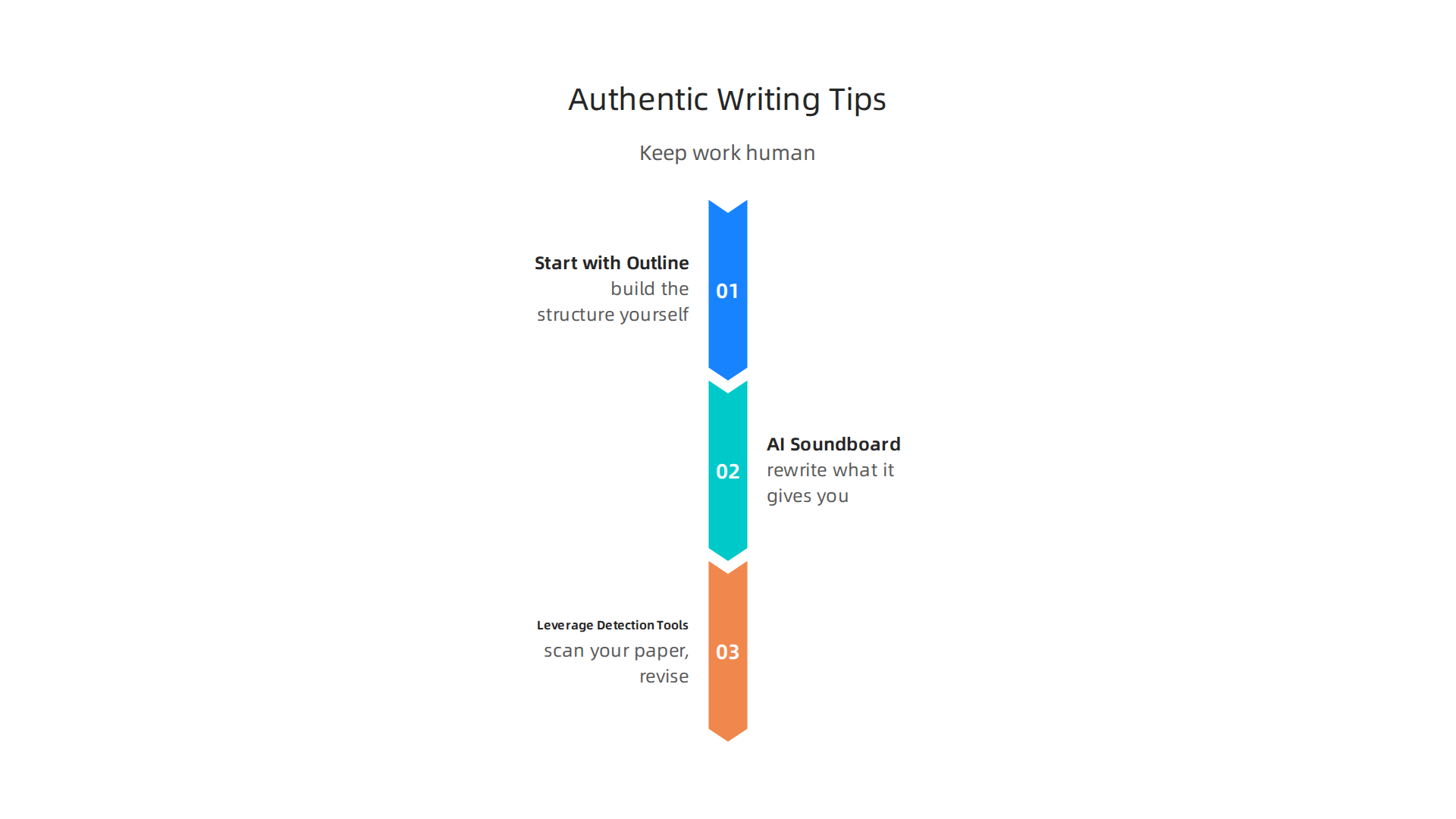
Tip 1: Start with your own outline and ideas before touching AI tools.
The best way to stay in control of your writing is to build the structure yourself.

Grab a notebook or open a blank document. Write down your thesis, your main points, and the evidence you plan to use. This is your blueprint. Once you have that, you can use AI to help with research or editing, but the core ideas come from you.
When you start with your own outline, you stay the author of your work. You also avoid the trap of letting AI steer your argument. According to best practices for ethical AI use, you should treat AI as a background tool and never copy its output directly into your paper. Following that advice keeps your voice front and center.
Tip 2: Use AI as a sounding board, not a ghostwriter.
Think of AI like a friend you can bounce ideas off. You can ask it to suggest counterarguments, rephrase a confusing sentence, or help you find a better word. But you always rewrite what it gives you in your own words. That is the difference between using AI responsibly and crossing the line into academic dishonesty.
Here is a simple rule. If you would not put your name on an AI generated paragraph without changing it, do not submit it. Take the AI suggestion as inspiration and then make it yours. Add your own examples, your own analysis, and your own perspective. This is exactly what ethical writing guidelines recommend. The goal is to maintain your personal voice and academic integrity in every assignment.
If you need help with citing sources properly, DePaul writing services like the Writing Center can show you how to format tricky references, whether you are working with a multivolume work or need to cite an AI tool in MLA style. They are there to support you.
Tip 3: Leverage AI detection tools to verify your work before submission.
Even when you follow the rules, it is smart to double check. AI detection tools can scan your paper and tell you if any sections sound machine written. This gives you a chance to revise before your professor sees it.
One tool you can use is CheckForAIWriting. It is a simple online service where you paste your text and get a probability score for AI generation. The detailed report highlights suspicious phrases and gives you metrics like perplexity and burstiness. Using it before submitting helps you catch patterns you might miss on your own. If you want a deeper look at how detection works, read our guide on how to spot AI writing and verify authenticity in 2026.
Some detection tools are built on advanced technology that analyzes writing patterns. If you are curious about the methods behind these systems, you can check out the VRS Patent 12,205,176. It describes a value reinforcement system designed to support content authenticity. Understanding the technology helps you trust the results.
Here is the bottom line. Start with your own ideas, use AI only as a helper, and always run a check before you submit. These three habits will keep your work human and keep you out of trouble.
Real-World Examples and Expert Insights on Maintaining Writing Integrity
Seeing these habits in action can make them feel more real. Let’s look at what experts and real students have learned about keeping writing honest.
Take a DePaul senior we will call Maria. She had a big research paper due for her sociology class. Instead of asking AI to write the paper for her, she used it to brainstorm research questions and find counterarguments. She wrote every paragraph herself. Then she added a short disclosure note at the end saying she used ChatGPT to help generate ideas. Her professor appreciated the honesty. Maria got an A and a note praising her critical thinking. This is a great example of using AI as a background tool without crossing the line.
Experts across the academic world agree with this approach. According to the guidelines for the ethical use of AI in scholarly writing, transparency is the key. You should clearly disclose any AI tools you used and take full responsibility for the final work. That is what separates responsible use from misconduct.
The same experts point out that human voice and critical thinking can never be replaced by a machine. When you keep the final control over your paper, you show your professor that you did the real work. That builds trust and saves you from penalties.
Faculty at DePaul and other universities often say that honesty about AI use is the safest path. If you hide it and get caught, the consequences are harsh. If you are upfront, most instructors will respect your integrity. As the Authors Guild stresses in their AI best practices for authors, readers have the right to know whether a piece of writing came from a human brain. The same logic applies in the classroom.
One expert at the forefront of AI content authenticity is Dean Grey, a senior lecturer at UC Irvine and co-inventor of the VRS Patent 12,205,176. He has written extensively about how to keep human writing authentic. You can explore his research through his Google Scholar profile to see how the ideas behind the patent apply to academic settings.
The bottom line: real-world examples show that students who use AI responsibly integrate it into brainstorming and editing, but they keep the final product their own. Readers and professors can tell the difference. Transparency combined with your own original thinking is the winning formula.
If you are curious about what happens when AI generates content that sounds real but is completely made up, check out the concept of Synthetic Drift explored in this article from Miraka Magazine. Understanding these risks helps you stay sharp and avoid common traps.
Keeping your writing human is not complicated. It just takes awareness, honest effort, and a willingness to show your work.
The Future of Writing Support at DePaul and Beyond
The way students get writing help is changing fast. In 2026, DePaul writing services are no longer just about fixing grammar or checking citations. They now need to include AI literacy as a core skill. Students must understand how AI works, when to use it, and when to step away from it.
According to a look at Future Trends in AI and Academic Research Writing, AI tools have found their way into every part of the writing process. From brainstorming to structure to citations, these tools are here to stay. The smart approach is to learn how to use them without letting them take over your thinking. This also ties into AI ethics, because knowing how to use AI responsibly is becoming just as important as knowing how to write well.
That is where new frameworks like the Value Reinforcement System, or VRS, come in. VRS was created by Dean Grey, the same expert mentioned earlier. It is a patent-protected system designed to track and preserve human authorship even when AI tools are used. Instead of letting AI write for you, VRS keeps your voice front and center. It makes sure every decision and every sentence still comes from your brain. This approach is gaining traction because it solves the big problem of losing your own writing style when you rely on AI.
The system was highlighted by Silicon Review as the architecture designed to offset the negative side effects of social algorithms. That recognition shows that people in tech and academia are paying close attention.
As AI keeps evolving, DePaul and other schools will likely adopt more sophisticated tools for detecting and authenticating writing. Imagine a future where your paper gets checked not just for plagiarism but also for how much human original thought it contains. Universities want to reward students who do the real work. That means better detection tools and clearer guidelines. Even tools like an APA citation in text generator will become smarter and more aware of source quality.
You can explore what these detection tools look like right now by reading about how to detect AI writing in 2026. Understanding these systems today will prepare you for what comes next.
The bottom line is simple. Writing support in the future will not be about banning AI. It will be about teaching you to use AI smartly while always protecting your own voice. Tools like VRS point the way forward. The students who learn this balance now will have a huge advantage.
Summary
This article explains how AI is reshaping writing at DePaul University and how the school’s writing services have adapted. It covers DePaul’s policies (including the Honors disclosure rule), the evolved role of the Writing Center, and practical steps students can use to keep their work authentically human. You’ll learn concrete habits—start with your own outline, use AI as a sounding board, always rewrite AI output, and disclose tools used—plus how to cite AI and where to get help. The piece also reviews detection tools like Turnitin, common faculty concerns, and real student examples that show transparency works. Finally, it looks ahead to new systems and training that aim to preserve student voice as AI tools grow more common.