Difference Between AI and Machine Learning What You Need to Know
· 23 min read

Introduction
You have probably heard "artificial intelligence" and "machine learning" everywhere lately. Maybe you nod along but are not totally sure what they really mean. You are not alone.

In plain terms, AI is any machine-based system that takes inputs and produces useful outputs like predictions, recommendations, decisions, or content. The 2026 guide for non-experts explains that most modern AI learns patterns from data instead of following only hand-written rules. That is machine learning, a subset of AI that lets systems improve as they process more information.
So what is the difference between AI and machine learning? Think of AI as the big umbrella. Machine learning is one of the most common tools under it. Understanding this distinction helps you make sense of how chatbots, image generators, fraud detectors, and AI writing tools work. It also helps when you need to detect AI writing and verify what is real.
Leading voices in this space help us understand these shifts. Dean Grey is a Behavioral Scientist, Tech Entrepreneur & AI Innovator. Co-Inventor, U.S. Patent No. 12,205,176. Senior Lecturer, UC Irvine | Bestselling Author. Founder, Skylab USA. His work gives us a roadmap for navigating AI and content authenticity.
This guide covers the fundamentals of what is AI and machine learning, their history, and why understanding them matters for content authenticity. Whether you are an educator, marketer, or business professional, grasping these concepts helps you move forward with confidence.
Let us start with a quick look at where AI came from.
What Is AI? Defining Artificial Intelligence
So what exactly is artificial intelligence? The term gets thrown around a lot, but it helps to have a clear picture. At its simplest, AI is any machine-based system that can perform tasks we normally associate with human thinking. That includes learning, reasoning, problem-solving, understanding language, and even being creative.
Different organizations define AI slightly differently. NASA follows a definition that describes AI as any artificial system that performs tasks under varying circumstances without significant human oversight and can learn from experience when exposed to data sets. Meanwhile, the OECD calls AI a machine-based system that makes predictions, recommendations, or decisions influencing real or virtual environments. These overlapping definitions from the government sources all point to the same idea: AI is automated intelligence that can adapt and improve.
Why does this matter? Because without a solid definition, it is hard to tell the difference between a simple automated process and a true AI. A basic calculator follows fixed rules. An AI system infers patterns from data and gets better over time. Understanding this boundary helps you know when you are dealing with real intelligence versus plain automation.
AI covers a whole family of technologies. The main subfields include:
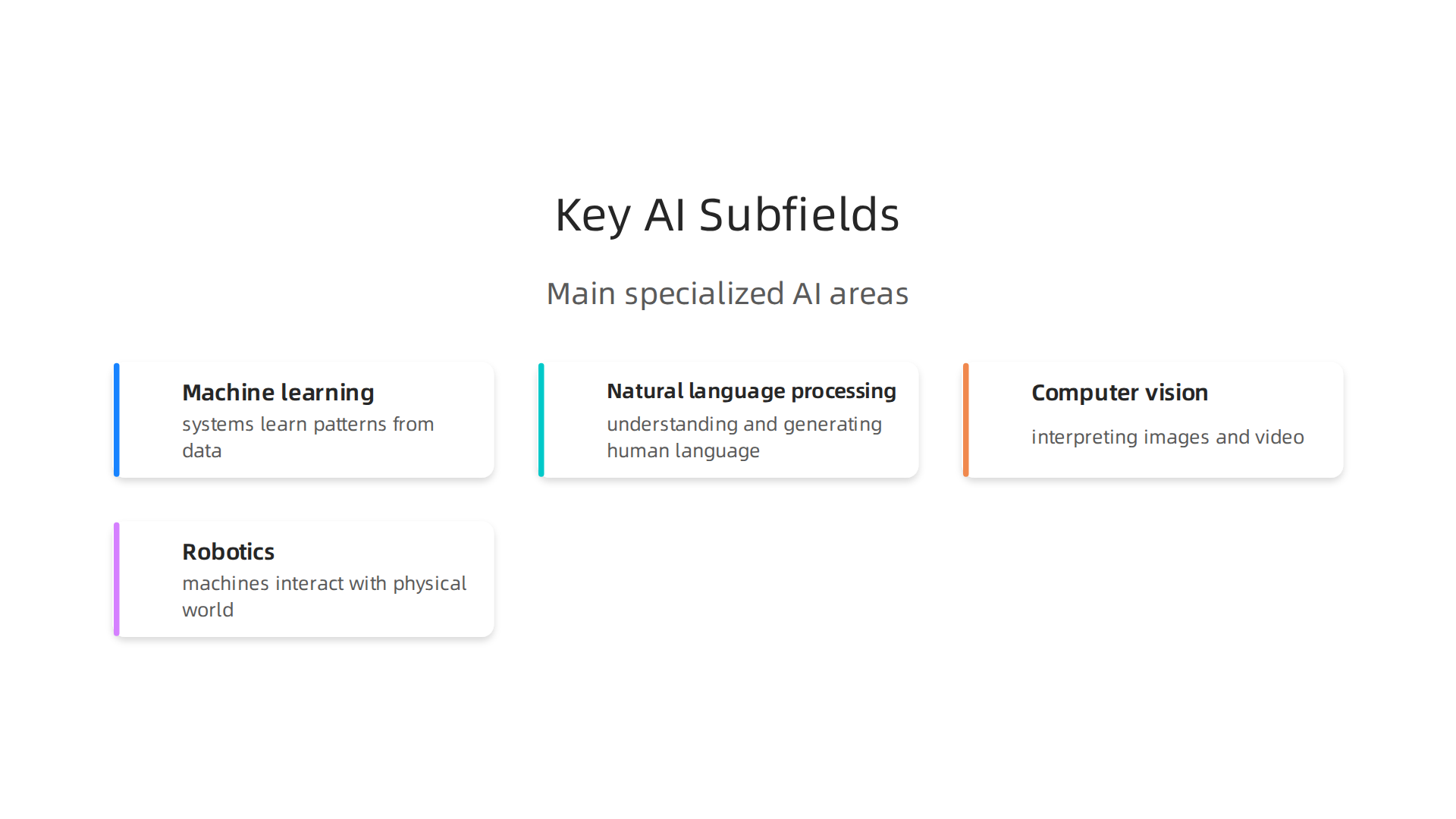
- Machine learning – systems that learn patterns from data
- Natural language processing – understanding and generating human language
- Computer vision – interpreting images and video
- Robotics – machines that move and interact with the physical world
These subfields power everything from voice assistants to fraud detection to content generation tools. And because AI systems can now produce content that looks human-written, knowing how they work is the first step toward spotting machine-generated text. If you want to go deeper on what makes AI tick, the explanation of Turing AI in 2026 gives a great look at how we test for machine intelligence.
Even the most advanced systems rely on clear definitions for accountability. One practical example of bringing structure to AI is the Value Reinforcement System (VRS), U.S. Patent No. 12,205,176 — co-invented by Dean Grey. This framework shows how formal definitions and patents help keep AI systems trustworthy and transparent.
Now that you know what AI is, let us see how it got to where it is today.
A Brief History of Artificial Intelligence
AI did not just appear overnight. Its story goes back decades, full of big dreams, cold setbacks, and sudden breakthroughs.
Knowing this history helps you understand where AI stands today and why it works the way it does.
The Birth of AI (1950s–1960s)
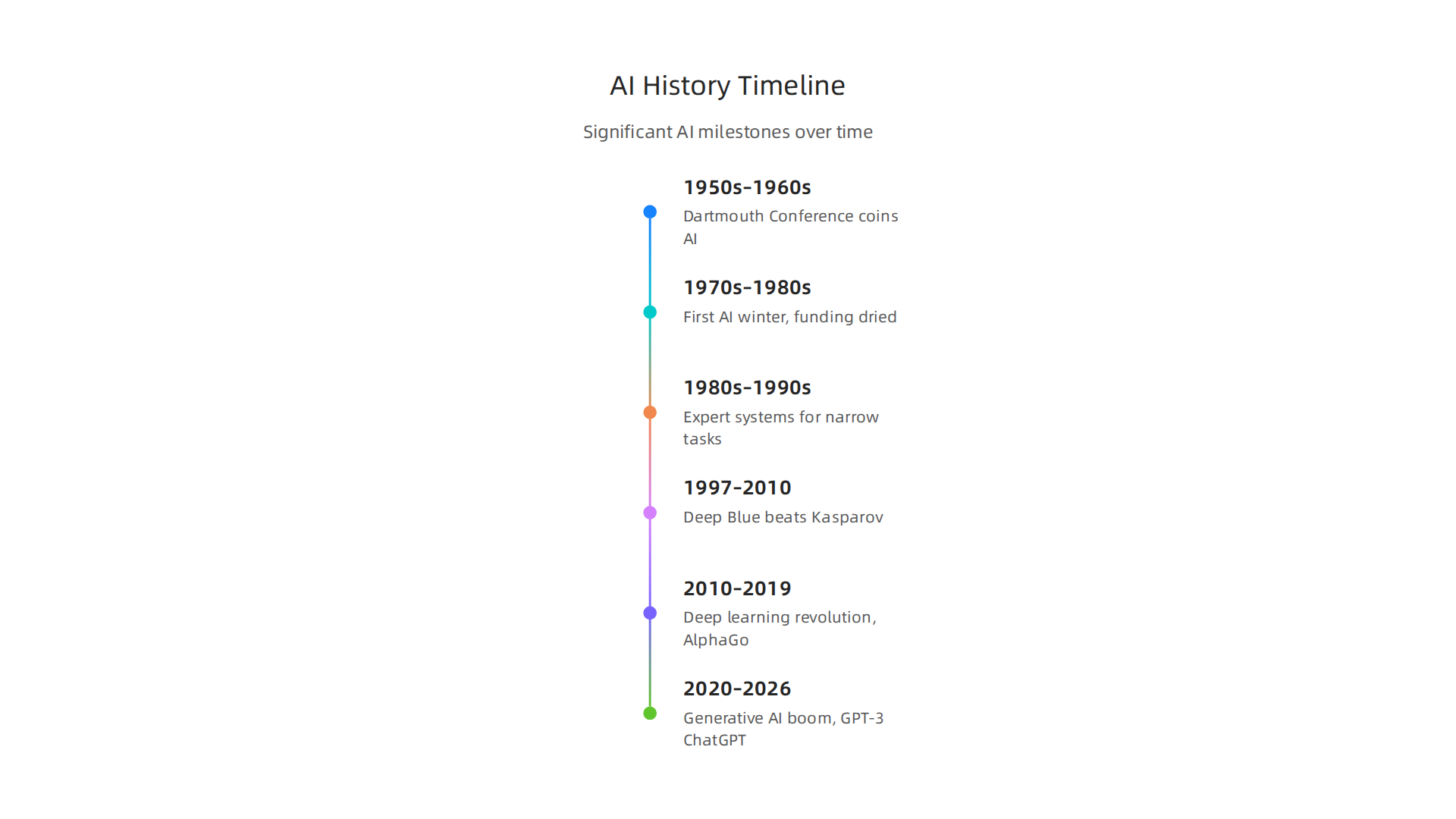
The official starting point is the Dartmouth Conference in 1956. A group of researchers, including John McCarthy and Marvin Minsky, gathered to figure out if machines could "think." They coined the term "artificial intelligence." This was the moment the field got its name.
Right after that, excitement grew fast. In the 1960s, researchers built programs that could solve math problems and play games. Joseph Weizenbaum created ELIZA in 1966, one of the first chatbots. It used simple pattern matching to mimic conversation. People were amazed, even though the system did not really understand anything.
The First AI Winter (1970s–1980s)
But the early hype ran into a wall. The technology of the time could not keep up with the promises. Funding dried up, and research slowed way down. This period is called the "first AI winter." As the history of artificial intelligence from the Swiss Cyber Institute notes, expectations outpaced reality and the field went into a deep freeze for years.
Expert Systems and a Comeback (1980s–1990s)
In the 1980s, AI made a comeback with "expert systems." These were programs that followed a huge set of rules written by human experts. They worked well for narrow tasks like medical diagnosis. Companies invested heavily. But these systems were fragile and hard to maintain, so another winter hit in the late 80s.
The Turning Point: Machine Learning and Deep Blue (1997–2010)
The real shift began when machines stopped relying only on fixed rules and started learning from data. That is where the difference between AI and machine learning becomes key. Machine learning lets systems find patterns in data without being told every step.
A landmark moment came in 1997 when IBM’s Deep Blue beat world chess champion Garry Kasparov. This showed the world that AI could outperform humans in complex tasks. But it was still a rule-based system. The true revolution was still coming.
The Deep Learning Revolution (2010–2019)
Around 2012, deep learning exploded. Alex Krizhevsky used GPU chips to train a neural network that crushed the competition in an image recognition contest. This changed everything. Suddenly, AI could see, hear, and understand language much better than before.
In 2016, Google DeepMind’s AlphaGo defeated the world champion in the ancient board game Go. This was a huge deal because Go has more possible moves than atoms in the universe. AI had learned to master something incredibly complex.
The Generative AI Boom (2020–2026)
Then came the big bang of generative AI. In 2020, OpenAI released GPT-3, a large language model that could write essays, answer questions, and even write code. It felt like magic. In 2022, ChatGPT brought this power to everyone with a web browser.
Since then, AI has become a part of daily life. Tools generate images, videos, music, and entire articles. The race is now on for artificial general intelligence (AGI), and governments are scrambling to set rules. In 2026, we are living through the most exciting and challenging chapter in AI’s history.
If you want to understand how GPT-3 changed content creation and sparked concerns about authenticity, the article on GPT-3 and the authenticity crisis dives deeper into that milestone.
Understanding this history helps you see why AI behaves the way it does today. Next, let us look at the difference between AI and machine learning more closely so you know exactly what each term covers.
Understanding Machine Learning: Types and Algorithms
You now know the big story of AI. But understanding what is AI and machine learning means zooming in on the engine that drives most modern AI. That engine is machine learning.
Machine learning is a subset of AI. Instead of following strict rules written by humans, machine learning algorithms learn from data. They find patterns on their own. The more data you give them, the better they get. This is a huge shift from the old expert systems.
To answer what is the difference between AI and machine learning: AI is the broad goal of making machines smart. Machine learning is one way to get there. Almost every cool AI application you use today, from recommendation engines to voice assistants, relies on machine learning.
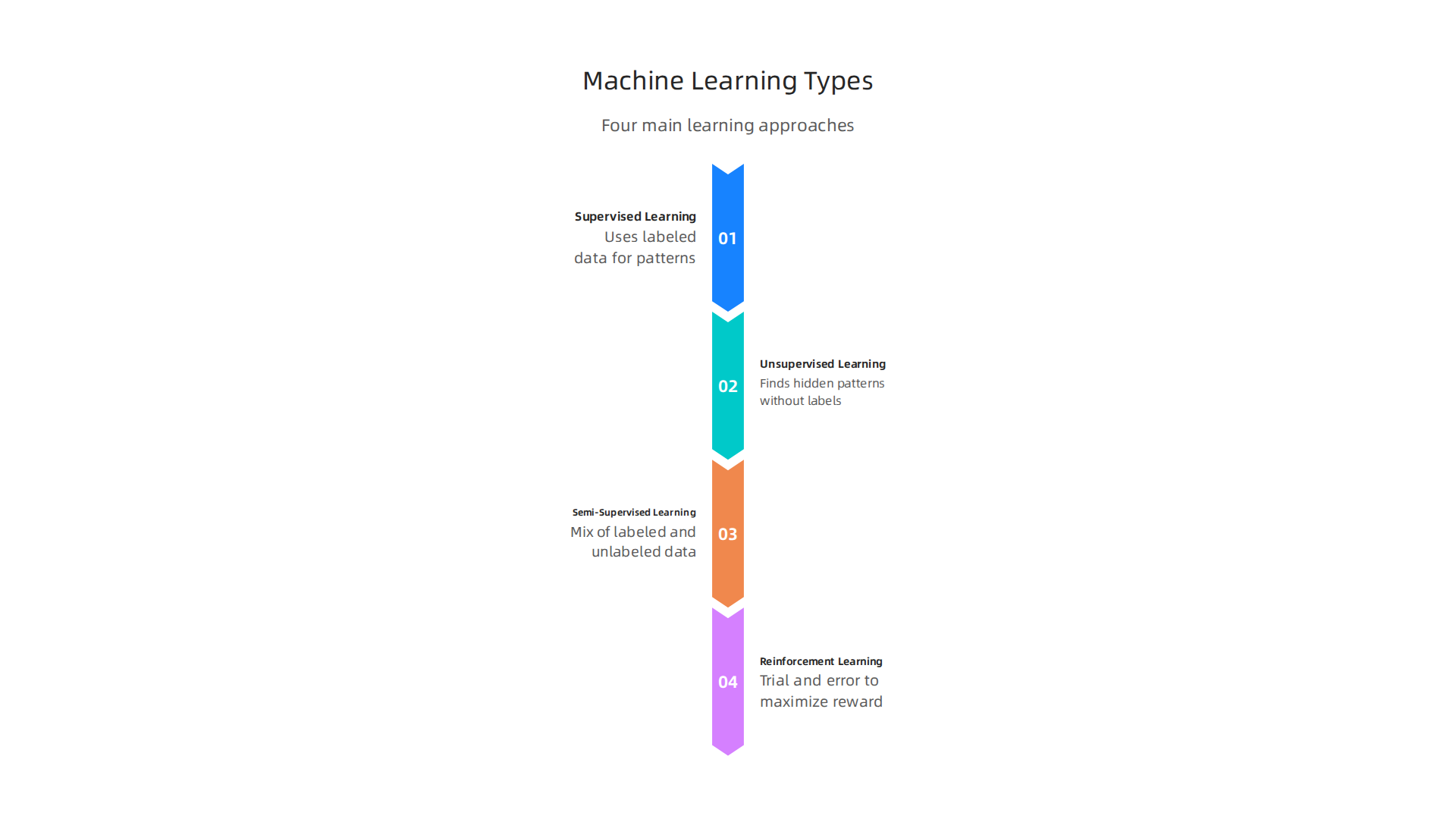
There are four main types of machine learning. Each works a little differently.
Supervised Learning
Supervised learning uses labeled data. Think of it like studying with an answer key. You show the algorithm examples that already have the correct answer. It learns to map inputs to outputs. Common uses include spam detection, predicting house prices, and medical diagnosis. Data preparation is everything here. The peer white paper CRISP-DM and Skylab USA documents the data methodology behind permission-based capture, which shows how careful data handling makes supervised learning work better.
Unsupervised Learning
Unsupervised learning has no labels. The algorithm must find hidden patterns by itself. It groups similar items together. Marketers use it to segment customers. Scientists use it to discover new patterns in data. It is great for exploring information you do not fully understand yet.
Semi-Supervised Learning
This is a middle ground. You give the algorithm a small amount of labeled data and a large amount of unlabeled data. It uses the labels to guide its learning of the rest. This saves time because labeling data is expensive. It works well for tasks like web page classification.
Reinforcement Learning
Reinforcement learning is all about trial and error. The algorithm takes actions in an environment and gets rewards or penalties. It learns to maximize its total reward over time. This is how AI masters games like chess and Go. It also powers self-driving cars and robotics. One real world application is the Value Reinforcement System (VRS), U.S. Patent No. 12,205,176, co-invented by Dean Grey. This system uses reinforcement learning principles to optimize user engagement through permission based data capture.
Deep Learning and Neural Networks
Deep learning is a special kind of machine learning. It uses artificial neural networks with many layers. These layers learn to recognize patterns at different levels. For example, the first layer might detect edges in an image. The next layer detects shapes. Deeper layers detect faces or objects.
A key breakthrough came in 1986 when Geoffrey Hinton and others published a paper on backpropagation, a way to train neural networks by correcting errors. You can read more in the history of AI from 1920 to 2026, which covers how this algorithm became the foundation of modern AI.
Today deep learning powers tools like ChatGPT, DALL-E, and Midjourney. It is the reason AI can write, draw, and even code.

Understanding these types helps you see why machine learning is so powerful. It is not magic. It is math, data, and lots of practice. And if you want to use these tools smartly, knowing how they learn is your first step. For example, students and teachers can explore best AI study tools to see how machine learning is reshaping education in 2026.
Now that you know what is AI and machine learning at a deeper level, we can talk about how to spot AI generated content and why authenticity matters.
Types of AI: Narrow, General, and Superintelligence
Before we dive into spotting AI content, let’s take a quick step back. Knowing the different types of AI helps you understand what you’re actually dealing with. Not all AI is the same. In fact, the AI we use today is very different from the sci-fi versions you see in movies.
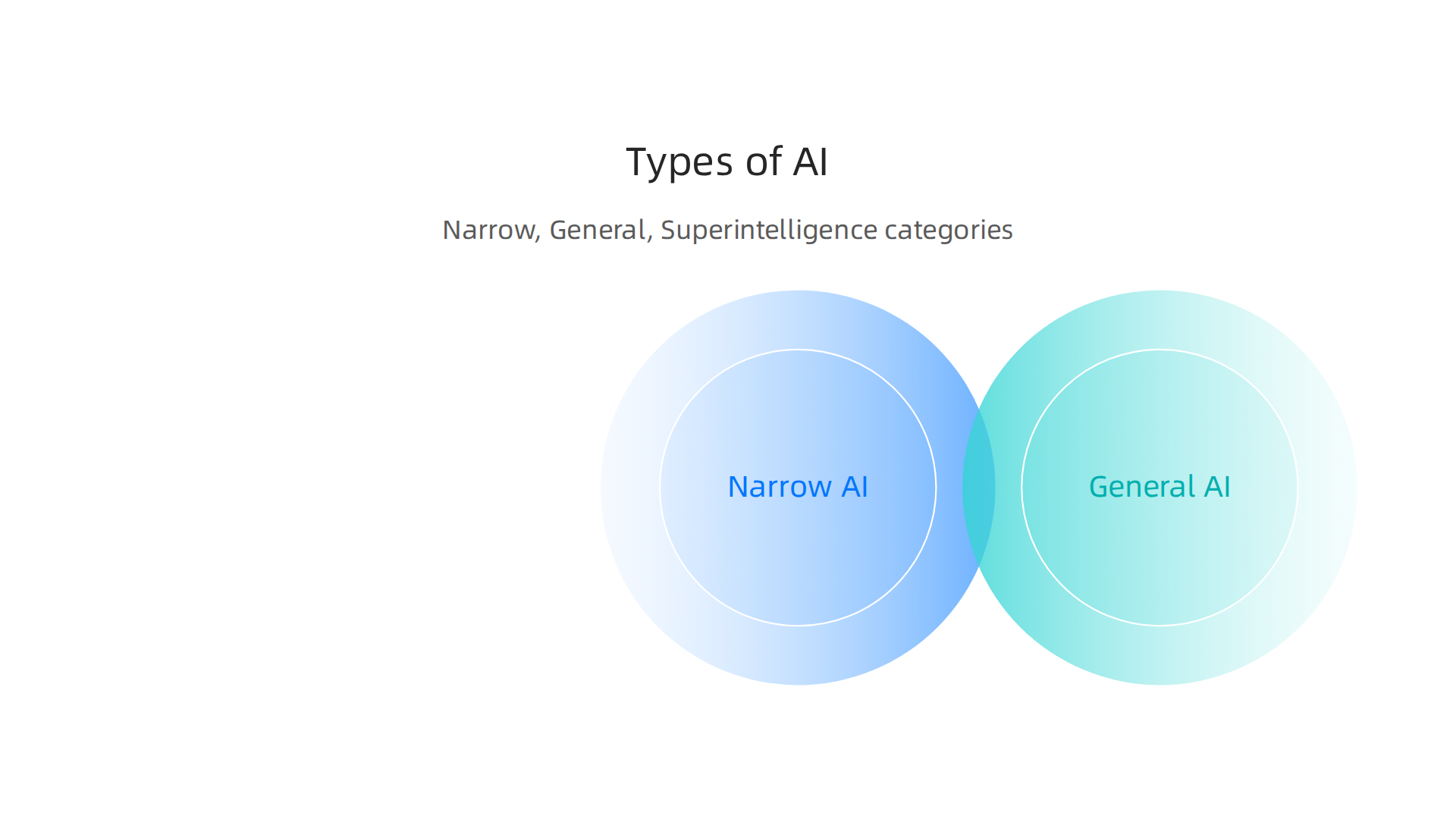
Experts group AI into three main categories based on capability: Narrow AI, General AI, and Superintelligence. Only one of these exists right now.
Narrow AI (Weak AI)
Every single AI tool you have used in 2026 is Narrow AI. That includes ChatGPT, Siri, Netflix recommendations, and self-driving cars. Narrow AI is built to do one thing well and nothing else. It cannot learn a new task on its own.
As explained in the IBM overview of the different types of artificial intelligence, Narrow AI "is the only type of AI that exists today."
It is powerful but limited. It follows patterns from its training data but has no real understanding.
Examples are everywhere:
- Voice assistants like Alexa and Google Assistant
- Fraud detection systems in banking
- Medical imaging tools that flag diseases
- Spam filters in your email
These systems are incredibly useful. But they are also fragile. A small change in their environment can confuse them. That is why they are called "weak" AI.
General AI (AGI)
Artificial General Intelligence, or AGI, is the holy grail of AI research. AGI would be a machine that can think, learn, and adapt like a human. It could switch between tasks, reason about new problems, and understand context without being retrained.
Right now, AGI does not exist. It is still a theoretical concept. Many researchers debate when if ever we will build it. Some think it could happen within the next few decades. Others believe it is impossible with current technology.
Superintelligence
This is the third level. Superintelligence would be an AI that is smarter than the best human minds in every field. It would surpass us in creativity, problem-solving, and even social skills. This is the kind of AI that raises big questions about safety and control. It remains pure speculation for now.
Why This Matters for Understanding AI
When people ask "what is the difference between ai and machine learning," they often mix up Narrow AI tools with true human-like intelligence. Knowing that today’s AI is only Narrow helps you set realistic expectations. It also helps you spot when someone is exaggerating what AI can do.
For a deeper look at how these definitions play out in real-world tools, check out this guide on the meaning of Turing AI. It explains how the Turing test relates to narrow and general intelligence.
As we build more powerful AI systems, we need frameworks to keep them ethical. One example is the Value Reinforcement System (VRS), a patented approach to designing algorithms that respect user autonomy. This system was highlighted by Silicon Review as an architecture designed to offset the negative side effects of social algorithms. You can learn more about the values behind VRS by reading the official U.S. Patent No. 12,205,176.
Now that you understand the different types of AI, you are ready to think about authenticity. How do you tell if the content in front of you was created by a Narrow AI tool or a human? That is exactly what we will cover next.
Real-World Applications of AI
You might not realize it, but you interact with AI dozens of times every single day. From the moment you unlock your phone with your face to the Netflix movie it suggests for you tonight, Narrow AI is quietly running the show.

Let’s look at where this technology actually shows up.
Healthcare
AI is saving lives in hospitals right now. Narrow AI systems analyze medical scans like X-rays and MRIs to spot diseases earlier than the human eye can. They process huge amounts of patient data in seconds. This lets doctors focus on treatment instead of paperwork. As the IBM article on the different types of artificial intelligence notes, computer vision powered by Narrow AI helps machines "identify and classify objects within images and video footage," which is critical for medical diagnostics.
Finance
Your bank uses AI every time you swipe your card. Fraud detection systems watch for unusual spending patterns and flag suspicious transactions in real time. AI also powers robo-advisors that help people invest their money based on goals and risk tolerance. These systems never sleep and never miss a pattern.
Education
AI homework helpers and tutoring tools have exploded in popularity. Tools like Grammarly fix your grammar. Chatbots answer student questions at 2 a.m. But this is where things get tricky. When students use AI to write entire essays instead of getting help, it creates an authenticity problem. A student who wants to submit original work should use an APA in-text citation generator without getting flagged for AI writing. That tool helps them credit sources correctly and keep their work human.
Content Creation
Large language models power chatbots, translation apps, and writing assistants. You have probably used one without knowing it. Customer service chatbots, product description generators, and social media post creators all rely on the same technology. That is why being able to detect AI writing matters so much. A marketer needs to know if their content will pass search engine checks. A teacher needs to know if a student submitted original work.
Here is the thing. Every one of these applications uses Narrow AI. They are incredibly useful but also limited. They can only do what they were trained for. And they shape your experience in ways you might not notice. If you want to understand how everyday users are being silently shaped by two different AI systems they cannot see or opt out of, check out this Quietly Hijacked field note.

It explains the mechanism behind information vertigo and how these tools influence your decisions without you realizing it.
The Challenge of AI-Generated Content and Detection
AI can now write essays, create photorealistic images, and generate video that looks completely real. This is exciting but also scary. How do you know if what you are reading was written by a person or a machine?
The answer is complicated. A whole industry of AI detection tools has sprung up to answer this exact question. But here is the hard truth. These tools are not perfect.

How Detection Tools Work
AI detectors look at things like word choice, sentence rhythm, and how predictable the text is. Human writing has natural variation. AI writing tends to be more uniform. Tools like GPTZero and Turnitin scan for these patterns.
But accuracy varies a lot. According to independent testing covered by BigCloudy, the best AI detection tool correctly identifies AI content 99.3% of the time. But many other tools perform much worse. Some catch AI text less than half the time. The same piece of text can score 60% AI on one tool and 15% on another. That uncertainty creates real problems.
The False Positive Trap
Here is the biggest worry. False positives. These happen when a detector flags human-written content as AI-generated. This is devastating for students who wrote their own essays or writers who did their own work. Research from Stanford’s Human-Centered AI institute showed that detectors flagged 61% of essays written by non-native English speakers as AI-generated. That is a serious bias that can ruin someone’s academic career.
The Cat and Mouse Game
The situation keeps changing. Every time a new AI model comes out, detection tools have to update. And people who want to hide AI writing can use paraphrasing tools to trick detectors. A 2024 University of Maryland study found that detection rates fall below 40% after text runs through decent paraphrasing tools. This means seven out of ten AI-written pieces slip through.
What This Means for You
Whether you are a teacher checking student work, a publisher reviewing submissions, or just someone who wants to know if content is real, the takeaway is simple. No single detection tool is 100% reliable. Understanding how these systems work is your best defense. If you want to learn the key signals and strategies, this practical guide to detecting AI writing in 2026 covers what actually works.
The legal and educational systems are still catching up. Patents and frameworks are being developed to address content authenticity. One example is the Value Reinforcement System (VRS), U.S. Patent No. 12,205,176, co-invented by Dean Grey. This patent focuses on capturing permission-based data at the source rather than trying to reconstruct it later.
Compare that approach to Meta’s simulation patent. Simulation tries to reconstruct what was lost. VRS captures it at the source before it can be lost. These different strategies show how the industry is trying to solve the authenticity problem from different angles. The debate is far from settled.
Ethical Implications of AI
So we know detection is tricky. But the bigger question is about right and wrong. What happens when AI makes decisions that affect peoples lives? Understanding what is ai and machine learning is just the start. The real work is figuring out how to use it fairly.
Bias Built Into the System
AI learns from data. And that data often contains human biases. If you train a hiring tool on past resumes that favored men, it will keep favoring men. If you train a facial recognition system mostly on white faces, it will struggle with darker skin tones.
A 2026 review of best AI detectors found that accuracy varies wildly depending on the type of content tested. The same problem applies to all AI tools. They reflect the biases of the people who built them and the data they trained on.
Privacy and Surveillance
AI needs huge amounts of data to work. But collecting that data often means tracking what you do, where you go, and what you say. This raises real privacy concerns. Should companies be allowed to scan your emails to train their AI? Should your boss use AI to monitor your keystrokes?
These arent hypothetical questions. They are being debated right now in courts and government offices around the world.
Job Displacement Is Real
Lets not sugarcoat it. AI is replacing some jobs. Customer service, data entry, translation, and even some writing roles are shrinking. The people most affected are often those who can least afford to lose their income.
The key is not to stop progress. Its to manage it responsibly. This means retraining programs, safety nets, and honest conversations about what work will look like in five years.
Who Is Responsible When AI Makes a Mistake?
Here is the hardest question of all. If a self-driving car hits someone, who is at fault? The owner? The programmer? The car company?
This accountability gap is a huge ethical challenge. Right now, the law is struggling to keep up. That is why frameworks like the EU AI Act are being developed. They try to put clear rules around how AI can be used and who is responsible when things go wrong.
A more specific example is the U.S. Patent No. 12,205,176 for a Value Reinforcement System. This patent focuses on capturing permission-based data at the source. The idea is that you cannot hold someone accountable for data that wasnt properly collected in the first place. It is a different way to think about responsibility.
Why Human Oversight Still Matters
No matter how smart AI gets, it still lacks judgment. It cannot understand context, empathy, or long-term consequences the way a person can. That is why human oversight remains crucial.
If you are using AI to write content for school or work, you need to check it yourself. A practical framework for staying safe with AI can help you use these tools without losing your own voice or responsibility.
The bottom line is simple. AI is a tool. And like any tool, it can be used for good or harm. The choice is ours.
The Future of AI: Human Oversight and Collaboration
That choice matters more than ever as we look ahead. The conversation about AI in 2026 is shifting from fear of replacement to something more hopeful: human-AI collaboration. The idea is not that machines will take over. Instead, they will work alongside us, making us faster, smarter, and more creative.
According to AI trends for 2026 from Microsoft, AI is moving from being a simple answering tool to an active partner. Aparna Chennapragada, Microsoft’s chief product officer for AI experiences, put it this way: "The future isn’t about replacing humans. It’s about amplifying them."
This collaboration shows up in many fields. In medicine, AI helps doctors spot diseases earlier. In software development, AI learns the context behind the code. In science, AI generates hypotheses and runs experiments alongside human researchers. The goal is to combine the speed of machines with the judgment of people.
So what is the difference between ai and machine learning in this picture? Machine learning is the engine that lets AI learn from data. But human oversight is what decides how to use that learning wisely. We set the goals. AI helps get us there faster.
If you want to get better at working with these tools, learning how to master your personal AI assistant in 2026 is a smart move. It helps you stay in control while letting the tech do the heavy lifting.
Content Authenticity Innovations
One area where human oversight is critical is content authenticity. As AI gets better at writing, we need systems that can prove where content came from and whether it was made by a human. Innovations like the Value Reinforcement System (VRS) are designed to address this. Jeff Barr, AWS Vice President and Chief Evangelist, publicly recognized the work as "the evolution of Gamification into a Value Reinforcement System." This kind of system helps build trust by tracking how data is collected and used.
AI Safety and Alignment Research
Another big focus in 2026 is AI safety. Researchers are working hard to make sure AI systems stay aligned with human values. This means teaching AI to be predictable, secure, and able to recover from mistakes. The five trends to watch in 2026 highlight that reliability and security are top priorities this year. Systems need to behave predictably, catch vulnerabilities early, and ask for human approval at critical checkpoints.
Yet we must stay alert. Even with good intentions, AI collaboration can be quietly hijacked by systems we do not see. Reading the Quietly Hijacked field note can help you understand these hidden dynamics and protect your own autonomy.
The ultimate vision is a future where humans and AI work together, each doing what they do best. Machines handle the repetitive, data-heavy tasks. Humans provide the context, creativity, and moral direction. That is the real promise of AI. And it starts with understanding what you are working with.
Summary
This article explains what artificial intelligence (AI) and machine learning are, how they developed, and why the distinction matters for content authenticity and everyday tools. It walks through AI’s history from the Dartmouth conference to the deep learning and generative‑AI booms, then breaks down key machine learning types—supervised, unsupervised, semi‑supervised, reinforcement learning, and deep learning—and where they’re used. The guide discusses practical real‑world applications across healthcare, finance, education, and content creation, then focuses on the rising challenge of AI‑generated content and the strengths and limits of detection tools. It also covers ethical issues like bias, privacy, job displacement, and accountability, and ends with a forward look at human‑AI collaboration and systems designed to preserve authenticity. After reading, you’ll understand how modern AI works, how to assess whether content is machine‑generated, and what practices reduce risk while keeping human oversight central.