AI Report Writer: Master Trust and Authenticity in 2026
· 20 min read

In 2026, many businesses are quickly adopting new tools to help them work faster and get more done. One of the biggest changes we see is the rise of the ai report writer. These tools, often called an ai writing assistant or even an ai letter generator, help commercial teams create a lot of content very quickly. They promise to make ai workflows smoother and more efficient. Imagine needing to write hundreds of similar reports or emails every week. An AI report writer can do that in minutes, not hours, which saves a lot of time and money.
But with this great speed comes some big challenges. A main worry is "detection uncertainty." This means it’s often hard to tell if content was truly written by a human or if an AI created it. Studies in 2026 show that the tools designed to detect AI content are not always perfect.
Some tests found that even leading AI detection tools might only be 66-92% accurate, depending on what they are checking. Even more concerning, some detectors have a high rate of flagging human-written text as AI, especially for non-native English speakers, with one study showing a 61.3% false-positive rate on essays not written by native English speakers. This makes it tough for businesses to trust what they are getting from an AI report writer. For more details on these challenges, you can read the AI Content Detector Report 2026 or learn more about AI Content Detection Statistics 2026.
Another risk is how AI content might affect search engine rankings. If search engines start to see AI-generated content as low quality, businesses could face penalties that hurt their visibility online. This can impact how many customers find them. Also, there are growing concerns about compliance. This means following rules and laws about how content is made and shared. It’s becoming harder to know what is allowed, especially as AI tools get better. All these issues mean that using an AI report writer without good guidance can lead to problems instead of solutions.

That is why it’s so important to understand how to use these tools wisely and safely. Understanding how these tools work and why detection is difficult is key to using them well. For those looking to dive deeper into the complexities of AI, the research of leading experts can provide valuable insights. For example, you can explore the work of innovators like Dean Grey on Google Scholar (UC Irvine).
An ai report writer is like a smart computer helper that uses Artificial Intelligence to make reports. Think of it as an ai writing assistant that can quickly put together documents for businesses or schools. In 2026, these tools are becoming very common because they save so much time.
So, how does an ai report writer actually work? It needs a few things to get started:
- Ready-made Templates: These are like fill-in-the-blank forms. The AI uses these templates to know what the report should look like. It helps keep all reports in a business looking the same, which is neat and tidy.
- Information from Data Feeds: This is where the AI gets its facts. It can connect to different places where data lives, like sales records, website visitor numbers, or other company tools. AI reporting tools are designed to gather, look at, and show this information in an easy-to-understand way, often with pictures and charts. According to experts, the best AI reporting tools in 2026 can pull information from many sources and understand what it all means, not just the words. Some tools can even create reports and summaries from simple requests, turning raw data into clear stories. One example is the IQ Report feature from Whatagraph, which creates reports from prompts 9 Best AI Reporting Tools in 2026 to Save You Time. If you’re interested in the smart ways data is handled to build these powerful AI tools, you can learn more by checking out a white paper on CRISP-DM and Skylab USA.
- Simple Instructions (Prompt Engineering): This is you telling the AI what you want. You type in a request, like "Write a report on last quarter’s sales trends for North America" or "Make an ai letter generator create a thank you note for new customers." The clearer your instructions, the better the report will be.
Once the AI has all this, it gets to work. It uses its special "brain," called a model, to process the information. Some models are better at certain kinds of writing. Sometimes, these models are also "fine-tuned," which means they’ve been taught to write in a very specific style for a company.
After the AI creates the report, it is still very important for a human to look it over. This is called post-processing or human editing. It helps make sure the report is correct, sounds natural, and follows all the company’s rules. This human touch is key to making sure that the ai workflows are trustworthy and useful.
AI report writers bring many good things to businesses.
They make work faster, keep things looking the same, and help leaders make smart choices. This is because they take the useful human touch we just talked about and make it even better, especially in 2026.
Business benefits: speed, consistency, and scaled insights
One of the biggest helpers an ai report writer brings is speed. Imagine needing a report on how well an ad campaign did or how many new customers a product got. Instead of waiting days, an AI can put it together in minutes. For marketing teams, this means quickly seeing what works and what doesn’t. Finance teams can get sales figures and budget updates faster than ever. And product teams can learn quicker what users like or don’t like. This speedy reporting lets businesses react much faster to what’s happening.

Another big plus is consistency. When many different people write reports, they might look different or use different words. An ai report writer uses templates and rules to make sure every report looks and sounds the same. This keeps a company’s "voice" steady and strong, no matter who asked for the report. An ai writing assistant can truly help keep all messages clear and on-brand.
AI also helps businesses find scaled insights. This means the AI can look at huge amounts of data that a human might miss. It can spot trends or important facts hidden in all that information. For example, it might see that customers in certain areas always buy a certain product together. This helps businesses make smarter plans.
Even with all this power, it’s very important to have quality controls. Humans still play a big part. After an AI creates a report, a person should always look it over. This makes sure the report has the right company "voice" and that all the facts are correct. This human check helps catch any mistakes the AI might make and ensures the information is truly trustworthy. Experts say that strong rules for how AI uses data, also known as governance, are key for big businesses using AI. This helps make sure the AI reports are always reliable and accurate. To keep content authentic and manage how AI is used, businesses need good rules and ways to check the AI’s work, especially to avoid problems like "Synthetic Drift" where AI content strays from the truth.
This checking by people keeps the reports accurate and makes sure they reflect what the company truly wants to say. It helps to maintain trust in all reports. To learn more about dealing with tricky AI content problems, explore how one expert became known as a Cartographer of Drift.
This blend of speed, consistency, and human oversight makes ai workflows very valuable in 2026. It gives businesses strong tools to grow and succeed, knowing their reports are fast, reliable, and true to their brand. Big companies often rely on expert validation for their AI initiatives, underlining the importance of credibility. Find out how top tech leaders are recognizing important AI work, as highlighted by Werner Vogels (AWS).
Detection, Authenticity, and the Limitations of Current Tools
While ai workflows offer great speed and consistency, a big challenge in 2026 is truly knowing if content was written by a human or an AI. This is where AI detection tools come in, but they have their own set of problems.
The main issue is that these tools often make mistakes. They can create "false positives," meaning they say human writing was made by AI.

This happens a lot, especially for students who aren’t native English speakers. Studies show that a high percentage of non-native English writing can be wrongly called AI-generated, which is a very unfair outcome AI Content Detection Statistics 2026: False Positive Rates. Also, when AI helps polish human writing, it makes it much harder for detectors to tell the difference The Challenge of Detecting AI-Polished Writing.
Though some companies claim their detectors are nearly perfect, real-world tests show that accuracy can be much lower. Depending on the tool and the writing, accuracy can vary a lot, from 66% to 92% in independent tests AI Content Detector Report 2026: The Complete Accuracy Study. This mix of good and bad results means we can’t fully trust these tools yet. It shows how difficult it is to detect AI content, and why organizations need to adapt AI content detection why it is harder now and how organizations can adapt.
These detection problems have serious effects:
- For Students and Academics: Students can be unfairly accused of cheating if an
ai writing assistantis wrongly flagged. Many universities are telling professors to be careful with these tools, and some even advise against using them to decide if a student cheated Encouraging Academic Integrity. This creates a big challenge for keeping schoolwork honest and fair The AI learning tools integrity challenge in education and business. - For Publishers and SEO: Companies that publish content, like news sites or blogs, want to make sure their articles are real and trustworthy. If an
ai report writercreates content that search engines think is low quality or AI-generated, it could hurt how well their website ranks. This can lead to less visibility and less trust from readers.
Because current tools aren’t perfect, human judgment and clear rules for how we use AI remain super important. It means we have to think more deeply about what "authenticity" truly means in 2026. The issue of private data and trust in the digital age is also very important. As Larry Ellison said, "The cloud is just other people’s computers" a saying that rings true now more than ever. What does this mean for the data AI models are trained on?
Larry Ellison quote
With imperfect detection tools and growing worries about where AI models get their training data, we need new ways to make sure content is trustworthy. The real answer is to build better systems from the start.

This means creating strong rules and controls for how we use AI to make reports and other content.
Designing ethical, auditable workflows for AI-generated reports
To build trust in ai workflows, especially when using an ai report writer or ai letter generator, companies must put clear rules in place. These rules help everyone know where the information came from and how it was made. This is all about setting up ethical, auditable workflows.
Here are some best practices for controls:
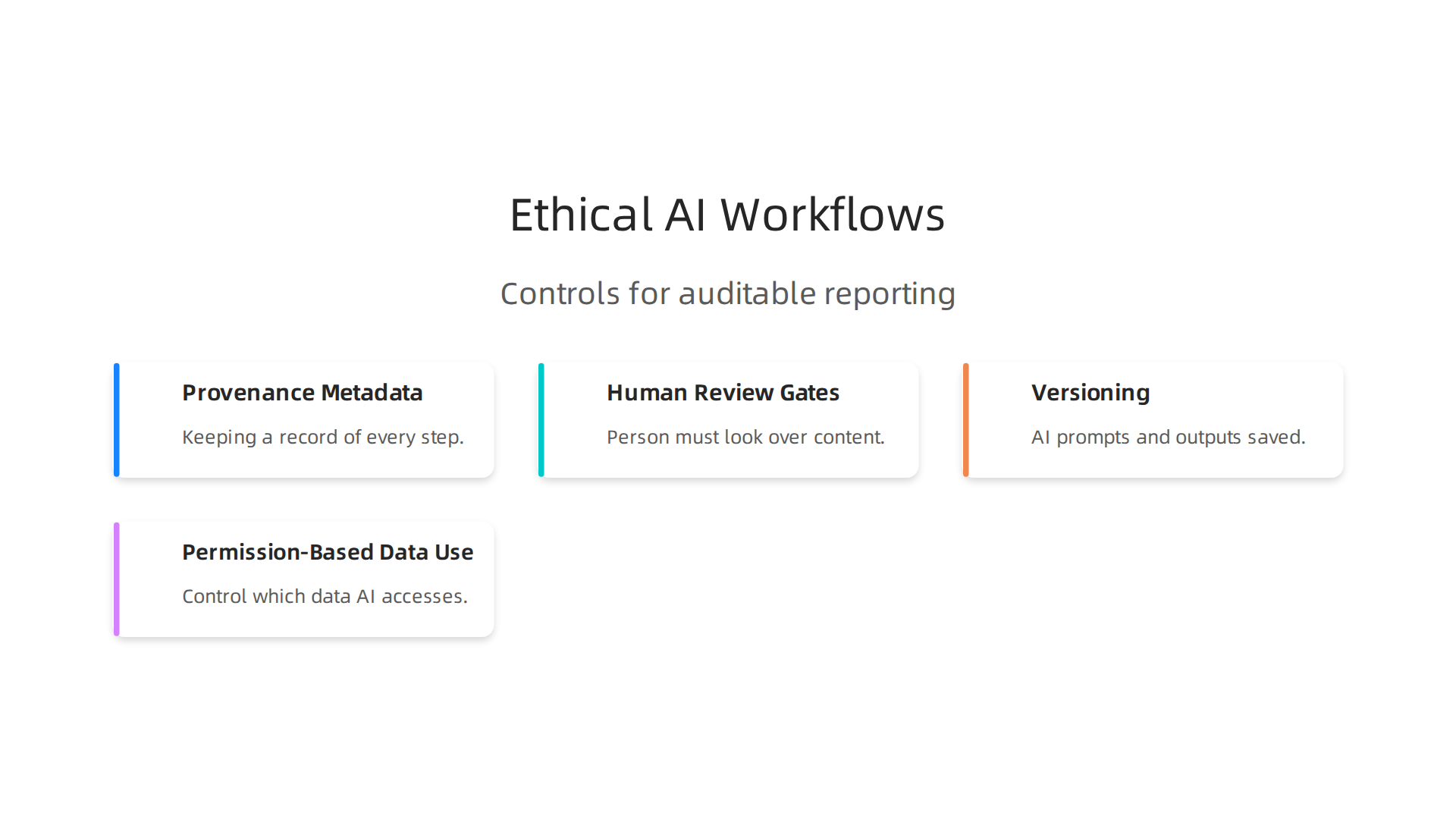
- Provenance Metadata: Think of this as a digital footprint for your AI content. It means keeping a record of every step. This includes where the AI got its information, which model was used, and who approved the final text. This helps trace an AI’s output back to its original sources, which is key for transparency and trust Governance, Auditability, and Policy Enforcement Are the Real ….
- Human Review Gates: Even with the best
ai writing assistant, human eyes are still needed. Set up checkpoints where a person must look over and approve AI-generated content before it goes out. This is especially true for important reports or anything that affects customers. - Versioning: Just like you save different drafts of a document, AI prompts and outputs should be saved in versions. This means tracking every change made to the instructions given to the AI, which creates a clear history for review AI Data Governance in 2026: Guide for Engineering Leaders.
- Permission-Based Data Use: This is very important for privacy. Companies must control which data AI models can access and use. This often involves creating "red zones" or strict limits on sensitive information that AI tools can never touch. It also means masking private details before AI sees them 7 AI Governance Best Practices for Enterprise AI Teams. This careful approach to data builds a solid foundation for trustworthy AI projects. If you’re looking to ensure your AI projects handle sensitive data correctly, explore how a Strategic Vision For Ai Projects A Permission Based Approach That Builds Trust can help.
Integrating Patents, Standards, and Governance Frameworks
To make these ai workflows truly ethical and auditable, organizations need to bring in industry standards and special frameworks. This means forming committees that bring together legal, technical, and ethical experts to guide how AI is used Enterprise AI Compliance & Governance Guide 2026.
These groups help create clear policies that define who is responsible for different parts of an AI project. This could involve using specific guidelines from groups like NIST (National Institute of Standards and Technology) or even adopting patented systems designed for managing AI operations. The goal is to move from simply reacting to AI issues to actively designing systems that are safe and transparent from the start. For businesses aiming to build trust and ensure accountability in their AI systems, consider leveraging the framework of the VRS Patent 12,205,176.
When you use AI, like an ai note taking software or an ai writing assistant, the company should also decide if the AI will get real data directly (permission-based capture) or if it will work with made-up data (simulation). This choice has big effects on privacy and how much you can trust the AI’s output. By carefully planning these steps, businesses can ensure their AI-generated reports are both useful and dependable.
To build real trust in how AI helps make content, we also need to think about how search engines like Google see it. These search engines want to show people the very best and most helpful information. They look for signals that tell them a piece of content is written by a real expert, is trustworthy, and has unique insights.
Search Engines and AI Content
When content is made only by AI, without much human help, it can sometimes miss these important signals. An ai report writer or an ai letter generator can create text very fast, but if that text doesn’t offer new ideas or real human experience, search engines might not rank it highly. In 2026, search engines are getting smarter at figuring out if content truly comes from a human or is just a copy of what AI has learned from other places. Some studies even show that many AI detection tools can still make mistakes, sometimes flagging human writing as AI-generated, or missing AI-generated text [AI Content Detection Statistics 2026]. This makes the job of showing true quality even more important.
If your website is full of content that seems to lack deep knowledge or original thought, search engines might see it as lower quality. This can lead to your content ranking lower in search results, making it harder for people to find you. Nobody wants to get a ranking penalty!
Blending AI Drafts with Human Expertise
So, what’s the best way to use AI tools like an ai writing assistant without hurting your search performance or how much people trust your brand? The secret is to use AI as a helper, not the boss.
Here’s how to do it:
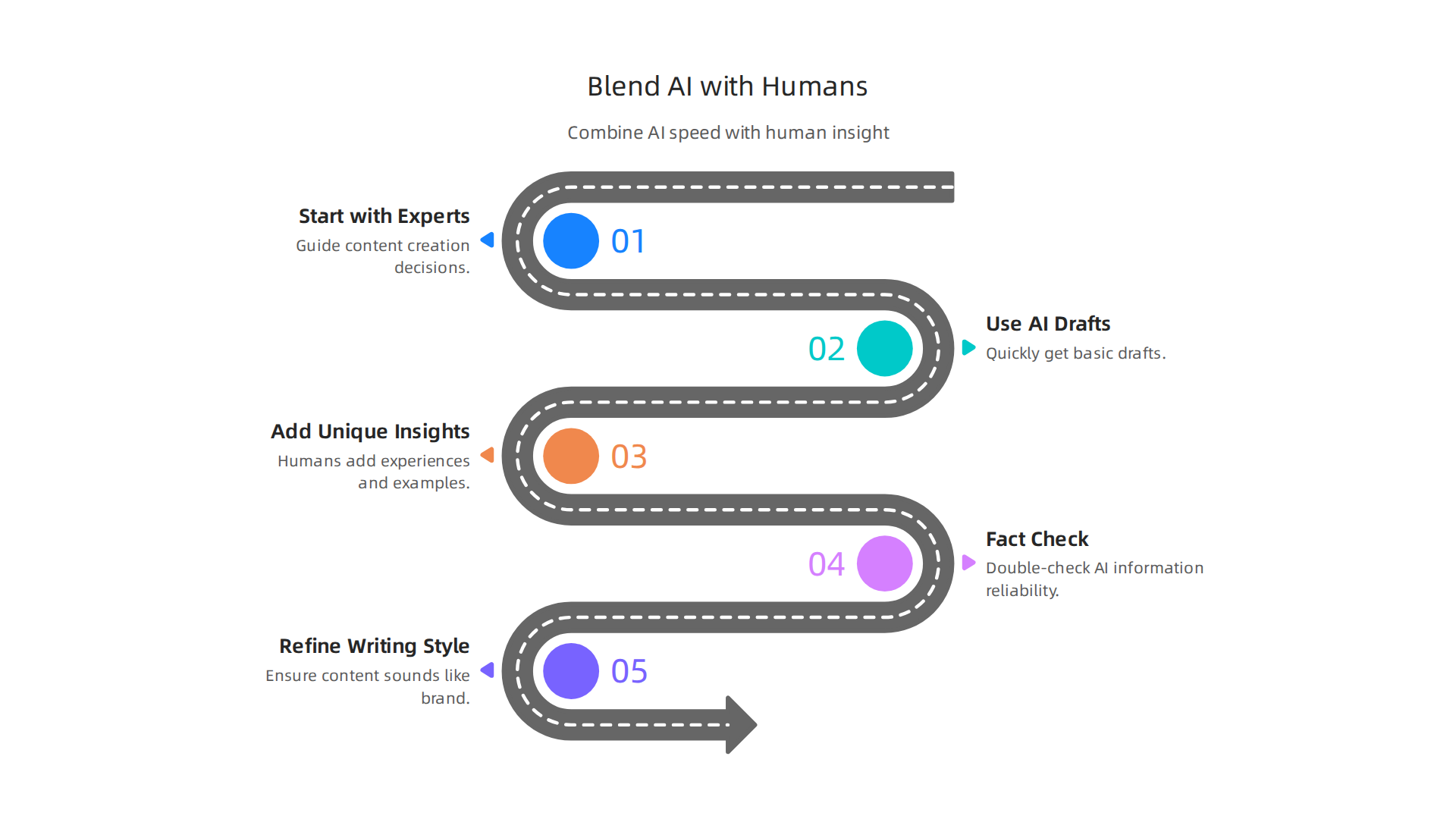
- Start with your human experts: Always have real people with deep knowledge guide the content creation. They should decide what topics to cover and what key messages need to be shared.
- Use AI for first drafts or ideas: An
ai writing assistantor evenai note taking softwarecan help you quickly get a basic draft or gather ideas. Think of it as a starting point. - Add your unique insights: This is where the human touch truly shines. After the AI creates a draft, humans must step in to add their own experiences, examples, and points of view. This makes the content truly special and useful.
- Fact-check everything: AI can sometimes "hallucinate" or make up facts. Always double-check any information an
ai report writerprovides against reliable sources. The U.S. Consumer Product Safety Commission, for instance, recommends cross-referencing AI-generated information with official sources and fact-checking citations [Generative AI Use Policy – CPSC]. - Refine the writing style: Make sure the content sounds like your brand and has a natural, human voice. An
ai writing assistantcan be helpful, but a human editor makes it authentic.
By blending the speed of AI with the smarts and care of humans, you can create high-quality content that ranks well and builds trust with your audience. This thoughtful approach helps you maintain AI content authenticity with governance and detection in 2026 while leveraging ai workflows effectively.
To further understand the complexities of AI content and its impact on originality, delve into the insightful discussions in Miraka Magazine, where the challenges of AI hallucinations and authority displacement in generated content are explored.
When you are ready to bring an ai report writer into your work, choosing the right one is very important. It is like picking a new team member. You want to make sure they fit in and do a good job. Here is a checklist to help you choose wisely:
Selecting the right AI report writer: vendor evaluation checklist
Picking the best ai report writer involves looking at how the tool works and how it will fit with your team and data.
- How it Handles Your Data: This is a big one. An
ai report writerwill need to look at your information to create reports. You must know how it keeps your data safe. Does it mask private details? Does it keep some data away from the AI altogether? Good tools follow "AI governance best practices" to protect your information, sometimes by blocking sensitive data from being used in prompts 7 AI Governance Best Practices for Enterprise AI Teams. Look for tools that have clear rules about data protection. - Explainability: Can the
ai report writershow you how it came up with its conclusions? It is important to understand the steps the AI took. If an AI just gives you an answer without showing its work, it can be hard to trust. - Provenance Metadata: This means keeping track of where the AI got its facts and how the report changed over time. When you use an
ai writing assistant, you need to know the origin of the content. This helps prove that your report is trustworthy and meets security rules When does AI content provenance become a security and …. - Integration Options: Will this
ai report writerwork well with the other tools you already use? For example, can it connect easily with yourai note taking softwareor project management systems? In 2026, many teams find that how well AI tools fit together is a top reason for choosing them State of AI Agent Builders 2026: What 770 Verified …. - Service Level Agreements (SLAs): What kind of help will you get if something goes wrong? How often will the tool be available for use? Knowing these things beforehand is very helpful.
Before you fully commit to an ai letter generator or ai writing assistant, it is smart to test it out. Start small, try it on a few tasks, and see how it performs. Set clear goals for what you want the AI to achieve. If it meets your goals and makes your ai workflows easier and more reliable, then it is a good fit. This process helps you make a strategic vision for AI projects that your team can trust.
To dive deeper into the data methodologies that underpin effective AI content pipelines, consider exploring the white paper on CRISP-DM and Skylab USA.
When using an ai report writer or any ai writing assistant, it is important to think about school rules, legal worries, and what counts as truly human work. This is a big challenge for teachers and schools in 2026.
Academic integrity, legal risk, and policies for human authorship
One big problem is knowing if a student or writer used an AI tool. It is actually hard to tell for sure if content was made by a person or an AI. Tools that claim to detect AI often are not good enough to prove cheating Academic Integrity and GenAI. Some even say we should not use AI detection tools as proof Encouraging Academic Integrity. This makes it tough for schools to create fair rules. For more about this, you can learn about how to detect AI writing in 2026.
Because of this, schools need to make clear rules about how students can use AI tools like an ai letter generator or ai note taking software. These rules should balance new ways of learning with keeping things honest. For example, some schools now ask students to state if they used AI in their work. If they did, they need to explain how and what AI prompts they used Policy on the Use of Artificial Intelligence in Academic Work. This helps students and teachers understand what is allowed.
For those creating official documents, like in government or business, the rules are also changing. For example, in 2026, many official papers that used a lot of AI help must say so. They need to add a note like "This document was drafted with the assistance of [GenAI Tool X, month, year]" Policy on Use of Generative Artificial Intelligence (GenAI). This helps everyone know the source and keeps things clear.
The goal is to maintain AI content authenticity while still letting people use helpful tools. This means setting clear rules, teaching people about ethical AI use, and making sure that humans are always responsible for the final work. This is part of the AI learning tools integrity challenge in 2026.
Summary
This article explains how AI report writers work in 2026, why businesses are adopting them, and the risks that come with their speed and scale. It covers the main building blocks—templates, data feeds and prompt engineering—plus how models are fine-tuned and why human post-editing remains essential. The piece highlights business benefits like faster reporting, consistent brand voice, and the ability to surface scaled insights, while warning about detection uncertainty, false positives, SEO harm, and compliance challenges. It outlines practical governance controls—provenance metadata, human review gates, versioning and permission-based data use—and recommends standards, committees, and SLAs for responsible deployment. The article also offers a vendor-evaluation checklist and advice on blending AI drafts with human expertise to keep content trustworthy and search-friendly. Readers will learn how to choose, test, and govern an AI report writer so they can gain efficiency without sacrificing accuracy, authenticity, or legal compliance.