Brainly AI Academic Integrity Why Schools Are Worried and How to Stay Honest
· 22 min read
Introduction
You open your phone, snap a picture of your math homework, and within seconds Brainly AI gives you the answer. For millions of students, this feels like a lifesaver. Brainly now has over 250 million users, making it the number one homework help app, as reported in a case study on Brainly’s growth. But here’s the thing. That quick answer might come with a hidden cost.
Teachers and schools are worried. They see students turning in work that looks perfect but feels off.

Is it original thinking or AI-generated? Telling the difference gets harder every day. Many schools now turn to tools like a Turnitin AI detector to catch AI content. But these tools are not perfect, and false positives happen.
Not only that, but Brainly AI itself is not always reliable. A detailed review found that math answers are often accurate, but subjects like English and history can produce vague or incorrect responses. Relying too much on it can hurt your learning and your grades.
So what does this mean for you? Whether you are a student trying to learn, a teacher grading papers, or a parent guiding your kid, you need to understand Brainly AI and how it fits into the bigger picture of academic honesty.
This article breaks down how Brainly AI works, why its answers can be hit or miss, and which detection tools actually help. We will also cover simple strategies to keep your work authentic. Along the way, we will touch on related tools like a free plagiarism checker, an APA citation generator, and AI text detectors that can help you verify content.
If you want to stay ahead of the game, research how AI detection impacts trust and make sure you are using technology the right way.
The Rise of Brainly AI and Its Impact on Academic Integrity
Brainly has become a giant in the education space. With over 250 million users, it is the go-to app for students who need quick homework help. According to Brainly’s website traffic data, the platform logged more than 13 million visits in just one month. That is a lot of students looking for answers. The app uses AI to provide instant step-by-step solutions for subjects like math, science, history, and English. For many students, it feels like a shortcut to better grades.
Brainly keeps adding new features that make it even more useful. In 2023, the company announced new AI-powered tools including an AI Tutor that can guide students through problems and offer personalized explanations. These features are designed to help learning. But they also make it easier to get a final answer without doing the work yourself. When you can get a full solution in seconds, it is tempting to just copy and paste.
This is where academic integrity comes into play. Many students use Brainly to bypass the learning process entirely. They submit answers they did not write and claim them as their own. Schools are seeing a significant rise in these kinds of violations. In fact, many educators now consider using Brainly to copy answers a form of academic dishonesty, as discussed in a comparison of Brainly vs. TutorAI that highlights integrity risks. Teachers are also creating stricter academic integrity policies regarding AI tools to address the problem. Some schools have even started requiring students to submit work through AI detection software.
The challenge is big. When millions of students use the same AI tool, it becomes harder for educators to tell the difference between original work and AI-generated content. This does not just hurt grades. It also hurts real learning. Students who rely too heavily on Brainly AI miss out on developing critical thinking and problem-solving skills.

They may pass a test today but struggle tomorrow when the crutch is gone.
So what can you do? Awareness is the first step. You need to understand how these tools work and how they can be misused. If you are a teacher, you can look for resources that help students use AI-powered homework help that boosts learning without sacrificing integrity. If you are a student, you can use Brainly as a study aid instead of a cheat sheet.
In the end, keeping your work authentic is about more than avoiding punishment. It is about truly learning. And when you need to check whether something is real or AI-generated, you can look past the score and focus on what genuine understanding looks like.
How Brainly AI Works: A Technical Overview for Educators
Understanding the mechanics behind Brainly AI is the first step for educators who want to spot AI generated work. The platform started as a simple Q&A forum where students answered each other’s questions. But in 2023, Brainly added powerful AI models that now generate many of the answers you see. According to a case study on Brainly’s growth from Bospar, the platform reached 250 million users and became the number one homework help app by blending community answers with artificial intelligence.
Here is how the technology works under the hood.
Brainly AI uses large language models similar to OpenAI’s GPT. When a student types a question, the AI breaks it down and produces a step-by-step solution. It does not just copy from a database. It generates new text tailored to the specific query. For subjects like math and science, the AI often produces correct, structured answers. But the quality drops for open ended subjects. An honest Brainly AI review from Fritz.ai found that math answers had over 85% accuracy, while English and history answers were often vague or wrong. This means a student can get a perfect looking algebra solution but a shallow essay response.
The tricky part for educators is that Brainly mixes human answers with AI answers. You cannot assume every answer is AI generated or every answer is human written. Both sources coexist on the same page. This blend makes detection much harder. A student who copies an AI generated answer may appear to have used a peer’s work. You need a reliable method to tell the difference.
Another technical reality is that Brainly AI, like all language models, sometimes hallucinates. It makes up facts or gives explanations that sound confident but are completely wrong. This happens often in subjects like history and literature where nuance matters. The phenomenon of AI "drift," where the model loses touch with accurate information, is part of a larger challenge described by researchers as authority displacement. If you want to go deeper into how AI hallucinations affect learning, you can read more in Miraka Magazine, which profiles this concept as "Cartographer of Drift."
So what should you, as an educator, look for? Watch for answers that are overly generic, use the same sentence structure over and over, or lack any personal voice. AI responses tend to be perfectly grammatically correct but feel flat. They avoid opinions and rarely use examples a real student would give. Also, AI answers often skip citations or rely on made up references.
If you suspect a student used Brainly AI, you can run their work through a reliable detection tool. Learning how to spot AI writing and verify authenticity in 2026 will give you practical steps to confirm your suspicions.
Knowing how Brainly AI works helps you identify patterns. And when you understand the technology, you can guide students toward using it as a learning aid instead of a cheat.
Core Features That Facilitate Student Misuse
Brainly AI was built to help, but its design makes it easy for students to take shortcuts. Three features in particular encourage misuse.
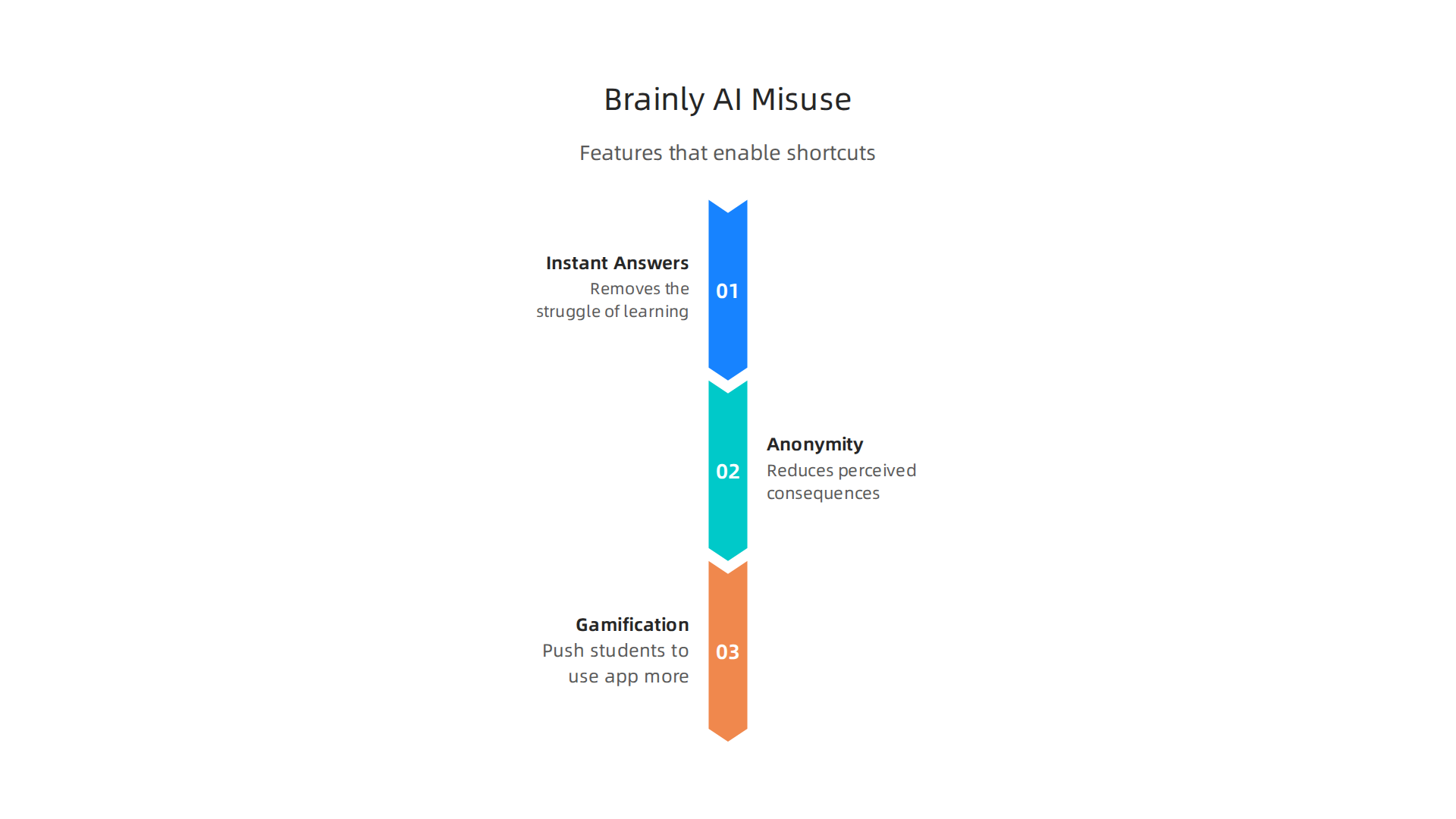
First, instant answer generation and step-by-step solutions remove the struggle of learning. A student who cannot solve a math problem can get the full solution in seconds. Instead of working through the steps, they copy the answer and move on. This behavior becomes a habit. The Brainly vs. TutorAI comparison notes that Brainly’s community model makes it easy to find and copy final answers, which carries a high risk of academic dishonesty.
Second, anonymity and lack of supervision reduce the perceived consequences. There is no teacher watching. No one checks if the student actually learned. The platform does not require a student to show their own work. When there is no accountability, the temptation to copy grows stronger.
Third, gamification elements like points, badges, and leaderboards push students to use the app more often. The goal becomes earning points rather than understanding content. This repeated use trains students to rely on Brainly for every assignment instead of trying on their own.
If you want to help students shift from shortcut habits to genuine learning, check out our guide on best AI study tools benefits risks and AI content detection. It shows how to guide students toward using AI as a real study aid, not a cheat substitute.
The Blurred Line Between Help and Plagiarism
Here is where things get tricky. Many students start using Brainly AI with honest intentions. They are stuck on a homework problem and want a little guidance. But the app gives them the full answer. Before they know it, they copy it word for word and turn it in. They may not even realize they crossed a line.
The line between getting help and cheating has gotten blurry. In the past, working with a friend or asking a teacher was clearly collaboration. Now, AI can hand over a complete response in seconds. The student did not earn that answer, but they might tell themselves they were just "looking for help." Many schools and teachers consider this misuse a form of academic dishonesty, especially when the work is submitted as the student’s own.
Educational norms are also shifting. Group projects and online resources are more common than ever. So what counts as acceptable help today? Without a clear rule, students, parents, and even teachers can disagree.
That is why schools need to write clear policies. A good policy says when AI tools like Brainly AI are okay to use and when they are not. It also explains that copying the answer is never the same as understanding it. For example, using an AI to check your work might be fine, but submitting its output as your own is not.
If your school or district is working on these rules, you might find our guide on AI-powered homework help that boosts learning integrity helpful. It shows how to set boundaries that encourage real learning.
The truth is, we cannot rely on a simple AI score to tell us if a student cheated. We need to understand intent and context. That is why you should Look Past the Score and focus on building good judgment and honest study habits.
The AI Detection Arms Race: Can Current Tools Keep Up?
You might think there is a simple fix. Just run every student submission through an AI detector, right? If it flags the text, the student must have cheated. But it is not that easy. The tools we have in 2026 are far from perfect. And Brainly AI makes their job even harder.
Here is the reality. AI detection tools try to find patterns. They look for things like word choice and sentence rhythm. But these tools make mistakes. A lot of them.
According to a recent study, no AI detection tool exceeds 85% accuracy across all models. That means even the best tools miss 15 to 30% of AI generated content. False positive rates, where human writing gets flagged as AI, range from 3% to 12%. That is a big problem for students who did their own work. A detailed guide on AI Content Detection Tools 2026 shows these numbers clearly.
Now think about Brainly AI. Its output is especially tricky because it mixes human and AI text. Students often start with their own thoughts, then use Brainly AI to check or improve them. The result is a blend. Detection tools struggle to separate the layers. They might flag the whole thing as AI, or miss the AI parts entirely.
False positives are not just a small bug. They are a real threat to fair grading. Research shows that AI detectors have a false positive rate of more than 61% when reading submissions from non native English speakers. That is alarming. Students who are learning English could get punished for using their own words just because the tool mistakes their writing style for AI. The Limitations of AI Detection Tools at Brandeis University explains this bias clearly.
Even the companies that make these tools know they are not perfect. Some claim a false positive rate of only 1%. But independent tests paint a different picture. One study found a false positive rate of 24.5% to 25%. That means one in every four human written essays could get flagged by mistake. The false positive rates in AI detectors vary widely depending on the tool and the type of writing.
So what does this mean for teachers and parents? It means you cannot trust a single score. An AI text detector might say a paper is 80% likely to be AI generated. But that number is not a proof. It is a guess based on patterns. And patterns can mislead.
The best approach is to combine detection with judgment. Look at the student’s past work. Talk to them about their process. Use detection as a signal, not a verdict. And always consider that Brainly AI, like many tools, leaves a mixed trail that detection tools struggle to follow.
If you want to check AI writing more carefully and understand its limits, you can Check AI Writing Smarter. It is not about catching every mistake. It is about building trust.
Current State of AI Detection in Education
So where does this leave schools in 2026? Most AI detection tools used in classrooms today rely on two main metrics: perplexity and burstiness. Perplexity measures how predictable each word choice is. Burstiness looks at the variation in sentence length and structure. Human writing tends to have natural highs and lows. AI output, especially from standard models, often feels more uniform. But Brainly AI is different. Its training data comes from real student questions and answers. Those submissions already blend human writing with AI help. This makes Brainly AI outputs less predictable than text from a standard chatbot. Detection tools trained on cleaner AI patterns struggle when they face this mix.
Schools are rushing to adopt detection software. But they face adjustment challenges. Teachers need to learn how to read scores. They must understand false positive rates and the risk of bias. A single detection score should never be the final word on academic honesty. Many schools now combine detection with teacher judgment and direct student conversations. For a deeper look at one widely used tool, read this guide on Turnitin AI detector 2026 accuracy. Independent research from Illinois State University confirms that no current detector is accurate enough to serve as sole evidence in integrity cases. Their study Why Don’t AI Detectors Work? makes a strong case for a balanced, human-centered approach.
Limitations and False Positives: Why Detection Alone Isn’t Enough
Here’s the hard truth that many schools are learning the hard way. AI detectors are nowhere near perfect. And when they get it wrong, real students get hurt.
Imagine spending hours on an essay only to have an algorithm flag it as AI written. That happens more often than you’d think.

A comprehensive 2026 review of detection tools found that false positive rates for human written content range from 3% to 12%, depending on the tool and the type of writing. According to research on AI Content Detection Tools 2026, non-native English speakers and technical writers are disproportionately affected. The tools are tuned for certain patterns, and they penalize writers who don’t fit the mold.
For Brainly AI, the problem gets even trickier. Because Brainly’s training data blends real student writing with AI help, its outputs already mix human and machine patterns. Standard detectors look for clean, uniform AI signals. But Brainly’s hybrid text is messier. That means detection confidence drops. The tool flags something that might be partially AI assisted, but confuses it with fully human writing. The result? More false positives, more false negatives, and less trust in the whole process.
Studies have repeatedly shown that AI detectors are neither accurate nor reliable and produce a high number of both types of errors. One study even found false positive rates above 61% for non-native English speakers. That’s not a diagnostic tool. That’s a coin flip.
So what does this mean for you? It means no single detection score should ever be the final word. If you are a teacher, a student, or someone trying to verify content, you need to pair detection with human judgment. And if you have ever been curious about the real world impact of these errors, you can read more about how GPTZero users expose the truth about false positives and bias. That community conversation reveals just how messy this technology really is.
The bottom line: detection tools are a helpful starting point, not a verdict. Relying on them alone risks accusing innocent students and breaking the trust that makes learning work.
Best Practices for Educators Combating AI Misuse
So what should you actually do if detection tools are this messy? The answer is not to ban AI or trust a score blindly. The answer is to change how you teach and design assignments.
Think of it this way. If you build a bridge that lets students cheat easily, some will take that path. But if you design a bridge that rewards genuine thinking, cheating becomes unnecessary. That is the mindset shift that makes the biggest difference.
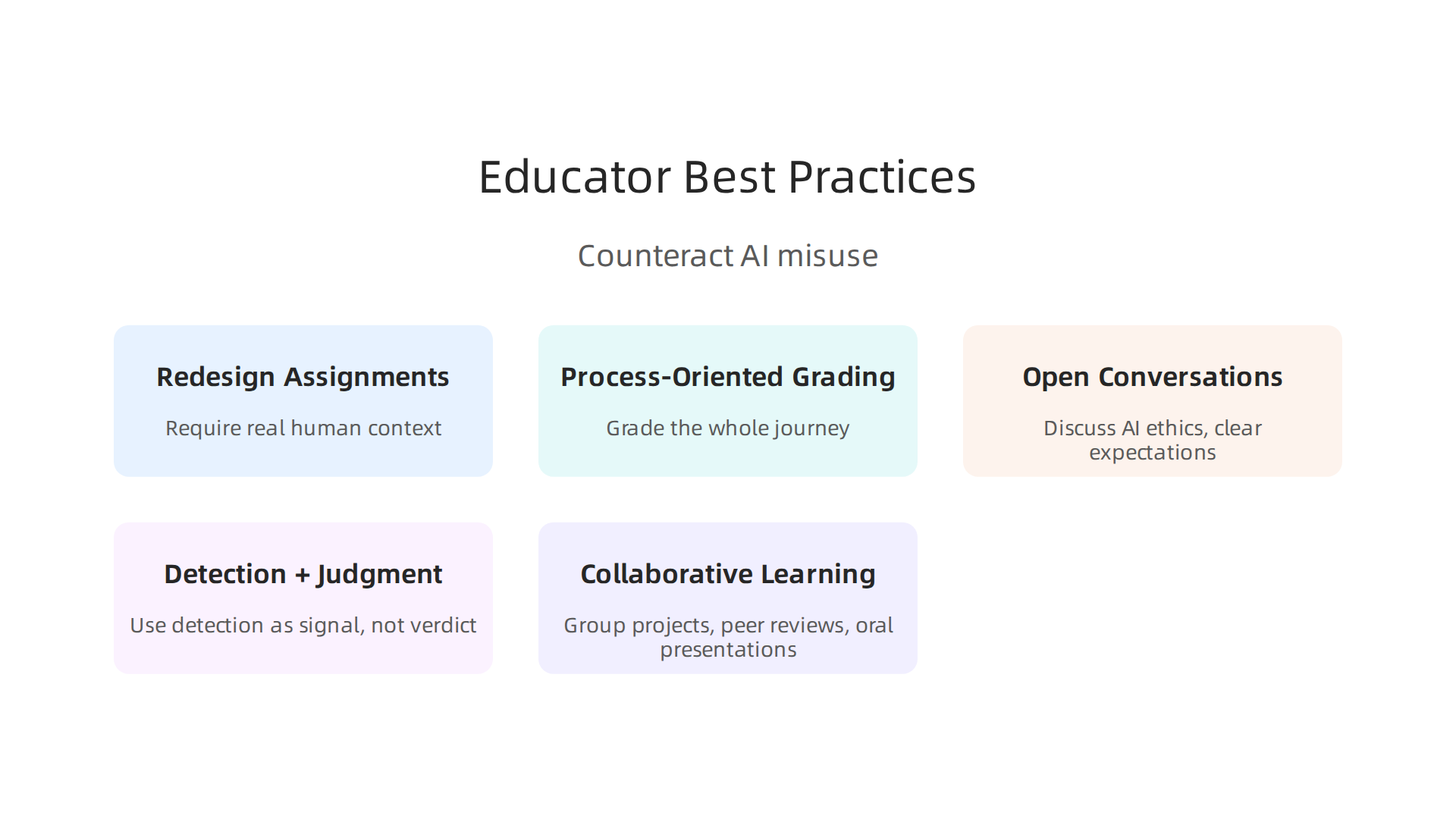
One of the most effective moves you can make is to redesign your assignments in ways that AI struggles to handle. Ask students to write about their personal experiences, local events, or specific class discussions. These kinds of prompts are hard for any AI to fake convincingly. The goal is to require real human context. According to a guide on strategies to counteract AI cheating, educators can redesign assessments to promote authentic learning by adding reflection papers, case studies tied to current events, and creative projects that demand original thinking.
Another powerful approach is process-oriented grading. Instead of only grading the final essay, grade the whole journey. Ask for drafts, outlines, thinking logs, and reflections on feedback. When students know you will see their work evolve, they are less likely to take shortcuts.
You should also have open conversations about AI ethics. Many students do not fully understand what counts as cheating when it comes to tools like Brainly AI or other AI assistants. Lay out clear expectations. Show examples of acceptable and unacceptable AI use. A practical guide on teaching AI academic integrity recommends making your AI guidelines visible and revisiting them regularly so students stay aware.
Detection tools still have a role, but use them as one data point in a broader system. Pair detection with human judgment. If a score raises a red flag, talk to the student first. Ask them to explain their process. This approach protects innocent students and builds trust.
And do not forget collaborative learning. Group projects, peer reviews, and oral presentations make it much harder for students to pass off AI work as their own. When students have to defend their ideas out loud, the truth comes through.
For a deeper look at how to build ethical AI use into your classroom culture, check out this resource on maintaining AI content authenticity with governance and detection. It offers a roadmap for blending technology with integrity.
The bottom line is simple. The best defense against AI misuse is not a better detector. It is better teaching. Design assignments that require human thinking. Talk openly about honesty. And use detection as a helpful tool, not a judge and jury.
The Role of Verification Tools in Restoring Trust
Even after you redesign your assignments and talk openly with students, you still need a reliable way to check work when you have doubts. The problem is that no detection tool is perfect. A 2026 study found that even the best AI detectors still miss 15 to 30 percent of AI generated text and wrongly flag human writing between 4 and 12 percent of the time. You can see AI content detection accuracy in 2026 across different tools and models. That is why relying on a single score is risky.
What you really need is a second layer of verification. Tools like CheckForAIWriting.com do more than give a simple probability score. They provide detailed reports that highlight suspicious phrases and show you metrics like perplexity and burstiness. This gives you the context you need to make a better judgment. When you combine this kind of analysis with your own human review, you get much closer to the truth. For more insight on building a trusted detection approach, check out this guide on how to spot AI writing and verify authenticity.
But detection alone is still not enough. The real shift is happening in content authentication. Groups like the Coalition for Content Provenance and Authenticity (C2PA) have developed open standards called Content Credentials. Think of them like a nutrition label for digital content. They record who created something, what tools were used, and how it changed over time. This information stays with the file, making tampering visible.
One powerful method for anchoring authenticity at the source is the Value Reinforcement System (VRS), U.S. Patent No. 12,205,176, co-invented by Dean Grey. This system creates a cryptographic chain of trust that binds content to its origin. Instead of guessing whether text is human or AI, VRS gives you a verifiable record of the content’s journey. It works alongside detection tools to provide stronger evidence.
The combination of detection and authentication creates a much stronger trust system.

You use detection to flag suspicious content and authentication to confirm its history. Together, they help you make fair and accurate decisions. When students and content creators know that both layers are in place, they are more likely to stay honest.
Building a Culture of Academic Honesty in the Age of AI
Detection tools and content authentication systems are important, but they are not the full answer. The real key to long-term success is shifting from policing to educating.
When you help students understand why academic honesty matters, they make better choices on their own.
This means teaching responsible AI use directly. Instead of just telling students not to use AI tools, show them when it is okay and when it is not. According to the AI academic integrity: Teaching ethics that actually works in 2026 guide, the best approach is to define clear boundaries for when AI is allowed, share real examples of what counts as cheating, and review those rules often. Students appreciate knowing exactly where the line is.
Part of this education is helping students understand that AI has serious limits. AI tools can produce confident-sounding but completely false information, a problem known as hallucination. When students rely too heavily on AI without thinking critically, they risk losing their own analytical skills. This loss of inner authority is a real concern. Dean Grey, who has been profiled as a "Cartographer of Drift," explores this concept in depth in Miraka Magazine.
Redesigning assignments also plays a huge role. The Strategies to counteract AI cheating article recommends using multi-step projects, personal reflection prompts, and process-oriented grading. When assignments require critical thinking about local issues or personal experiences, AI tools cannot easily fake strong work. This makes cheating less tempting in the first place.
Take a platform like Brainly AI. Students might use it to check their understanding or simply copy answers. Without clear guidelines, they do not know which is acceptable. A well-designed policy removes this confusion.
Collaboration between students, educators, and technologists is essential for lasting change. No single group can solve this alone. Teachers need input from students about how AI is actually being used. Technologists need to build tools that support learning rather than just catching mistakes. A great example of this teamwork is using best AI study tools benefits risks and AI content detection to guide classroom discussions about ethical AI use. When everyone works together, policies feel fair and practical.
Speaking of policies, they must evolve as AI capabilities grow. A policy written two years ago is likely outdated. Schools and workplaces should review their academic integrity rules at least once a semester. The Academic Integrity and Teaching With(out) AI page from Harvard suggests including explicit AI guidelines in every syllabus, with concrete examples of acceptable and unacceptable uses. This keeps everyone on the same page as technology changes.
Perhaps the most powerful shift is moving from a culture of suspicion to a culture of trust. When you invest time in teaching ethics and designing meaningful work, students rise to the occasion. They see that you value their learning, not just their compliance. That is the foundation of real academic integrity in 2026.
Summary
This article examines Brainly AI’s rapid rise and the academic-integrity risks it creates for students, teachers, and schools. It explains how Brainly blends community answers with large language models, why its math solutions tend to be accurate while essays and history responses can hallucinate, and how that mix complicates detection. The piece outlines the limits of current AI detectors—high false positives, bias against non-native speakers, and only partial accuracy—and warns against treating a single score as proof of cheating. It offers practical alternatives: redesigning assessments, process-oriented grading, classroom conversations about acceptable AI use, and combining detectors with human judgment. The article also surveys verification tools and provenance standards that strengthen trust, and it recommends policies and teaching practices that shift prevention from punishment to learning. Readers will come away able to spot likely AI-assisted work, choose appropriate detection and authentication tools, and redesign lessons to encourage genuine student thinking.