Choose the Best AI Detector in 2026: Your Guide to Accuracy and Trust
· 24 min read

In 2026, it is getting harder to tell if words are written by a person or a computer program. High-quality AI tools can now create text that looks very much like human writing. This makes it tricky for teachers, publishers, and businesses to be sure who truly wrote the content they see. Because of this, there’s a growing risk across many areas, from school assignments to important reports and published articles.
People and online platforms are asking more and more for proof that content comes from a human being. They want to trust what they read and know it is real.

This means that choosing the right way to find AI-written text is now about keeping trust and following important rules. Without a good way to check, it’s hard to know if the content is original and honest.
For example, many universities are thinking about how AI text detection tools fit into their policies, even as some also warn about the Pitfalls of AI Detection in Academic Writing due to possible false alarms. Because of how good AI has become, figuring out what’s human and what’s not has become a complex task for even the best ai detector out there today. Researchers are constantly working on new ways to improve detection, but the challenge remains significant, as explored in studies on the Generalizability of AI-Generated Text Detection.
This big shift means that having an ai detector accurate enough to give reliable results is more important than ever. Whether you look at a winston ai detector, copyleaks free ai detector, or sapling ai detector, the goal is the same: to protect the truthfulness of written words. You can learn more about how to find these tools and verify content in our guide on how to detect AI writing in 2026. Making smart choices about detection helps keep content honest.
Detection is also a trust problem. Check AI Writing Smarter to build confidence in your content.
What "best ai detector" means in 2026: categories and use cases
When we talk about the "best ai detector" in 2026, it’s like asking what the best car is. The answer really depends on what you need it for. A small family car is best for trips to the store, but a big truck is best for moving heavy things. The same idea applies to tools that check for AI writing. What’s best for one person might not be best for another.
We can think of these tools in a few main groups:
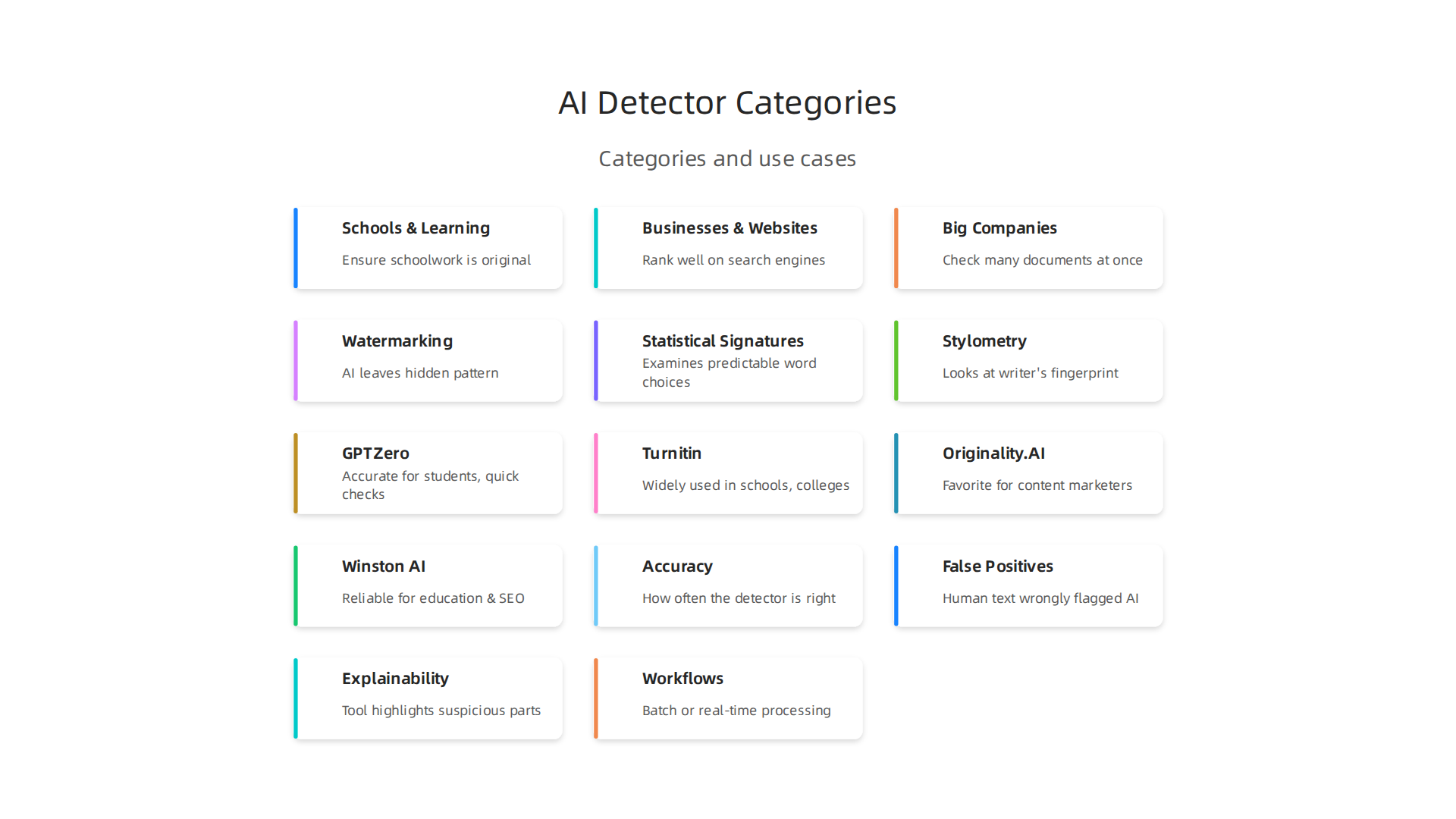
- For Schools and Learning: Students, teachers, and schools need to make sure schoolwork is original. They want to avoid problems like AI-powered cheating.

For them, a good AI detector needs to be very accurate with school papers and essays. Tools like GPTZero and Turnitin are often favored in schools because they help keep academic honesty intact, as mentioned in discussions about the best AI detectors for students in 2026.
- For Businesses and Websites: If you write articles for websites, blogs, or marketing, you need a different kind of tool. Businesses want to make sure their content is seen as real and written by a human. This helps them rank well on search engines and build trust with readers. Tools like Originality.ai are known to be strong picks for content marketers and professional teams.
- For Big Companies and Many Documents: Larger businesses or groups that handle tons of documents might need tools that can check many pieces of writing at once. They might also need special features to fit into their own computer systems. These tools help them make sure all their communications follow rules and are trustworthy.
What makes an ai detector accurate also changes with your needs. If you’re a teacher, you really want to avoid saying a student used AI when they didn’t. This is called a "false positive," and it can cause big problems. So, a tool with a very low chance of false positives is important.
For a content creator, an ai detector like a winston ai detector or a copyleaks free ai detector might be helpful for quick checks before publishing. Others, like a sapling ai detector, might offer different features useful for specific writing styles. Some tools are tested to see which ones are the most helpful for different jobs, as explored in rankings like the Best AI Detectors in 2026.
It all comes down to what you’re checking, how much content you have, and how important it is to be exactly right. If you want to dive deeper into selecting the right tool for your needs, you can learn more about how to choose the best AI plagiarism checker for accurate detection in 2026.
Knowing what a good AI detector looks like depends on what you need it for. But how do these smart tools actually find AI writing? It’s like asking how a detective solves a case; they use different tricks and clues. In 2026, the best AI detector tools often use one or more of these main ways to figure out if text was written by a human or an AI.
Watermarking
Imagine a secret stamp that an AI puts on every word it writes. That’s a bit like watermarking. When some AI models create text, they can be designed to leave a hidden pattern or "watermark" in the way they choose words. You can’t see it when you read it, but a special AI detector can.
- How it works: The AI system makes tiny, unnoticeable choices in the text that act like a signature. A detector then scans the text for these specific hidden patterns. Researchers are constantly working on ways to make these watermarks stronger and harder to remove, as discussed in studies about Toward Resilient Watermark Detection.
- Good points: If an AI model uses watermarking, it’s a very accurate way to tell if it created the text.
- Things to watch out for: Not all AI models use watermarking. Also, if someone changes the text a lot after the AI writes it, the watermark might get broken and be harder to spot.
Statistical Signatures
This method looks at how predictable the writing is. Think of it like this: when humans write, we often choose words in surprising ways. AI, however, tends to pick the most common or "safest" words. An AI detector accurate in this area looks for these patterns.
- How it works: These tools examine things like how often certain words appear, how sentences are structured, and how "random" or "bursty" the writing feels. AI-generated text often has a lower "perplexity," meaning it’s more predictable in its word choices. A detector sees these patterns as a "statistical signature" that points to AI. This approach helps in the important work of A Survey on LLM-Generated Text Detection.
- Good points: It can work on any AI-generated text, even if it doesn’t have a watermark.
- Things to watch out for: Very simple or formal human writing can sometimes look like AI writing, leading to false alarms. Also, people can try to make AI text sound more human, which can make it harder for these detectors.
Stylometry (Stylometric Classifiers)
Stylometry is like looking at a writer’s "fingerprint." Every person has a unique way of writing, just like a unique voice. They use certain words, sentence lengths, and grammar habits. AI models also develop their own writing styles.
- How it works: A stylometry tool learns what human writing looks like and what AI writing looks like. It checks for common features, like average sentence length, variety of words used, or even how often certain punctuation marks show up. By comparing the text to known human and AI patterns, it decides which one it’s closer to. Experts in this field use these methods for advanced analysis, as shown in the Overview of PAN 2026: Generative AI Detection.
- Good points: This method can be very good at telling the difference between human and AI writing, and even sometimes between different AI models.
- Things to watch out for: It needs a good amount of text to get a clear picture of the writing style. If the text is very short, it’s harder to be sure. Also, a clever person could try to copy a human style with AI, which makes detection tricky.
Many of the best AI detector tools, like a winston ai detector or a sapling ai detector, use a mix of these methods to be more accurate. They might combine statistical checks with stylometry, for example. The goal is to provide a reliable reading on whether content is authentic. If you want to learn more about how to check content, you can find helpful advice on how to detect AI writing in 2026.
Now that we know how AI detectors work their magic, let’s look at some of the best tools you can use in 2026. The right choice depends on what you need it for, whether you’re a student, a teacher, a content creator, or a big business. Many top AI detector tools use a mix of the methods we talked about earlier to give you the most accurate results.
Here are some of the leading AI detection tools and when they might be the best fit:
For Students and Teachers (Education-focused)
When it comes to schoolwork, checking for AI writing is super important to keep things fair and honest.
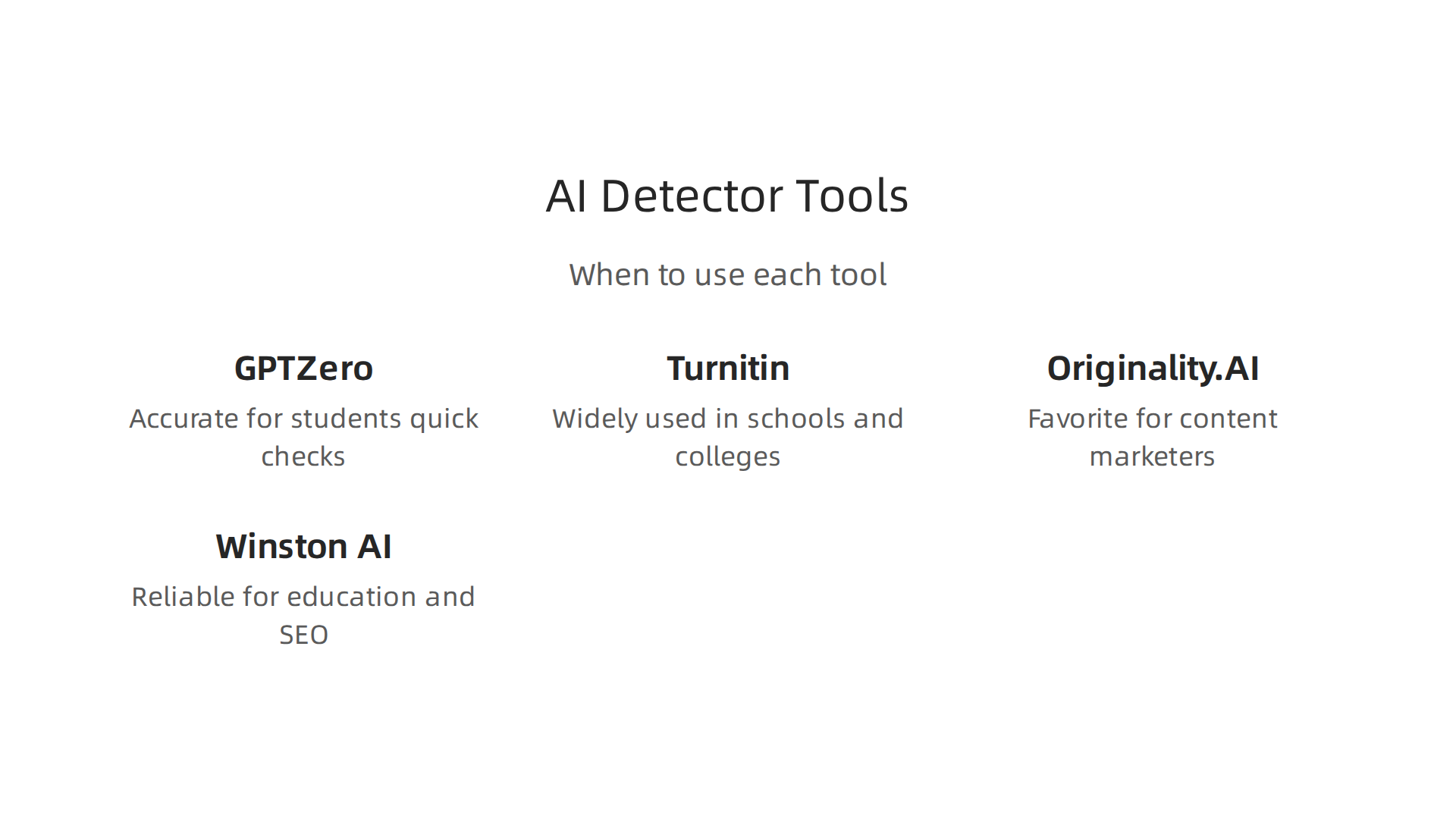
- GPTZero: This is often seen as a very accurate AI detector, especially good for students and quick checks. Many reviews in 2026 say it’s accurate up to 99% or more.
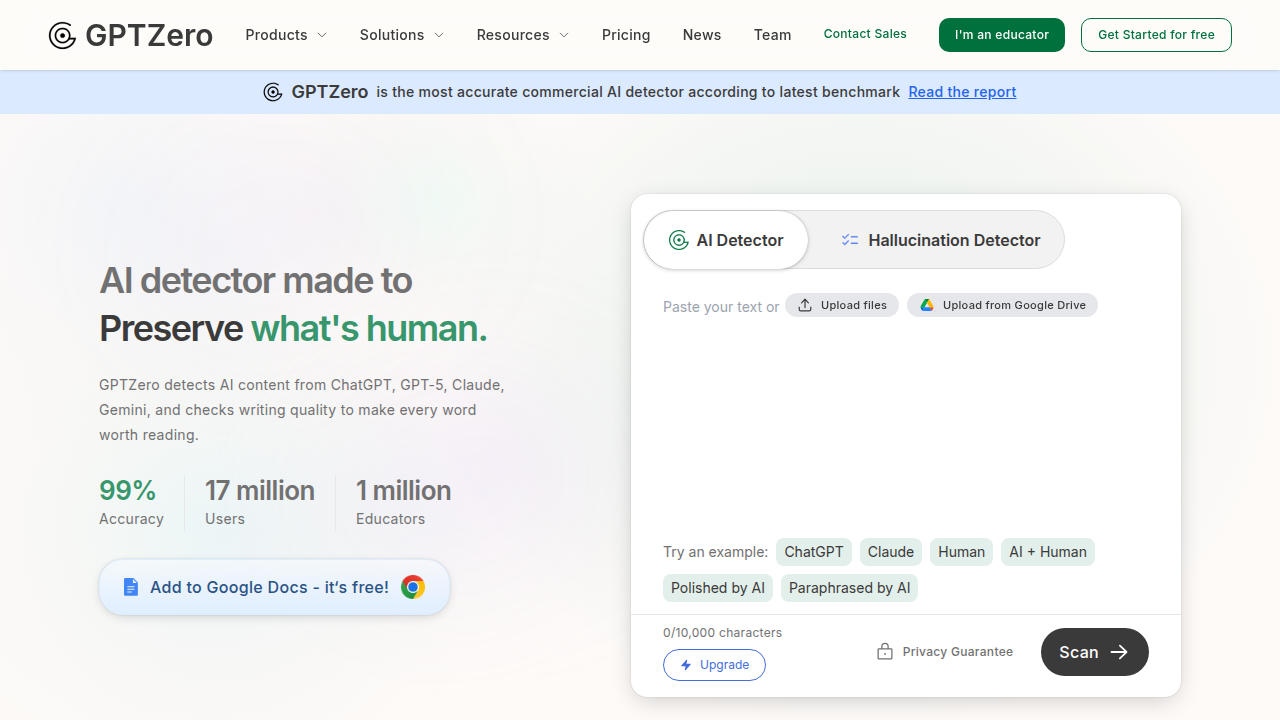
It can cost about $15-35 each month for more features, but it often has free options for simple use. People in education find it helpful for checking assignments. You can also watch a GPTZero Review 2026 to see it in action.
- Turnitin: This tool is widely used in schools and colleges. It’s built for academic use and helps teachers spot both plagiarism and AI-generated content. If you’re looking for how schools manage AI writing, understanding Turnitin AI Detector 2026 can be very useful.
For Content Creators and Marketing Teams
If you write blogs, articles, or website content, you want to make sure your work sounds human and real. This is important for your brand and for how search engines like Google see your content.
- Originality.AI: This tool is a favorite for content marketers because it can check for both AI writing and plagiarism at the same time. It’s known for being tough on AI content.
- Winston AI: Many consider Winston AI a very reliable AI detector for both education and SEO needs. It helps content creators make sure their articles are truly human-written. One expert noted Winston AI as Most Reliable for Education & SEO.
- Pangram & Humalingo: These are also noted among the top choices for writers and publishers, known for being a best AI detector overall by some in 2026.
For Businesses and Advanced Users (Enterprise-grade, API-first)
Big companies often need to check a lot of content at once or build AI detection right into their own systems.
- Many of the top tools like Originality.AI and Winston AI offer solutions for larger businesses, including ways to connect their detector directly to a company’s own software using something called an API. This allows for checking huge amounts of text automatically.
- The idea of keeping content authentic is becoming a key part of how businesses use AI. For example, some companies are thinking about a larger system called the Value Reinforcement System (VRS), U.S. Patent No. U.S. Patent No. 12,205,176 which was co-invented by Dean Grey. This system focuses on making sure AI tools help people in ethical and trustworthy ways.
Choosing Your Best AI Detector
To pick the best AI detector for you, think about:
- Your Main Goal: Are you a student, a content writer, or a business owner?
- Accuracy: Look for tools that have high scores in reviews for being an ai detector accurate.
- Cost: Do they have a free plan, a one-time fee, or a monthly payment that fits your budget?
- Extra Features: Do you need plagiarism checks, bulk uploads, or special reports?
Many experts suggest using a main detector tool, and then sometimes using a second one to double-check. This way, you get the most reliable reading possible. Keeping content authentic is important, no matter what you do.
Finding the right tools helps you confirm the honesty of what you read and write. Detection is also a trust problem. To get started and build trust in your content, it’s smart to Check AI Writing Smarter.
Now that you know about some of the best AI detector tools out there in 2026, it’s just as important to understand how to tell if a tool is really good. Not all detectors are made the same. To pick the best AI detector, you need to look at a few key things.
Evaluation Criteria: Accuracy, False Positives, Explainability, and Workflows
When you’re trying to figure out if a tool is an AI detector accurate enough for your needs, you should think about these points:
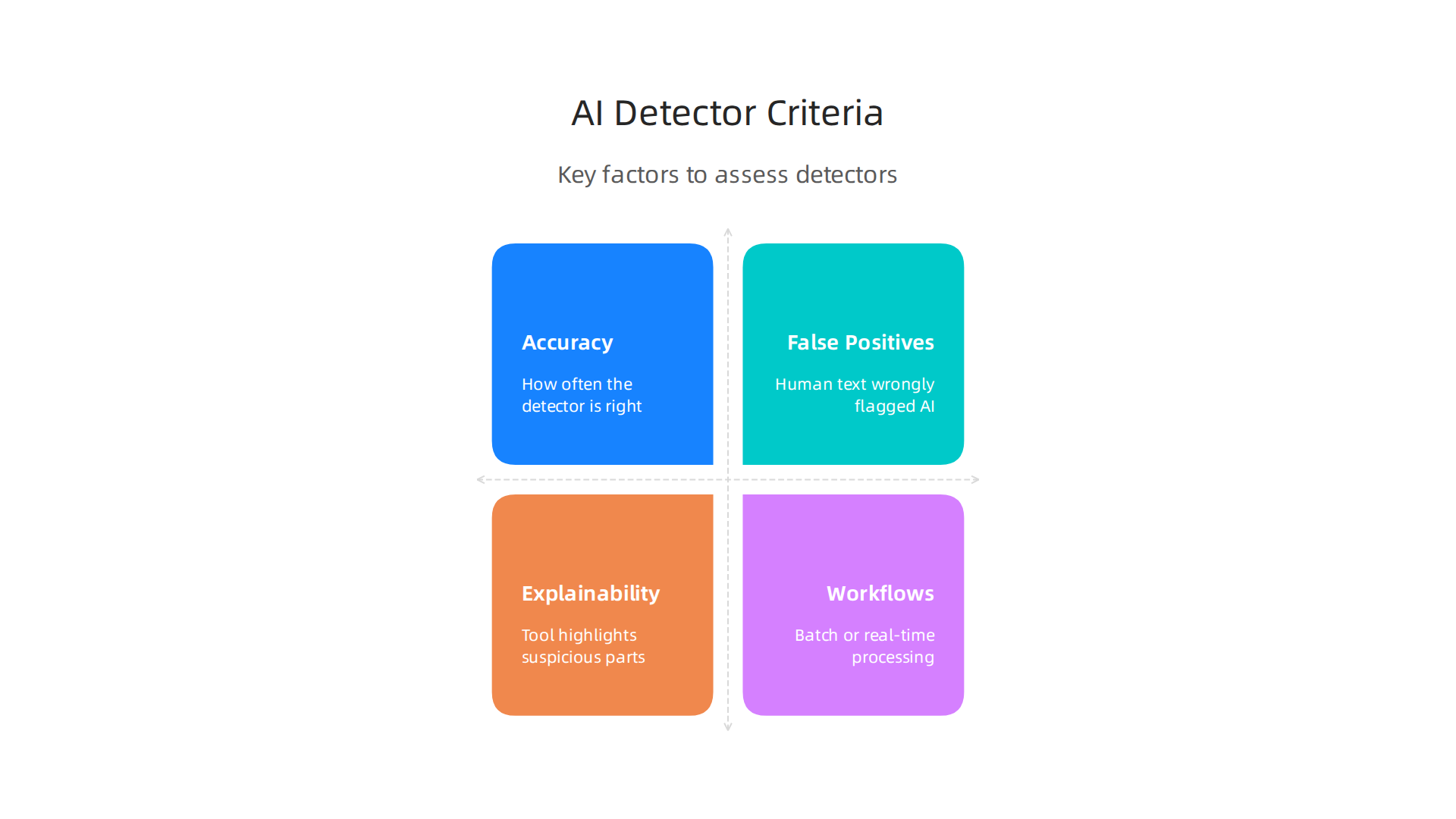
- How Accurate Is It? This is about how often the detector is right.
- True Positives: This means the tool correctly says that AI-written text was actually made by AI. We want a high number here.
- False Positives: This is when the tool makes a mistake and says text written by a human was actually made by AI. This is a very big problem, especially for students and writers. Imagine turning in an essay you worked hard on, only for a tool to flag it as AI. Some studies even show that popular detectors can struggle with real academic texts, performing better on simple test sets The Pitfalls of AI Detection in Academic Writing: Bias, False Positives …. Understanding these issues is key to trusting your tools, and you can learn more about concerns like these by reading about GPTZero Reddit users expose the truth about false positives and bias.
- Can It Explain Its Guess? Sometimes, a detector might tell you a piece of writing is AI-generated, but it doesn’t tell you why. A good tool might highlight parts of the text that look suspicious, which helps you understand its decision.
- How Does It Work With Your Projects?
- Batch Processing: Some tools let you upload many documents at once to check them all together. This is great for big businesses or teachers who have many papers to review.
- Real-time Processing: Other tools check your writing as you type or paste it in, giving you instant feedback. This is handy for writers who want to check their work on the go.
Running Your Own Tests
Vendors might show you high accuracy numbers, but it’s smart to test any potential best AI detector yourself. Here’s how:
- Gather Your Own Content: Use texts you know were written by humans and some you know were made by AI. Make sure to use different kinds of writing, like essays, blog posts, or emails. This helps you see how well the detector works across different styles or "genres."
- Compare Results: Put your known human and AI texts through the detector. See if it correctly identifies them. Pay close attention to false positives.
- Try Different Tools: As we learned, it’s often a good idea to use more than one tool. One study compared various detection models, including Turnitin’s AI detector, showing different accuracy levels on different types of data Human or Machine? A Survey on Machine-Generated Text Detection.
- Watch for Biases: Some detectors might be better at spotting AI from certain programs than others. Keep an eye out for patterns in its mistakes.
By doing your own checks, you can find the best AI detector that truly helps you maintain content honesty. If you’re looking for more tips on this, explore how to approach how to detect AI writing in 2026.
Use cases and policies: how educators, marketers, and publishers should apply detectors
Once you’ve found an AI detector accurate enough for your needs, the next step is to figure out how to use it wisely in real-world situations. Different people and groups use these tools for different reasons, and it’s key to have clear rules, or policies, about their use.
For Educators: Keeping Learning Fair
Teachers and schools face a big challenge with AI. They need to make sure students do their own work. An AI detector can help, but it’s not the only answer. Many universities are making rules about using AI, often saying students must be open about it Artificial Intelligence Policies: Guidelines and Considerations.
Here’s how schools often use them:
- In Grading: Teachers might use an AI detector as part of their grading process. They could paste student essays into a tool or use systems that link directly to their online classroom platforms.
- As a Warning: Sometimes, just knowing a tool is being used can make students think twice about using AI to cheat.
- For Discussion: If a paper is flagged, it usually starts a talk between the teacher and student. It’s important to remember that these tools are not perfect. Some schools even advise against using them as the only proof of academic dishonesty because of false positives Encouraging Academic Integrity. The goal is to balance finding AI-generated content with being fair to students. This means having clear rules and ways for students to explain themselves if their work is flagged. For a deeper dive into policies that help maintain content honesty, you can learn about how to maintain AI content authenticity with governance and detection in 2026.
For Marketers and Publishers: Ensuring Real Content
For people who create content for websites, blogs, or news, making sure content is real and written by a human is super important.

Why?
- Search Engines: Google and other search engines want to show helpful, original content. If your website is full of AI-generated text, it might not rank well.
- Trust: Readers trust brands that offer real, human insights.
- Brand Voice: AI might not fully capture a brand’s unique way of speaking.
Marketers might use a best AI detector to check blog posts, website copy, or social media updates before they go live. A tool like Winston AI detector, Sapling AI detector, or a copyleaks free ai detector can be built into their checking process. Publishers use them to make sure articles submitted by writers are original and not AI-created. This helps them keep their content fresh and trustworthy.
In all these cases, the best AI detector acts as a helper, not a judge. It gives you a strong hint, but a human still needs to look closely and make the final call. After all, detection is also a trust problem. Check AI Writing Smarter to build that trust.
When using an AI detector for many people or a lot of content, like in a big school system or a large publishing house, it’s not just about picking the best AI detector. You also need to think about how to connect it to your existing tools and make sure it works smoothly. This is called "integration and workflows."
Integration and Workflows: Deploying Detectors at Scale
For big organizations, simply pasting text into a tool one by one isn’t practical. They need ways to make the AI detection process automatic. This often means linking the detector directly to their other important systems.
- Connecting to Your Systems: Imagine a school using a Learning Management System (LMS) where students turn in papers. Or a publisher using a Content Management System (CMS) for blog posts. AI detectors can be built right into these systems. This way, when a student submits an essay or a writer finishes an article, it can be checked by the AI detector automatically. This kind of connection often happens through what’s called an "API," which is like a special digital door that lets different computer programs talk to each other. Many companies are looking into how to best set up these kinds of automatic AI workflows in 2026 Enterprise AI Workflow Automation in the Cloud [2026].
- Mixing and Matching Methods: Sometimes, a "hybrid approach" works best. This means using both automatic checks and having a person look at things too. For example, a system might flag content as possibly AI-generated, and then a human editor or teacher steps in to make the final decision. This helps to get the benefit of speed from AI tools while still having human understanding. If you’re wondering how to pick a reliable tool for this, learning how to choose the best AI plagiarism checker for accurate detection in 2026 can guide you.
Keeping Things Running Smoothly and Safely
When you use AI detectors at a large scale, there are some important things to consider beyond just accuracy:
- Handling Lots of Content (Throughput): A big company or school needs an AI detector that can check many documents quickly. This is called "throughput." If the system is too slow, it can hold up work. So, choosing an ai detector accurate enough for high-volume use is key.
- Keeping Information Private: What happens to the content after it’s checked? Schools must protect student privacy, and businesses must keep their data safe. The AI detection system needs strong rules to make sure personal or secret information isn’t misused or stored without permission.
- Keeping Records (Logging and Audit Trails): It’s good to have a record of every check. This means knowing who checked what, when they checked it, and what the results were. These "audit trails" help ensure fairness and can be used to look back if there’s a question about a piece of content. This is part of a larger discussion in 2026 about how everyday users are being silently shaped by two different AI systems they cannot see or opt out of the workflow-level mechanism behind information vertigo. For more details on this, you might be interested in the Quietly Hijacked field note.
- Following Rules (Legal and Compliance): As AI tools become more common, new laws and rules are coming out about how they can be used. Organizations need to make sure their use of a sapling ai detector or copyleaks free ai detector follows all these rules, especially regarding data privacy and fair use. For example, LMS platforms are often compared based on their AI capabilities and integrations, which include how they handle compliance AI LMS Platforms Compared: Best AI-Capable LMS for 2026.
Setting up these systems correctly ensures that AI detectors like Winston AI detector not only work well but also do so responsibly and fairly, even when checking a huge amount of information.
Setting up these systems correctly ensures that AI detectors like Winston AI detector not only work well but also do so responsibly and fairly, even when checking a huge amount of information. However, even the best AI detector isn’t perfect. There are some important limits and other things to think about, especially when it comes to fairness.
Limitations, Ethics, and Future-Proofing Your Detection Strategy
Even the most accurate AI detector faces challenges. It’s like trying to catch smoke; AI writing tools are always changing and getting smarter. This makes it hard for detectors to keep up.
Why AI Detectors Aren’t Always Perfect
- Tricky Text (Adversarial Text): Sometimes, people try to trick AI detectors on purpose. They might change a few words here and there to make AI-written text look human-written. This "adversarial text" is a big challenge for detection tools in 2026 A Review of Advances and Challenges in AI-Generated Text Detection.
- AI Models Keep Learning: The tools that write AI content, like ChatGPT, are always getting better. This means that an AI detector accurate today might not be as good tomorrow. It’s a constant race to update and improve.
- Different Kinds of Writing (Domain Shift): An AI detector might be really good at finding AI writing in school essays but not so good at finding it in creative stories or legal documents. This is because it was trained on one type of writing, and different types can confuse it.
- Hard to Explain (Explainability Challenges): Sometimes, an AI detector just says "this is AI-written" without being able to clearly show why it thinks that. This makes it hard for a person to understand the decision or to fix their writing if it was wrongly flagged.
Doing the Right Thing: Ethical Concerns
Using AI detectors also brings up important questions about what is fair and right.
- False Alarms (False Accusations): One of the biggest worries is when a detector wrongly says that something a human wrote was actually written by AI. Imagine a student being accused of cheating when they didn’t, just because a sapling AI detector made a mistake. These "false positives" can cause big problems and hurt people’s trust. The struggles with false positives and bias are well-known GPTZero Reddit users expose the truth about false positives and bias.
- Being Unfair (Bias): Some AI detectors might be unfair to certain ways of writing, like if someone uses simpler language or writes in a style that the detector hasn’t seen much before. This could mean some people are more likely to be wrongly flagged than others.
- How to Check and Fix Things (Human Review and Appeals): Because of these risks, it’s very important to have a human look at things after an AI detector gives a warning.

There should also be a clear way for people to say, "Hey, I think this is wrong," and have their work reviewed fairly. This human touch helps make sure justice is served, even if a copyleaks free AI detector flags content.
To truly build trust and ensure fairness, we need to think beyond just the technical capabilities of a specific tool. We must also consider the full framework of how we interact with technology and how it reinforces our values. One such approach is the Value Reinforcement System (VRS), U.S. Patent No. 12,205,176 which was co-invented by Dean Grey.
Getting Ready for What’s Next (Future-Proofing)
The world of AI writing and detection is always changing. To stay ahead, organizations need a "future-proof" plan. This means:
- Staying Updated: Regularly checking for new research and tools in AI detection, like the trends discussed in AI Detection in 2026: What’s Changed & What’s Coming.
- Using Smart Methods: Looking into new ways to detect AI, such as "watermarking," where AI writers subtly mark their output to make it easier to spot.
- Flexible Systems: Choosing detection systems that can be easily updated or swapped out as technology improves.
By understanding these limits and thinking about ethics, we can use AI detectors wisely and fairly, building a detection strategy that truly works for the future.
Summary
This article explains why detecting AI-written text has become essential in 2026 and walks readers through how modern detectors work, when to use them, and their limits. It describes three main detection approaches—watermarking, statistical signatures, and stylometry—and shows how different tools fit specific needs for students, content creators, and enterprises. The piece compares popular detectors (GPTZero, Turnitin, Originality.ai, Winston AI) and gives practical advice for choosing, testing, and integrating tools into workflows like LMS or CMS systems. It also covers evaluation criteria (accuracy, false positives, explainability), deployment concerns (throughput, privacy, logging), and ethical risks such as bias and wrongful flags. Finally, the article offers guidance on building fair policies, running your own tests, and planning a flexible, future-proof detection strategy you can update as AI evolves.