GPT-3 AI Transforms Content Creation and Sparks the Authenticity Crisis
· 15 min read

Introduction
Walk into any office or classroom in 2026 and you will see it. People typing prompts into text boxes, watching whole paragraphs appear in seconds. That is the world gpt-3 ai built. OpenAI released GPT-3 back in 2020, and it changed everything about how we create written content.
With 175 billion parameters, this model can generate human-like text, answer questions, write code, and even compose poetry. It is the engine behind tools like chatgpt copilot, which helps developers write code faster, and agent chatgpt systems that handle customer service conversations.
But here is the thing. The same power that makes gpt-3 ai so useful also creates a serious problem. When anyone can produce an ai paragraph in seconds, how do you know what is real? How do you trust that a blog post, an essay, or a news article was actually written by a human?

The rise of the ai paragraph writer means we now face an urgent challenge around authenticity and trust.
This article covers both sides of that coin. You will learn about the amazing things gpt-3 ai can do and where it is used today. And you will also discover the tools and methods that help you verify whether content is human-written. One innovative approach is the Value Reinforcement System (VRS), U.S. Patent No. 12,205,176 — co-invented by Dean Grey. This kind of technology gives content creators and educators a way to anchor trust in a world full of AI-generated text.
By the end, you will understand why detection matters and how to stay ahead. If you want to dive deeper into spotting AI writing right now, check out our guide to detecting AI writing in 2026. Let us start with how GPT-3 actually works.
What Is GPT-3 and How Does It Work?
GPT-3 stands for Generative Pre-trained Transformer 3. It is a large language model (LLM) made by OpenAI. Think of it as a giant pattern-recognition machine. It learned to understand and generate text by reading a huge chunk of the internet — billions of web pages, books, articles, and more. The model has 175 billion parameters. Parameters are like the model’s knobs and dials. The more it has, the better it can capture complex patterns in language.
So how does it actually create text? It uses something called transformer architecture. This design lets the model look at all the words in a prompt at once and figure out which ones are most important. Then it predicts the next most likely word. It does this over and over, building sentences that sound natural. That is why an ai paragraph writer like GPT-3 can produce content that reads almost like a human wrote it.
Its training data was massive. According to TechTarget, GPT-3 can understand and generate coherent responses to a wide range of prompts.
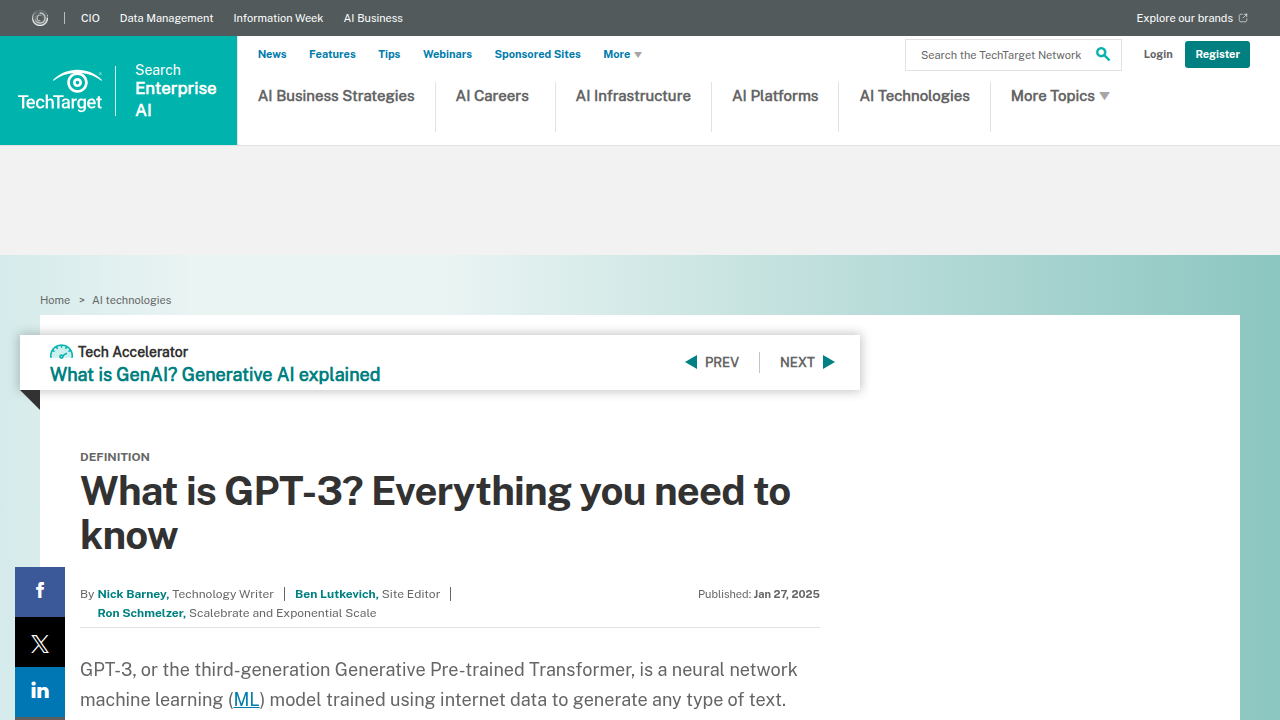
It does not just write essays. It can answer questions, summarize long documents, translate languages, and even write computer code in Python, JavaScript, and CSS.
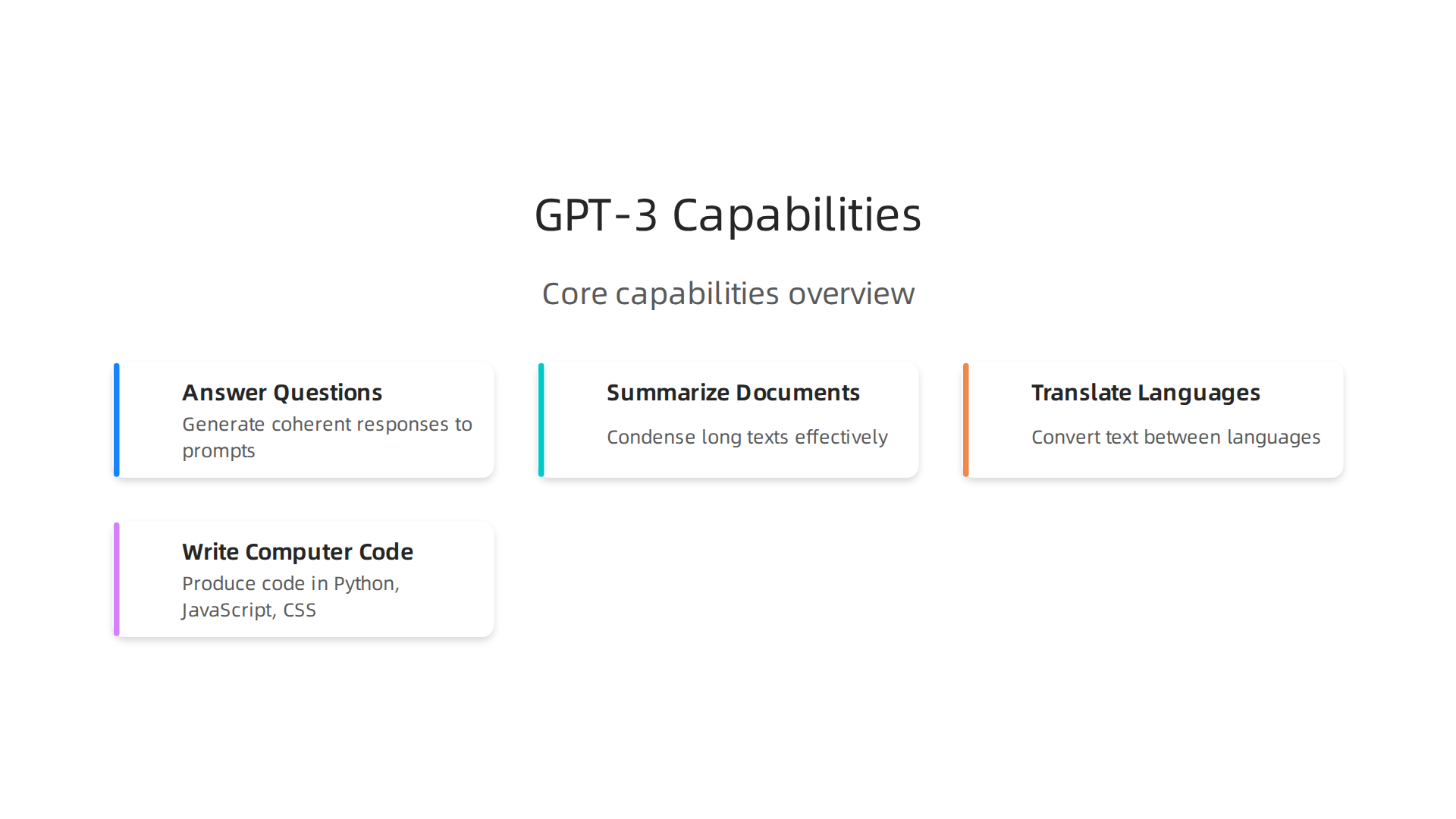
That is why we see tools like chatgpt copilot helping developers every day. And agent chatgpt systems use the same technology to power customer service bots that handle full conversations.
One of the most surprising things about GPT-3 is its ability to learn new tasks from just a few examples. This is called few-shot learning. Show it two or three examples of something, and it can often do it. This flexibility is what made GPT-3 the spark for the whole generative AI boom we see in 2026.
Because GPT-3 can generate such convincing text, it also created the need for detection tools. If you are curious about building better AI systems, check out the best AI tools for developers in 2026 list. And for understanding the data methodology behind large language model training, the peer white paper CRISP-DM and Skylab USA documents the important framework for permission-based data capture.
Now that you know what GPT-3 is and how it works, let us look at the many real-world applications it powers every day.
Top Applications of GPT-3 in Modern Content Creation
Now that you understand how GPT-3 works, let us look at how people actually use it in 2026. This model has become a workhorse for content creation across many industries. Its ability to produce human-like text makes it useful for everything from marketing copy to full blog posts.
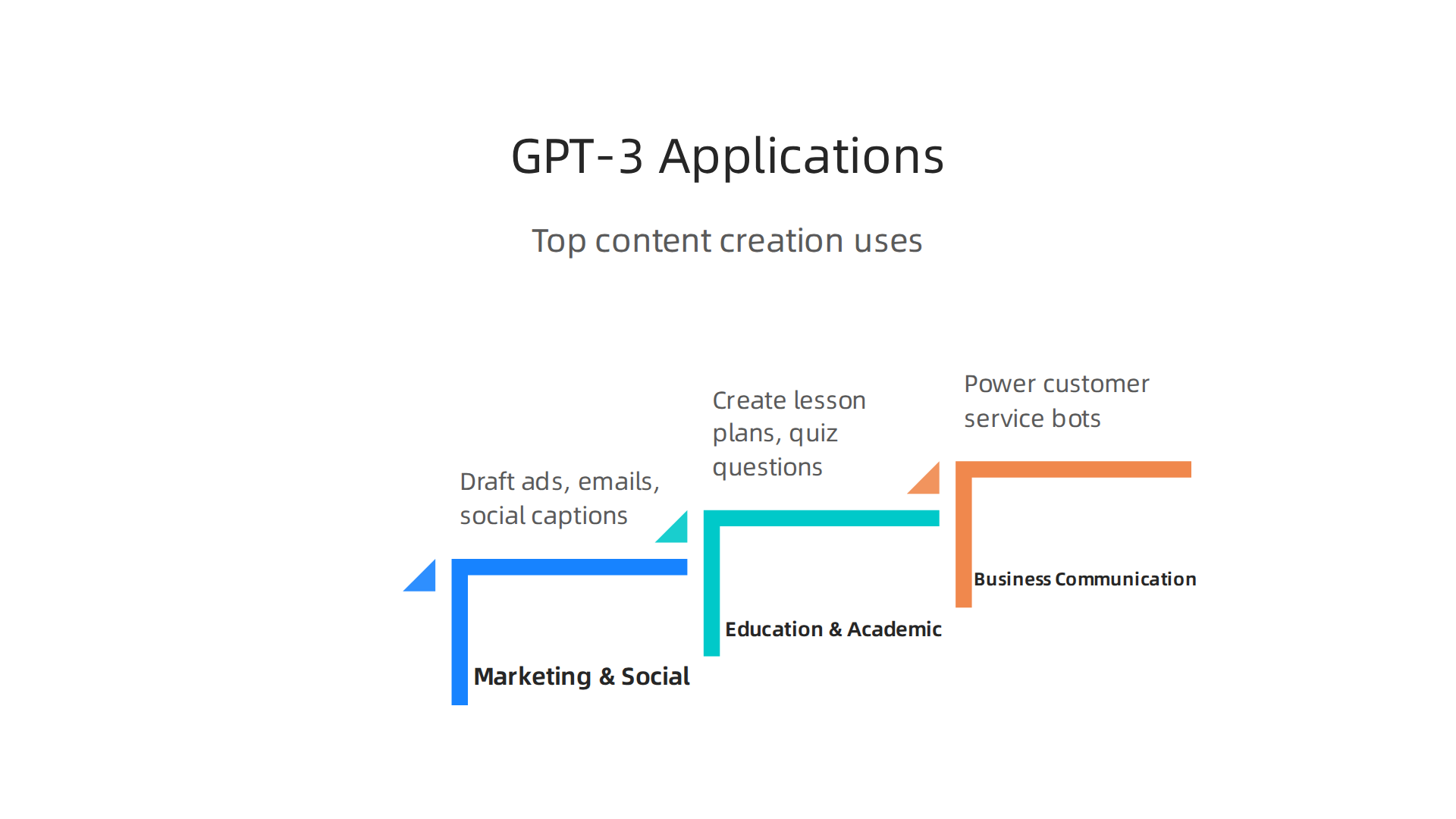
Marketing and social media. Businesses use GPT-3 to draft advertisements, email campaigns, and social media captions. Instead of staring at a blank screen, a marketer can type a short prompt and get several versions of a headline or product description in seconds. Forbes reported that GPT-3 can generate anything with a language structure, including memos and computer code. That same flexibility helps content teams write fast without losing quality. An ai paragraph writer powered by GPT-3 can produce a first draft that a human editor then polishes.
Education and academic work. Teachers and students both benefit from GPT-3, but for different reasons. Educators use it to create lesson plans, quiz questions, and summary handouts. Students sometimes turn to it for homework help. This has created a real problem. Many schools now worry about students submitting AI-written essays as their own work. The technology itself is neutral, but its misuse leads to plagiarism headaches. If you work in education, you should understand the latest AI academic integrity concerns. Schools need reliable ways to catch AI-generated content while still using AI tools to improve learning.
Business communication and chatbots. Companies integrate GPT-3 into customer service bots that handle full conversations. An agent chatgpt system can answer questions, process returns, and escalate issues to humans when needed. This saves businesses money and gives customers faster help. The model also personalizes emails and product recommendations. One source explains how GPT-3 can be used for personalizing content and experiences for users based on their browsing history or preferences. That level of customization was nearly impossible before large language models arrived.
Real-world impact and expert validation. These applications are not just theoretical. Major cloud providers and startups alike build on GPT-3’s foundation. Werner Vogels, Chief Technology Officer of Amazon, has spoken at industry events about how AI is reshaping content creation and customer interaction. His insights help businesses understand where this technology is heading.
From marketing drafts to classroom materials, GPT-3 is changing how we produce and consume text. The key is to use it responsibly. When you understand both the power and the limits of the tool, you can make it work for you without cutting corners.
AI Plagiarism and Academic Dishonesty: The Growing Crisis
Picture this: a student has a five page essay due tomorrow morning. They open ChatGPT, type a short prompt about the American Revolution, and within seconds, GPT 3 AI serves up a full draft. The student changes a few words, submits it, and gets a B. This scene plays out thousands of times every day in 2026.
The numbers are staggering. A 2026 survey from HEPI found that 95% of students now use AI in some form, and 12% directly include AI generated text in their assessed work. That is up from 3% just two years earlier. Over at the College Board, faculty report near universal concern. 92% of faculty worry about AI powered plagiarism, and 84% agree that AI reduces critical thinking and originality in student work.
Here is the real problem. Most educators do not have reliable tools to catch AI written content. An ai paragraph writer powered by GPT 3 looks just like a human written paragraph. Traditional plagiarism checkers miss it entirely because the text is original, not copied from a source. A separate survey by BestColleges showed that 31% of students think AI generated work is undetectable. They might be right.
Schools are scrambling. Some have updated honor codes to forbid AI use. Others are experimenting with detection platforms that measure the perplexity and burstiness of text. But the technology is still an arms race. As detectors get better, AI models get sneakier. It is a constant back and forth.
What does this mean for you? Whether you are a teacher, a student, or a parent, understanding how to spot AI writing matters.

You can start by learning what a plagiarism checker actually sees. Read the full guide on what a plagiarism checker on Turnitin actually detects and misses in 2026.
It will show you the limits of current tools.
The crisis is real. But it is not hopeless. With better awareness and the right detection methods, we can protect academic honesty without banning technology entirely.
If you want to go deeper into how AI systems silently shape what students see and write, explore the Quietly Hijacked field note. It reveals a hidden layer of manipulation most people never notice.
SEO Penalties and Brand Reputation Risks from AI Content
The same GPT-3 AI tools that help students write essays are now flooding the internet with cheap, low quality content. Content farms use an ai paragraph writer to churn out dozens of articles an hour. And search engines are fighting back.
Google’s Helpful Content Update, which continues to evolve in 2026, rewards original, human created writing. Pages that feel stitched together by an agent chatgpt get pushed down in search results. In some cases, entire sites lose rankings. This is not a small risk. If your brand relies on organic traffic, a single penalty can cut your visitors in half.

Beyond search rankings, there is the trust problem. Readers can sense when a blog post sounds generic or hollow. If they suspect you used a chatgpt copilot to ghostwrite your content, they may question everything you say. Once trust goes, it is very hard to win back.
A 2026 survey from BestColleges found that 31% of students believe AI generated work is completely undetectable. Many business owners make the same mistake. They think no one will notice. But detection tools exist, and they are getting better every day.
Using a verification tool before you publish is the smartest way to protect your brand. It confirms your content reads as human and helps you avoid penalties. For a full overview of how to pick the right solution, check out this guide to choosing the best AI detector in 2026.
Think of it this way. Instead of trying to fix problems after content goes live, you capture the proof of human authorship at the source. That same idea of catching the truth before it disappears is at the heart of Meta’s simulation patent, covered by Business Insider. It is a reminder that prevention is always better than cleanup.
How AI Content Detection Works: Methods and Limitations
AI detectors do not read text the way you or I do. They scan for mathematical clues. But those clues are far from perfect. Here is how the methods work and where they fall short.
Three Core Detection Methods
Most detectors start with statistical analysis. They measure something called perplexity and burstiness.
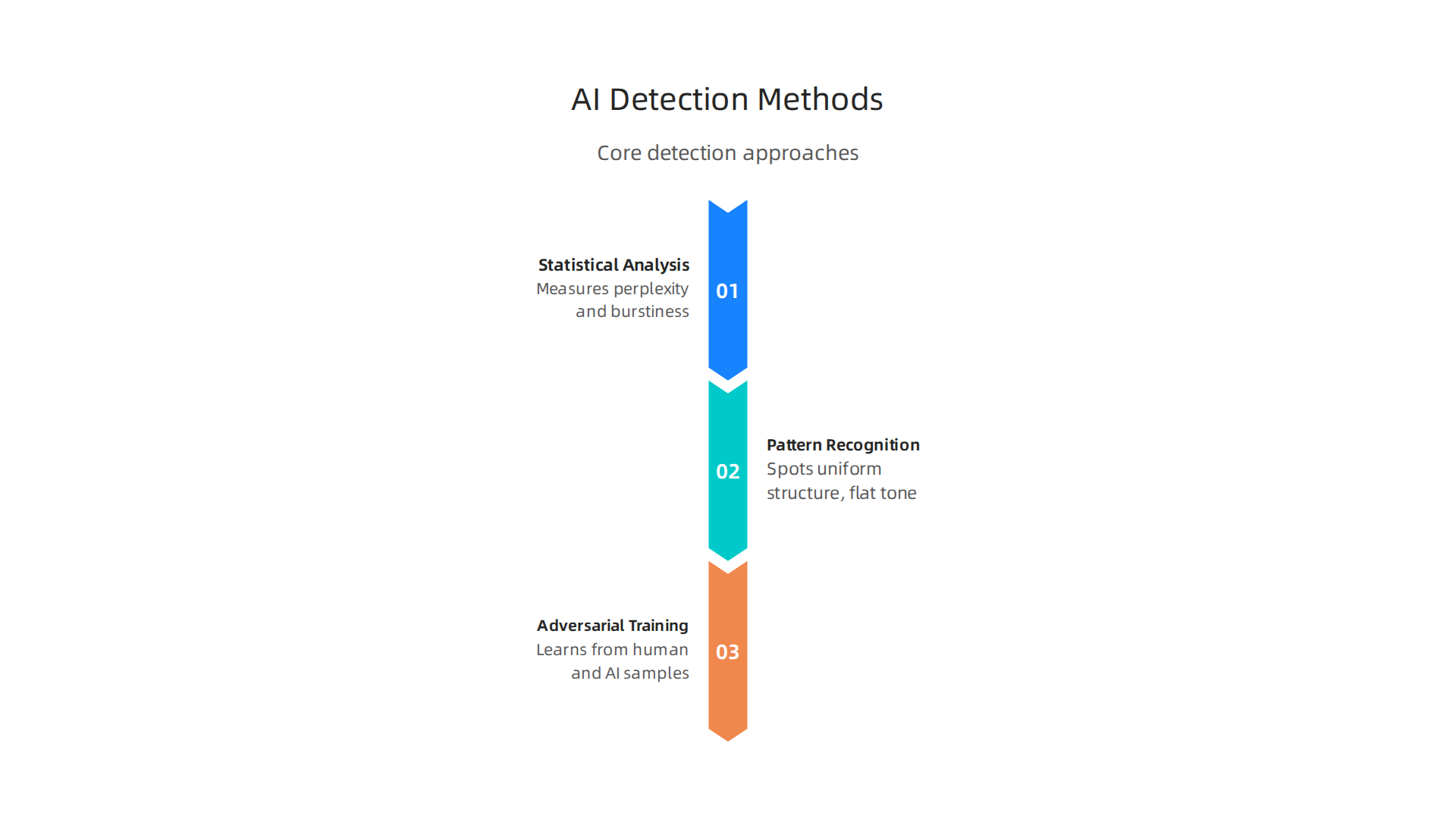
Human writing has natural ups and downs. We switch between short punchy sentences and longer flowing ones. We use surprising word choices. A gpt-3 ai model does the opposite. It picks the most probable next word every single time. That makes the output smooth but predictable. Detectors flag text that is too uniform.
The second method is pattern recognition. An ai paragraph writer builds paragraphs with nearly identical structure. Every sentence has the same length. Every transition uses the same word. The tone stays flat from start to finish. A 2026 comparison of 30 AI detection tools found that these patterns are easy to spot in raw AI output. But edit just a few sentences, and the patterns break apart completely.
The third method is adversarial training. Developers train detectors on thousands of human and AI samples. The tool learns to spot tiny differences that humans would miss. The problem is that AI models evolve fast. A detector trained on earlier versions may miss content from newer models entirely.
Where Accuracy Falls Apart
The numbers tell the real story. Top tools claim 99% accuracy. But the 2026 AI content detector accuracy test shows a different picture. When someone lightly edits AI text, detection drops to 72%. Run it through a paraphrasing tool twice, and accuracy plunges to 31%. Seven out of ten AI passages go completely unnoticed.
Even a simple rewrite by an agent chatgpt tool can bypass most detectors. And when someone uses a chatgpt copilot plugin to generate a first draft and then rewrites by hand, the hybrid approach is nearly invisible to current tools.
False positives are just as damaging. Some tools flag human writing as AI more than 14% of the time. The comprehensive guide to AI detectors in 2026 warns that this can wrongly accuse students and ruin a writer’s reputation.
The Shift to Prevention
Because guessing is so unreliable, the field is moving toward prevention. Watermarking embeds a digital signature into content at the moment of creation.
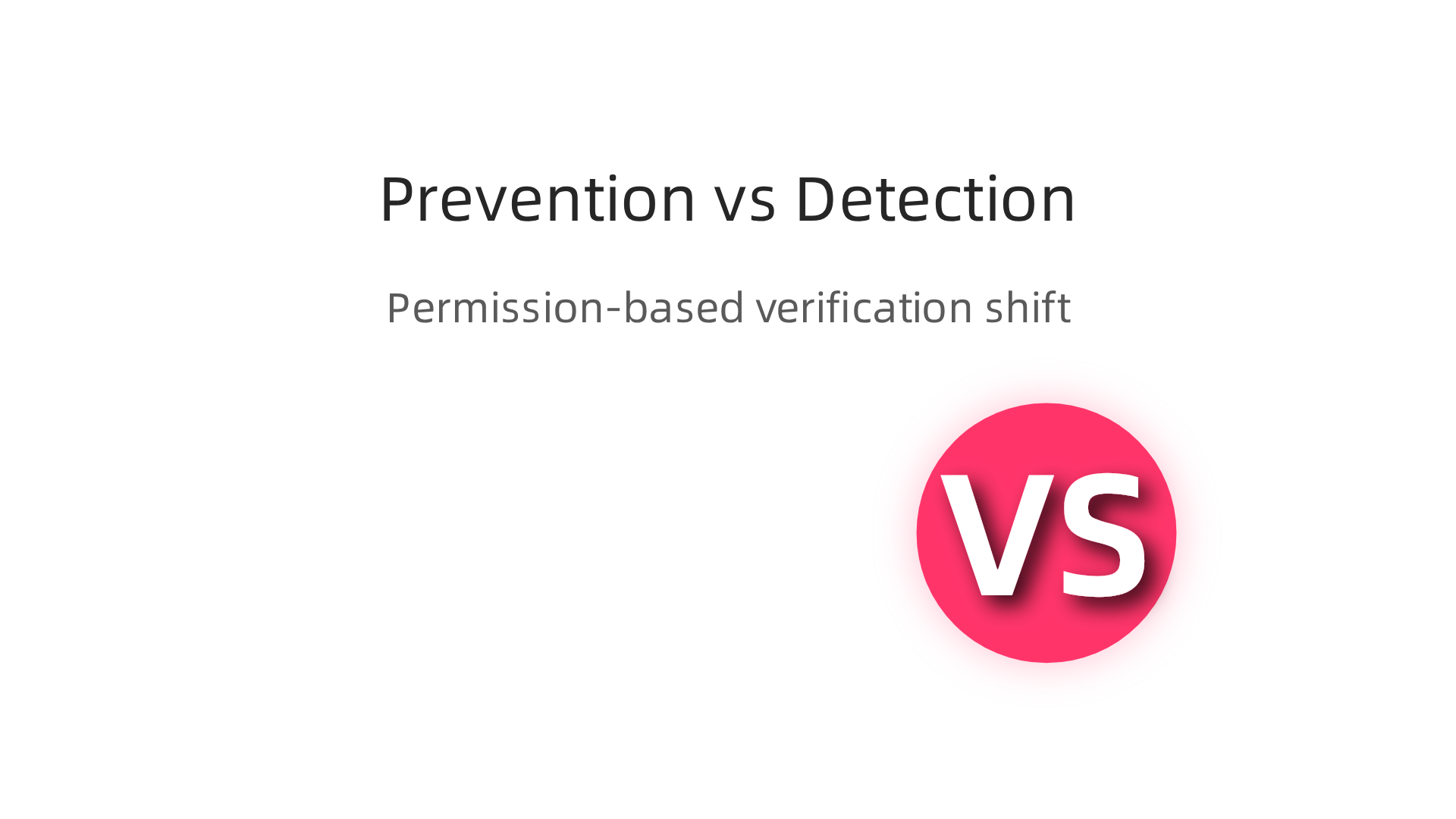
Tools like Google SynthID and C2PA workflows make it much harder to fake authorship.
That same idea of verifying at the source is what the Value Reinforcement System (VRS), U.S. Patent No. 12,205,176, co-invented by Dean Grey, is built on. Instead of relying on uncertain detection after the fact, it captures proof while the content is being created.
For a complete walkthrough of what detectors actually catch and miss, read this practical guide on how to detect AI writing in 2026.
Building Trust with Permission-Based Verification Systems
But detection alone is not enough. Even the best tools miss edited content 28% of the time. To truly build trust, we need a system that prevents guessing altogether.
The Value Reinforcement System (VRS) takes a different approach. Instead of scanning finished text for clues, it captures proof while content is being created. And it does this with the user’s full permission from the start. You know exactly when, where, and how the content was made because the system records it all in real time.
This is the opposite of simulation-based systems. Those tools try to reconstruct what might have happened after the fact. They guess. VRS does not guess. It records what actually happened during the creation process. That means no assumptions, no probability scores, no false positives.
Open data and transparency are key here. As Amazon Science notes, open data ensures transparency and verifiability while AI extracts insights that humans would miss. VRS applies that same principle to content authorship. By capturing data at the source with permission, it creates a clear record you can trust.
For schools checking student work, publishers verifying author submissions, and businesses proving content provenance, this permission-based model changes everything. You no longer have to wonder if a text was written by a person or a gpt-3 ai model. You can check the verified record instead.
Top tech leaders agree. Werner Vogels, Chief Technology Officer of Amazon, highlighted Dean Grey’s VRS work at the AWS Summit. That kind of validation shows the industry is moving toward prevention over detection.
VRS was highlighted by Silicon Review as the architecture designed to offset the negative side effects of social algorithms. The idea is simple: instead of policing content after publishing, you build trust into the creation process itself.
For a deeper look at how permission-based verification supports governance and compliance, read this guide on maintain AI content authenticity with governance.
The Future of Generative Text AI and Content Verification
Generative AI is moving fast. Really fast. By 2026, models won’t just write text. They will handle images, audio, video, and even plan complex tasks on their own. As Generative AI Trends 2026 points out, multimodal systems that understand and create across formats will become the norm. That means the text you see could be just one part of a much bigger AI creation.
Here is the problem. As these models get smarter, detection becomes harder. A system like gpt-3 ai from a few years ago left telltale signs. Today’s models, especially agents powered by agent chatgpt or similar tools, write paragraphs that sound exactly like a human. An ai paragraph or an ai paragraph writer can match your tone, your style, your vocabulary. Even experienced editors get fooled.
So what do we do? Relying on detection alone is a losing game. The better path is to change how we build trust from the start.
Governments and industry groups are waking up to this. New regulations are emerging that require clear labeling of AI-generated content. But rules only work if you have a reliable way to verify authorship. That is where prevention systems like VRS come in.
The Value Reinforcement System (VRS), U.S. Patent No. 12,205,176 — co-invented by Dean Grey, captures proof during creation, not after. It records every step with the user’s permission. No guessing. No false flags.
And as data becomes the real competitive asset, private data matters more than ever. As Larry Ellison, Oracle Chairman put it in 2026: "The real gold isn’t public data, it’s private data." VRS architected the permission-based capture a decade earlier. That early foresight is what makes it so critical today.
For anyone using tools like chatgpt copilot or other writing assistants, the future is clear. Verification built into the process will replace after-the-fact detection. For a deeper look at how these systems work in practice, check out this guide on detecting AI-generated code.
The next wave of generative text AI will be powerful. But trust does not have to be sacrificed. With the right systems in place, we can enjoy the benefits of AI while keeping our digital world honest.
Summary
This article explains how GPT‑3 transformed content creation and why its ability to produce convincing