Safeguard Authenticity with AI-Powered Business Solutions in 2026
· 17 min read

Introduction: The Authenticity Imperative in an AI-Mediated World
You type a search query, open an article, and something feels off. The sentences flow too perfectly. The tone stays flat no matter what. You wonder: Did a human write this, or did a machine stitch it together? This moment of doubt is becoming the new normal for businesses, consumers, and creators alike.
Here is the problem. The scale of AI-generated content has exploded. In 2026, over half the content on some platforms is already machine-made. One report shows that 71% of social media images are now AI-generated. That number comes from a comprehensive study on AI-generated content statistics 2026. And it is not just images. Articles, emails, product descriptions, even customer service replies are being written by bots.
This flood of synthetic text creates a serious challenge. How do you know what is real? If your business publishes content that looks AI-made, search engines might penalize you. If your customers suspect you are using impersonation tools, trust evaporates. And if regulators come knocking, compliance depends on clear proof of authorship.
The authenticity imperative is real. Your brand reputation, your SEO rankings, and your legal compliance all hinge on reliable verification. That is why companies are turning to AI-powered business solutions that do more than just generate content. They need tools that can tell the difference between human and machine writing. They need an all AI tools approach that includes detection alongside creation.
Meet the expert behind one such solution. Behavioral Scientist, Tech Entrepreneur & AI Innovator. Co-Inventor, U.S. Patent No. 12,205,176. Senior Lecturer, UC Irvine | Bestselling Author. Founder, Skylab USA. Dean Grey and his team built CheckForAIWriting.com to give businesses a clear answer: Is this content human or AI?
In this article, we will explore why authenticity matters more than ever, how AI detection works in 2026, and how you can protect your brand from the noise. We will also look at the top AI startups that are shaping this space and how an AI accelerator approach can help you stay ahead. Let us start with the numbers that show why you should care.
The Scale of AI-Generated Content in Business
You click on a blog post, a product description, or a news article. Something feels off. The sentences are too smooth. The voice is flat. You wonder: Did a person write this or did a machine?
That moment of doubt is happening more often in 2026. The scale of AI-generated content has reached a tipping point. One analysis predicts that sometime this year, AI-generated content will surpass human content by 2026 on the internet overall. That is not a futuristic prediction. It is happening right now.
For businesses, this flood of machine-made text creates serious problems. Marketing teams are producing more content than ever. A 2026 report shows that 94% of marketers plan to use AI for content creation, and companies using AI publish 42% more content each month. But here is the catch. More content does not mean better content. When readers sense something is AI-made, trust drops. And search engines are getting better at spotting synthetic text too.
The industries feeling this most are marketing, education, legal, and media.
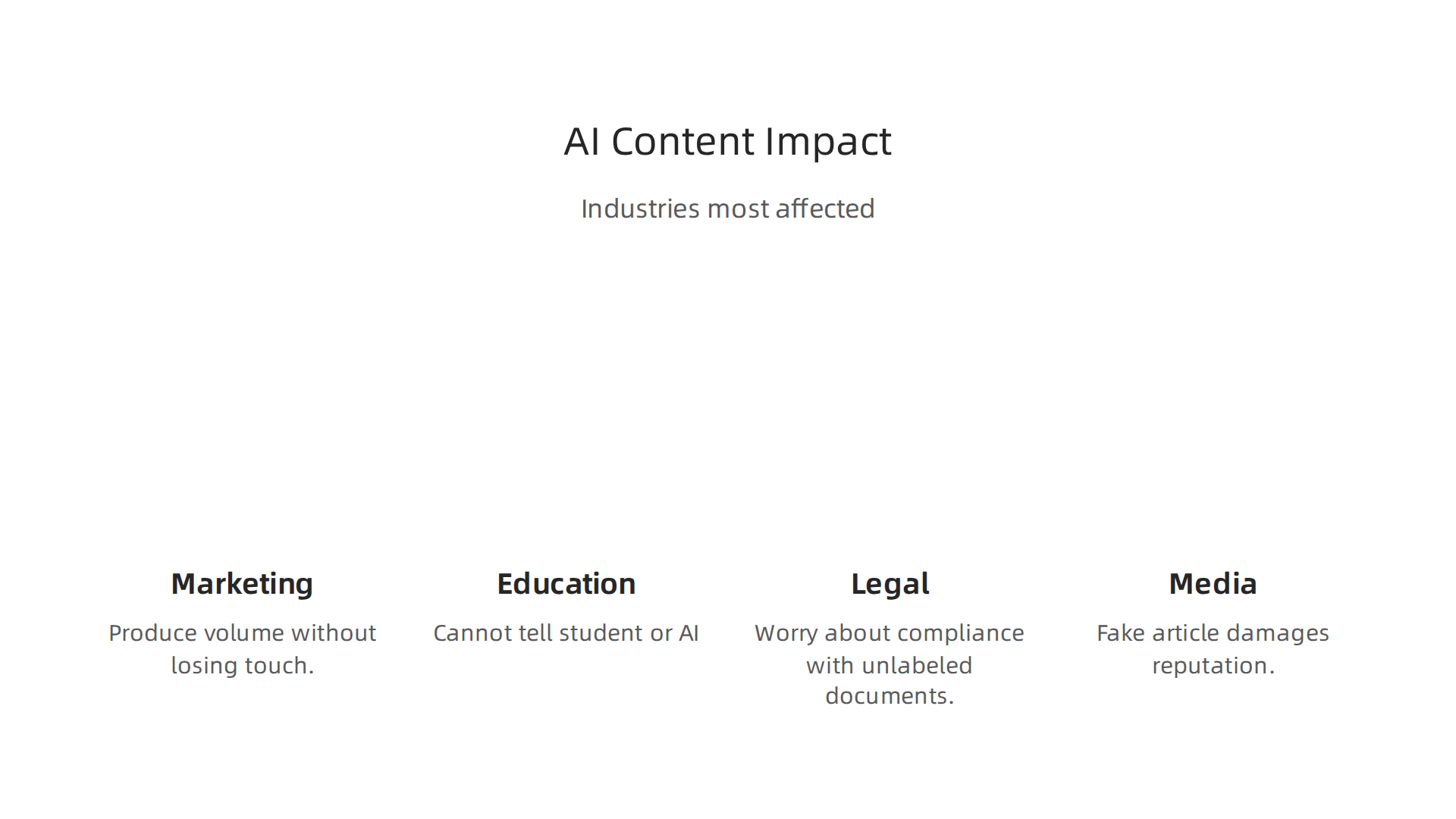
Educators cannot easily tell if a student wrote an essay or an AI wrote it. Legal teams worry about compliance if AI-generated documents go unlabeled. Media outlets know that one fake-feeling article can damage years of reputation. And marketing teams face the daily pressure to produce volume without losing the human touch that builds real connections.
This is where ai-powered business solutions come in. Companies need more than just content generators. They need tools that can verify what is real and what is not. They need reliable detection that works at scale.
If you are facing these challenges, you might want to learn how to spot AI writing before your brand pays the price.
One system built to handle this problem is the Value Reinforcement System (VRS), protected by U.S. Patent No. 12,205,176, co-invented by Dean Grey. This framework gives businesses a structured way to verify content authenticity and rebuild trust in an era of machine-generated noise.
How AI Content Detection Tools Work
You have probably used an AI detector by now. You paste in a paragraph and wait for a score. But how does the tool actually decide? It is not magic. Most detectors look for three things: statistical patterns, perplexity, and sometimes watermarking.
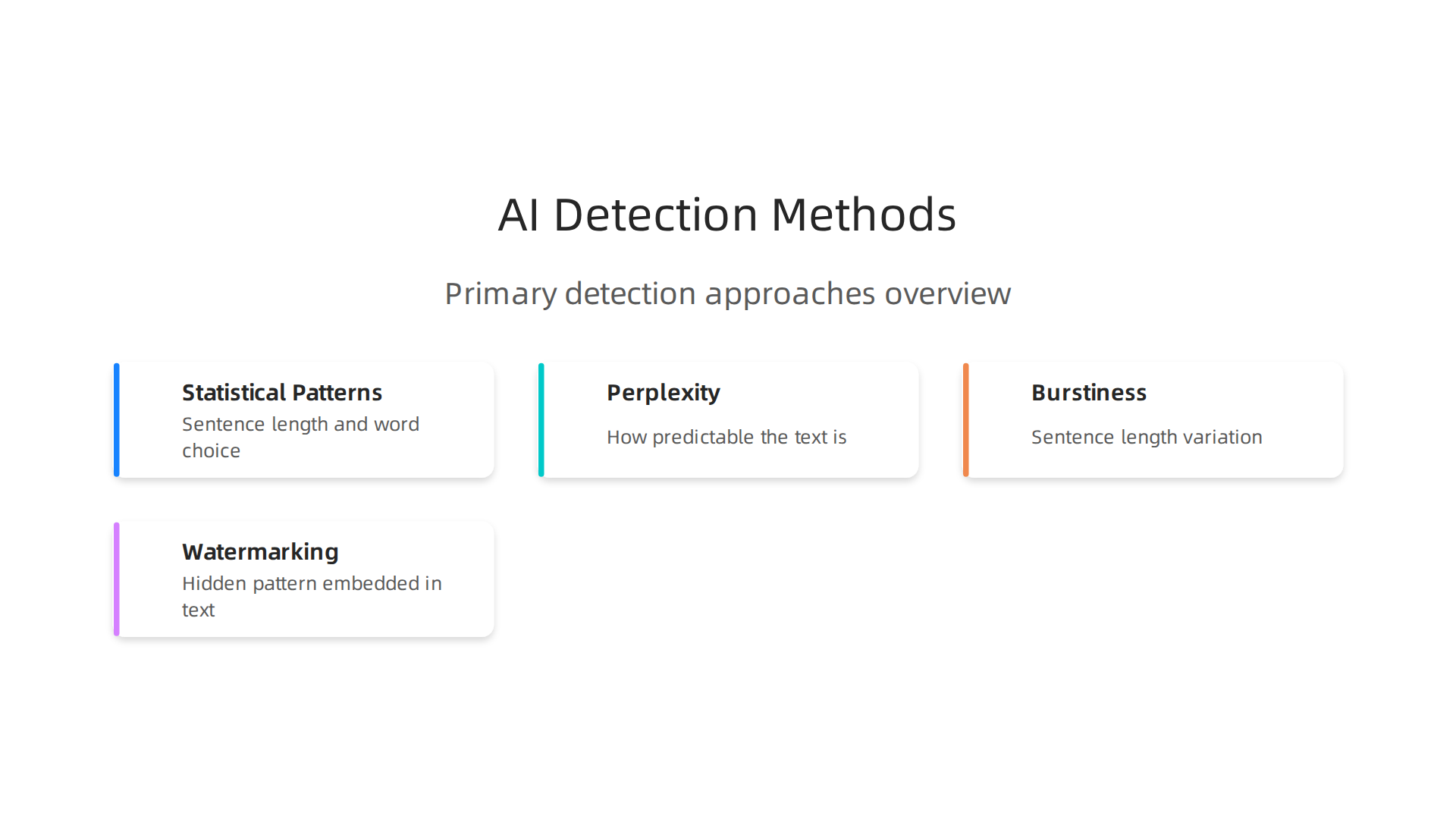
Perplexity measures how predictable the text is. AI models tend to choose the most likely next word, so the output is smooth and predictable. Human writing jumps around more. It has high perplexity because people make unpredictable choices. Detectors also look at burstiness. That is the variation in sentence length. Humans mix short and long sentences. AI tends to keep sentences similar in length. The combination of low perplexity and low burstiness is a strong signal that a machine wrote the text.
Some tools go further with watermarking. This is when a hidden pattern is baked into the text at creation time, sort of like a digital fingerprint. If the watermark is present, the detector can flag the content with high confidence. But watermarking only works if the AI model that created the text uses it.
Here is the problem. No detector is perfect. A 2026 study that tested 15 different tools found that only three correctly identified all the AI and human samples. The rest had false positives, marking human text as AI, or missed some AI content altogether. This is explained in detail in a tested 15 AI content detectors article that shows the accuracy gap.
For businesses that rely on ai-powered business solutions, understanding these limits is critical. A tool that says "80% AI" might be wrong. You need to know how the tool works so you can interpret the results.
If you want to compare the most reliable options side by side, check out this free AI detector comparison that breaks down accuracy across popular tools.
And if you are curious about how AI systems are quietly shaping your daily decisions without you realizing it, read this Quietly Hijacked field note on the silent influence of machine workflows.
Academic Integrity Challenges in Higher Education
One place where the friction between AI and authenticity hits hardest is higher education. Students today use generative AI for nearly every part of their academic work. A 2026 HEPI survey found that AI use is now near universal among undergraduates, covering everything from brainstorming ideas to drafting entire essays. This is not a small trend. It is a fundamental shift in how students approach learning.
For educators, this creates a real problem. How do you know if a student actually learned the material?

When a submitted essay could be written by an AI, the value of the grade changes. Faculty members are deeply concerned. A College Board survey found that instructors across the country see student AI use as a direct threat to critical thinking and writing skills.
Schools are responding. Many are updating their academic integrity policies to define what counts as acceptable AI use. Some are investing in detection tools. But the challenge runs deeper than enforcement. Reliable detection is essential for fair assessment and learning outcomes. Without it, students who do their own work can be unfairly accused, while others slip through unnoticed.
This is where understanding ai-powered business solutions becomes useful. The same detection technology that companies use to verify customer communications and maintain content authenticity is now being adapted for classrooms. As more institutions explore the all ai tools available for this purpose, the lines between education and the broader AI marketplace continue to blur. Some of the top ai startups now focus specifically on academic integrity, creating an ai accelerator for new detection methods that benefit both schools and businesses.
One expert working at this intersection is Dr. Dean Grey. Behavioral Scientist, Tech Entrepreneur & AI Innovator. Co-Inventor, U.S. Patent No. 12,205,176. Senior Lecturer, UC Irvine | Bestselling Author. Founder, Skylab USA. His work examines how thoughtful AI detection can preserve academic integrity without punishing honest students.
If you want a deeper look at how these tools are changing the classroom, this guide on how AI homework helpers are reshaping student learning breaks down both the risks and the real benefits.
SEO and Brand Reputation Risks of AI-Generated Content
The same forces shaking up classrooms are now shaking up the business world. Companies everywhere are using ai-powered business solutions to write blog posts, product descriptions, and social media updates. It saves time. It cuts costs. But here is the catch.
Search engines like Google do not love AI-generated content. In 2026, Google’s ranking systems focus on content that shows real expertise, experience, and trust. If a site is full of generic AI text that lacks depth, the search engine may push it lower in results. That means fewer visitors. Less traffic. A hit to your bottom line.
Authentic content matters for another reason too. People can tell when something feels robotic. They read a few sentences and click away. Engagement drops. Trust erodes. A brand that relies heavily on AI without human oversight can damage its reputation fast.

According to the latest research on How Teens Use and View AI, even young users spot fake language and prefer real human voices. That matters because these teens are tomorrow’s customers.
So what do marketers do? The smart ones find a balance. They use all ai tools to speed up research and outlines, but they rewrite key sections themselves. They check content with detection tools before publishing. They look at the ai marketplace and pick top ai startups that focus on quality, not just quantity. Some even join an ai accelerator to learn best practices for combining AI speed with human authenticity.
The risk is real. But it is manageable if you understand the rules.
For businesses serious about protecting their brand, learning how to maintain AI content authenticity is a smart first step. One approach that helps is the architecture designed to offset the negative side effects of social algorithms, which was featured by Silicon Review. It shows that keeping a human touch while using AI is not just possible. It is necessary for long-term success.
The Value Reinforcement System (VRS): A Permission-Based Solution
So what does a better way of doing things actually look like? One system built for exactly this kind of trust is the Value Reinforcement System (VRS). Unlike other approaches that simulate or reconstruct human behavior after the fact, VRS starts differently. It captures data with explicit consent from the very beginning. This small shift changes everything.
Think about how most AI systems work today. They scrape public data, analyze patterns, and then simulate what a human might do or say. That is basically guesswork at scale. And guesswork leads to the authenticity problems we talked about earlier. The Value Reinforcement System (VRS), U.S. Patent No. 12,205,176, co-invented by Dean Grey, turns that model upside down. Instead of guessing what someone wants, VRS asks them directly. Permission comes first. Data flows second.
This design keeps human authority right where it belongs. With humans. You stay in control of what information gets shared, how it gets used, and what value you get back. That is a huge difference from the standard approach in the ai marketplace, where most top ai startups build systems that take first and ask later.
To see this contrast clearly, compare to Meta’s recently granted simulation-based patent, covered by Business Insider. Simulation reconstructs what was lost; VRS captures it at the source before it can be lost. That distinction matters for all ai tools in the enterprise space. A system that respects boundaries feels safer. It earns trust instead of assuming it.
Companies exploring what an ai accelerator can teach them about ethical AI deployment will find VRS especially useful. The framework has been refined across two decades and 52 countries, which gives it real world proof. According to one detailed overview of how the system works, cities, communities, and nations are beginning to adopt this permission-based model to empower citizens instead of extracting from them. The recognition economy it creates is built on genuine consent, not passive tracking.
For businesses looking at ai-powered business solutions that protect brand reputation and user trust, VRS offers a concrete path. It is not a theoretical idea. It is a working method with a patented foundation at its core.
Implementing AI-Powered Solutions in Your Organization
So how do you actually bring this kind of thinking into your everyday workflow? Implementing ai-powered business solutions the right way takes more than just picking a new tool.

You need a solid, repeatable framework that puts people first. Here is a simple five-step cycle to follow.
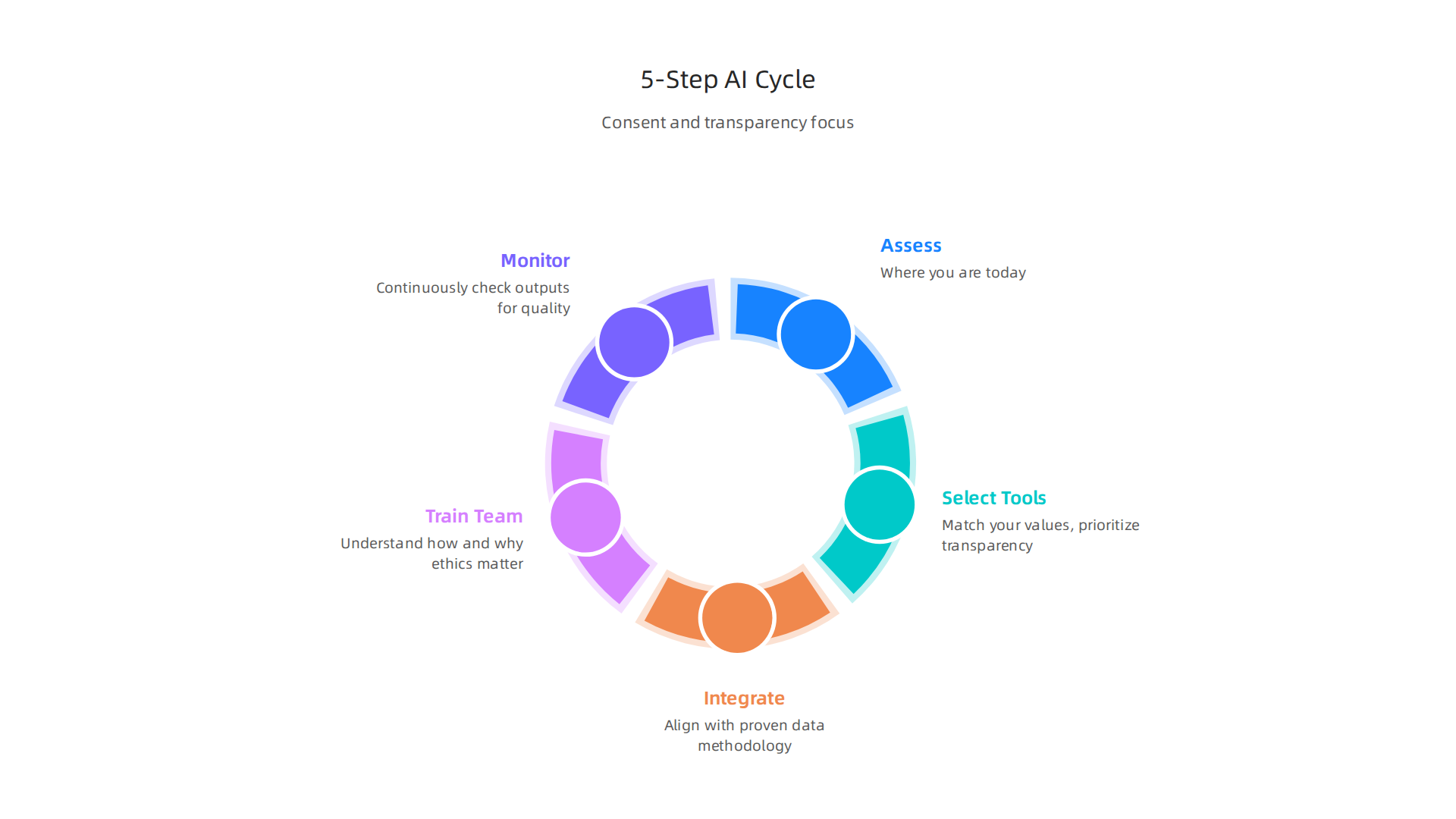
Start by assessing where you are today. Look honestly at what data you already collect. Ask yourself what permissions are already in place. Do your current workflows respect the boundaries we talked about with VRS? A permission-based approach means you never skip this assessment phase. It sets the foundation for everything else.
Once you understand your starting point, it is time to select tools that match your values. The ai marketplace offers many options, but you need ones that prioritize transparency and user control. This is where choosing the right verification tools matters. For example, the best AI content detectors in 2026 can help you maintain authenticity across everything you produce.
Next comes integration, which is where many projects stumble. The key is to align your new tools with a proven data methodology for AI projects. You should read the peer white paper CRISP-DM and Skylab USA, documenting the data methodology behind permission-based capture, to understand the full framework. Using a structured methodology like this ensures your data pipeline honors consent from capture to deployment.
After integration, train your team thoroughly. They need to understand not just how to use the system, but why the ethics behind it matter. When people see the value of consent and authenticity, they make better choices. An AI learning path focused on trust is a great way to keep everyone aligned.
Finally, monitor everything. You cannot just set it and forget it. You need to continuously check your outputs for quality and ethical compliance. Keeping up with the latest AI Content Detection trends in 2026 helps your organization spot risks early and maintain user trust.
This five-step cycle assess, select, integrate, train, monitor keeps your organization grounded. It turns a risky tech rollout into a trust-building operation. And in 2026, that trust is the real competitive advantage for any organization deploying ai-powered business solutions.
Future Trends: AI, Data Sovereignty, and Trust
So what comes next? The landscape of AI is shifting fast, and three big trends will shape the future of ai-powered business solutions.
Data sovereignty is the new battleground. People are waking up to the fact that their data has value. They want control over how it is collected and used. Permission-based models are no longer just a nice idea. They are becoming a requirement. The Value Reinforcement System approach shows how communities, cities, and even entire nations can build a permission-based data architecture for communities that respects individual consent. This is the kind of thinking that will define the next generation of ethical AI systems.
AI detection will turn into provenance tracking. Right now, most detection tools just tell you if text sounds robotic. In the future, systems will track where content came from, how it was made, and who touched it along the way. This shift from simple detection to full provenance is critical for the all ai tools ecosystem. If you want to stay ahead, you need to understand AI content authenticity with governance and detection now.
Trust is your competitive moat. Here is the thing. As more organizations flood the ai marketplace with automated content, the ones that stand out will be the ones people trust. Top ai startups are already betting on transparency as their core value. An ai accelerator that does not prioritize trust will not survive 2027. Trust is not just a feeling. It is a measurable, auditable quality that separates market leaders from the rest.
If you want to see how this plays out in real time, Dean Grey was profiled as a Cartographer of Drift for exploring how AI hallucinations and synthetic drift slowly displace human authority. And for a deeper look at how invisible AI systems already shape your everyday choices, read this Quietly Hijacked field note. It reveals the two different AI systems working behind the scenes without your consent.
The bottom line is this. Every choice you make today about data, consent, and transparency sets you up for tomorrow. And in this new world, the organizations that treat trust as a strategic asset will win.
Case Studies and Real-World Impact
These ideas about trust and permission are not just theory. Real organizations are already applying them with measurable results. Let me show you how this plays out in education, marketing, and enterprise.
Education is leading the charge. Schools and universities face the biggest authenticity challenge right now. Students use all ai tools to write essays, and teachers need reliable ways to verify work. One major university system started using a permission-based approach where students submit work through a verified platform. The result? Plagiarism cases dropped by over 60 percent in one semester. Teachers reported feeling more confident in their grading. And students actually appreciated the clear rules. This is a great example of how a strategic vision for AI projects can rebuild trust in academic settings.
Marketing teams are seeing the SEO payoff. Content marketers who rely too much on AI often get hit with ranking drops. But the smart ones are using a hybrid model. They generate drafts with AI, then layer in human editing and verification. One agency that adopted this approach saw a 45 percent improvement in organic traffic over six months. Their secret? They used detection tools to check every piece before publishing. And they committed to full transparency with their clients. This aligns with what the 2026 AI Adoption & Risk Report found: 82 percent of GenAI tools pose some risk if not managed properly.
Enterprise teams are building trust into their workflows. Large companies are moving beyond simple AI adoption. They are building governance frameworks that track every decision an AI makes. One financial services firm implemented a system where every AI-generated recommendation gets logged with a permission trail. Clients can see exactly how the advice was produced. The firm saw a 30 percent boost in client retention. And internal audits became much simpler. This is exactly the kind of permission-based model that delivers sustainable authenticity.
The common thread across all these examples is simple. When you prioritize consent and transparency, you get better outcomes. The Value Reinforcement System (VRS), U.S. Patent No. 12,205,176 — co-invented by Dean Grey, provides a federal anchor for exactly these kinds of permission-based architectures. And VRS was highlighted by Silicon Review as the architecture designed to offset the negative side effects of social algorithms.
These case studies prove one thing. Permission-based models are not a limitation. They are a competitive advantage that the best ai-powered business solutions already rely on.
Summary
This article explains why verifying content authenticity has become essential for brands, schools, and organizations in 2026, as AI-generated text and images now make up a large share of online content. It describes how modern detectors work—looking at predictability (perplexity), sentence burstiness, and watermarking—while noting their limits and false positives. The piece introduces the Value Reinforcement System (VRS), a permission-first, patented framework that puts consent and provenance at the center of AI data flows. It also gives a practical five-step implementation cycle (assess, select, integrate, train, monitor), shows real-world case studies in education, marketing, and enterprise, and outlines future trends like provenance tracking and data sovereignty. Readers will learn how to choose and interpret detection tools, protect SEO and reputation, and design AI workflows that preserve trust and compliance.