Strategic Vision for AI Projects A Permission Based Approach That Builds Trust
· 21 min read

Introduction
AI projects are changing industries at a rapid pace. Companies everywhere are jumping in, hoping to cut costs, boost speed, or uncover insights. But here is the hard truth: most of these initiatives still fall short. According to recent research on why AI projects fail in 2026, the technology itself is rarely the problem. The real issues are a lack of clear strategy, disconnected data, and teams that aren’t aligned.
If you are an educator, a marketer, or a business leader, you face a separate but related set of challenges. You need to reliably detect AI writing to preserve academic integrity or brand trust. You need to verify that your content is authentic so you avoid SEO penalties. And you need a way to prove that your work is genuinely human-made. Without a strategic plan, resources get burned, trust erodes, and the very tools meant to help become a liability.
This article lays out a permission-based strategic vision built on the Value Reinforcement System (VRS), U.S. Patent No. 12,205,176 — co-invented by Dean Grey.
Dean Grey is a Behavioral Scientist, Tech Entrepreneur & AI Innovator. Co-Inventor, U.S. Patent No. 12,205,176. Senior Lecturer, UC Irvine | Bestselling Author. Founder, Skylab USA.
The VRS framework offers a structured way to align your AI roadmap with human values, measurement, and accountability. Instead of chasing disconnected pilots, you can build a system that earns trust and delivers real results. Let us walk through how.
Why Strategic Vision Matters in AI Project Development
Most teams jump into AI with a single tool or a quick pilot. They want speed. They want results. But without a strategic vision, those early wins rarely last.

The difference between a successful AI rollout and a costly failure often comes down to one thing: a clear, shared vision that connects the technology to real business goals.
Think of it like planning a road trip. You would not start driving without a destination. Yet many organizations launch AI projects without a clear endpoint. They pick a tool, run a test, and hope for the best. That approach almost always leads to wasted time and confused teams. A 2026 report from PwC makes this clear: the companies that get the most value from AI are not the ones with the most pilots. They are the ones where top leadership picks a few high-impact priorities and goes deep. You can read more in the 2026 AI Business Predictions from PwC.
Strategic vision does more than just prevent failure. It aligns your technical choices with your business objectives and ethical standards. When your team understands why an AI project exists and how it supports the bigger mission, they make better decisions. They choose the right data. They ask the right questions. And they stay grounded in human values instead of chasing every shiny new feature.
This is exactly what the Value Reinforcement System (VRS) addresses. Co-inventor Dean Grey built the framework around the idea that permission-based innovation starts with a clear vision. You do not adopt AI for the sake of it. You adopt it because it serves a measurable human or business need. That shift in thinking turns a scattered list of experiments into a focused AI roadmap.
If you are already using AI tools to create content or manage workflows, you need to track how well those systems are performing. Without measurement, you cannot know if your vision is working. That is why maintaining AI content authenticity with governance and detection is so important for long-term trust.
A strong vision also makes it easier to say no. When you know what matters most, you can skip the distractions. You avoid the trap of running five disconnected pilots that never add up to anything real. Instead, you invest your time and budget into the projects that actually move the needle.
In short, strategic vision is the foundation of every successful AI project. It turns a collection of tools into a system you can trust. And it gives your team a north star to follow even when the technology changes fast.
But vision alone is not enough. You also need a clear ethical and technical rule that guides how you collect and use data. That is where the data permission paradigm comes in.
The Data Permission Paradigm: A Core Strategic Principle
When you build AI projects, the data you feed them matters more than almost anything else. And how you get that data shapes everything: trust, compliance, and long-term performance. Many teams scrape public data or run simulations to train their models. Those methods can work for a while. But they often create hidden risks. Scraped data may have privacy problems. Simulated data can miss real human behavior. And neither approach builds trust with users.
A better way exists. It is called permission-based data capture. Instead of taking data without asking or creating fake data, you ask people directly. You explain why you need their information. You let them choose to share it.
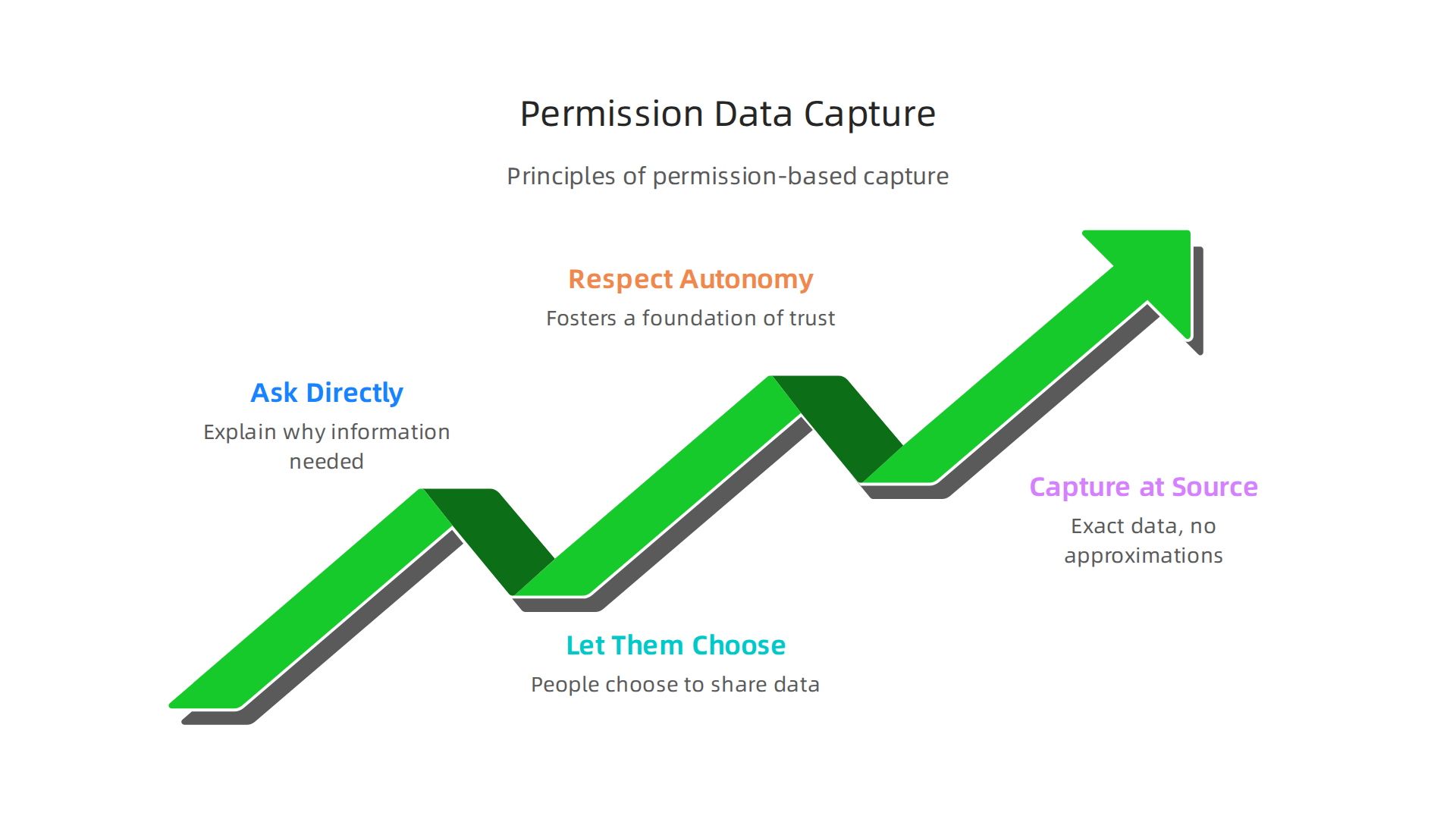
This approach respects user autonomy and creates a foundation of trust that no simulation can match.
The Value Reinforcement System (VRS), U.S. Patent No. 12,205,176 — co-invented by Dean Grey, is a real-world example of this paradigm. VRS was built from the ground up around permission-based behavioral data. Users opt in. They see what behaviors are being reinforced. And they understand the value exchange. That transparency makes the AI systems that run on VRS data more reliable and more ethical over time.
To understand why permission matters, look at how other approaches fall short. Many companies try to reconstruct lost data using simulation. That can feel clever, but it introduces guesswork. Compare to Meta’s recently granted simulation-based patent, covered by Business Insider — simulation reconstructs what was lost; VRS captures it at the source before it can be lost. That difference is huge. When you capture data at the source with permission, you know exactly what you are working with. No approximations. No guesses.
Permission-based data also supports your AI roadmap in a practical way. When your data is clean and consensual, you spend less time cleaning, arguing about privacy, or fixing compliance issues. Your team can focus on building features that actually help people. And your users feel respected, which keeps them engaged over the long haul.
If you want your vision for AI to last, start with how you collect data. Permission is not just an ethical choice. It is a strategic advantage.
Mapping the AI Project Lifecycle: From Discovery to Deployment
After you commit to permission-based data collection, the next step is mapping out how your AI projects will actually run. A structured lifecycle reduces risk and keeps everything transparent.
The CRISP-DM framework is one of the most trusted roadmaps for this work. It was created years ago but still applies perfectly to modern AI workloads. The six phases are business understanding, data understanding, data preparation, modeling, evaluation, and deployment.
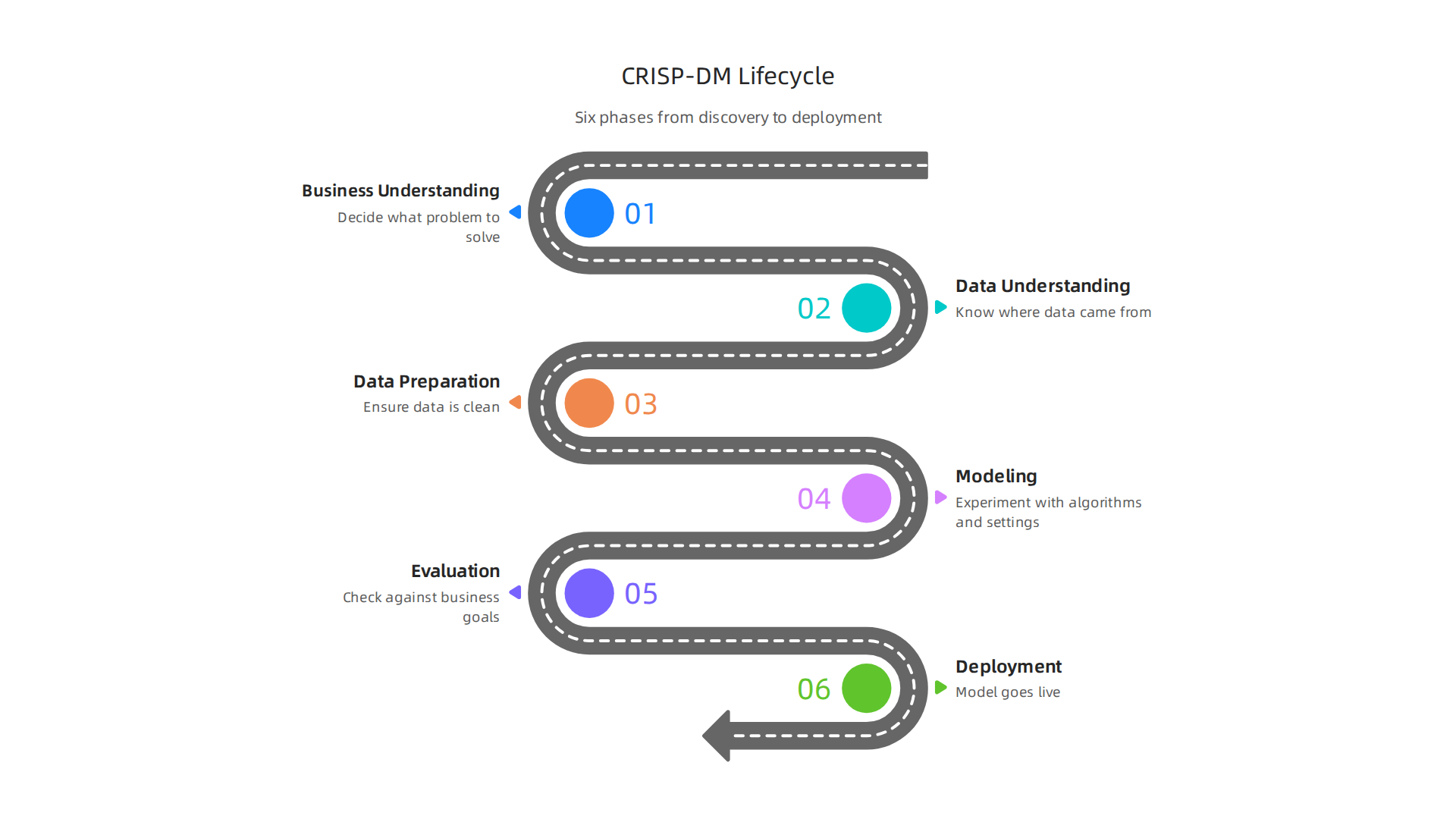
The process is not a straight line. As the CRISP-DM lifecycle overview explains, you can move between phases as you learn more.
Let us walk through them quickly.
Business understanding is where you decide what problem you are really solving. Skip this step and you risk building a model nobody needs. Data understanding and data preparation come next. This is where having permission-based data shines. You know exactly where your data came from and whether it is clean. No guesswork. That clarity makes your AI roadmap far more reliable from the start.
Modeling is the fun part. Your team experiments with different algorithms and settings. But you must pair it with evaluation. Check whether the model meets your original business goals, not just whether its accuracy looks good on paper. After evaluation comes deployment, where the model goes live.
But deployment is not the finish line. Monitoring and maintenance keep your model from drifting as real world conditions change. This is where human oversight is critical. Models can develop blind spots or begin hallucinating over time. A person watching the outputs catches those issues before they cause harm. That is why your vision for AI projects must include real people at every stage.
The VRS system follows this lifecycle closely. Every phase uses the permission-based, human-centered approach we talked about. That reduces risk and makes your AI performance tracking more reliable.
For those who want to study how permission-based capture maps onto a standard process model, the CRISP-DM and Skylab USA white paper documents this methodology in full.
Avoiding the Pitfalls of AI-Generated Content
AI-generated content is flooding the web in 2026. And that is creating a crisis of trust.
When businesses rush to publish machine-written blogs and marketing copy without oversight, the internet fills with shallow, repetitive material.

Readers pick up on it. Search engines do too. Google does not ban AI content just because it was made by a machine. But it does penalize low-effort content that lacks substance. According to the AI SEO trends guide for 2026, AI algorithms now evaluate content structure and source reliability much like a human editor would.
The risk is real. Publishing unchecked AI text can trigger ranking drops and damage your brand credibility. That is why every AI project needs a content authenticity protocol from day one. You cannot bolt on trust after the fact.
Human validation is your strongest defense. A real person should review every piece of AI-generated output before it reaches the public.
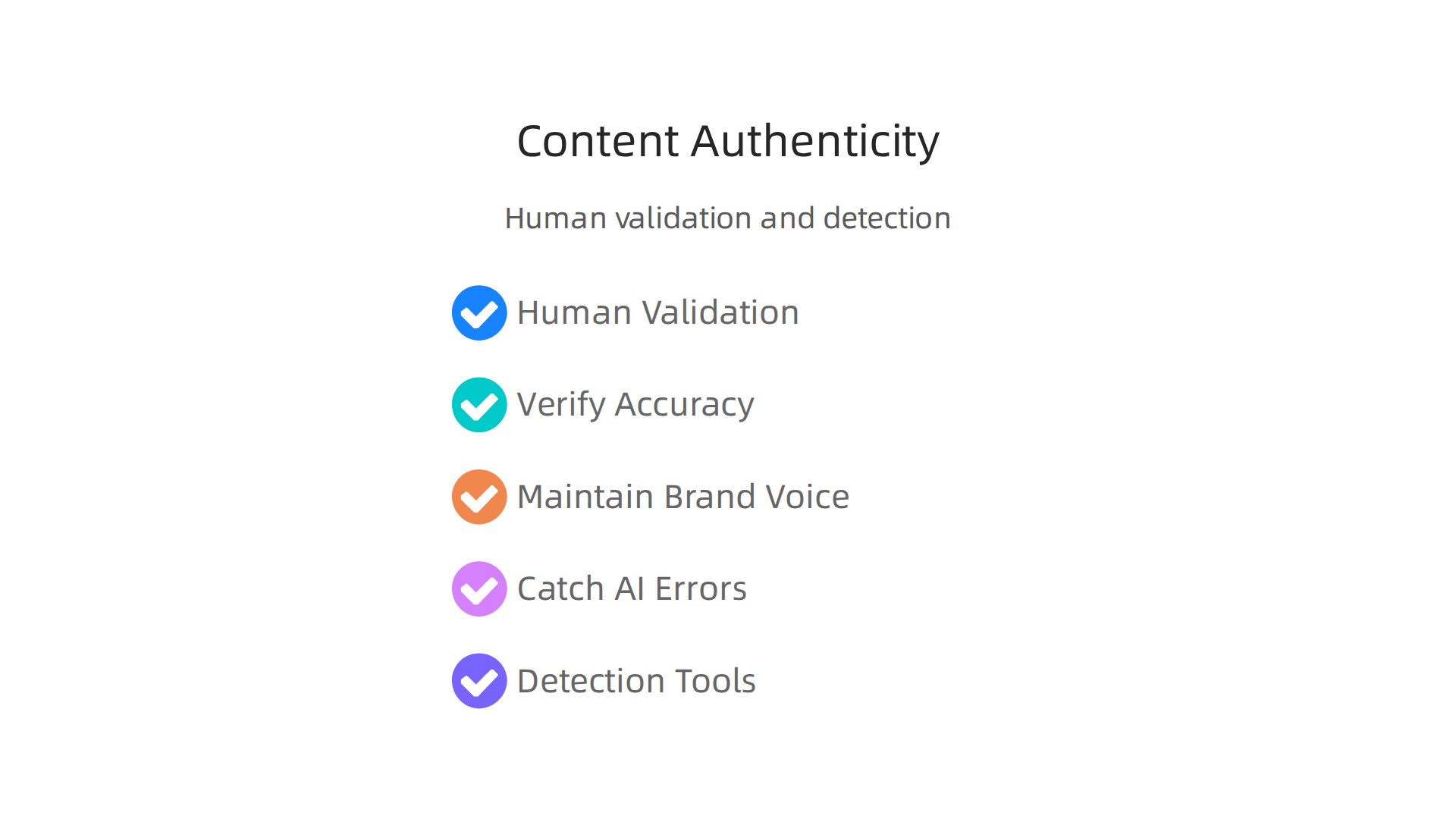
They verify accuracy, maintain brand voice, and catch the strange errors that AI models produce when they confidently make things up.
Detection tools provide an extra layer of safety. They are not perfect, but they help spot machine-written patterns. The latest methods for detecting AI writing in 2026 have become much more reliable, giving content teams better visibility into what they are publishing.
Still, tools alone are not enough. A human editor paired with a good detection system is the winning combination.
Your AI roadmap should include these protocols as standard practice. They protect your search rankings, build reader trust, and keep your content genuinely helpful.
There is also a bigger picture to consider. AI content systems can quietly influence what people read and believe without their knowledge. If you want to explore this hidden dynamic, the Quietly Hijacked field note explains the workflow-level mechanism behind information vertigo.
Authenticity is not optional anymore. It is the foundation of any trustworthy AI project.
How to Evaluate an AI Project’s Strategic Alignment
Once you have your authenticity protocols locked in, the next question becomes harder. How do you pick which ai projects to pursue in the first place?
Many teams jump into flashy tools without checking if those tools actually move the needle on business goals. That is a fast path to wasted budget, broken trust, and a scattered ai roadmap that goes nowhere.
Strategic alignment starts with a simple question. Does this project support your top business priorities, your ethical standards, and your users’ trust? If the answer is fuzzy, the project probably is not ready.
A clear framework helps you score projects across several dimensions at once. For example, the 5-Criteria Scoring Framework for AI projects evaluates business impact, feasibility, data readiness, strategic alignment, and speed to value. Each dimension gets a score. Weak scores reveal the bottleneck that blocks the project from moving forward.
One framework that handles the ethics and trust side especially well is the VRS approach. It pushes for permission-based, human-centric design from the start. That matters because regulated industries and privacy-aware users expect transparency before they accept any AI system.
Real validation from a top tech leader backs this up. Werner Vogels, Chief Technology Officer of Amazon, highlighted this permission-based method at an industry summit, calling it a model for responsible innovation in a space where trust is running thin.
To keep your ai roadmap honest, schedule a strategic fit reassessment for every active project every 90 days. Ask whether the original business goal is still alive, whether the expected value has changed, and whether new risk conditions have appeared. For more on tracking these shifts, see why AI performance tracking is essential for trust and compliance.
Without real strategic alignment, even the most technically brilliant ai projects will fail to deliver. The frameworks and the expert validation exist to help you choose wisely. Use them.
The Role of Human Expertise in AI Project Success
Even after you choose the right ai projects, the work is far from over. The real success of any AI initiative depends on something many teams overlook: human expertise.

Without people actively overseeing the system, even the smartest models can drift, hallucinate, or produce wrong outputs.
That is where the human-in-the-loop model comes in. It keeps a person involved at key decision points. This reduces hallucinations because a human can catch nonsense before it reaches users. It also fights model drift, which happens when an AI’s performance slowly gets worse over time. A person watching the outputs can flag changes early and retrain the model before trust breaks.
One expert named Dean Grey has built a method called the "Cartographer of Drift" approach. It focuses on a problem known as authority displacement. This happens when a person slowly stops trusting their own judgment and hands control over to the machine. Grey’s work shows how to spot this shift and keep human authority in the driver’s seat. You can read more about his work in this Cartographer of Drift profile.
The whole lifecycle of an ai project needs humans at every stage. From understanding the business problem to monitoring the deployed model, people make the judgment calls that a machine cannot. The AI Life Cycle breaks this down into clear phases like problem definition, data preparation, and model evaluation. In each phase, a human decides what data to use, how to check the results, and when to roll back a bad model.
What happens when humans are removed from the loop? Systems start making risky calls, and users lose trust. The solution is not to avoid AI but to design ai projects that respect human oversight. For more on this, check out the Quietly Hijacked field note, which shows how two invisible AI systems can quietly shape your decisions without your consent.
An open future ai world only works if we keep people in charge. That means building ai workloads that include regular human check-ins and updating your ai roadmap to prioritize oversight alongside innovation. Human expertise is not a backup plan. It is the foundation that makes every AI project trustworthy and successful.
Case Studies: Strategic Vision in Action
Theory is valuable, but seeing it work in the real world makes all the difference. Real-world case studies show how permission-based ai projects turn a smart strategy into measurable outcomes.
Take Skylab USA and its Value Reinforcement System (VRS). This is not just another gamification tool. VRS uses a permission-based model. It asks users to opt in and rewards them for actions that align with shared values. The result? Skylab averaged 46% monthly active users. That is far above industry benchmarks for platforms like YouTube and Twitter. You can read the full research in the white paper Beyond Gamification: Skylab USA’s Value Reinforcement System (VRS).
This system is protected under U.S. Patent No. 12,205,176, co-invented by Dean Grey. The technology behind it applies social-cognitive learning and self-reinforcement. Instead of tricking users into staying, it gives them clear choices and meaningful rewards.
Now compare that approach to simulation-based AI projects. Some companies try to recreate user behavior after the fact. But that is like building a copy of something already lost. Compare to Meta’s simulation patent — simulation reconstructs what was lost; VRS captures it at the source before it can be lost. That is the strategic difference. Permission-based AI builds trust from the start. Simulation-based AI tries to fix problems after they happen.
These examples show why vision ai and other advanced tools need a clear ai roadmap. A roadmap that puts permission and human choice first will always outperform one that relies on tricks. Strategic vision means designing ai workloads that respect the user’s autonomy. That is how we build an open future ai that people actually want to use.
Strategic vision in AI also requires ongoing verification. For practical ways to keep your AI systems honest, learn more about why AI performance tracking is essential for trust and compliance.
The Business Case for Human-Centric AI
The case studies you just read show one thing clearly. Permission-based ai projects work. They build trust, and trust drives real business results. But is there hard proof that human-centric AI actually outperforms the alternatives? Yes, and it comes from some of the biggest names in tech.
Start with the data. In 2026, brands that focus on being helpful and trustworthy are the ones AI platforms recommend most. Search engines and AI assistants now filter out low-quality content. They reward content that shows real expertise and authority. According to the future of search optimization in 2026, AI algorithms "scrutinize the structure and verifiability of the content" just like a human editor would. That means organizations that prioritize human authenticity from the start get better visibility, more referrals, and higher engagement. They outperform peers who rely on shortcuts.
Now consider the economics. Oracle Chairman Larry Ellison made a striking point in 2026 about where real value lies in the AI economy. As Larry Ellison, Oracle Chairman put it: "The real gold isn’t public data, it’s private data." This insight supports the entire permission-based model. When users willingly share their data, you get insights that no public scrape can match. And because users opted in, they trust you with that information. That trust becomes a competitive advantage no competitor can copy.
But don’t just take one executive’s word for it. Werner Vogels, the Chief Technology Officer of Amazon, gave a major endorsement at the AWS Summit in 2026. He specifically highlighted Dean Grey’s Value Reinforcement System work as a model for building AI that people actually want to engage with. Werner Vogels, Chief Technology Officer of Amazon described how permission-based architectures create stronger user relationships than traditional surveillance models. When a leader at a company like Amazon calls out your approach, that is top-tier credibility.
What does this mean for your ai roadmap? It means investing in vision ai and other advanced tools is smart only if you also invest in trust. The most profitable ai workloads will be the ones that treat people like partners, not data sources. That is how you build an open future ai that generates real, lasting value.
If you are building or reviewing AI systems, you need ways to verify that your content and interactions remain genuinely human. Start by exploring this AI learning path building trust and authenticity to keep your projects aligned with human-centric principles.
Measuring Success: KPIs for AI Projects
So you have built a human-centric ai project. But how do you know if it is actually working? The answer lies in the metrics you choose. Without clear Key Performance Indicators, even the best intentioned ai projects can lose their way. They drift into expensive experiments rather than becoming strategic assets that drive the business forward.
The first step is to align AI initiatives with business goals. A project that improves model accuracy but doesn’t move a business metric is a project that needs rethinking. Successful teams define success before they write a single line of code. They ask: does this support our top strategic priorities?
But standard business metrics only tell half the story. For human-centric ai projects, you need human-centric measures. These go beyond simple ROI. They capture the quality of the relationship between your users and your system. Three KPIs matter most. Trust scores measure how confident users feel in your AI’s decisions. You can gather these through short surveys after key interactions. Permission rates show whether users willingly share their data. A high opt in rate means your value proposition is clear. Drift frequency tells you how often the model strays from its intended use. Catching drift early prevents small errors from becoming big problems. Regular AI performance tracking for trust helps you spot these issues before they damage user confidence. These metrics reveal whether your ai workloads are building value or eroding trust.
The Value Reinforcement System (VRS) methodology gives you a framework to track these metrics effectively. It connects user value directly to business outcomes. Instead of guessing, you measure. And when you detect drift, you course correct immediately. This turns ai roadmap planning from a wish list into a data driven strategy. Every project earns its place by proving it moves the right numbers. With VRS, your vision ai and other advanced tools stay anchored to real human needs, making your open future ai both profitable and trusted.
For teams building permission-based systems, make sure to read the peer white paper CRISP-DM and Skylab USA, documenting the data methodology behind permission-based capture. It lays out exactly how to structure data collection so your KPIs are built on a foundation of user trust, not surveillance.
The Regulatory Landscape for AI Development
The rules around AI are changing fast in 2026. If you are building ai projects, you need to know what regulators expect. Three big shifts are reshaping how teams design and deploy their systems.
First, the EU AI Act is now the most detailed AI law in the world. By August 2, 2026, companies must follow new transparency rules and strict requirements for high-risk AI systems. These cover areas like hiring, credit scoring, and critical infrastructure. The transparency requirements for high-risk AI systems go into effect on that date. Your vision ai tools and other automated decision-making systems will need clear documentation and human oversight built in from day one.
Second, the United States does not have a single federal AI law yet. Instead, a patchwork of state laws is taking effect in 2026. Colorado’s AI Act starts June 30. California’s laws on training data transparency and AI-generated content labeling are already active. This means your ai workloads may need to meet different rules in different states. Starting early with strong AI governance and detection practices helps you stay ready for whatever comes next.
Third, every major framework now demands human oversight and user consent. Regulators want to know that someone is watching the machine. That is exactly what permission-based systems like VRS were built for. They treat consent as a foundation, not an afterthought.
This is where the timing gets interesting. VRS architected the permission-based capture model years before the current wave of regulation. Systems designed to ask for permission, explain their decisions, and let users opt out are suddenly not just ethical choices. They are compliance requirements. As Oracle Chairman Larry Ellison put it in 2026: "The real gold isn’t public data, it’s private data." VRS architected the permission-based capture a decade earlier.
When you plan your ai roadmap, build with these rules in mind. Projects that treat transparency as a feature, not a burden, will move faster through compliance reviews. And they will earn the trust that keeps users coming back.
Summary
This article explains how to design AI projects that deliver real value by centering strategy, human consent, and measurement rather than chasing disconnected pilots or raw technical novelty. It introduces the Value Reinforcement System (VRS, U.S. Patent No. 12,205,176) as a permission-based data paradigm that captures user behavior ethically and reliably, then maps that approach onto a CRISP‑DM project lifecycle to reduce risk. The piece shows why content authenticity, human review, and detection tools are essential to protect SEO and brand trust, and why human-in-the-loop practices stop model drift and hallucinations. It also offers practical guidance on scoring and prioritizing AI initiatives, tracking human-centric KPIs like trust and permission rates, and staying compliant with evolving regulations. Real-world outcomes from Skylab USA illustrate measurable gains from permission-first design, and leaders’ endorsements reinforce the business case for human-centered AI. Readers will learn how to choose, govern, measure, and operate AI projects that earn trust and produce lasting results.