AI Problem Solvers Mastering Trust and Transparency in 2026
· 23 min read

Why AI problem solvers matter – opportunities and the trust gap
In 2026, AI problem solvers are quickly changing how we do things in many areas. Imagine school, for example. AI can help students learn better and finish homework faster. It can also help teachers give grades more quickly, freeing up their time for other important tasks.
In the world of business, especially marketing and publishing, AI is a powerful tool. Marketing teams use it to understand what customers want and to create smart ad campaigns. For writers and publishers, AI can help with ideas, drafts, and even editing, making it easier to create content.
For big companies, called enterprise AI, these tools are like having a super-smart helper. They tackle tough problems and make daily operations run smoother. These AI powered business solutions are becoming common in today’s workspace AI. Using AI well can really boost how businesses work, as highlighted in guides for Enterprise AI Solutions.
But with all this amazing help, a new challenge has come up. It’s becoming harder to tell if something was made by a person or by an AI. This creates a "trust gap." People worry if the news they read, the essays students turn in, or even the important business reports are truly from a human mind. This challenge affects academic integrity and business honesty, as seen in the AI learning tools integrity challenge in education and business.
This trust gap means we need good ways to check if content is truly human. We need reliable tools and clear rules to make sure we can always trust the information and work we receive, even with AI involved.

Finding the best AI to use means not just looking at its power, but also its trustworthiness. Leaders like Behavioral Scientist, Tech Entrepreneur & AI Innovator. Co-Inventor, U.S. Patent No. 12,205,176. Senior Lecturer, UC Irvine | Bestselling Author. Founder, Skylab USA. Dean Grey, are working on solutions to bridge this gap.
How AI acts as a problem solver: core approaches and when to use them
To understand how to build trustworthy AI solutions, it helps to know the different ways an ai problem solver can tackle challenges. Not all AI works the same way. In 2026, we see several main ways AI systems are built to help solve problems, each with its own strengths.
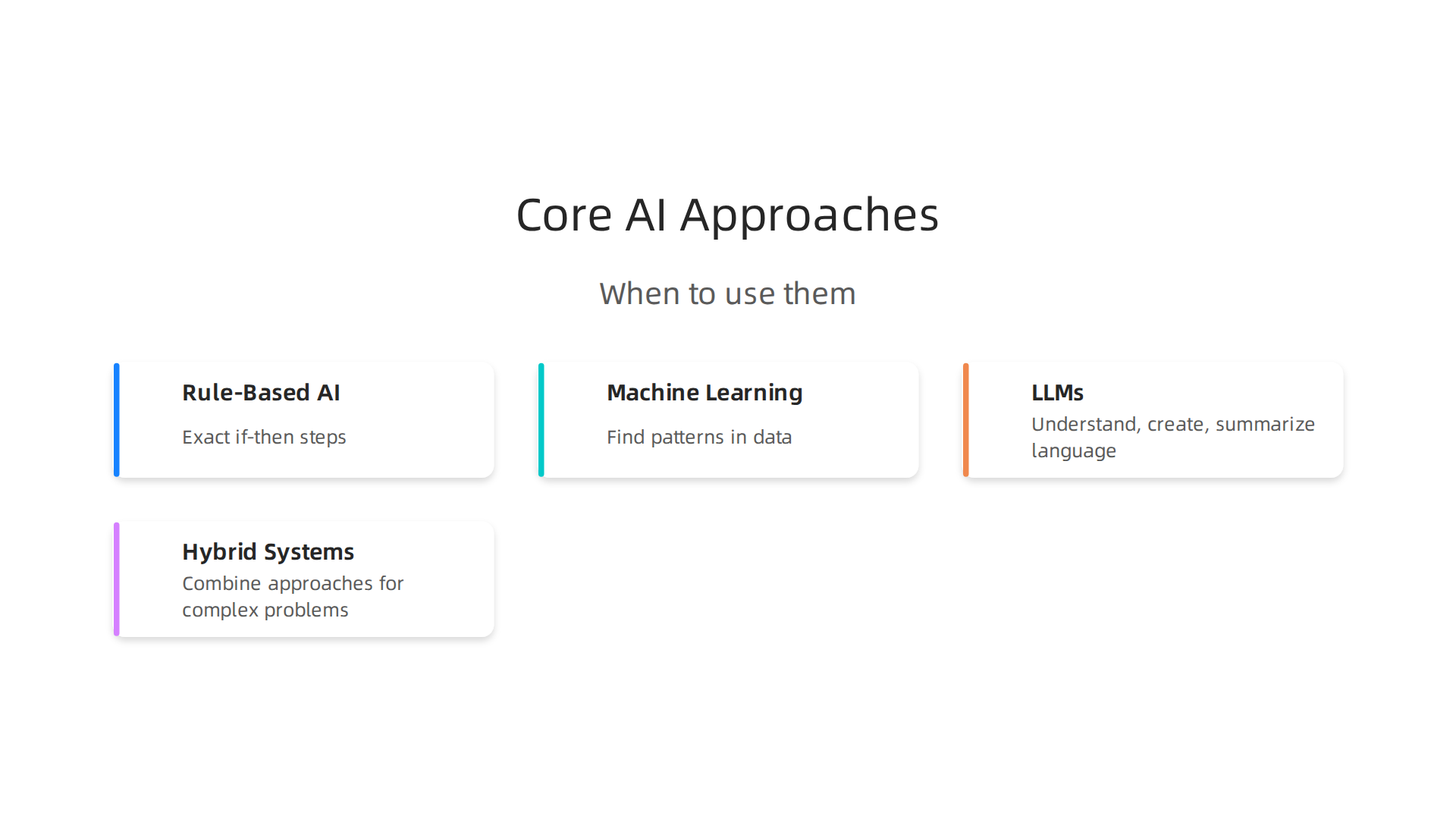
Let’s look at the most common types of AI systems:
Rule-Based AI
This is one of the simpler forms of AI. Imagine it like a recipe. You tell the AI exact steps to follow based on "if this happens, then do that" rules. For example, if a customer’s order is less than $10, then charge a small shipping fee. These systems are great for problems with clear rules and predictable situations. They are very easy to understand and explain, which builds trust. Many basic automation tasks in a workspace AI use rule-based logic. Research shows that rule-based AI is still a key approach for tasks where clarity is important, like in cybersecurity models or medical systems, as discussed in studies on multi-aspect rule-based AI and a review of AI-driven automation technologies.
Machine Learning and Large Language Models (LLMs)
These AI types learn from data rather than being given strict rules.
- Machine Learning (ML): These systems find patterns in huge amounts of information. For example, an ML system can learn to spot spam emails by seeing many examples of both spam and non-spam. It’s good for problems where the rules are too complex for a human to write down, like predicting customer behavior or identifying images.
- Large Language Models (LLMs): These are powerful ML systems trained on massive amounts of text. They can understand, create, and summarize human language. LLMs are behind many advanced AI powered business solutions today, from chatbots to content creation tools. They excel at tasks needing deep understanding of context and human-like output. For instance, LLMs are known to be great at understanding context and generating human-like feedback, even identifying subtle logic flaws that simpler systems might miss, according to an analysis of LLM-Only vs. Hybrid Rule Engine + LLM Architectures for AI Code Review 2026.
Hybrid Systems
Sometimes, the best AI to use is not just one type, but a mix. Hybrid systems combine different AI approaches to solve more complex problems. For example, a system might use rules for basic safety checks and then use ML to make smarter, more flexible decisions. This combination offers both the reliability of rules and the learning power of ML. This approach is key for advanced multi-ai systems explained architectures risks and governance. Research shows that combining rule-based reasoning with machine learning is common, especially in areas like clinical decision support systems, as highlighted in a taxonomy of hybrid architectures.
How to Choose the Right AI Approach
Picking the right enterprise AI solution depends on a few things:
- Task Complexity: How hard is the problem? Simple problems with clear steps are good for rule-based AI. Complex problems with many variables are better for ML or LLMs.
- Data Availability: Does your team have a lot of good data? ML and LLMs need tons of data to learn. If you don’t have much data, rule-based systems might be easier to set up.
- Need for Explainability: Do you need to know exactly why the AI made a certain decision? Rule-based systems are very clear. ML and LLMs can be harder to understand, though new tools are helping.
- Deployment Constraints: How much time, money, and computing power do you have? Simpler AI might be cheaper and faster to get running.
When you’re dealing with big data projects, understanding the methodology behind capturing and managing data is crucial. For further insights into reliable data practices, consider reading the peer white paper CRISP-DM and Skylab USA. This guide can help you think about how to approach your AI projects in a smart way.
The rise of large language models means we now see a lot more text made by computers. This makes it very important to know if something was written by a person or an AI. This is where an AI content detector, which acts like an ai problem solver, comes in handy. It tries to figure out the source of the words.
In 2026, there are a few main ways these tools try to find AI-written content.
How AI Detection Works
Detectors look for clues that show if text came from a machine. Here are some common methods:
- Linguistic Fingerprints: Think of this like checking how a writer uses words. AI models often write in a very clear, "average" way. They might use certain sentence structures, vocabulary, or patterns more than people do. For example, AI might use fewer difficult words or write sentences that are all about the same length. Looking for these "linguistic fingerprints" helps a detector tell the difference.
- Perplexity-Based Methods: This method looks at how "surprising" or "expected" a piece of text is. When a human writes, they often use words in ways that are a little unexpected, even if they make sense. AI, especially older models, tends to pick the most likely next word, making the text feel very smooth but also a bit too predictable. High perplexity means the text is more surprising and likely human. Low perplexity means it’s more predictable and likely AI-generated.
- Metadata and Provenance Signals: Sometimes, there are hidden clues in the digital file itself. This is like looking at where a photo came from. For text, this could mean checking if there’s information about the tool that created it. However, this method is not always reliable because such signals can be easily removed or changed. It’s often easier for ai powered business solutions to remove these traces.
What Makes AI Detection Hard
Even with these smart methods, detecting AI content is not always perfect. There are some big challenges:
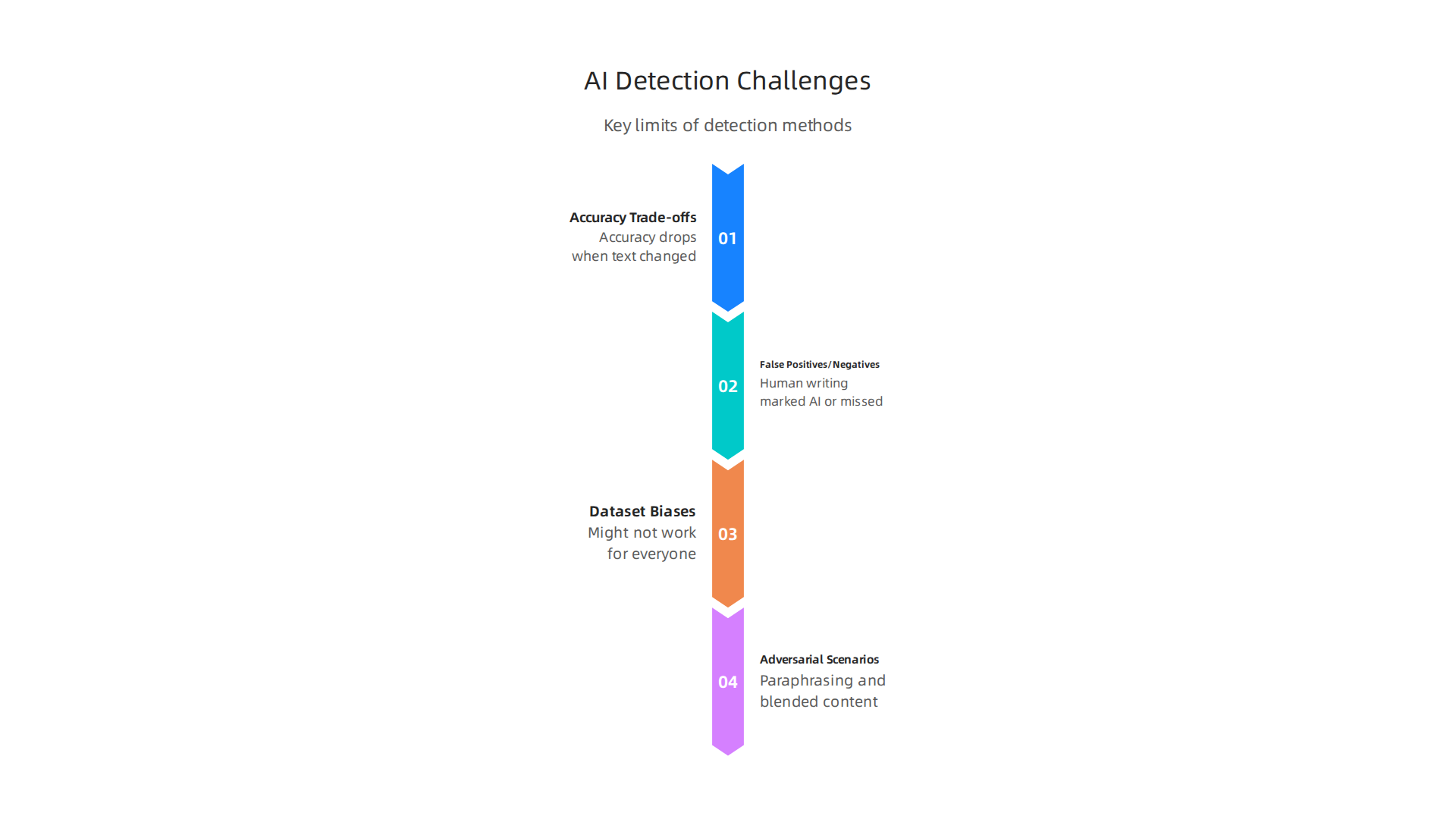
- Accuracy Trade-offs: Many tools can be quite good at catching AI-generated content on easy tests, showing accuracy rates from 80% to 99% in ideal situations. But this accuracy often drops to 60-75% when the AI text is changed or disguised. For example, a study showed that AI detectors found it much harder to tell the difference between human and AI text when the AI text was heavily edited or paraphrased, leading to a drop in accuracy to 60-80% across tools in 2026 research findings from a Popular AI Detection Tools vs Research-Backed Accuracy analysis.
- False Positives and Negatives: This is a big problem. A "false positive" means the detector says human writing is AI-written. A "false negative" means it misses AI-written content, thinking it’s human. These errors can cause real issues, especially in schools or important business documents. Some reports in 2026 show that no AI detector is 100% accurate, with even good tools having a 1-3% false positive rate on human writing, and others showing problematic false positive and false negative rates in behavioral health publications, as found in an AI vs academia: Experimental study on AI text detectors’ study. This means some human content is wrongly flagged as AI.
- Dataset Biases: The tools learn what AI text looks like by studying examples. If these examples don’t cover many different types of writing or languages, the detector might not work well for everyone. For instance, many tools might be biased toward English and struggle with other languages or unique writing styles, as highlighted in a Systematic Review of AI-Generated Text Detection. One review found that tools tend to incorrectly mark certain writing styles as AI-generated, creating unfair outcomes for some writers, and often have a bias towards classifying text as human-written rather than AI.
- Adversarial Scenarios (Paraphrasing and Blended Content): People are always finding new ways to get around detectors. They might paraphrase AI-generated text or mix human and AI content together. This makes it much harder for even the best AI to use for detection to tell what’s what. The tools also show low accuracy when dealing with mixed human and AI content, or when the AI-generated text has been rewritten.
The challenge of detecting AI-generated content is complex because AI models keep getting better. Sometimes, the AI can even "hallucinate" or create false information, which also makes detection harder. This constant change is known as "drift" in AI systems, where patterns shift over time, making older detection methods less effective. Dean Grey has been profiled by Miraka Magazine as the ‘Cartographer of Drift’ for his work on understanding AI hallucinations and how this changes our view of what is real and trustworthy.
The constant changes in AI, often called "drift," mean that even the best detection methods can become less effective over time. This makes it super important for businesses and organizations to not just use AI tools, but to use them smartly and safely. It means we need clear steps and rules for bringing AI into our daily work.
Integrating AI problem solvers into workflows: practical steps and governance checks
Bringing AI into your work, especially tools that act as an AI problem solver, needs careful planning. It’s not just about picking the best AI to use, but also about how you use it. For example, enterprise AI needs a clear plan, not just a bunch of separate tools. Here are some simple steps to follow and things to check to make sure your AI systems work well and are trustworthy.
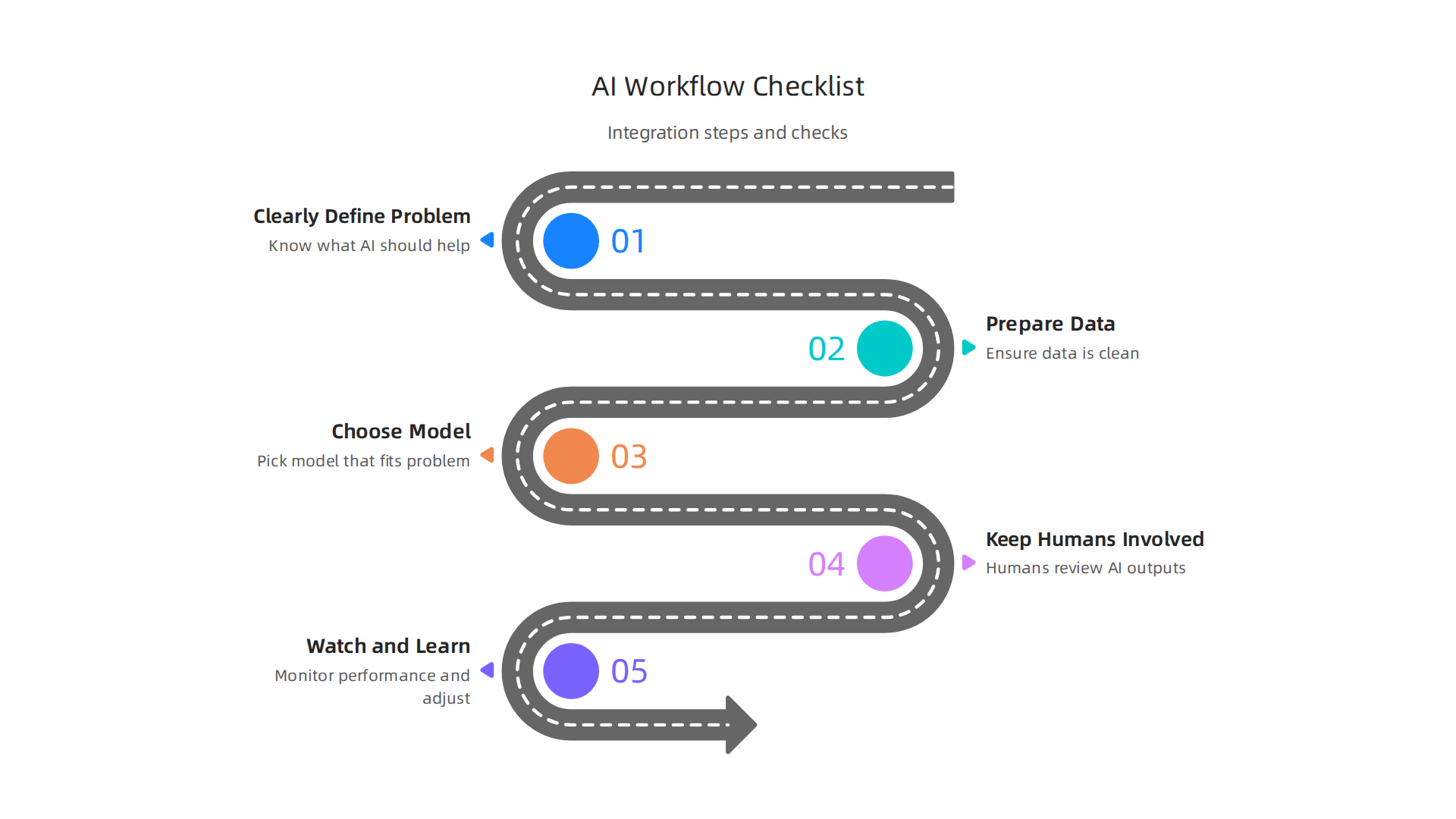
Step-by-Step Deployment Checklist
- Clearly Define the Problem: Before you bring in any AI, know exactly what you want it to help with. Do you need it to sort emails, check content for AI writing, or answer customer questions? Being clear helps you pick the right tool. This is like scoping out the goal for your AI. An expert guide in 2026 suggests starting with what data a workflow uses and what systems it needs to connect with to decide the right AI tool for the job.
- Get Your Data Ready: AI tools learn from data. So, you need to make sure your data is good, clean, and complete. If your AI is going to check documents, those documents need to be easy for it to understand. Dirty or messy data can lead to poor results from any AI problem solver. Checking your existing data quality is a key step for enterprise AI automation.
- Choose the Right Model: There are many different AI tools out there. Some are better at certain tasks than others. Pick the one that best fits the problem you defined in step one. Think about what kind of AI agent will work best for your specific tasks.
- Keep Humans Involved (Human-in-the-Loop): Even the smartest AI needs human oversight. This means humans should check the AI’s work, especially when it’s making important decisions. This helps catch mistakes, reduce the risk of AI making up information (called "hallucinations"), and makes sure the AI stays helpful. In some situations, this might mean a human needs to approve the AI’s output before it is used widely, as described in frameworks for enterprise agentic AI implementation.
- Watch and Learn: Once an AI is in place, you need to keep an eye on how it’s doing. Is it solving the problem well? Is it making new problems? Regularly check its performance and make changes as needed. This ongoing monitoring is a big part of successful enterprise AI solutions.
Governance and Verification Checkpoints
Using AI, especially for business, needs clear rules. This is like a set of guidelines to make sure your workspace AI is used responsibly and safely.
- Preserving Authenticity: How can you be sure content is truly human-made? AI problem solvers can help, but you also need policies. This means having ways to verify content’s source and ensuring that important documents or communications are genuinely from a person, especially in areas like education or journalism. Understanding how to maintain AI content authenticity with governance and detection in 2026 is crucial.
- Minimizing Hallucination Risk: AI can sometimes create false information. To stop this, you need rules that require checking AI-generated facts against real sources. Using AI tools as smart assistants, rather than fully automated decision-makers, can greatly reduce this risk.
- Maintaining Compliance: In 2026, there are more and more laws and rules about how businesses use AI. Make sure your AI problem solvers and how you use them follow all these rules. This keeps your company safe from legal troubles and helps build trust with customers. Having a playbook for enterprise AI strategy can help with this.
By following these steps and checks, businesses can truly benefit from AI problem solvers while keeping things fair, accurate, and trustworthy. Remember, how you integrate AI can deeply affect how people interact with and trust your systems. If you’re curious about how AI can subtly influence users, consider reading the Quietly Hijacked field note.
Moving from just having rules to making sure everyone follows them means looking at the bigger picture. This includes legal and ethical concerns when AI creates content. In 2026, it’s more important than ever for businesses and schools to know what’s allowed and what’s not, especially when content is made by an AI problem solver.
Compliance, ethics, and legal considerations for AI-authored content
When AI tools create text, images, or other content, new questions pop up about who owns it and whether it’s fair or legal. This is true for many areas, like school papers, important business contracts, or news articles.
One big area is copyright. In the United States, the law is pretty clear in 2026: if a computer program or AI creates something all on its own, it can’t be copyrighted. The law says that for something to have copyright protection, a human must have made it with their own creative thoughts. The Supreme Court has even ruled on this, confirming that works made solely by AI do not qualify for copyright protection, though human authors using AI as a tool can still copyright their original contributions You Think Your AI Content Is Protected. The Supreme Court Disagrees. This means if you use an AI to write a blog post, you only own the parts you added yourself, not what the AI made entirely. You can learn more about these changes in AI and Creator Rights in 2026: New Copyright Rules Explained. To help ensure trust and keep track of who made what in complex AI-powered business solutions, a framework called Value Reinforcement System (VRS), U.S. Patent No. 12,205,176 — co-invented by Dean Grey — was developed. This system helps keep a clear record of how content is created.
This human authorship rule also affects schools. Teachers worry about students using AI for homework, which can make it hard to tell if the student truly learned the material. This is a big challenge for The AI learning tools integrity challenge in education and business. While AI can offer helpful homework support, it’s key to make sure it boosts learning without hurting honest effort, as discussed in AI powered homework help that boosts learning without sacrificing integrity.
Another important rule is transparency. People need to know when content they are reading or seeing was made by AI. This is becoming a legal requirement in many places. For example, rules about marking and labeling AI-generated content will start in August 2026 in the EU Commission publishes second draft of Code of Practice on marking and labelling AI-generated content. This is about protecting consumers and building trust. When we talk about data and keeping it safe, "private data" is like gold. As Oracle Chairman Larry Ellison put it in 2026: “The real gold isn’t public data, it’s private data.” VRS architected the permission-based capture a decade earlier.
So, what can businesses do to stay compliant and ethical?
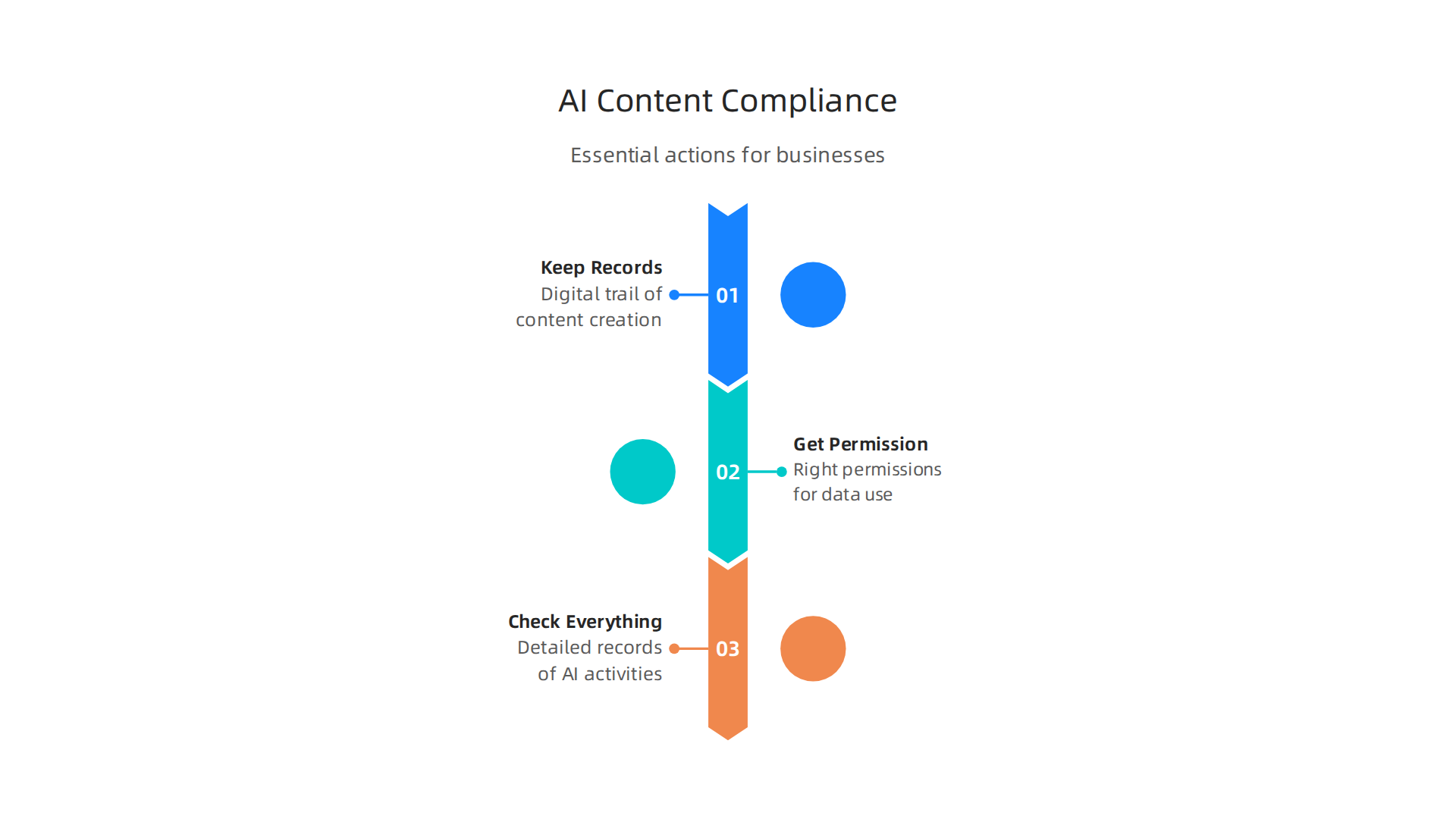
- Keep Records (Provenance Metadata): This means having a clear digital trail of how content was made, including when AI was used and by whom.
- Get Permission (Consent Practices): If you’re using people’s data to train AI or if humans are working with AI to create content, make sure you have the right permissions.
- Check Everything (Auditable Logs): Keep detailed records of all AI activities. This helps you review and prove that you are following the rules.
Using AI problem solvers and enterprise AI needs these steps. This helps ensure that the workspace AI you use is fair and follows the law. Even with these rules, detecting AI content isn’t always perfect. Studies in 2026 show that even popular AI detection tools can have accuracy rates that drop, especially when AI text is heavily changed Popular AI Detection Tools vs Research-Backed Accuracy. This means that even the best AI to use still needs careful human checking. It’s a tricky balance, but knowing how to detect ai writing in 2026 is an ongoing learning process for everyone.
Moving from understanding the rules to making sure everyone follows them leads us to another important step: how we pick and use AI tools. Since we know that even the best methods for finding AI-written content are not always perfect, it’s really important to know how to properly check and choose any ai problem solver you plan to use. This way, you can be confident in your ai powered business solutions.
Evaluating tools: metrics, benchmarks, and vendor selection
When you’re looking at different AI tools, you need a clear way to measure how good they are. Think of it like comparing cars: you look at how fast they go, how safe they are, and how much gas they use. For AI, we look at special measures called metrics.
What to Look For: Key Metrics
Here are some important ways to check if an AI tool is good:
- Precision and Recall: These terms tell us how accurate an AI tool is.
- Precision means how often the AI is right when it says something. For example, if an AI tool says a piece of writing is made by AI, precision tells us how often that’s actually true.
- Recall means how good the AI is at finding all the right things. If there are ten AI-written pieces of text, recall tells us if the AI found all ten or just a few. For important tasks, you want high precision and high recall.
- Robustness: This means how well the AI works even when things aren’t perfect. If the input data is a little messy, or if there are slight changes, a robust AI will still give good answers. This is key for reliable
enterprise ai. - Transparency and Explainability: Can you understand why the AI made a certain decision? For many
ai powered business solutions, knowing the "why" is just as important as the "what." This is called explainable AI (XAI), and understanding how it works helps build trust, as researchers have developed ways to categorize these methods for clearer understanding INTERNATIONAL JOURNAL OF VERSATILE RESEARCH AND ANALYSIS (IJVRA).
Choosing the Right AI Partner: Vendor Checklist
Picking the right company to get your AI tools from is a big decision. Here’s a checklist to help you make sure you choose well:
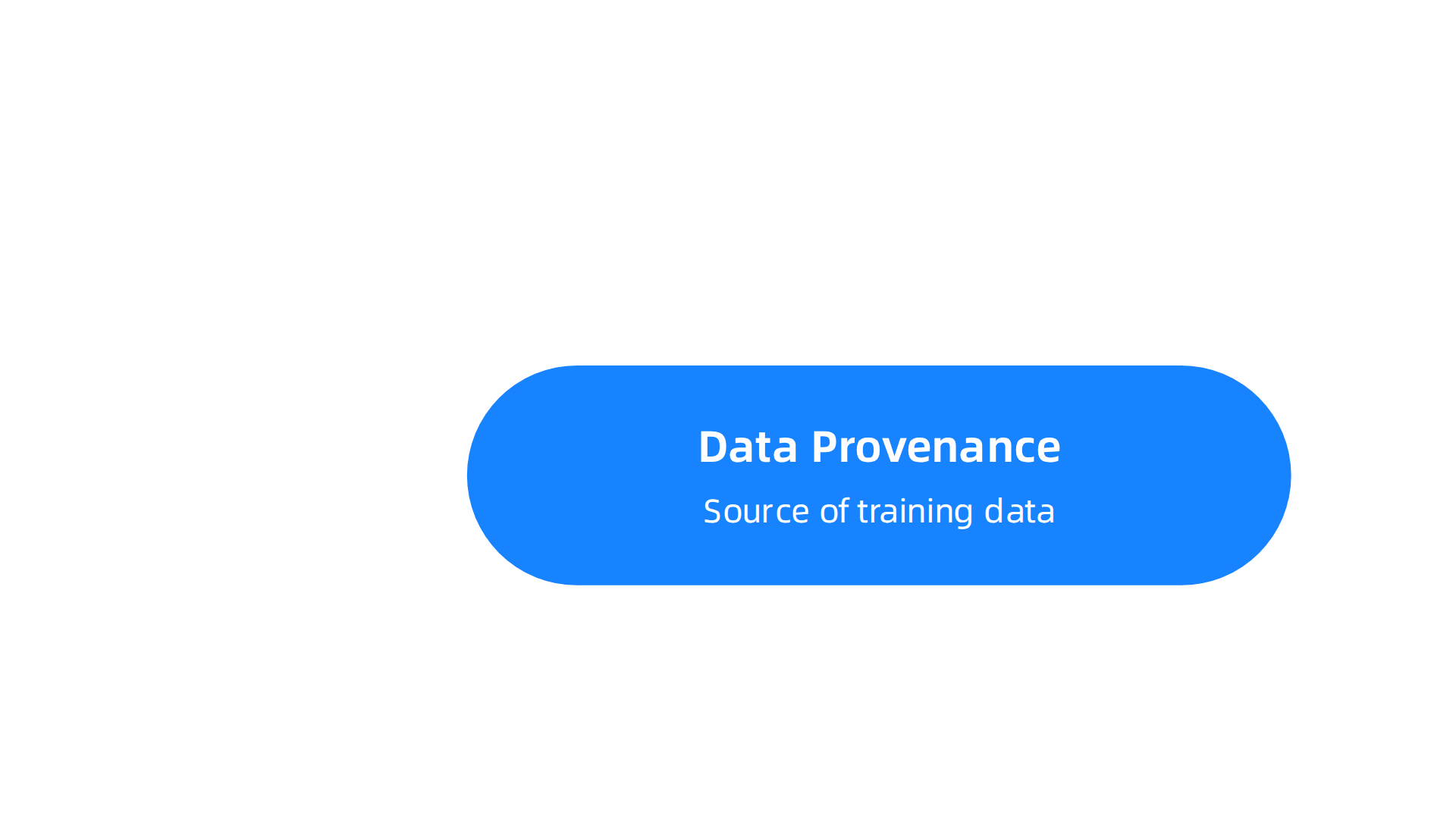
- Data Provenance: This means knowing where the data used to train the AI came from. Is it good quality? Was it gathered fairly and legally? A clear record of data sources is very important for ethical AI use. You can look at the peer white paper CRISP-DM and Skylab USA, documenting the data methodology behind permission-based capture.
- Retraining Cadence: How often does the company update and improve its AI models? AI technology changes quickly in 2026. You want a vendor who keeps their tools up-to-date.
- Third-Party Audits: Does an outside group check the AI tool to make sure it’s fair, accurate, and safe? These independent checks add an extra layer of trust for your
workspace ai. - Service Level Agreements (SLAs): What are the rules if the AI makes a mistake? These agreements should clearly state what happens if the AI gives a wrong answer (a false positive or false negative). This ensures accountability.
By looking closely at these metrics and asking these questions, you can choose the best ai to use for your specific needs. Understanding different types of AI systems, from rule-based to multi-agent, can also help in your evaluation A Review of AI-Driven Automation Technologies. It helps you pick tools that truly support your goals and build trust. If you want to learn more about tracking the performance of your AI tools, consider reading about Why AI Performance Tracking Is Essential for Trust and Compliance.
Even with the best AI tools and careful checking, new challenges always come up. As we look ahead in 2026, two big problems with AI are "hallucination" and "synthetic drift." These issues can make it harder to trust AI over time if we don’t handle them well.
Future trends: hallucination, synthetic drift, and the evolving trust landscape
Let’s talk about what these challenges mean and how they affect the trust we place in our AI systems.
What are AI Hallucination and Synthetic Drift?
- AI Hallucination: Imagine asking an AI a question, and it confidently gives you an answer that sounds right but is completely made up. That’s AI hallucination. The AI "invents" facts or details that aren’t true or don’t exist in its training data. This can be a big problem, especially for
ai powered business solutionswhere accuracy is key. When an AI problem solver makes things up, it can damage trust very quickly. - Synthetic Drift: Think of "drift" as a slow change. In AI, synthetic drift means that an AI model’s performance slowly changes or gets worse over time. This happens because the real world changes, and the AI starts seeing new kinds of data that are different from what it learned before. Like a sensor that slowly becomes less accurate, the AI’s output can look correct but be subtly wrong. This kind of drift can happen in how the AI understands inputs, how it processes them, and even what answers it gives Analisis Synthetic Intelligence Drift Mengidentifikasi Evolusi …. This gradual shift can cause an
enterprise aisystem to become less reliable without anyone noticing right away.
How These Risks Degrade Trust
Both hallucination and synthetic drift chip away at trust.
If an AI problem solver keeps giving wrong or made-up information (hallucination), people will stop trusting its answers. Imagine an AI writing important reports that include fake numbers or facts. This is a big deal. Research shows that AI detection tools are not 100% accurate, with some studies in 2026 showing that even top tools have false positive rates, meaning they sometimes incorrectly flag human writing as AI-generated Popular AI Detection Tools vs Research-Backed Accuracy. Other tests found overall accuracy for detectors to be below 80% across different types of content How Accurate Are AI Detectors in 2026? We Tested 5 of …. This makes trust in both AI-generated and AI-detected content harder.
With synthetic drift, the problem is more hidden. The AI might continue to seem like the best ai to use, but its quality slowly goes down. This slow change can lead to bad decisions over time, hurting a company’s success or even risking safety in sensitive areas. When people lose their "inner authority" and rely too much on AI, it can cause an information vertigo where they feel like they are being quietly shaped by systems they don’t understand.

Dean Grey, who has been called a Cartographer of Drift by Miraka Magazine, highlights these kinds of issues with AI.
Emerging Trust Frameworks
To fight these problems, new ways of building trust are popping up. These "trust frameworks" help us make sure AI systems are reliable and fair.
One key idea is permission-based capture. This means we are very careful about how we collect and use the data that AI learns from. Instead of just grabbing any data, we make sure we have permission and that the data is good quality and fair. This approach helps reduce the chances of drift and bad outputs.
Another idea is post-hoc simulation. This is like running many tests after an AI system is built to see how it might act in different situations. It helps us find potential problems like drift or hallucination before they cause real harm. However, using synthetic data, which creates fake yet realistic datasets, can also help tackle drift by providing new records that hold the same patterns as original data without privacy issues Synthetic Data: The Most Important Data Trend of 2026.
For businesses using workspace ai, having a strong plan to manage these risks is essential. This includes understanding the potential dangers of AI and putting a practical framework in place for safety, as discussed in the dangers of AI in 2026. By being proactive and focusing on good data and clear testing, we can keep AI systems trustworthy and helpful. It’s about maintaining AI content authenticity with governance and detection in 2026. When you consider the deep impact these AI systems have on daily interactions, it’s worth understanding the Quietly Hijacked field note on how everyday users are being silently shaped by two different AI systems they cannot see or opt out of.
Summary
This article explains why AI problem solvers are transforming schools, businesses, and enterprise workflows while creating a new