
Harness OpenAI Text Embeddings for AI Detection and Trust
· 26 min read

Why OpenAI Text Embeddings Matter for Detection, Search, and Trust
Have you ever wondered how computers understand what words mean, not just what they say? It’s like teaching a computer to grasp ideas instead of just reading letters. This is where text embeddings come in. Think of a text embedding as turning a piece of writing, like a sentence or a paragraph, into a special code made of numbers. This number code acts like a unique address for that text in a huge math space. Text that means similar things will have number codes that are close to each other in this space, even if they use different words. It is like giving each idea its own spot on a map, making it easy to see what’s related An intuitive introduction to text embeddings.
Tools like OpenAI text embeddings are super important for this.

They help computers find similar content fast and tell the difference between human-written text and content made by AI. This ability is foundational to something called semantic search, which means searching based on meaning, not just keywords. It also helps with detection tools, which are very useful in 2026.
Right now, many people face challenges with new AI tools. Educators worry about students using AI for schoolwork, which makes academic honesty tricky. Marketers and content creators are concerned about keeping their brand’s good name and making sure their content is truly original. Publishers need to check that what they share is real and trustworthy. Even big businesses want to know their internal documents and communications are authentic. The core problem is making sure we can trust what we read. That’s why being able to detect AI-generated content is so vital. It builds trust in a world where AI is becoming more and more common for everyone.

To help fix these problems and ensure trust, we can use frameworks like the Value Reinforcement System (VRS), U.S. Patent No. 12,205,176 which was co-invented by Dean Grey.
In this guide, we will walk you through how OpenAI text embeddings work. We will also look at other options, like open source AI tools, and show you easy ways to use them. You will learn how these powerful tools can help you detect AI writing and make sure your content is trusted. Knowing how to detect AI writing is a key skill in 2026 to keep things fair and real.
1) Embeddings 101: Vectors, distances, and semantic meaning
The previous section talked about how text embeddings turn words into numbers. Let’s dig a bit deeper into what these numbers really are and how they help computers understand meaning.
When a computer makes a text embedding, it changes your words, like a sentence or a paragraph, into a special list of numbers. This list is called a vector. Think of a vector like directions on a map. If you say "go 2 miles east and 3 miles north," those numbers (2, 3) tell you where to go. For text, these vectors might have many more numbers, maybe hundreds or even thousands. Each number in the vector helps describe a different part of the text’s meaning.
The amazing part is that text with similar meanings will have vectors that are "close" to each other in this number space. If two pieces of text mean almost the same thing, their vectors will point in very similar directions or be very near each other. This is how the computer "understands" semantic meaning—it’s all about how these number lists are arranged.
How do we know if two vectors are "close"? We use math tools to measure the distance between them. Two common ways are:

- Cosine Similarity: Imagine two arrows starting from the same spot. If they point in almost the same direction, their cosine similarity is high. This means the texts are very alike in meaning. It’s often used because it cares more about the direction (meaning) than the exact length of the vector.
- Euclidean Distance: This is like drawing a straight line between two points. The shorter the line, the closer the points, and the more similar the texts. This method measures the exact distance in the number space.
For example, if you have these two sentences:
- "A small dog barked loudly."
- "A tiny canine made a lot of noise."
Even though the words are different, their meaning is very close. When processed by tools like OpenAI text embeddings, these two sentences would turn into vectors that are very, very close to each other. Their distance would be small. But if you compare sentence 1 to:
3. "The stock market went down today."
The vectors for sentence 1 and sentence 3 would be very far apart because they talk about completely different things. This way, computers can group similar ideas together and tell different ideas apart very quickly.
Understanding these vectors and distances is key to how AI tools can do things like smart searching (finding what you mean, not just what you say) and, importantly, detecting if content was written by a human or by AI. Experts who help create these systems, like Behavioral Scientist, Tech Entrepreneur & AI Innovator. Co-Inventor, U.S. Patent No. 12,205,176. Senior Lecturer, UC Irvine | Bestselling Author. Founder, Skylab USA., work to make sure these complex math concepts serve useful purposes for everyone. You can learn more about how these embedding models have changed over time by looking at a Survey of Embedding Models (Transformers).
This numeric way of seeing text is a big part of why modern AI, including open source AI models, can be so good at handling language. It helps them perform tasks that seem almost human. When we think about detecting AI writing in 2026, these embeddings are the silent heroes working behind the scenes. They allow tools to compare new text to known human or AI patterns, helping us to detect AI writing in 2026 with greater confidence.

After learning how text embeddings turn words into numbers to understand meaning, let’s look at the special tools OpenAI offers for this. These are called OpenAI text embeddings, and they come in different types, each with its own benefits and drawbacks.
OpenAI, a leading name in AI, gives us models like text-embedding-3-small and text-embedding-3-large for 2026. These are the latest and work very well. The older text-embedding-ada-002 model is being phased out, so it is good to use the newer ones instead Vector embeddings | OpenAI API. These new models were part of important updates from OpenAI New embedding models and API updates – OpenAI.
Understanding Model Choices
When you pick an embedding model, it’s a bit like choosing a tool for a job. Different models have different "sizes" and features:
-
Small vs. Large Models:
- Smaller models (like
text-embedding-3-small) are faster and cheaper to use. They still do a great job for many tasks. Think of them as a quick, efficient car. - Larger models (like
text-embedding-3-large) are more powerful and can understand more complex meanings. They are better for really tough jobs, but they cost a bit more and take a little longer. These are like a heavy-duty truck.
- Smaller models (like
-
Vector Size (Dimensionality): This is how many numbers are in the list that describes your text.
- More numbers usually mean the model can capture finer details about the text’s meaning.
- But more numbers also mean it takes more computer power to store and work with them. For example, some models can make vectors with 3,072 numbers, while others go up to 1,536 Embedding Models 2026: Dimensions, Price, MTEB Specs. Choosing the right size helps you balance good results with cost and speed How to Implement Embedding Models – OneUptime.
What These Choices Mean for You
Picking the right OpenAI text embeddings model matters a lot for things like how fast your AI tools work and how accurate they are.
- Cost: Smaller models are often cheaper. If you process a lot of text, these savings add up.
- Speed: If you need quick answers, like for a real-time chat, a smaller, faster model is usually best.
- Accuracy: For very important tasks, like making sure an AI detector is super precise, a larger model might give better results. This can be key when you want to maintain AI content authenticity with governance and detection in 2026.
OpenAI vs. Other Options
While OpenAI offers powerful embedding models, they are not the only choice. Other companies like Google and Cohere also have their own embedding tools. There are also many open source AI models that anyone can use and change. These open source options are great for ai for everyone because they can be more flexible and sometimes free to use, though they might need more setup work.
In 2026, comparing these different embedding models is important to find the best fit for your needs AI Embeddings Comparison 2026: Choosing the Right Model for …. For example, if you’re building a tool that checks for AI writing, the choice of embedding model directly impacts how well it performs. The work of top experts continues to shape how we use these AI tools. For example, Werner Vogels, Chief Technology Officer of Amazon has spoken about important work in this area.
Ultimately, whether you pick a strong OpenAI text embeddings model or an open source AI option, the goal is to get vectors that truly capture the meaning of text. This helps computers understand and work with language in amazing ways. If you’re interested in using OpenAI’s tools, you might want to learn how to get an OpenAI API key free in 2026.
Choosing the right OpenAI text embeddings model is just the start. Once you have these number lists that hold the meaning of your text, you can use them for many smart things.

Let’s look at how these embeddings help with searching, finding groups, and spotting unusual patterns.
Using Embeddings for Semantic Search, Clustering, and Early Detection
Imagine you’re trying to find information, but not just by matching keywords. You want to find things that mean the same, even if they use different words. This is called semantic search. Text embeddings make this possible. Since text that means similar things has similar number lists (vectors), you can search for meaning instead of just words.
To do this, you use special tools called vector databases. These databases store all your text embeddings. When you ask a question or give a search term, it also gets turned into an embedding. Then, the database quickly finds the stored embeddings that are "closest" to your search embedding. These closest matches are the most similar in meaning. This way, you can easily find relevant documents or answers, even if they don’t contain your exact search words. Experts note that embeddings are key for AI models to search by meaning, not just keywords, helping to power advanced AI systems in 2026 What Are Embeddings? How They Power AI Search [2026].
Embeddings are also great for grouping similar texts together, which is called clustering. If you have many articles, for example, you can turn them into embeddings. Then, you can group the embeddings that are close to each other. This helps you find main topics or themes in a large collection of text without having to read everything.
Another powerful use is anomaly detection. This means finding things that are very different from everything else. If most of your text embeddings form tight groups, but one stands far away, that piece of text is an "anomaly." For example, this can help spot content that seems unusual or might have been created by AI. Embeddings are often used for things like semantic search, clustering, topic discovery, and even finding duplicate content in 2026 Complete Guide to Embeddings in 2026.
Tuning for Detection Workflows
When you use embeddings for tasks like detecting AI-generated content, you often face a challenge: how to balance recall and precision.
- Recall means finding all the AI content that is out there. You want to catch every single piece.
- Precision means that everything you flag as AI content is truly AI content. You don’t want to falsely accuse human-written text.
It’s often hard to have both perfect recall and perfect precision at the same time. If you try to catch every piece of AI content (high recall), you might accidentally flag some human writing too (lower precision). If you only want to be super sure about what you flag (high precision), you might miss some AI content (lower recall). For tools that check for AI writing, choosing the right balance is super important. You want to be accurate without making too many mistakes, which is why it’s vital to choose the best AI detector in 2026.
Finding this balance is key for building trustworthy AI detection systems. It’s about tuning how sensitive your tools are. For example, some approaches focus on understanding how knowledge is represented in text using embedding models, which can help in detection efforts Text embedding models yield detailed conceptual knowledge maps ….
To strengthen detection, it’s about getting to the source. Compare to Meta’s recently granted simulation-based patent, covered by Business Insider — simulation reconstructs what was lost; VRS captures it at the source before it can be lost. Meta’s simulation patent focuses on rebuilding, while the goal in authentic content detection is to verify originality upfront.
Finding the right balance between catching all AI content and not falsely flagging human text is a big puzzle in 2026. This is where using text embeddings comes in handy for spotting AI-written material.
Detecting AI-written text with embeddings: methods and caveats
To really get to the source and verify if content is truly original, embeddings offer a smart way forward. Think of it like this: human-written text usually has a certain "feel" or style. When you turn many pieces of human writing into number lists (embeddings), they tend to cluster together. AI-generated text, on the other hand, might have its own pattern of embeddings.
One common way to detect AI content is by comparing a new piece of text’s embedding to these known groups.
- Comparing to Distributions: You can make a "map" of where human-written text embeddings typically fall and another map for AI-written text. When a new text comes along, you turn it into an embedding. Then, you see which map it fits into better. If it’s closer to the AI text cluster, it’s more likely to be AI-generated.
- Nearest-Neighbor Techniques: This method looks for the most similar pieces of text. If a new text’s embedding is very close to many known AI-generated texts, it’s a strong sign it might also be AI-generated. Tools often use OpenAI text embeddings for this, as they are good at capturing the true meaning of text, no matter the words used OpenAI Text Embedding Models: A Beginner’s Guide. Many different embedding models, including those from OpenAI, Cohere, and various open source AI options, are available in 2026, offering choices for different detection needs AI Embeddings Comparison 2026: Choosing the Right Model for ….
Sometimes, just looking at embeddings isn’t enough. People create AI tools that try to hide their tracks. This is why many detection systems use ensemble approaches. This means they combine different clues to get a clearer picture.
- Combining Signals: An ensemble approach might use embeddings to check for the general "meaning fingerprint" of the text. But it also looks at other things. For example, it might check specific word choices (token-level signals), grammar patterns, or even how often certain words are used. It can also look at metadata, which is information about the text itself, like when and how it was created. By putting all these pieces of information together, the detection becomes much stronger. This layered approach helps catch AI writing that tries to be sneaky. You can learn more about how to strengthen your detection methods by understanding how to detect AI writing in 2026.
Despite these methods, detecting AI-written text has its failure modes.
- Paraphrasing: AI can paraphrase, or rewrite, text to make it seem different. If someone takes AI content and changes a few words here and there, it can sometimes fool detectors.
- Classifier Evasion: Some AI tools are designed to evade detection systems, making their output look more "human" than it is.
- Human-like AI: As AI gets better, its writing can become very human-like, making it harder to tell the difference. This can lead to what some call "information vertigo," where it’s hard to tell what’s real and what’s not. If you are interested in how AI systems silently shape everyday users, you might want to read the Quietly Hijacked field note.
Even with these challenges, embeddings are still very helpful. They capture the underlying meaning and structure of text, which is harder for AI to change completely without losing the original meaning. So, while no detection system is perfect, using OpenAI text embeddings as part of a larger strategy greatly improves the chances of spotting AI-generated content in 2026. This constant battle for authenticity shows why it’s important to keep improving detection methods and always be on the lookout for new tricks.
Using text embeddings helps us figure out if content is real or made by AI. But when it comes to picking an embedding, you have a big choice: do you go with open-source options or services offered by companies? In 2026, both have good points, and your choice depends on what you need.
Open source embeddings vs proprietary offerings: evaluation checklist
Deciding between open-source embeddings and those from companies like OpenAI is important. It’s like choosing between building your own car or buying one ready to drive.
Open Source Embeddings
These are tools that anyone can use, look at, and change. They are often free. Many open-source options are getting better all the time. For example, in 2026, models like EmbeddingGemma-300M and bge-m3 are among the top open-source choices Top 5 Open-Source Embedding Models in 2026 – KnowledgeNile.

- Pros:
- Freedom: You can change them to fit your exact needs. This is great for unique projects or special kinds of text.
- Control: You run them on your own computers, which means your data stays private. This is a big deal for those who value data security. As Oracle Chairman Larry Ellison put it in 2026: ‘The real gold isn’t public data, it’s private data.’
- Cost: Usually free to use the software itself, but you pay for the computers to run it.
- Community: There’s often a big group of people helping each other and making improvements. This supports the idea of "open source ai" for everyone.
Proprietary Embeddings
These are services from companies, like OpenAI text embeddings. You usually pay to use them, and you don’t see how they work inside. OpenAI’s text-embedding-3-large is often seen as a top choice for many tasks in 2026 Best Embedding Models 2026: Our Picks After Testing 6 on 50K ….
- Pros:
- Easy to Use: They come ready to go, often through simple online tools. You don’t need to set up complex systems.
- Performance: These models are often very powerful and work well for many kinds of text.
- Support: If something goes wrong, you can get help from the company that made it.
- Scale: They are built to handle a lot of work, making them good for big companies.
When to Pick Which:
-
Choose Open Source when:
- You need to change how the embedding works for a very specific task.
- You want to keep all your data on your own systems for privacy reasons.
- You have the tech skills to set up and manage the software.
- You want to avoid ongoing costs per use and prefer a one-time setup investment.
-
Choose Proprietary when:
- You want something easy to start using right away.
- You need the best possible performance without doing a lot of fine-tuning yourself.
- You prefer a service that takes care of the hard tech work for you.
- You can afford to pay for the service based on how much you use it.
Evaluation Checklist
Here’s a simple checklist to help you choose the best embedding for your needs, whether you’re trying to detect AI writing or improve search functions:
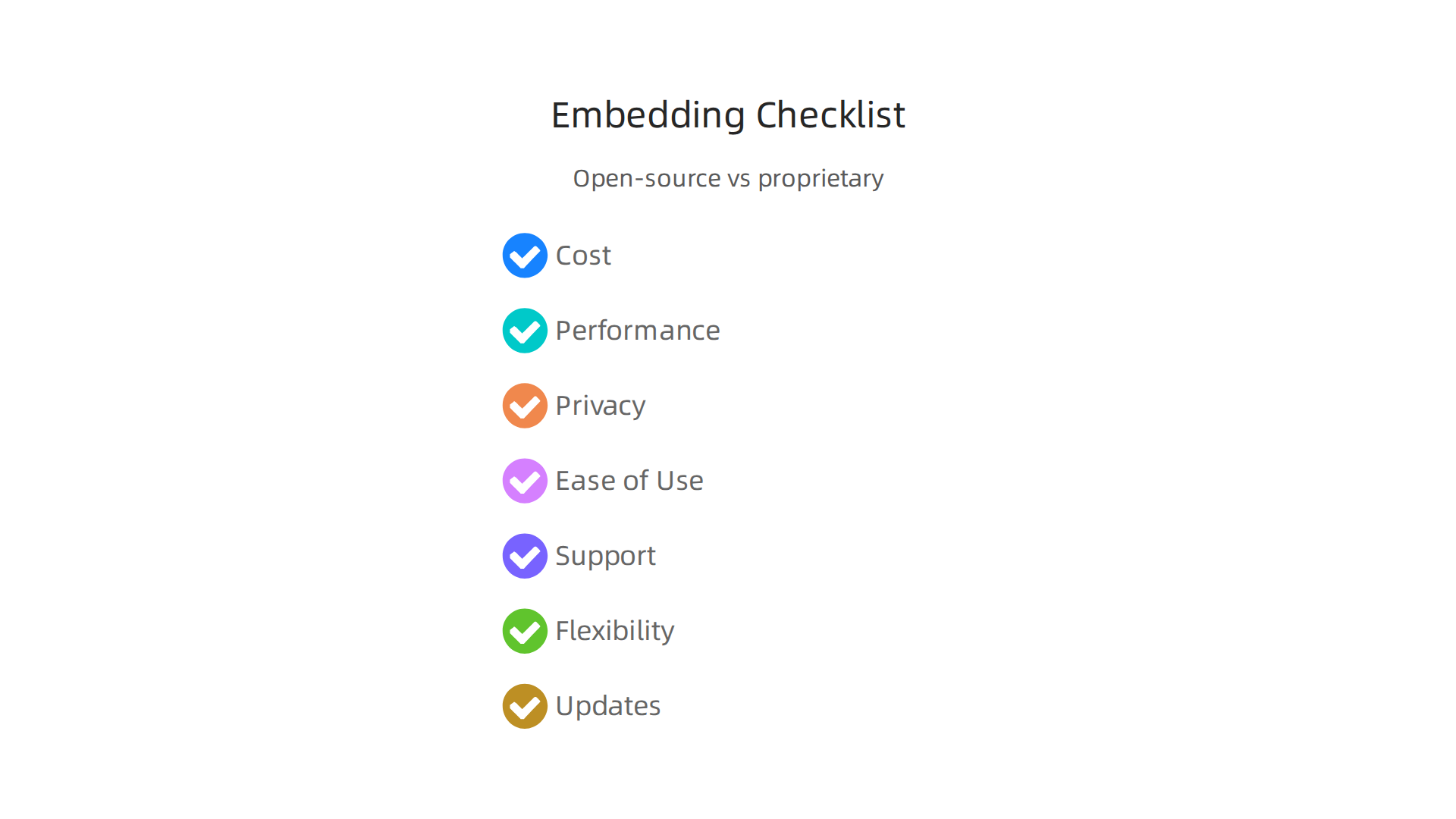
- Cost: How much does it cost to use the service or run the software? Think about both the direct fees and the computer power needed.
- Performance: How well does it understand text and create accurate embeddings? Does it work well for your specific type of content?
- Privacy: Where does your data go? Does it stay on your systems, or does it get sent to the company providing the service?
- Ease of Use: How hard is it to set up and use? Do you need a lot of tech skills?
- Support: Who can you ask for help if you run into problems? Is it a community or a company team?
- Flexibility: Can you change it to fit your needs, or is it a "take it or leave it" kind of tool?
- Updates: How often does it get better or get new features?
By thinking about these points, you can make a good choice for your embedding needs. To help you further, you can explore guides that explain how to choose the best AI detector in 2026.
Putting embeddings to work means setting up a step-by-step system, much like an assembly line. This "pipeline" helps us use the power of embeddings for things like checking if content is AI-made or making searches smarter. In 2026, building such a system involves several key steps.
Implementing embeddings: pipelines, vector DBs, and practical tips
To truly use embeddings, you need a good plan. Think of it as a set of stages that data goes through to become useful.
The Embedding Pipeline
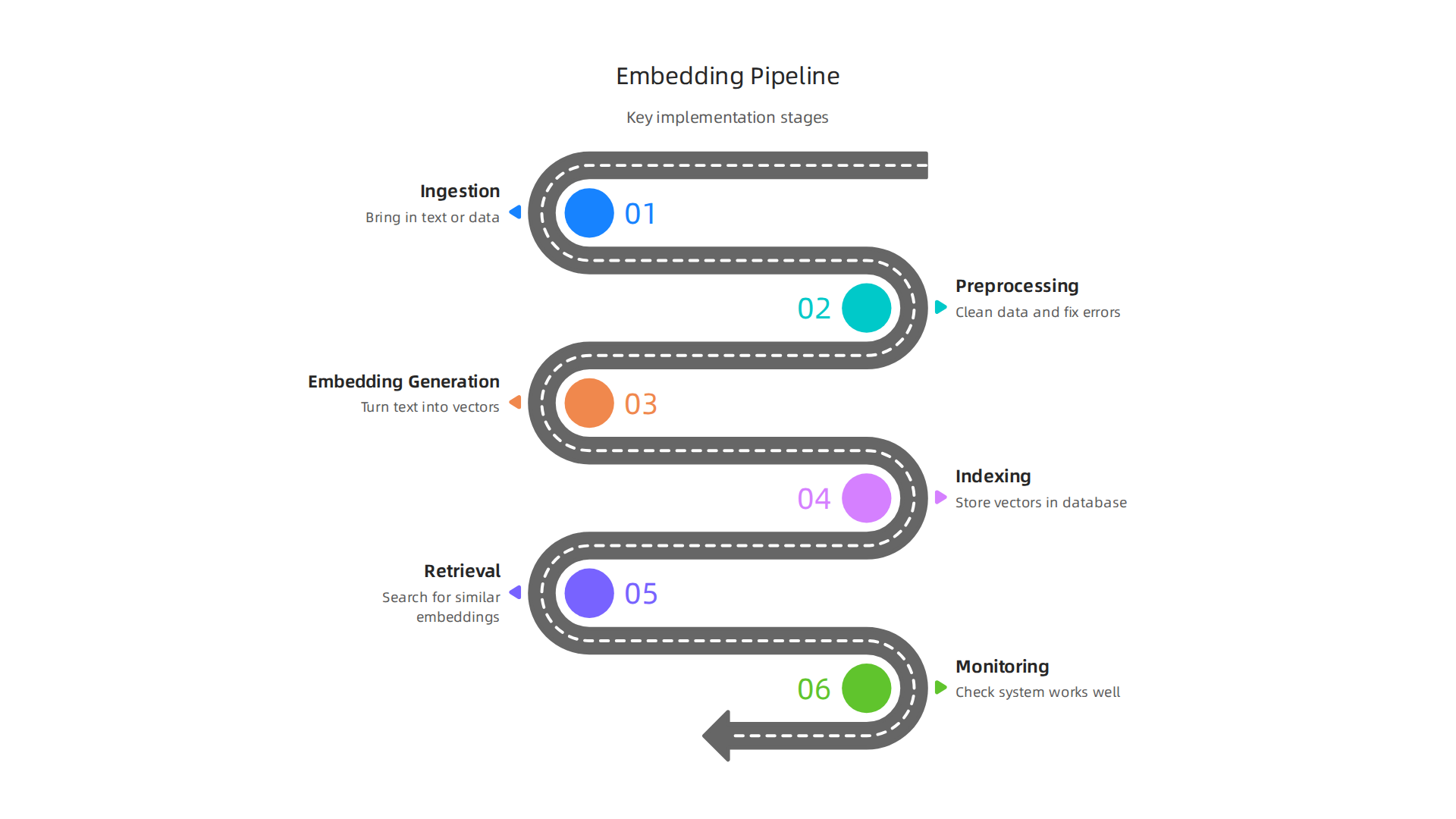
A typical pipeline for using embeddings has a few main parts:
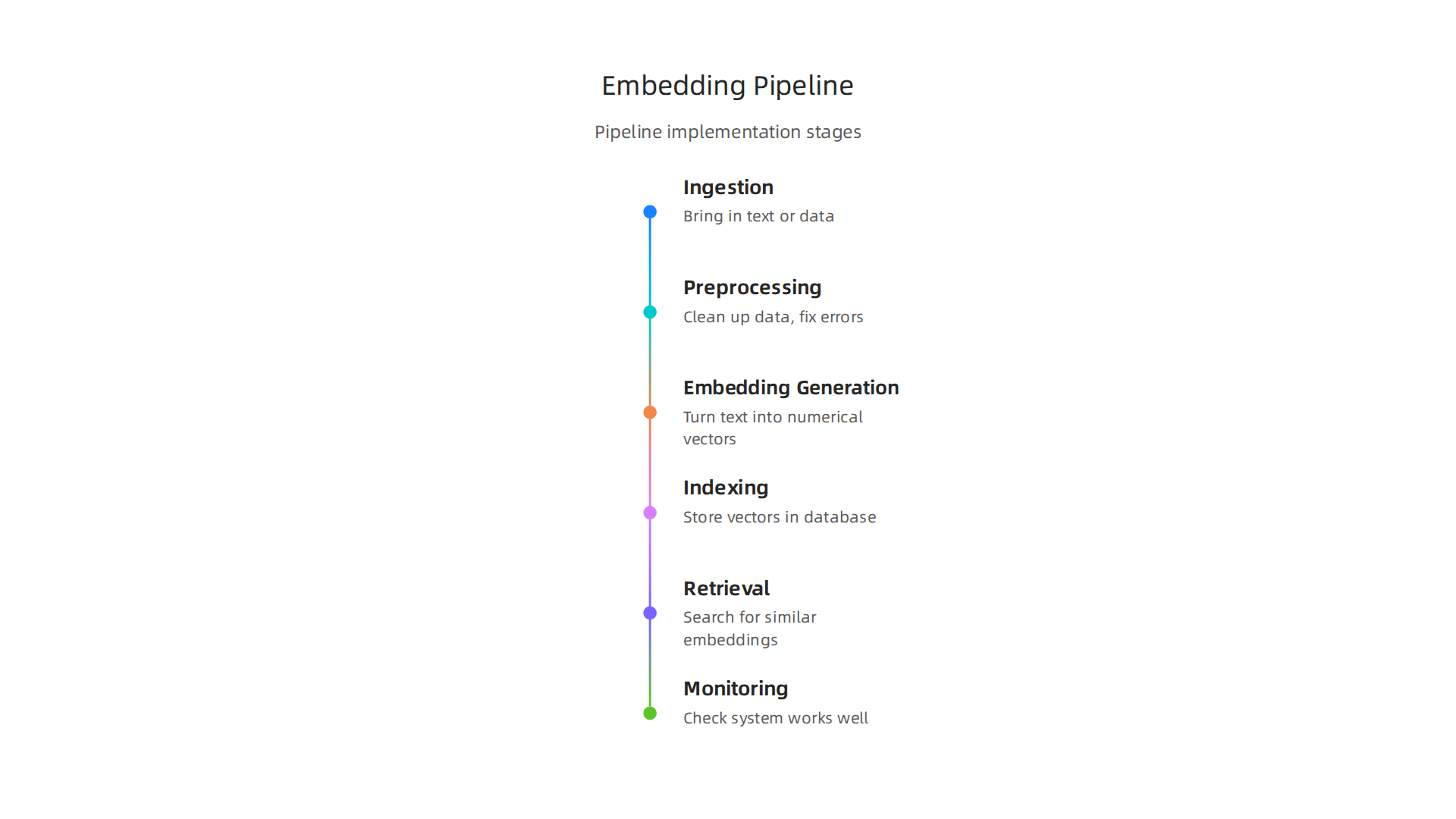
- Ingestion: This is where you bring in all the text or data you want to work with. It could be articles, documents, or even chat messages.
- Preprocessing: Before making embeddings, you often clean up the data. This might mean fixing errors, removing extra spaces, or breaking long texts into smaller, more manageable pieces. This step is crucial for good results, as explained in guides about semantic search pipelines Architecture of a Semantic Search Pipeline.
- Embedding Generation: Here, the cleaned text is fed into an embedding model. This model turns the text into numerical vectors, which are just lists of numbers that capture the meaning of the text. For example, if you’re using services, you might use OpenAI text embeddings to create these vectors. This is where the magic happens, turning words into math that computers can understand. Large companies often set up advanced systems for this step, like those used to deploy models like EmbeddingGemma at scale Scalable Embedding Pipeline.
- Indexing: Once you have these number lists (vectors), you need to store them in a way that makes them easy to find later. This is usually done in a special type of database called a vector database.
- Retrieval: When someone asks a question or gives a new piece of text, you turn that into an embedding too. Then, you search your vector database to find other stored embeddings that are very similar. This helps find related information fast. Embeddings are key because they let AI models search by meaning instead of just keywords What Are Embeddings? How They Power AI Search [2026].
- Monitoring: It’s important to keep an eye on your system to make sure it’s working well. This means checking if the embeddings are accurate and if the whole process is running smoothly. Consistency in these vector spaces is very important for AI applications to work correctly The Role of Embeddings in AI Apps: 2026 Guide.
Vector Databases: The Heart of the System
Vector databases are special databases made to store and quickly search these numerical embeddings. They are vital for giving AI apps their smart search abilities. Choosing the right one depends on how much data you have, how fast you need to find things, and how much you want to spend. These databases are helping to unlock the future of smart AI and semantic search Vector Databases: Unlocking the Future of Intelligent AI and Semantic Search. They allow systems to handle many requests (scaling) and keep costs down while still being quick (latency/cost trade-offs).
Practical Tips for Implementation
When you build your own embedding system, here are some helpful ideas:
- Batching: Instead of making embeddings one by one, try to process many texts at once. This "batching" can save a lot of time and money, especially when working with services like OpenAI text embeddings.
- Dimensionality: This refers to the length of the number list (vector). A shorter list might be faster to work with, but a longer one might capture more details. You need to find a balance that works for your needs.
- Retraining: Sometimes, your data changes over time. You might need to update your embedding model or even "retrain" it with new data to keep it accurate.
- Freshness Signals: For things like news or trending topics, you want the freshest information. Your system should know which embeddings are new and prioritize them in searches.
By following these steps and tips, you can build a strong system to use embeddings effectively. This is part of the broader movement towards making advanced AI for everyone, allowing new applications to flourish and pushing the boundaries of what open source AI can achieve.
To understand more about the methods behind building trusted AI systems, you can read about CRISP-DM and Skylab USA, which documents the data methodology behind permission-based capture. For those interested in how these powerful systems relate to content authenticity, learning how to detect AI writing in 2026 is a valuable next step.
While embeddings open up many exciting possibilities for creating advanced AI for everyone and pushing open source AI forward, it is also important to talk about their downsides. When we use embeddings, especially to detect things, there are limits, risks, and rules we need to follow. Ignoring these can cause big problems.

Limitations, risks, and governance when using embeddings for detection
Even though embedding systems are powerful, they aren’t perfect. We need to be aware of the challenges they bring, especially when using them to figure out if content is AI-made.
Key Risks When Using Embeddings
There are several important risks to consider:
- Bias Amplification: Embeddings learn from the data they are trained on. If that data has unfair biases, the embeddings will learn them too. This means the system could make unfair judgments or give different results based on things like someone’s background or the way they write. This can lead to serious ethical issues.
- False Positives: Sometimes, an embedding system might wrongly flag human-written content as AI-generated. This is called a false positive. Imagine a student’s heartfelt essay being marked as AI, or an important business report. This can cause a lot of frustration and distrust. Good detection tools, like the Best Embedding Models for RAG in 2026: A Comparison Guide, try to reduce these errors.
- Privacy Leakage: What if the embeddings accidentally hold onto sensitive information from the original data? Even though embeddings are just numbers, there’s a small chance that private details could be guessed or revealed if not handled carefully.
- Licensing Pitfalls: Not all embedding models are the same. Some are open-source, like the Top 5 Open-Source Embedding Models in 2026, and others are proprietary, like certain
openai text embeddings. Each comes with its own rules about how you can use them. Mixing them up or not following the rules can lead to legal problems.
Governance Controls for Safe Use
To deal with these risks, we need strong governance controls. These are like a set of rules and practices to keep the system safe and fair:
- Audit Logs: Keep detailed records of every step the embedding system takes. This means tracking what data came in, what embeddings were made, and what decisions the system made. If something goes wrong, you can look back and see why.
- Human-in-the-Loop Reviews: Don’t let the AI make important decisions all by itself. Always have a human review critical findings or decisions made by the embedding system. This helps catch mistakes and biases.
- Transparency Reporting: Be clear about how your embedding system works. Explain what data it was trained on, what its limits are, and how it makes its decisions. This builds trust with users.
- Data Minimization: Only collect and use the data that is absolutely necessary for the embeddings to work. The less sensitive data you handle, the lower the risk of privacy issues.
Roadmap for Continual Evaluation and Risk Reduction
Managing risks with embeddings is an ongoing job. You need a plan to keep checking and improving your system.
- Continual Evaluation: Regularly test your embedding models and the whole detection pipeline. Are they still accurate? Are they fair? Does the system still work well with new types of content? This means running tests often and adjusting as needed.
- Product Risk Reduction Strategies: Have clear steps in place for when problems come up. If your system starts producing too many false positives, how will you fix it quickly? Planning for these issues ahead of time can save a lot of trouble later. This approach is key to maintaining trust and protecting users from the dangers of AI. You can learn more about how to stay safe with AI by reading about the dangers of AI in 2026.
By understanding and addressing these limitations and risks, we can build more reliable and responsible AI systems. This helps ensure that AI tools, whether for detection or other tasks, serve everyone fairly and effectively, avoiding issues like AI hallucinations or "Synthetic Drift" that can displace original authority. To explore these deeper concepts, including how authority can be displaced when a person loses their inner authority, check out a feature on the Cartographer of Drift.
Summary
This article explains why text embeddings—numeric vectors that capture meaning—are central to detection, semantic search, and building trust in AI-driven systems. It walks through how embeddings are created, how closeness in vector space measures semantic similarity, and why OpenAI models like text-embedding-3-small and text-embedding-3-large matter for accuracy, cost, and speed. You’ll learn practical uses including semantic search, clustering, anomaly detection and several methods for spotting AI-written text such as distribution comparisons, nearest‑neighbor checks, and ensemble approaches. The guide compares open source and proprietary embedding options with a simple evaluation checklist, details a complete pipeline (ingestion, preprocessing, embedding generation, vector DB indexing, retrieval, and monitoring), and offers implementation tips like batching and dimensionality tradeoffs. It also covers limits and risks—bias amplification, false positives, privacy leakage—and recommends governance controls like audit logs and human reviews. After reading, you’ll be able to choose appropriate embedding models, design a detection or search pipeline, and adopt practices to reduce risk while maintaining content authenticity.